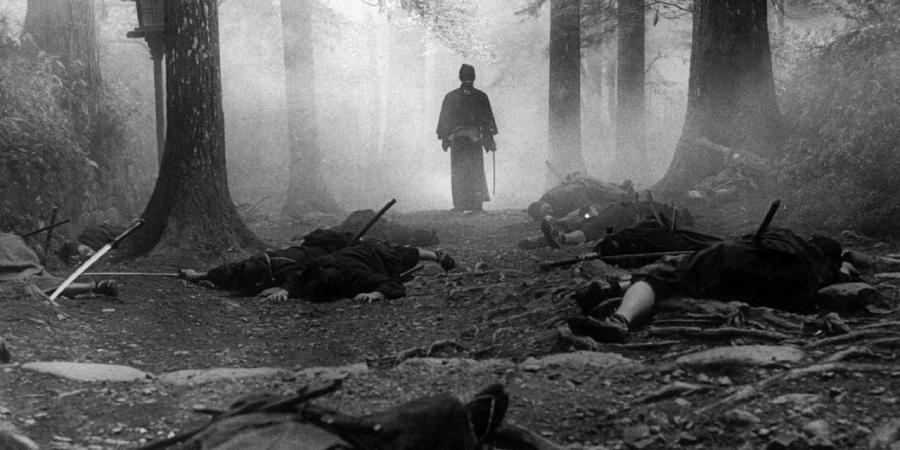

Ryunosuke Tsukue is not a hero. He is a maelstrom of violence, a sociopathic ronin whose soulless sword technique mirrors his empty heart. The Sword of Doom offers one of cinema’s most unforgettable villains as its protagonist, a man defined only by his next kill.
Detailed Summary
The Silent Sword
The film opens on the Great Bodhisattva Pass. An elderly pilgrim and his granddaughter pray for safe passage. Suddenly, the samurai Ryunosuke Tsukue (Tatsuya Nakadai) appears and murders the old man without provocation or warning. His granddaughter flees in terror.
Ryunosuke is scheduled to fight a fencing exhibition match in his village. His opponent is Bunnojo Utsuki. However, Bunnojo’s wife, Hama, fears for her husband’s life against Ryunosuke’s notoriously cruel style. She begs Ryunosuke to throw the match, offering her virtue in exchange.
A Fateful Deal
Ryunosuke accepts Hama’s desperate offer. In the subsequent match, he intentionally loses by simply stepping out of the ring. A furious and dishonored Bunnojo ambushes Ryunosuke on his way home, seeking revenge. Ryunosuke, using his unorthodox one-handed stance, easily kills him.
Having witnessed the affair and murder, Ryunosuke’s father disowns him. Consequently, Ryunosuke flees his village, taking the disgraced and widowed Hama with him as his common-law wife. Meanwhile, Bunnojo’s brother, Hyoma Utsuki (Yuzo Kayama), vows to find and kill Ryunosuke to avenge his family.
Exile and Employment
Two years pass. Ryunosuke now works as a paid assassin in Edo for a group of political samurai known as the Shinsengumi. His sword, and the skill behind it, is terrifyingly efficient. However, he is emotionally vacant and treats Hama with cold indifference, even after she bears him a son.
The Shinsengumi plot to assassinate a government official. Their master strategist brings in the renowned sword master Toranosuke Shimada (Toshiro Mifune) to test the group’s skills. Shimada effortlessly disarms the assassins, concluding that their swordsmanship is undisciplined and spiritually weak, except for Ryunosuke’s. Shimada senses the pure, unthinking evil in Ryunosuke’s blade.
Descent into Madness
During a mission, Ryunosuke encounters Hyoma, who has joined the opposing faction. Hyoma’s swordsmanship is a mirror image of Shimada’s, as he has become the master’s student. Ryunosuke notes the similarity but is now haunted by visions of the men he has killed. Furthermore, he begins to fear that his eyesight is failing, a terrifying prospect for a swordsman.
Ryunosuke’s paranoia deepens. He learns Hama has been secretly meeting the granddaughter of the pilgrim he killed in the film’s opening scene. Believing Hama is betraying him, he murders her in a fit of rage while their infant child sleeps nearby. The act finally shatters his mind completely.
Movie Ending
The ending of The Sword of Doom is one of the most famous and abrupt in cinema history. After murdering Hama, Ryunosuke is besieged by hallucinations in a snow-covered brothel. The ghosts of his victims, including Hama and Bunnojo, torment him. He furiously slashes at paper screens and shadows, his mind completely broken.
Shinsengumi assassins, ordered to silence him, burst into the room. Ryunosuke, now a cornered animal, fights with inhuman ferocity. He slaughters dozens of men in a breathtakingly chaotic sequence. As the last man falls, a blood-soaked and exhausted Ryunosuke looks toward the camera. The film then abruptly freezes on a close-up of his face, contorted in a silent scream, and the credits roll.
This was not a stylistic choice so much as a commercial one. The film was intended to be the first part of a trilogy, but it performed poorly at the box office. Consequently, the planned sequels were never made, leaving Ryunosuke’s ultimate fate forever frozen in that final, haunting frame.
Are There Post-Credits Scenes?
No, there are no post-credits scenes in The Sword of Doom. The story concludes with the final freeze-frame before the credits.
Type of Movie
The Sword of Doom is a Japanese jidaigeki (period drama), and more specifically a chanbara (sword-fighting) film. Its tone is relentlessly dark, bleak, and nihilistic. Unlike many samurai films that champion honor and justice, this movie focuses on the spiritual corruption and psychological collapse of its villainous protagonist.
Cast
- Tatsuya Nakadai – Ryunosuke Tsukue
- Michiyo Aratama – Hama
- Yuzo Kayama – Hyoma Utsuki
- Yoko Naito – Omatsu
- Kei Sato – Kamo Serizawa
- Toshiro Mifune – Toranosuke Shimada
Film Music and Composer
The score for The Sword of Doom was composed by Masaru Sato. Sato was a frequent collaborator with director Akira Kurosawa, having scored classics like Yojimbo and Sanjuro. His music for this film is crucial to its unsettling atmosphere.
Sato blends traditional Japanese instruments with jarring, modernist sounds. The score avoids heroic themes, instead using dissonant arrangements and percussive cues to heighten the sense of dread and reflect Ryunosuke’s fractured psyche.

Filming Locations
Director Kihachi Okamoto shot the film almost entirely in Japan, utilizing both studio sets and natural locations. The stark, snow-covered landscapes are particularly significant. For instance, the opening murder at the pass and the final “battle” in the brothel are both framed by snow, metaphorically linking Ryunosuke’s inner coldness to the world around him.
Much of the film was shot at Toho Studios in Tokyo, where elaborate sets were constructed for the interiors, including the dojos and the climactic brothel scene.
Awards and Nominations
Despite its current status as a masterpiece of Japanese cinema, The Sword of Doom did not receive any major international awards or nominations upon its release. Its critical and cult reputation grew significantly in the decades that followed.
Behind the Scenes Insights
- The film’s abrupt ending is its most discussed feature. It was intended as a cliffhanger for a trilogy that was cancelled due to disappointing box office returns from this first installment.
- Tatsuya Nakadai’s performance is iconic for its minimalism. He used a fixed, unblinking stare to convey Ryunosuke’s soullessness, a technique that reportedly caused him physical discomfort during filming.
- Director Kihachi Okamoto was known for his frantic, unconventional editing and camera work, which is on full display in the film’s frenzied action sequences, especially the final battle.
Inspirations and References
The Sword of Doom is based on an epic, unfinished Japanese serial novel titled Daibosatsu Toge (Great Bodhisattva Pass) by author Kaizan Nakazato. The book was published in newspapers from 1913 to 1941.
Alternate Endings and Deleted Scenes
There are no known alternate endings or significant deleted scenes. As mentioned, the film’s ending was not an artistic choice but the result of the cancelled sequels. Had the trilogy been completed, the story would have continued Ryunosuke’s journey and his inevitable final confrontation with Hyoma Utsuki.
Book Adaptations and Differences
The film adapts only a fraction of Kaizan Nakazato’s massive 41-volume novel. The source material is far more sprawling, delving deeper into the political climate of the late Edo period and providing more context for Ryunosuke’s nihilism, which is tied to Buddhist philosophy and family history.
In contrast, the film streamlines the narrative to focus almost exclusively on Ryunosuke’s psychological decline. It presents his evil as an inherent, almost elemental force, rather than something born from complex circumstances as explored in the novel.
Memorable Scenes and Quotes
Key Scenes
- The Opening Murder: Ryunosuke kills an old man on a snowy mountain pass for no reason, establishing his character’s profound amorality in the first few minutes.
- Shimada’s Duel: Toshiro Mifune’s character, Toranosuke Shimada, effortlessly demonstrates the difference between true mastery and Ryunosuke’s empty technique by defeating multiple opponents with a wooden sword.
- The Final Massacre: Ryunosuke’s descent into madness culminates in a spectacular, chaotic rampage where he slaughters dozens of men in a brothel, his skill undiminished even as his sanity evaporates.
Iconic Quotes
- Ryunosuke (to Hama): “You mistake me for a human being.”
- Toranosuke Shimada: “The sword is the soul. Study the soul to know the sword. Evil mind, evil sword.”
Easter Eggs and Hidden Details
- Watermill Symbolism: A watermill appears several times, grinding away mindlessly. This serves as a visual metaphor for Ryunosuke’s existence—an endless, unthinking cycle of destructive motion.
- The Shadow Play: In the final scene, Ryunosuke slashes at paper walls. The torn screens cast flickering shadows that look like demonic figures, externalizing his inner torment.
- Unorthodox Stance: Ryunosuke’s unique, one-handed sword stance with his other arm limp at his side is not just a stylistic choice. It visually represents his spiritual imbalance and amoral detachment from his violent acts.
Trivia
- The source novel, Daibosatsu Toge, is one of the longest literary works in Japan. Its unfinished state mirrors the film’s abrupt conclusion.
- Despite being a top-billed star, Toshiro Mifune has less than ten minutes of screen time. His presence was largely a marketing tool to draw in audiences.
- The film’s Japanese title, Daibosatsu Toge, directly translates to “Great Bodhisattva Pass,” the location of the film’s opening scene.
Why Watch?
Watch for Tatsuya Nakadai’s chilling performance as cinema’s most compelling anti-protagonist. Its stunning black-and-white cinematography, groundbreaking swordplay, and unforgettable ending make this a truly unique and haunting masterpiece of the chanbara genre.
Director’s Other Movies
- Japan’s Longest Day (1967)
- The Human Bullet (1968)
- Battle of Okinawa (1971)
Recommended Films for Fans
- Harakiri (1962)
- Samurai Rebellion (1967)
- Yojimbo (1961)
- Lone Wolf and Cub: Sword of Vengeance (1972)
- 13 Assassins (2010)