
On the Town gives you three sailors, 24 hours of shore leave in New York City, and one of the most joyfully chaotic romantic comedies ever committed to film. Released in 1949, it marked a landmark moment in movie musical history by shooting key sequences on actual New York City streets, not just a studio backlot. Gene Kelly and Stanley Donen co-directed with infectious energy, and the result still crackles with wit and charm.
Detailed Summary
Shore Leave Begins: Three Sailors Hit New York
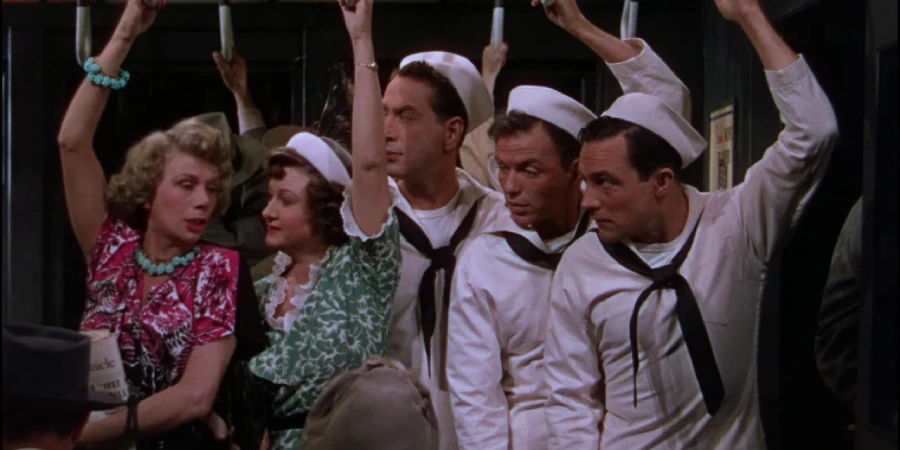
At the crack of dawn, three sailors burst off a Navy ship in the Brooklyn Navy Yard with exactly 24 hours of shore leave ahead of them. Gabey (Gene Kelly), Chip (Frank Sinatra), and Ozzie (Jules Munshin) are practically vibrating with excitement. They sprint through the empty streets in the iconic opening number, singing “New York, New York.”
Gabey spots a poster on the subway advertising Ivy Smith as “Miss Turnstiles,” a rotating monthly honor from the New York City Transit Authority. He immediately becomes smitten. His buddies, amused and supportive, agree to help him track her down across the entire city.
The Chase for Miss Turnstiles
Gabey’s quest takes the trio through the Museum of Natural History, where Ozzie causes a spectacular scene by accidentally knocking over a dinosaur skeleton. Meanwhile, Chip has already caught the eye of Brunhilde Esterhazy (Betty Garrett), a fast-talking, aggressively flirtatious cab driver who essentially kidnaps him as a passenger and refuses to let go. Frank Sinatra plays Chip as delightfully flustered throughout, which works beautifully against Garrett’s bold comic energy.
At the museum, Ozzie meets Claire Huddesen (Ann Miller), an anthropology student with a particular fascination for prehistoric men. She instantly fixates on Ozzie as a prime physical specimen. Their connection is equal parts absurd and charming, and Miller gets to show off her legendary tap skills.
Gabey Finds Ivy, Then Loses Her
Gabey eventually tracks down Ivy Smith, played by Vera-Ellen, and the two share an immediate, genuine connection. However, Ivy has a secret she works hard to hide: she is not the glamorous, accomplished woman her Miss Turnstiles poster suggests. She is actually a struggling dancer taking cello lessons to pad her resume, and her real ambitions are far more modest than the subway advertisement implies.
Ivy, embarrassed by the gap between her public image and her reality, initially tries to keep Gabey at a distance. She feeds him a story about her demanding schedule. Nonetheless, sparks fly hard enough that she agrees to meet him and the group later that evening.
A Wild Night Across the City
All three couples careen across Manhattan through a series of comic set pieces. Chip and Brunhilde, Ozzie and Claire, and eventually Gabey and Ivy all converge at a rooftop nightclub called Diamond Eddie’s. Ivy’s cello teacher, Madame Dilyovska (Florence Bates), recognizes her there and blows her cover, loudly announcing that Ivy is her student and has no business pretending to be a celebrated artist.
Gabey feels briefly hurt by the deception. In addition, the group faces mounting pressure as their shore leave clock ticks down toward dawn. A chase sequence involving police officers, nightclub bouncers, and a Coney Island setting gives the film its wildest, most frenetic final stretch.


Movie Ending
All three couples end up at Coney Island in a sequence that blends physical comedy with genuine romantic stakes. Gabey finds Ivy again after losing her in the chaos, and the two reconcile properly. Ivy drops the pretense entirely; Gabey makes clear he fell for the real person, not the poster. Their reunion is warm and sincere without being syrupy.
Meanwhile, the police have been chasing the entire group for various minor infractions committed across the city throughout the night. Consequently, all three sailors face arrest as dawn breaks. The girls show up at the pier to say goodbye, genuinely heartbroken, which elevates the ending beyond pure farce into something with real emotional weight.
As the sailors board their ship and sail away, three new sailors immediately pour off another vessel and sprint into the city. The film closes on this cyclical image: New York endlessly renewing itself, always ready for the next round of dreams and chaos. It is a beautifully optimistic note, suggesting that joy and connection, however brief, are always worth chasing.
Are There Post-Credits Scenes?
On the Town contains no post-credits scenes. Films of this era did not include them as a convention. Once the final frame fades out, the experience is complete.
Type of Movie
On the Town is a musical romantic comedy with strong elements of screwball farce. Its tone is relentlessly upbeat and playful, though genuine warmth runs underneath the comedy. It never takes itself too seriously, and that self-awareness is a large part of its lasting appeal.
Cast
- Gene Kelly – Gabey
- Frank Sinatra – Chip
- Jules Munshin – Ozzie
- Betty Garrett – Brunhilde Esterhazy
- Ann Miller – Claire Huddesen
- Vera-Ellen – Ivy Smith
- Florence Bates – Madame Dilyovska
Film Music and Composer
The original stage musical featured music by Leonard Bernstein, and most of his score carried over into the film. However, MGM brought in Roger Edens to write additional songs, which replaced some of Bernstein’s more complex compositions. Bernstein reportedly found this frustrating, though the retained songs remain undeniably strong.
The opening number, “New York, New York” (not to be confused with the later Sinatra standard), is arguably one of the most famous musical openings in cinema history. “Prehistoric Man,” performed by Ann Miller and Jules Munshin, delivers a blistering tap showcase. Furthermore, “Come Up to My Place,” sung by Betty Garrett and Frank Sinatra, stands out as a gem of comic songwriting.



Filming Locations
On the Town made history by filming key sequences on actual New York City streets. Gene Kelly and Stanley Donen pushed hard for location shooting, which was genuinely unusual for a studio musical at the time. MGM agreed to a limited shoot in New York, covering spots including the Brooklyn Navy Yard, Rockefeller Center, and the Empire State Building.
Most interior scenes and the bulk of the musical numbers were still shot on MGM soundstages in Culver City, California. In contrast to the backlot artificiality of many contemporaries, the real New York footage gave the film a kinetic authenticity that set it apart. Coney Island also features prominently in the climactic sequences.
Awards and Nominations
On the Town won the Academy Award for Best Scoring of a Musical Picture, with Roger Edens and Lennie Hayton taking home the honor. Its commercial and critical success at the time far outpaced its awards recognition, which feels like a mild injustice in retrospect.
Behind the Scenes Insights
- Gene Kelly and Stanley Donen co-directed the film, continuing a collaboration that would later produce Singin’ in the Rain.
- MGM initially resisted location shooting in New York, viewing it as unnecessarily expensive and logistically complicated.
- Frank Sinatra reportedly preferred to film his musical numbers in as few takes as possible, believing his first takes contained the most natural energy.
- Betty Garrett’s aggressive pursuit of Sinatra’s character on screen was a deliberate comic inversion of typical gender dynamics in Hollywood musicals.
- Ann Miller’s tap sequences required extraordinary physical stamina; she was known for performing at speeds that few other dancers could match.
- Vera-Ellen’s singing voice was dubbed for the film, a practice not uncommon for the era.
- Leonard Bernstein had limited involvement in the film adaptation and was not consulted on the decision to replace several of his songs.
Inspirations and References
On the Town originated as a Broadway musical, which itself grew out of Jerome Robbins’s ballet Fancy Free, first performed in 1944. Fancy Free told the story of three sailors on shore leave looking for female companionship in New York City, essentially the same core premise. Bernstein composed the ballet’s score before collaborating with Betty Comden and Adolph Green to expand the concept into the stage musical.
Comden and Green also wrote the screenplay for the film adaptation, maintaining strong continuity between the stage and screen versions. Their sharp, witty dialogue is one of the film’s most durable qualities.
Alternate Endings and Deleted Scenes
No widely documented alternate endings or significant deleted scenes for On the Town are part of the public record. The replacement of several Leonard Bernstein songs with Roger Edens compositions represents the most significant creative alteration from the stage version. Those original stage songs, including some of Bernstein’s more adventurous material, did not make the final cut of the film.
Book Adaptations and Differences
On the Town is not based on a book. It adapted the 1944 Broadway stage musical of the same name, itself inspired by the ballet Fancy Free. For a comparison of the stage and screen versions, the most notable difference is the substantial replacement of Bernstein’s original score with new songs composed by Roger Edens.

Memorable Scenes and Quotes
Key Scenes
- The opening “New York, New York” sequence, shot on real city streets at dawn, with all three sailors sprinting and singing through an almost empty city.
- Ozzie knocking over the dinosaur skeleton at the Museum of Natural History, triggering a slapstick chain reaction that horrifies museum staff.
- Ann Miller’s ferocious tap number “Prehistoric Man,” performed with full company energy and Miller’s signature lightning-fast footwork.
- Brunhilde essentially capturing Chip in her cab and refusing to release him, setting the comic tone for their entire relationship arc.
- The Coney Island finale, where romantic reconciliations and police pursuits collide in cheerful, breathless chaos.
- The closing image of three new sailors bursting off a ship, mirroring the opening and giving the film its elegant circular structure.
Iconic Quotes
- “New York, New York, it’s a wonderful town, the Bronx is up and the Battery’s down.”
- “I’m in love with a girl I just met, which has never happened to me before because I never met a girl before.” (Gabey, expressing his infatuation with characteristic Kelly earnestness)
- “Come up to my place.” (Brunhilde’s persistent, cheerful invitation to a mortified Chip, repeated throughout their scenes together)
Easter Eggs and Hidden Details
- The cyclical structure of the opening and closing shots, both featuring sailors flooding off a ship, rewards attentive viewers with a quietly poetic bookend.
- Several extras visible in the New York location footage are clearly real New Yorkers going about their day, adding unscripted authenticity to the street scenes.
- Claire’s academic obsession with “primitive men” mirrors her instant attraction to the earthy, physical Ozzie, a joke the film layers in gradually rather than announcing upfront.
- Ivy’s Miss Turnstiles poster lists accomplishments that are comically inflated, planting the seeds of her deception for sharp-eyed viewers well before the reveal.
Trivia
- This was Gene Kelly’s first film as co-director, and he and Donen would reunite for Singin’ in the Rain in 1952.
- Frank Sinatra and Gene Kelly had previously appeared together in Anchors Aweigh (1945), and their chemistry was already well established by the time they made this film.
- Betty Garrett’s role as Brunhilde essentially reversed the era’s standard Hollywood dynamic of men chasing women, which was deliberately subversive for 1949.
- Ann Miller reportedly tapped at a rate exceeding 500 taps per minute during her peak sequences.
- The film’s New York location footage was shot over just a few days, yet its impact on the visual identity of the movie is enormous.
- Leonard Bernstein’s stage score is widely considered one of his finest achievements; the film version preserving only a portion of it remains a point of discussion among musical theater scholars.
- Jules Munshin is the least-remembered of the three leads today, yet his physical comedy throughout the film is genuinely inventive and often steals scenes from his more famous co-stars.
Why Watch?
Few musicals capture pure, uncut joy as efficiently as this one does. Gene Kelly, Frank Sinatra, and Ann Miller bring their absolute best, and the real New York location footage still feels startlingly alive. Moreover, at under two hours, the film wastes not a single minute of your time.
Director’s Other Movies
- Singin’ in the Rain (1952)
- It’s Always Fair Weather (1955)
- Invitation to the Dance (1956)
- The Happy Road (1957)
- Tunnel of Love (1958)
- Gigot (1962)
- A Guide for the Married Man (1967)
- Hello, Dolly! (1969)
- The Cheyenne Social Club (1970)
- Xanadu (1980)
Recommended Films for Fans
- Singin’ in the Rain (1952)
- Anchors Aweigh (1945)
- An American in Paris (1951)
- The Band Wagon (1953)
- Seven Brides for Seven Brothers (1954)
- Funny Face (1957)
- Bye Bye Birdie (1963)