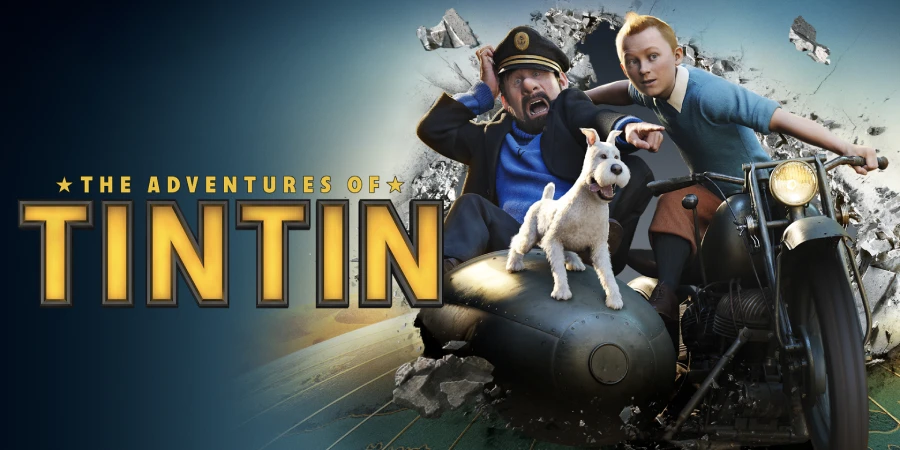

Steven Spielberg’s motion-capture adventure pulls off something genuinely audacious: it brings a beloved comic-book hero to life without a single frame of live action, and it works brilliantly. The Adventures of Tintin (2011) is a kinetic, globe-trotting thriller that treats its source material with real affection. It packs three of Hergé’s beloved albums into one breathless story, and the result is one of the most purely enjoyable blockbusters of that decade.
Detailed Summary
Tintin Buys a Model Ship
Young reporter Tintin spots an intricate model of a three-masted ship called the Karaboudjan at a street market and buys it immediately. A mysterious man named Barnaby warns him not to sell it, and almost simultaneously a menacing stranger named Sakharine offers to purchase it at a suspiciously high price. Tintin refuses, and the trouble begins almost instantly.
Back at his flat, his dog Snowy accidentally knocks the ship over and breaks it, releasing a rolled-up piece of parchment hidden inside the mast. Before Tintin can read it properly, Snowy bats it away. Meanwhile, someone breaks into the flat and steals the parchment entirely.
Kidnapping and the Karaboudjan
Tintin investigates Barnaby’s shooting and traces the ship to Sakharine. He soon finds himself kidnapped and locked inside the hold of a real cargo vessel, also called the Karaboudjan. Sakharine is behind the abduction, and he is clearly after something far bigger than a model ship.
On board, Tintin discovers a captive: the drunk and perpetually dishevelled Captain Haddock. Haddock has no idea why he is a prisoner on his own ancestral ship. In contrast, Sakharine seems to know exactly what the Haddock family bloodline means to his plan.
The Secret of the Unicorn
Haddock begins to piece together his family history through fragmented, alcohol-fuelled memories. His ancestor, Sir Francis Haddock, captained a ship called The Unicorn in the 17th century. Sir Francis was betrayed by a pirate named Red Rackham, who seized his cargo: three chests of pure gold.
Before Red Rackham could claim his prize, Sir Francis sank The Unicorn to keep the treasure out of his hands. He hid the location clue inside three model ships, one for each of his sons. Consequently, only by combining all three scrolls could anyone find the sunken treasure.
Escape and the Desert Chase
Tintin and Haddock escape the Karaboudjan in a lifeboat and end up stranded in the Sahara. Their adventure through the desert is both harrowing and, frankly, very funny. Haddock’s alcohol-fuelled hallucinations and his desperate thirst provide some of the film’s most entertaining sequences.
They eventually reach the city of Bagghar, a fictional North African port ruled by a powerful local potentate named Omar Ben Salaad. Salaad owns the third model ship, and Sakharine plans to steal the scroll hidden inside it during a public opera performance. Moreover, he intends to use a pickpocket to do his dirty work during the concert’s chaos.
The Opera Heist and the Chase Through Bagghar
Sakharine deploys a trained falcon to snatch the scroll from the broken model during the performance. Tintin races to intercept, triggering one of cinema’s most spectacular single-take chase sequences through the winding streets of Bagghar. Motorcycles, tanks of water, cranes, and a soaring falcon all collide in a sequence that Spielberg clearly designed as a love letter to physical comedy and action.
Despite Tintin’s best efforts, Sakharine escapes with all three scrolls. However, Tintin managed to photograph the scrolls with a camera, preserving their content digitally. As a result, the location of the sunken treasure remains within reach.
Sakharine’s True Identity
On board Sakharine’s ship, Tintin and Haddock finally confront him directly. Sakharine reveals that he is a descendant of Red Rackham himself, and he views reclaiming the treasure as a matter of ancestral vengeance against the Haddock bloodline. His obsession is personal, not merely financial.
Sakharine also possesses a powerful weapon: a sonic bird call that can shatter glass at close range. He uses it to devastating effect throughout the ship’s final confrontation. In addition, he shows a cold, theatrical cruelty that makes him a genuinely intimidating villain.
Movie Ending
Haddock and Tintin face Sakharine in a massive crane duel at the docks, with Haddock operating one crane and Sakharine controlling another. Both men swing the cranes violently, crashing them together in a beautifully staged, almost cartoonishly grand finale. Haddock’s surprising competence in the moment, fuelled by genuine rage for his ancestor’s honour, gives him the decisive edge.
Haddock finally defeats Sakharine by knocking him off his crane and into the water below. Thomson and Thompson, the bumbling detective duo who have been chasing a pickpocket subplot throughout the film, arrive just in time to arrest Sakharine. It is a neat, satisfying convergence of the film’s two comic threads.
Tintin uses the photographed scrolls to decode the location of Red Rackham’s treasure. Together, he and Haddock realise that Marlinspike Hall, a grand estate in Europe, sits directly above the sunken wreck. Haddock, notably, has just enough money left to bid for the estate at auction, which he wins.
Inside Marlinspike, they discover a globe that Sir Francis used to hide the treasure itself. Inside the globe: a single ruby, the surviving remnant of Red Rackham’s legendary hoard. It is a small but emotionally resonant payoff, rewarding Haddock’s journey from hopeless drunk to a man who has reclaimed his family’s legacy and his self-respect.
Sakharine’s arrest hints at a sequel, and Tintin’s final line, challenging Haddock to join him on the next adventure, functions as both a character beat and a deliberate franchise setup. Peter Jackson was announced as director for the sequel, though it has yet to materialise as of this writing.
Are There Post-Credits Scenes?
No, The Adventures of Tintin does not include a post-credits scene. Once the main story wraps up at Marlinspike Hall, the film ends cleanly. You can safely leave once the credits begin to roll.
Type of Movie
This is a family adventure film with strong mystery and action-thriller elements. Its tone blends slapstick humour with genuine tension, sitting somewhere between a classic Saturday-matinee serial and a modern blockbuster. Spielberg pitches it squarely at older children and adults who remember Hergé’s comics fondly.
In contrast to many animated films, it never condescends to younger audiences or over-explains its plot. The pacing is relentless, and the emotional stakes feel real despite the heightened, cartoonish visual style.
Cast
- Jamie Bell – Tintin
- Andy Serkis – Captain Haddock / Sir Francis Haddock
- Daniel Craig – Sakharine / Red Rackham
- Simon Pegg – Thompson
- Nick Frost – Thomson
- Toby Jones – Barnaby
- Cary Elwes – Lieutenant Delcourt
- Daniel Mays – Allan
- Mackenzie Crook – Silk
- Kim Stengel – Bianca Castafiore
Film Music and Composer
John Williams composed the score, his second consecutive collaboration with Spielberg after War Horse that same year. Williams crafts a swashbuckling, brassy main theme that feels instantly classic, drawing from the tradition of golden-age adventure scores. It announces itself like a fanfare and never lets up.
Notable tracks include the exhilarating chase music accompanying the Bagghar sequence, which Williams wrote to match the action beat for beat. In addition, the gentle, nostalgic cues tied to Haddock’s ancestral memories provide real emotional depth. Williams was in his eighties at the time of writing the score, and the music sounds absolutely vital.


Filming Locations
Principal production took place at Weta Digital in Wellington, New Zealand, using performance-capture technology on large motion-capture stages. Because the entire film is computer-generated, no traditional exterior locations appear on screen. However, the environments were heavily inspired by real places.
The Bagghar sequences draw visual inspiration from Moroccan and North African cities like Fez and Marrakech. Similarly, the European streetscapes echo Belgian and French architecture, a respectful nod to Hergé’s homeland. Weta and the art department created entire cities from scratch, building on photographic reference from real locations.
Awards and Nominations
The Adventures of Tintin won the Golden Globe Award for Best Animated Feature Film in 2012, a significant recognition for a motion-capture production. It also received nominations from several critics circles and technical guilds, particularly for its visual effects and John Williams’s score.
Behind the Scenes Insights
- Spielberg had been trying to adapt Hergé’s comics since the 1980s, when Hergé himself reportedly approved Spielberg as the right director before his death in 1983.
- Andy Serkis, already legendary for motion-capture work as Gollum in The Lord of the Rings, threw himself into Haddock’s physicality with remarkable commitment.
- The film combined the plots of three Hergé albums: The Crab with the Golden Claws, The Secret of the Unicorn, and Red Rackham’s Treasure.
- Spielberg directed the entire film without shooting a single frame of live action, marking a first in his career at that level of production.
- The Bagghar chase sequence was reportedly designed as one continuous, unbroken virtual camera shot, a technical and creative feat that the crew spent months choreographing.
- Peter Jackson served as producer on the film, with plans for him to direct the sequel as part of a two-director arrangement agreed between the two filmmakers.
- Jamie Bell, cast as Tintin, trained specifically to capture the character’s eager, forward-leaning energy during motion-capture sessions.
Inspirations and References
Hergé’s original comic albums form the direct source material, and screenwriters Steven Moffat, Edgar Wright, and Joe Cornish worked to synthesise three separate stories into one coherent narrative. Their primary challenge involved preserving the spirit of each album while making the combined plot feel organic. Notably, Moffat wrote an early draft, and Wright and Cornish substantially reworked and expanded it.
The film also draws on the tradition of classic adventure serials, particularly the Indiana Jones franchise, which Spielberg himself created. Furthermore, the visual design references Hergé’s signature ligne claire drawing style, translated into three-dimensional space. Sharp outlines, bold colours, and clean compositions all echo the original artwork directly.
Alternate Endings and Deleted Scenes
No officially confirmed deleted scenes or alternate endings have been made widely public from The Adventures of Tintin. Given the enormous complexity of motion-capture production, any discarded sequences would have required substantial investment to complete even partially. It is likely that significant early-stage conceptual material exists, but none of it has been formally released.
Book Adaptations and Differences
As noted above, the film adapts three Hergé albums: The Crab with the Golden Claws (1941), The Secret of the Unicorn (1943), and Red Rackham’s Treasure (1944). In the original comics, Tintin and Haddock actually sail to the Caribbean in Red Rackham’s Treasure to search for the wreck. The film compresses and reorders this significantly, cutting the ocean dive entirely.
In contrast to the albums, the film introduces Sakharine as an active, menacing villain with a personal connection to Red Rackham. In the original The Secret of the Unicorn, Sakharine is a much more minor character without this villainous role. This change gives the story a clear human antagonist and sharpens the dramatic stakes considerably.
Thomson and Thompson’s subplot involving the pickpocket Aristides Silk runs across several albums in the comics. The film smartly weaves it in as comic relief that eventually pays off during Sakharine’s arrest. Overall, the adaptation is faithful in spirit while being freely inventive with its structure.

Memorable Scenes and Quotes
Key Scenes
- The opening market sequence, where Tintin spots the model ship and Hergé himself appears as a street artist sketching Tintin’s portrait, a wonderful meta-moment.
- Haddock’s flashback to Sir Francis Haddock’s battle aboard The Unicorn, rendered in a gorgeous, storm-lashed period sequence full of practical-feeling chaos.
- The single-take Bagghar chase, widely regarded as one of the most inventive and technically astonishing action sequences in Spielberg’s career.
- Haddock’s alcohol-breath accidentally igniting a plane’s fuel trail in the desert, saving their lives in the most absurdly brilliant fashion.
- The crane fight finale at the docks, a grand, swinging duel that feels like a theme-park ride translated directly to film.
Iconic Quotes
- “I’m a reporter. I follow the story wherever it leads.” (Tintin, establishing his core character in one clean line.)
- “Billions of blistering barnacles!” (Haddock, deploying his signature comic oath with full Andy Serkis commitment.)
- “We’re not beaten yet, Snowy. We haven’t even begun to fight.” (Tintin, rallying after a setback in the desert.)
- “There are plenty of others willing to call you a dreamer, and dreamers are rare.” (A line that captures Tintin’s outsider optimism perfectly.)
Easter Eggs and Hidden Details
- Hergé himself appears in the opening market scene as the street artist drawing a caricature of Tintin, a loving tribute to the character’s creator.
- The opening credits sequence presents Tintin’s adventures as a series of shadow-puppet silhouettes, referencing classic Hergé album cover compositions in stylised form.
- A model of the Aurora, the ship from Hergé’s The Black Island, appears briefly among background props, rewarding eagle-eyed fans of the comics.
- Thomson and Thompson’s identical appearance and speech patterns, a recurring gag throughout the comics, receives several background visual jokes that fans of the albums will catch immediately.
- The colour palette and lighting of the European city streets deliberately mimic the flat, warm tones of Hergé’s ligne claire illustration style.
- During the opera sequence, the singer’s voice shattering glass is a nod to Bianca Castafiore’s famous role across multiple Hergé albums as a hilariously overpowering soprano.
Trivia
- Hergé reportedly told Spielberg in a letter that he was the only filmmaker he trusted to adapt Tintin, shortly before Hergé’s death in 1983.
- The film grossed over 370 million dollars worldwide, performing particularly strongly in Europe where Tintin is a genuine cultural institution.
- Edgar Wright and Joe Cornish wrote their script draft before either of them had directed a major Hollywood production, and Spielberg hired them partly on the strength of Hot Fuzz.
- Andy Serkis researched the effects of alcoholism extensively to portray Haddock’s dependency with authenticity rather than pure comedy.
- Daniel Craig took the role of Sakharine partly because it allowed him to play a villain freely, something his tenure as James Bond did not permit.
- The film was shot entirely in roughly three months of performance-capture work, an unusually fast production schedule for a project of its visual complexity.
- Snowy the dog required particular animation attention because a photorealistic dog needed to convey emotion without human facial movement, a significant technical challenge for Weta Digital.
Why Watch?
The Adventures of Tintin is a masterclass in pure cinematic entertainment: it moves fast, looks gorgeous, and treats adventure storytelling as a serious art form. Spielberg and his team prove that motion capture, done with this level of craft and passion, can produce something genuinely magical. For fans of Hergé and newcomers alike, this film delivers.
Director’s Other Movies
- Duel (1971)
- Jaws (1975)
- Close Encounters of the Third Kind (1977)
- Raiders of the Lost Ark (1981)
- E.T. the Extra-Terrestrial (1982)
- The Color Purple (1985)
- Schindler’s List (1993)
- Jurassic Park (1993)
- Saving Private Ryan (1998)
- Minority Report (2002)
- Catch Me If You Can (2002)
- Lincoln (2012)
- Bridge of Spies (2015)
- Ready Player One (2018)
- West Side Story (2021)
- The Fabelmans (2022)
Recommended Films for Fans
- Raiders of the Lost Ark (1981)
- The Secret of the Incas (1954)
- Spirited Away (2001)
- Treasure Planet (2002)
- The Tale of Despereaux (2008)
- How to Train Your Dragon (2010)
- Hugo (2011)
- The Peanuts Movie (2015)