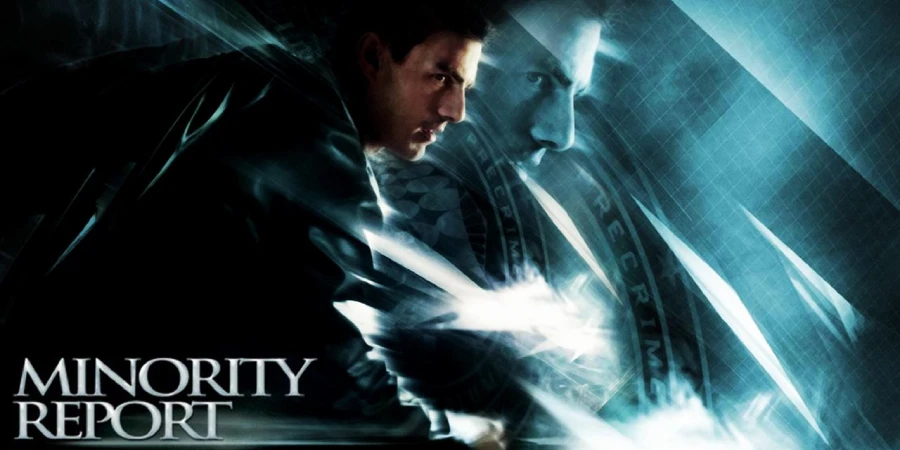

Predicting murder before it happens sounds like a foolproof system until the man running it becomes the next suspect. Steven Spielberg’s 2002 sci-fi thriller drops Tom Cruise into a Washington D.C. where free will is essentially illegal, and then spends two hours methodically dismantling every assumption that premise rests on. Shot in a bleached, overexposed palette that makes the future look like a headache you can’t shake, Minority Report is the rare blockbuster that earns its philosophical ambitions by grounding every idea in a ticking clock and a genuinely personal stakes.
Detailed Summary
The PreCrime Division and How It Works
John Anderton (Tom Cruise) runs the PreCrime unit in Washington D.C., circa 2054. Three psychic individuals known as Precogs, floating in a sensory-deprivation pool called the Temple, experience visions of murders before they occur. Anderton and his team decode those visions, locate the future killers, and arrest them before a single drop of blood is shed.
It sounds airtight. Spielberg presents the system with genuine seductive logic, and for the first act you almost buy it. Anderton believes in it completely, partly because he is grieving his missing son Danny and PreCrime gives his fractured life a purpose.
A Federal Investigator Arrives
Danny Witwer (Colin Farrell), a Justice Department agent, arrives to audit PreCrime ahead of a national rollout. He is sharp, skeptical, and almost immediately suspicious of Anderton. Their friction drives the film’s opening act and plants the seed that the system may not be as perfect as its architects claim.
Anderton Becomes the Suspect
Everything pivots when Anderton runs the next PreCrime vision and sees himself murdering a man named Leo Crow, someone he has never met. He has roughly thirty-six hours before the predicted moment. Rather than surrender, he runs.
This is the film’s best structural move. Spielberg flips the genre so that the audience is now watching a cop-procedural from the fugitive’s side, and the machinery that Anderton trusted becomes the thing hunting him.
The Eye Replacement and Underground Network
Anderton seeks out Dr. Solomon Eddie, a black-market surgeon, to have his eyes replaced so the city’s omnipresent retinal scanners cannot identify him. Spielberg stages the surgery and its aftermath with gleeful nastiness, including a sequence where Anderton has to hold his old eyeballs out in front of a scanner while hiding inside a rotting apartment, nearly drowning in a bathtub during post-op recovery.
It is grotesque and funny in equal measure, and it is the moment Cruise commits fully to playing a man whose competence is being systematically stripped away.
Agatha and the Minority Report
Anderton kidnaps Agatha (Samantha Morton), the most powerful of the three Precogs, removing her from the Temple and breaking the entire PreCrime system in the process. He needs her because she may hold a minority report: a dissenting vision that conflicts with the consensus prediction, which would prove that his future is not fixed.
Morton is extraordinary here. She barely raises her voice, yet every line she delivers feels like it comes from somewhere outside normal cognition. Her physical performance, disoriented and hyper-aware at the same time, does more work than most actors manage with full dialogue.
Anne Lively and the Buried Truth
Agatha keeps showing Anderton a fragmented vision of a woman drowning. That woman turns out to be Anne Lively, Agatha’s biological mother, who was murdered after she tried to reclaim her daughter from the PreCrime facility. The killing was covered up because Director Lamar Burgess (Max von Sydow), the founder of PreCrime, ordered it.
Burgess used a chilling exploit in his own system. He arranged for someone to murder Anne in a way that perfectly mimicked an earlier attempted drowning that the Precogs had already flagged. Because PreCrime does not log “echo” visions, the real murder went unrecorded. It is a tight, elegant piece of plotting.
The Leo Crow Setup
Anderton tracks down Leo Crow at a hotel room and finds photos of missing children, including his son Danny, pinned to the walls. Crow confesses to abducting Danny. Anderton raises his gun, consumed by grief and fury. Then Crow grabs the barrel and forces it toward himself, begging to be shot so his family will be paid off.
Anderton chooses not to pull the trigger. He arrests Crow instead. But Crow lunges, the gun fires, and Crow dies. It looks like the prediction came true, but the agency of the moment was Crow’s, not Anderton’s. Free will operated in the gap.
Anderton Captured and Imprisoned
Anderton is taken into custody and placed in a Halo device, which paralyzes him and puts him into cryogenic storage along with all the other PreCrime inmates. His ex-wife Lara (Kathryn Morris) ultimately helps break him out. She still loves him, and she never believed he was capable of what the system predicted.
Movie Ending
Anderton pieces together that Burgess killed Anne Lively, and he confronts him at a gala event. Burgess cannot let Anderton expose him without destroying everything he built. So Agatha’s vision plays out in reverse logic: Burgess is now the man facing a binary choice, and he knows it.
Anderton broadcasts their confrontation, making it public. He tells Burgess that the Precogs have already seen what happens next. If Burgess kills him, PreCrime is proven fallible because its own director committed an unpredicted murder. If Burgess does not kill him, the truth comes out anyway.
Burgess shoots Anderton. Then he shoots himself. It is a quiet, almost mournful scene. Max von Sydow plays the moment with genuine tragedy, a man who built something he believed in and corrupted it from the very beginning. His suicide feels less like defeat and more like a man keeping one last appointment.
PreCrime is shut down. Every inmate, including all those arrested for crimes they never actually committed, is released. Anderton and Lara reconcile. She is pregnant. The Precogs are taken to a remote, undisclosed location where they can finally live in peace, and the film closes on Agatha and the other two reading books in a sunlit cottage.
That final image is deliberately ambiguous. The Precogs are free, yes, but they are also still isolated, still defined entirely by what was done to them. Whether that constitutes a happy ending is a question the film deliberately leaves open, and it is the right call.
Are There Post-Credits Scenes?
Minority Report has no post-credits scene. You can leave when the cottage appears. Nothing waits for you on the other side of the scroll.
Type of Movie
Minority Report is a science fiction neo-noir thriller. Its tone sits somewhere between paranoid conspiracy film and chase movie, with genuine philosophical weight underneath the action. It does not play as a straightforward blockbuster because Spielberg keeps slowing down to let the ideas breathe.
The film earns a PG-13 rating but pushes it hard, particularly in the eye-surgery sequence and the climax. Tonally it is closer to Blade Runner than to Jurassic Park.
Cast
- Tom Cruise – Chief John Anderton
- Colin Farrell – Danny Witwer
- Samantha Morton – Agatha
- Max von Sydow – Director Lamar Burgess
- Kathryn Morris – Lara Clarke Anderton
- Lois Smith – Dr. Iris Hineman
- Peter Stormare – Dr. Solomon Eddie
- Tim Blake Nelson – Gideon
- Steve Harris – Jad
- Neal McDonough – Officer Fletcher
Film Music and Composer
John Williams composed the score. He had already worked with Spielberg across decades by this point, but Minority Report gave him something genuinely unusual to work with. Instead of sweeping heroic themes, the film called for something colder and more anxious.
Williams leaned heavily on strings and brass in ways that feel dissonant rather than reassuring. The score rarely lets you feel safe, which mirrors the film’s argument that certainty itself is dangerous. His work here is one of the most underrated elements of their long collaboration.



Filming Locations
Principal photography took place primarily in Virginia and Washington D.C., which gave the near-future setting a grounded political texture. Using actual federal corridors and urban architecture made the surveillance state feel like a natural extension of the present rather than a foreign dystopia.
Scenes were also shot in Los Angeles and at various studio facilities. Production designer Alex McDowell built environments that felt worn-in and functional rather than sleek and chrome-polished, which was a deliberate counter to most sci-fi aesthetics of the era.
Awards and Nominations
Minority Report received nominations at the Saturn Awards and the BAFTA Awards, among others, primarily in technical and craft categories. It did not dominate awards season, which remains one of the more puzzling critical oversights of 2002 given how precisely constructed the film is.
Behind the Scenes Insights
- Spielberg convened a think tank of futurists and scientists before production to design a plausible 2054. Architects, engineers, and technology experts spent days mapping out what near-future Washington D.C. might look like.
- Tom Cruise trained extensively with police tactical units to make Anderton’s movements feel authentic, even though Anderton is eventually stripped of all that competence by circumstance.
- Samantha Morton improvised much of Agatha’s fragmented, stream-of-consciousness dialogue. Her performance was more instinctive than scripted, which explains why it feels genuinely unnerving rather than stylized.
- Spielberg intentionally desaturated the film’s color palette in post-production, pushing toward whites and blues to create a visual coldness that contrasted with the emotional heat of the story.
- The iconic gesture-based computer interface that Anderton uses to sort PreCrime data directly influenced real-world research into gesture-control computing technology after the film’s release.
- Colin Farrell reportedly lobbied hard for the role of Witwer. He wanted the part precisely because the character functions as an antagonist who turns out to be morally correct, which is a trickier performance than it looks.
Inspirations and References
Philip K. Dick’s 1956 short story The Minority Report provided the central premise. Dick’s story is leaner and more abstract; the film fleshed out Anderton’s personal tragedy and added the Anne Lively conspiracy to give the plot emotional stakes that the source material did not prioritize.
Spielberg and screenwriter Scott Frank drew on Raymond Chandler-era noir conventions, particularly the idea of a detective who becomes so enmeshed in the case that he can no longer trust his own perception of events. The film also echoes arguments from political philosophy about pre-emptive punishment, a debate that was already live in policy circles before the film arrived.
Alternate Endings and Deleted Scenes
Several scenes were trimmed from the final cut that expanded on the mechanics of the PreCrime system and gave secondary characters more screen time. Witwer’s backstory, including details about his own family, was reduced significantly in editing.
No radically different alternate ending was officially released. Spielberg committed early to the Burgess suicide as the moral conclusion; the idea of Anderton killing Burgess in a more conventional revenge arc was considered and discarded because it would have collapsed the film’s argument about choice.
Book Adaptations and Differences
Philip K. Dick’s original story is very short, closer to a thought experiment than a developed narrative. In the story, Anderton is older, and his conflict with his colleague is driven more by professional jealousy than by the personal grief that powers Cruise’s version.
Anne Lively does not exist in the source material. Danny Witwer is a different kind of antagonist in the story, and the Precogs are far less humanized. Screenwriter Scott Frank and writer Jon Cohen built essentially a new architecture around Dick’s central philosophical question, which was the right call given that the story’s premise is richer than its execution.


Memorable Scenes and Quotes
Key Scenes
- Anderton uses the holographic display to scrub through PreCrime footage while Schubert plays in the background; his hands move like a conductor, and for a moment the violence he is cataloguing looks almost like art.
- The spider-bots flooding the tenement building and scanning every resident’s eyes is the film’s purest nightmare-fuel sequence, and Spielberg shoots it with almost no score.
- Agatha grabbing Anderton’s face in the shopping mall and whispering “Can you see?” as she narrates the paths other people are about to take is genuinely strange and unlike anything else in the film.
- The jet-pack chase through a car factory, which Spielberg builds with spatial clarity so you always know exactly where everyone is.
- Leo Crow’s death, with the gun trembling between two men who both know what is supposed to happen next.
- Burgess raising his glass at the gala and then making his quiet, final choice.
Iconic Quotes
- “Everybody runs.” (Anderton, as he prepares to flee the system he built)
- “The fact that you prevented it from happening doesn’t change the fact that it was going to happen.” (Witwer, cutting straight to the system’s core contradiction)
- “You can choose.” (Agatha, to Anderton, at the critical moment)
- “I didn’t pick the cases. The cases picked me.” (Anderton, explaining his faith in the Precogs)
Easter Eggs and Hidden Details
- When Anderton is on the run, advertisements on the walls and screens address him by name using retinal scan data, a detail that requires you to be watching the background carefully to notice.
- Philip K. Dick appears as a name on a storefront in one street scene, a quiet nod to the source material’s author.
- Several newspapers visible in the background contain headlines about real-world privacy debates, blurring the line between the film’s fictional future and its 2002 present.
- The three Precogs are named Agatha, Arthur, and Dashiell, a tribute to mystery writers Agatha Christie, Arthur Conan Doyle, and Dashiell Hammett.
- Spielberg hid a copy of Jurassic Park as a prop on a bookshelf in one interior scene.
Trivia
- Spielberg completed Minority Report back-to-back with Catch Me If You Can, releasing both in 2002. The tonal contrast between the two films is remarkable given how closely they were made.
- Tom Cruise was involved in producing the film and helped shape the script’s development over several years before cameras rolled.
- The PreCrime gesture interface was designed before multi-touch screens were commercially available; watching it now feels less like science fiction and more like an early prototype demo.
- Agatha’s name was chosen specifically: she is the most powerful Precog, and Agatha Christie was famously the most commercially successful mystery writer in history.
- Spielberg cited Alfred Hitchcock’s influence explicitly during production, particularly the idea of an innocent man pursued by a system that cannot hear his defense.
- The film was shot with anamorphic lenses and heavy diffusion filters to achieve that overexposed, bleached look; cinematographer Janusz Kaminski pushed the processing to create halos around light sources.
- The film’s technological predictions accurately anticipated real-world developments, including gesture-based computing and targeted advertising.
Why Watch?
Cruise’s performance in the Leo Crow hotel room alone justifies the price of admission: a man who wants to pull the trigger, chooses not to, and watches fate find a way regardless. That scene does more to dramatize the free will debate than most philosophy lectures manage. Spielberg builds a genuinely uncomfortable thriller around ideas that only get sharper the longer you think about them.
Director’s Other Movies
- Duel (1971)
- Jaws (1975)
- Close Encounters of the Third Kind (1977)
- Raiders of the Lost Ark (1981)
- E.T. the Extra-Terrestrial (1982)
- Schindler’s List (1993)
- Jurassic Park (1993)
- Saving Private Ryan (1998)
- A.I. Artificial Intelligence (2001)
- Catch Me If You Can (2002)
- Munich (2005)
- Lincoln (2012)
- Bridge of Spies (2015)
- Ready Player One (2018)
- West Side Story (2021)
- The Fabelmans (2022)