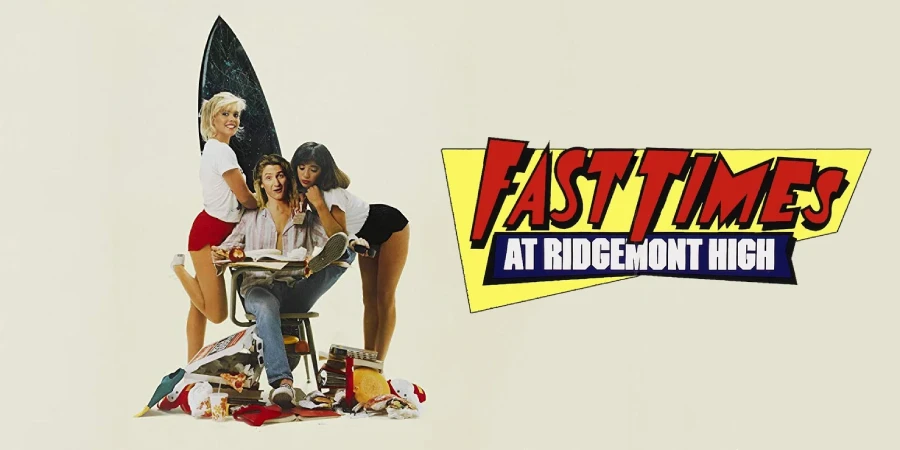

Sean Penn improvising his way through a bag of chips while forgetting basic math might be the most accurate portrait of a certain kind of teenager ever committed to film. Fast Times at Ridgemont High arrived in 1982 and treated its characters like actual human beings rather than cautionary tales or punchlines.
Amy Heckerling’s debut feature captures the boredom, horniness, and low-stakes tragedy of suburban high school life with a precision that most adult filmmakers never manage. This film has teeth hiding underneath all that Valley-speak and tanning oil.
Detailed Summary
Welcome to Ridgemont Mall
We open at the Ridgemont Mall, a fluorescent shrine to consumerism where half the student body apparently works. Stacy Hamilton is fifteen years old and working at a pizza counter, eager to shed her inexperience and fit in with older, more confident peers. Her friend and coworker Linda Barrett appoints herself Stacy’s romantic tutor, dispensing advice with the authority of someone who has seen everything.
Brad Hamilton, Stacy’s older brother, lords over his own job at a burger joint with the confidence of a guy who has no idea the world is about to humble him. He drives a used car he is proud of and thinks his relationship with his girlfriend is rock solid. It is not.
Enter Jeff Spicoli
Jeff Spicoli rolls into Mr. Hand’s history class late, barefoot, and carrying a pizza. Mr. Hand responds by confiscating the pizza and sharing it with the class, announcing that if Spicoli is willing to waste his time, the class will waste Spicoli’s food. It is a perfect comedic standoff between two characters who are, in their own bizarre way, mirror images of each other.
Spicoli is not merely a stoner joke. Penn plays him with complete internal consistency, a person who has genuinely reasoned his way into a philosophy of radical present-tense living. Every clash with Mr. Hand reinforces this dynamic rather than just repeating the gag.
Stacy’s Education, Linda’s Bravado
Stacy takes Linda’s advice to heart and pursues Ron Johnson, a 26-year-old stereo salesman she meets at the mall. She lies about her age. They have sex in a dugout that is about as romantic as a bus station, and Heckerling frames the scene without glamour, a crucial directorial choice that keeps the film from endorsing what is essentially statutory rape.
Linda, for all her worldly posturing, is in a relationship with a college boyfriend she barely mentions. Her confidence is real but also a kind of armor. The film never mocks her for it.
Mark Ratner and Mike Damone
Mark Ratner is the shy, earnest theater usher who develops genuine feelings for Stacy. His friend Mike Damone fancies himself a scalper, a smooth operator, and a life coach, despite having the emotional intelligence of a parking meter.
Damone lends Ratner a system for picking up women, delivered in a monologue that is equal parts hilarious and depressing. Ratner follows the advice faithfully. It does not work, because real affection does not follow a script.
Brad’s Downfall and Fantasy
Brad gets dumped by his girlfriend and then loses his job after snapping at a rude customer while dressed as a pirate. This is one of the film’s best sequences, both comedically and emotionally. His mascot costume becomes a visual symbol of how quickly dignity can evaporate.
Brad lands a new job at a convenience store and starts over, quietly. His daydream about Linda stepping out of a pool in slow motion, set to The Cars, is the film’s most self-aware moment, punctured brilliantly when Stacy walks in and catches him.
Stacy Gets Pregnant
Stacy and Damone have sex after Ratner sets up the introduction. Damone performs his move, literally, and leaves almost immediately afterward. Stacy discovers she is pregnant. She asks Damone for help paying for an abortion, and he agrees, then ghosts her.
Ratner steps up. He drives Stacy to the clinic after Damone fails to show. The abortion is treated matter-of-factly, not as a trauma to be milked for drama or a moral lesson to be delivered. Heckerling’s refusal to editorialize here is genuinely brave filmmaking for 1982 or any other year.
Spicoli vs. Mr. Hand, Round Final
Mr. Hand shows up at Spicoli’s home on the night of the prom to deliver the lectures Spicoli slept through. He commandeers Spicoli’s evening and goes through the entire semester’s material. Spicoli absorbs it with surprising grace.
It is a strange, warm scene that reframes their entire rivalry. Hand is not a villain; he is a teacher who refuses to give up on a student who refuses to try. Spicoli, somewhere under the weed smoke, actually listens.



Movie Ending
Damone gets publicly humiliated, which he deserves completely. Ratner confronts him at school, and word spreads that Damone left Stacy stranded at the abortion clinic. His social currency evaporates overnight. Penn’s Spicoli, having passed his history exam thanks to Mr. Hand’s surprise cram session, narrates a brief fantasy about rescuing a drowning David Lee Roth using the money from selling a wrecked car, which is pure Spicoli logic applied to a happy ending.
Stacy and Linda part ways for the summer with their friendship intact but slightly recalibrated. Stacy seems lighter, more self-possessed. She starts something genuine with Ratner, who earned it. Brad, meanwhile, gets his footing back and accepts that his post-high-school plans need revising.
Where credits roll title cards track each character’s fate. Spicoli goes on to save Brooke Shields from drowning. He then blows the reward money hiring Van Halen to play his birthday party. Ratner and Stacy date. Damone is last seen paying off a debt to classmates who know what he did. Brad becomes a successful manager at a new job. These title cards land like a class reunion you actually want to attend.
What makes the ending work is that nobody gets punished melodramatically and nobody gets a fantasy victory. Everyone just moves forward, slightly wiser, largely intact. For a teen movie made by adults, that restraint is almost shocking.
Are There Post-Credits Scenes?
Fast Times at Ridgemont High has no post-credits scenes. The title cards at the end function as the film’s coda, and once those are done, it is done. No stingers, no hidden jokes, no sequel bait.
Type of Movie
This is a coming-of-age comedy-drama. It leans comedic in its set pieces, especially anything involving Spicoli, but it handles its dramatic material, particularly Stacy’s pregnancy arc, with genuine seriousness. The tone shifts fluidly between laugh-out-loud and quietly sad, sometimes within the same scene.
It belongs to the early-1980s teen movie cycle but operates with more honesty than most of its contemporaries. It does not wrap its characters in wish-fulfillment. That places it closer to a slice-of-life drama than a conventional high school comedy.
Cast
- Sean Penn – Jeff Spicoli
- Jennifer Jason Leigh – Stacy Hamilton
- Judge Reinhold – Brad Hamilton
- Phoebe Cates – Linda Barrett
- Brian Backer – Mark Ratner
- Robert Romanus – Mike Damone
- Ray Walston – Mr. Hand
- Forest Whitaker – Charles Jefferson
- Eric Stoltz – Stoner Bud
- Nicolas Cage – Brad’s Buddy (billed as Nicolas Coppola)
- Anthony Edwards – Stoner Bud
Film Music and Composer
The film does not rely on a traditional orchestral score. Instead, it uses a wall-to-wall rock and pop soundtrack that functions as its emotional engine. Artists including Jackson Browne, The Cars, Poco, Fleetwood Mac, and Don Henley supply the texture of the era.
Don Felder’s “Heavy Metal (Takin’ a Ride)” opens the film with exactly the right swagger. The Cars’ “Moving in Stereo” scores Brad’s poolside fantasy sequence, and the song choice is so perfect it feels like the scene was written around the music rather than the other way around.
The absence of a composed score is itself a creative decision. Using existing radio hits grounds the film in a specific cultural moment rather than aestheticizing it from a distance.
Filming Locations
Principal photography took place in the San Fernando Valley in California. Ridgemont Mall in the film was largely shot at Sherman Oaks Galleria, a real Valley mall that had opened just a few years earlier. That location gave the film its authentic suburban energy.
The high school scenes used Van Nuys High School. Director Amy Heckerling wanted real locations rather than backlot approximations, and that choice pays off. The fluorescent lighting, the actual food court architecture, the sprawling school corridors all make the world feel inhabited rather than constructed.
Shooting in the Valley also kept the film true to Cameron Crowe’s source material. Crowe had actually enrolled as an undercover student in a real Southern California high school to research the book.
Awards and Nominations
Fast Times at Ridgemont High did not land major awards recognition upon release. Critics were respectful but the awards circuit largely ignored it, a pattern common for teen comedies of the era regardless of their actual quality.
Behind the Scenes Insights
- Cameron Crowe enrolled undercover as a student at Clairemont High School in San Diego to research the book the film is based on. He was in his early twenties passing as a teenager.
- Amy Heckerling was only 27 when she directed the film, making her one of the youngest directors to helm a studio release at that point.
- Sean Penn stayed in character as Spicoli throughout much of the production, frustrating some crew members but deepening the performance’s consistency.
- Phoebe Cates was reportedly uncomfortable filming the pool fantasy sequence, though it became one of the most discussed scenes of the decade.
- Nicolas Cage appeared under the name Nicolas Coppola to avoid trading on his famous uncle Francis Ford Coppola’s name. He later legally changed his surname.
- Forest Whitaker makes one of his earliest screen appearances here as Charles Jefferson, the football star whose car gets trashed by Spicoli.
- The production kept a tight schedule to capture the feel of an actual school year rather than a stylized recreation.
Inspirations and References
The film is a direct adaptation of Cameron Crowe’s 1981 nonfiction book of the same name. Crowe spent a year embedded in a Southern California high school, interviewing real students and documenting their lives. The resulting book was sold to Hollywood quickly, and Crowe wrote the screenplay himself.
The film preserves the book’s documentary instinct, its interest in economic reality, in teenagers who have jobs and money worries alongside their romantic anxieties. That specificity separates it from teen comedies that treat adolescence as a consequence-free sandbox.
Alternate Endings and Deleted Scenes
No widely documented alternate endings exist for Fast Times at Ridgemont High. Some scenes from Crowe’s source material did not make it into the final cut, including additional detail about peripheral characters who appear briefly in the film. The theatrical version closely follows the structure Crowe developed in his screenplay, and no major alternate cut has been released publicly.
Book Adaptations and Differences
Crowe’s 1981 book Fast Times at Ridgemont High: A True Story is nonfiction, built from real interviews and observations. The film fictionalizes the characters and compresses the timeline while preserving the book’s central concerns: work, sex, class anxiety, and the gap between teenage mythology and teenage reality.
Some characters in the book are composites or renamed versions of real students. The film streamlines the ensemble and sharpens the dramatic arcs of Stacy, Brad, and Damone. Spicoli in the book is less central than he becomes in the film, a shift driven almost entirely by what Penn brought to the role in casting sessions.


Memorable Scenes and Quotes
Key Scenes
- The Pizza Delivery Scene: Spicoli orders a pizza delivered to Mr. Hand’s class. Hand redistributes it to the students while staring Spicoli down. Nobody blinks first. Nobody needs to.
- Brad’s Pool Fantasy: Brad daydreams about Linda walking toward him in a red bikini, slow motion, set to “Moving in Stereo.” The camera holds on Phoebe Cates unhooking her top, then cuts brutally to Stacy walking in on Brad in the bathroom. Judge Reinhold’s panicked scramble earns the biggest laugh in the film.
- The Abortion Clinic: Heckerling shoots this sequence quietly, no swelling music, no lecture. Ratner waits in the parking lot. Stacy walks out. They drive away. The restraint makes it more affecting than any melodramatic treatment would have.
- Mr. Hand Visits Spicoli: Hand arrives at Spicoli’s house on prom night. Spicoli, in his tuxedo, genuinely engages with the material. It is the warmest scene in the film and one of Ray Walston’s best moments on screen.
- Damone’s “System” Monologue: Damone delivers his five-point plan for talking to girls with complete sincerity. It is funny and sad in equal measure, a window into exactly the kind of confidence that collapses on contact with reality.
Iconic Quotes
- “I don’t know. She was talking about going to prom, and next thing I know she’s crying. I don’t know what I did.” (Ratner, lost as always)
- “Learn it. Know it. Live it.” (Brad, to a new coworker, about the restaurant’s special sauce)
- “You are a dick. You know that?” (Stacy, to Damone, delivered quietly and perfectly by Leigh)
- “All I need are some tasty waves, a cool buzz, and I’m fine.” (Spicoli, summarizing his entire worldview in one sentence)
- “What Jefferson was saying was, ‘Hey! You know, we left this England place because it was bogus.'” (Spicoli, rewriting American history with alarming confidence)
Easter Eggs and Hidden Details
- Nicolas Cage appears so briefly that most viewers miss him entirely on first watch. Look for him in scenes with Brad.
- The Sherman Oaks Galleria used for the mall later appeared in other 1980s productions set in the San Fernando Valley, making it an unofficial landmark of the era’s teen film geography.
- Spicoli’s van and its airbrushed mural are treated with the same visual care the film gives to any character detail. The van tells you everything about Spicoli before he says a word.
- Background extras in the mall scenes are largely dressed in authentic early-1980s fashion sourced from actual Valley shops rather than costume department approximations.
- The film includes an early glimpse of Eric Stoltz before his breakthrough in Mask (1985). He appears with Anthony Edwards, another future star, in a small supporting role.
Trivia
- Cameron Crowe was only 22 when he began researching the book by going undercover in high school.
- Sean Penn’s performance as Spicoli effectively launched his career as a serious actor, which is a remarkable outcome for a role built on pizza and surf slang.
- Amy Heckerling went on to direct Clueless (1995), another teen comedy that punched well above its genre’s expected weight.
- Ray Walston, who plays Mr. Hand, was known primarily for television work before the film. His performance here reminded audiences of what he could do with the right material.
- The film’s honest depiction of a teenage abortion was controversial in 1982 and remains relatively rare in mainstream Hollywood filmmaking even today.
- Jennifer Jason Leigh prepared for the role extensively, researching the actual experiences of teenage girls in Southern California rather than playing a generic version of the character.
- The film’s soundtrack album sold separately from the film and performed well commercially on its own.
Why Watch?
Jennifer Jason Leigh’s performance as Stacy Hamilton is the reason to sit down with this film today. She plays a fifteen-year-old navigating experiences she is not ready for with a specific combination of eagerness and quiet devastation that no other actor in the film quite matches. Heckerling trusts her completely, and that trust produces the most honest portrait of a teenage girl in 1980s American cinema.
Director’s Other Movies
- National Lampoon’s European Vacation (1985)
- Look Who’s Talking (1989)
- Look Who’s Talking Too (1990)
- Clueless (1995)
- Loser (2000)