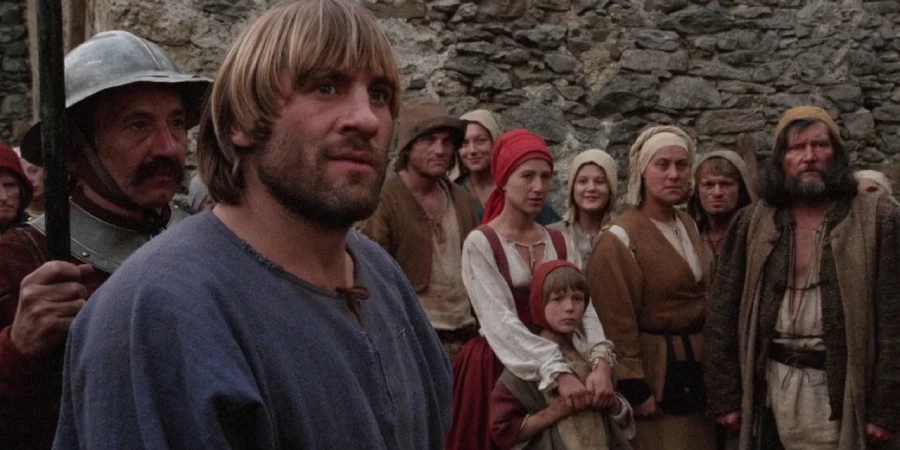
A man walks back into a village after years of absence, claims his wife, his land, and his life, and almost gets away with it. The Return of Martin Guerre (1982) is a French historical drama built on one of the most audacious impersonations ever recorded, and director Daniel Vigne tells it with a quiet, unsettling precision that makes the deception feel both thrilling and deeply human. Based on a real sixteenth-century court case, the film forces viewers to question identity, loyalty, and what we owe to the truth. It is a slow burn with a devastating payoff.
Detailed Summary
A Marriage in Sixteenth-Century France
The film opens in the village of Artigat in southern France, where the young Martin Guerre marries Bertrande de Rols. Both families are peasant farmers rooted in rigid Catholic tradition. Their union is practical, not romantic.
For years, Martin and Bertrande struggle to conceive. Rumors of a curse circulate through the superstitious community. Eventually, a priest performs a ritual, and the couple finally has a son.
Martin Disappears
Without warning, Martin Guerre abandons his wife, his child, and his farm. He simply vanishes, leaving Bertrande in a punishing social limbo. As a married woman whose husband has deserted her, she cannot remarry without proof of his death.
Years pass. Bertrande raises their son largely alone, managing the household under the watchful eye of Martin’s father, Pierre Guerre. Her life is suspended, trapped between widowhood and marriage.
The Stranger Returns
A man arrives in Artigat claiming to be Martin Guerre. He is charming, warm, and surprisingly knowledgeable about village life and family history. Neighbors embrace him with relief and celebration.
Bertrande, however, hesitates. She studies this man carefully before accepting him. In contrast to the cold, distant Martin she remembers, this version is affectionate, attentive, and emotionally present.
She ultimately accepts him as her husband. Whether she immediately suspects the truth or genuinely believes him remains one of the film’s most carefully maintained ambiguities.
Life with the Imposter
The man we come to understand as Arnaud du Tilh settles into Martin’s life with remarkable confidence. He and Bertrande grow genuinely close, and their relationship carries a warmth the original marriage apparently lacked. Moreover, he manages the farm competently and earns respect in the community.
Pierre Guerre, Martin’s uncle (the film consolidates some familial roles from the historical record), grows suspicious over time. Financial disputes over the inheritance of the Guerre estate sharpen his doubts.
Suspicion Grows
Pierre begins openly accusing the man of being an imposter. He rallies others in the village to support his claim. Consequently, the case moves toward a formal legal proceeding.
Bertrande finds herself at the center of the accusation. She is the wife. Her testimony carries enormous weight. The film raises the devastating possibility that she knows the truth and has chosen to live with it anyway.
The Trial
Arnaud stands trial before a judge. He defends himself brilliantly, answering questions about the Guerre family history with astonishing accuracy. Witnesses line up on both sides, with roughly equal numbers vouching for and against his identity.
Bertrande testifies against him. This moment is agonizing because the audience senses she loves this man and knows he is not Martin. Yet her faith, her honor, and her fear of eternal damnation drive her to speak against him.
For instance, the film frames her piety not as weakness but as a genuine moral force. She cannot continue living in what the Church would call adultery, even if the alternative destroys her happiness.


Movie Ending
Just as the judge seems ready to acquit Arnaud, a one-legged soldier appears at the back of the courtroom. He announces that he is the real Martin Guerre. The room goes silent. Arnaud’s composure finally cracks.
Martin, played with cold severity by Richard Anconina in a brief but pivotal appearance, confirms the impersonation. Arnaud du Tilh, played throughout by Gérard Depardieu, cannot talk his way out of this. The judge orders his arrest.
Arnaud confesses. He does not beg or collapse entirely; instead, he faces his sentence with a kind of resigned dignity. The court condemns him to death for fraud and adultery.
He is hanged outside the Guerre family home, in full view of the village. Before his execution, he reportedly asks forgiveness from Martin and from Bertrande. It is a moment of genuine humanity that the film refuses to undercut with sentimentality.
Bertrande is left with the real Martin, a man she barely knows and apparently did not miss. The film does not offer her a happy ending. Furthermore, it does not allow the audience one either. She has done the righteous thing and lost everything that made her life bearable.
This ending matters because it refuses to moralize simply. Bertrande is not punished for wickedness; she is punished for honesty. Arnaud is not a villain; he is a man who built something real on a fraudulent foundation. The film trusts its audience to sit with that contradiction.
Are There Post-Credits Scenes?
The Return of Martin Guerre contains no post-credits scenes. It is a 1982 French historical drama, and the film ends on its final image without any additional footage. Audiences can leave without waiting.
Type of Movie
This film is a historical drama with strong elements of courtroom thriller and psychological mystery. Its tone is measured, somber, and often melancholic. However, it builds genuine suspense through character observation rather than action.
It belongs to a tradition of French cinema that prioritizes moral complexity over narrative resolution. Expect patience to be rewarded.
Cast
- Gérard Depardieu – Arnaud du Tilh (the imposter posing as Martin Guerre)
- Nathalie Baye – Bertrande de Rols
- Roger Planchon – Pierre Guerre
- Maurice Jacquemont – Judge Rieux
- Barnard-Pierre Donnadieu – The real Martin Guerre
- Richard Anconina – Carbon Barrau
Film Music and Composer
Michel Portal composed the score for The Return of Martin Guerre. Portal is a French musician known primarily for his jazz work, and he brings an unusual textural quality to the film’s music. His score avoids conventional period-drama orchestration.
Instead, Portal uses sparse, folk-inflected arrangements that feel rooted in the soil of rural France. The music underscores the film’s emotional restraint rather than amplifying it into melodrama. Notably, this subtlety makes the few moments of musical emphasis land harder.



Filming Locations
Production filmed on location in the Ariège department of southern France, in and around the actual village of Artigat where the historical events took place. This choice was deliberate and meaningful. Using the real location gives the film an authenticity that studio sets simply could not replicate.
The landscape, with its stone buildings, narrow paths, and agrarian rhythms, becomes a character in itself. It reminds viewers constantly that these people had nowhere to run and no anonymity to hide behind. Consequently, every social transgression carried enormous weight.
Awards and Nominations
The Return of Martin Guerre earned four César Award nominations, including Best Film. Nathalie Baye received a nomination for Best Actress. The film also gained significant international attention and helped introduce Depardieu to wider global audiences.
Behind the Scenes Insights
- Historian Natalie Zemon Davis served as a historical consultant on the film, and her involvement was so deep that she later wrote her own book expanding on the case.
- Gérard Depardieu threw himself into the physical reality of peasant life during production, working to understand the rhythms of sixteenth-century rural labor.
- Director Daniel Vigne was drawn to the case because of its central ambiguity: nobody could prove with certainty what Bertrande knew or when she knew it.
- Many extras in the village scenes were local residents, which added an unrehearsed, lived-in texture to crowd sequences.
- The production paid close attention to period-accurate costume and architecture, consulting historians throughout the design process.
Inspirations and References
The film draws directly from a real sixteenth-century French legal case. In the 1560s, a man named Arnaud du Tilh impersonated Martin Guerre in the village of Artigat, fooling the community for several years before the real Martin returned.
The case survived in historical records partly because the judge, Jean de Coras, found it so remarkable that he published an account of it in 1561. That document, Arrest Memorable, served as a primary source for the filmmakers.
In addition, the broader story taps into universal anxieties about identity, recognition, and the stories we tell ourselves about the people we love.
Alternate Endings and Deleted Scenes
No documented alternate endings or significant deleted scenes for The Return of Martin Guerre appear in widely available production records. The film’s ending closely follows the historical outcome of the real trial. Vigne and his co-writer Jean-Claude Carrière appear to have committed to the true story’s conclusion from early in development.
Book Adaptations and Differences
Historian Natalie Zemon Davis, who consulted on the film, published The Return of Martin Guerre as a book in 1983, one year after the film’s release. However, this book is not the source the film adapted; rather, the film and the book grew from the same historical material simultaneously.
Davis’s book goes further in analyzing Bertrande’s possible motivations and agency. She argues, perhaps more forcefully than the film does, that Bertrande may have knowingly participated in the deception from early on. On the other hand, the film preserves this as ambiguity rather than argument, which is arguably a more cinematically honest choice.


Memorable Scenes and Quotes
Key Scenes
- Bertrande’s first, hesitant reunion with the man claiming to be Martin, her long pause before acceptance carrying enormous dramatic weight.
- The courtroom sequence where witness after witness contradicts another, turning the trial into a disorienting portrait of collective memory.
- Bertrande’s testimony against Arnaud, a scene shot with quiet devastation as she essentially condemns the man she loves.
- The arrival of the real Martin Guerre at the back of the courtroom, a single figure who collapses Arnaud’s entire constructed world in seconds.
- Arnaud’s execution outside the family home, filmed without dramatic music, letting the act speak for itself.
Iconic Quotes
- “You are not Martin Guerre.” The moment Bertrande finally speaks the truth aloud carries a weight the entire film has been building toward.
- Arnaud’s courtroom declaration of his own identity, performed with such conviction that even the audience momentarily doubts the witnesses against him.
Easter Eggs and Hidden Details
- Several background costumes in crowd scenes reflect specific regional textile traditions of the Ariège, a detail most viewers miss but historians praised.
- The body language between Bertrande and Arnaud in early scenes subtly hints at mutual recognition before the film makes anything explicit.
- Historian Natalie Zemon Davis herself appears briefly in the film as an extra in a crowd scene, a quiet nod to her role in the production.
- The framing of certain courtroom shots deliberately mirrors the layout described in Jean de Coras’s original 1561 legal document.
Trivia
- American filmmakers adapted the same story as the musical Martin Guerre (later The Pirate Queen composer Claude-Michel Schönberg also worked on a stage version), showing the story’s cross-cultural appeal.
- Sommersby (1993), starring Richard Gere and Jodie Foster, is a direct American remake transposed to the post-Civil War American South.
- Gérard Depardieu was already a major star in France before this film, but Martin Guerre helped solidify his reputation internationally.
- Jean-Claude Carrière, the co-screenwriter, is one of the most celebrated French screenwriters of the twentieth century, known for his collaborations with Luis Buñuel.
- The film was shot in the summer to capture the warmth of the southern French countryside, a visual contrast to the cold moral atmosphere of the story.
- Daniel Vigne has said in interviews that he was particularly interested in how communities construct shared memory and how that memory can be manipulated.
Why Watch?
The Return of Martin Guerre rewards viewers who want cinema that genuinely respects their intelligence. Depardieu delivers one of his most charismatic and layered performances, and Nathalie Baye matches him beat for beat. Few films this old still generate the same uneasy, lingering questions about identity and complicity. It is a masterclass in restraint.
Director’s Other Movies
- La Fille de Prague avec un sac en bandoulière (1994)
- One Woman or Two (1985)