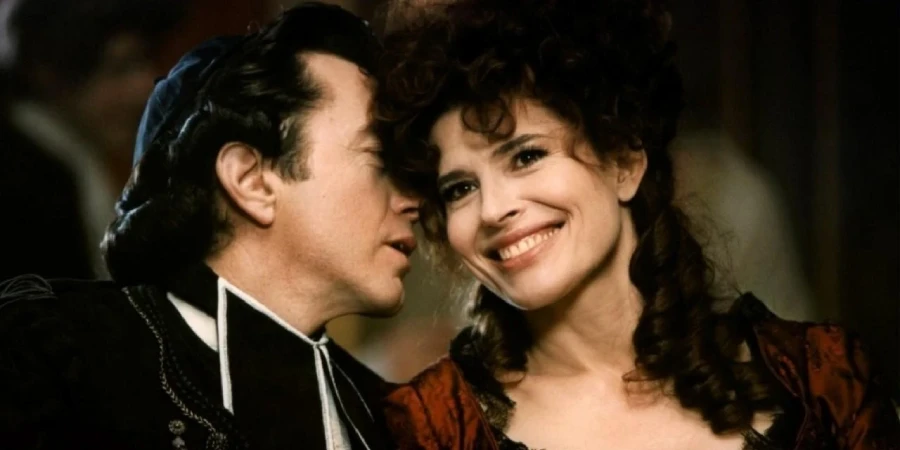

Wit can be a weapon sharper than any sword, and Ridicule proves it with devastating elegance. Patrice Leconte’s 1996 masterpiece drops a naive provincial engineer into the glittering, vicious court of Louis XVI, where a well-turned joke can make your career and a single clumsy phrase can end it. This film does not celebrate wit; it interrogates it, exposing how intelligence weaponized for social survival becomes its own kind of moral corruption. Few films have ever made wordplay feel so dangerous.
Detailed Summary
A Provincial Idealist Arrives at Versailles
Gregoire Ponceludon de Malavoy, a young engineer from the Dombes marshlands, travels to Versailles with a practical, urgent mission: he wants royal funding to drain the swamps that breed disease and kill the peasants on his estate. His cause is genuinely noble. However, he quickly realizes that no one at court cares about drainage, disease, or dying peasants.
Versailles operates on a completely different currency: wit. Bon mots, cutting remarks, and perfectly timed verbal humiliations determine who rises and who disappears into obscurity. Gregoire arrives clumsy and earnest, almost immediately becoming the butt of jokes rather than their author.
The Rules of the Game
Gregoire’s luck changes when the Comte de Bellegarde, an older nobleman who has chosen to retreat from court life rather than play its games, takes him under his wing. Bellegarde teaches him the rules: never apologize, never explain, and always land the last word. In addition, Bellegarde warns him that the court rewards cruelty dressed as cleverness.
Bellegarde’s daughter, Mathilde, is a brilliant young scientist obsessed with underwater breathing experiments. She is already engaged to an elderly, wealthy nobleman, a practical arrangement she accepts without joy. Gregoire and Mathilde feel an immediate intellectual and emotional pull toward each other, though both are too guarded to act on it quickly.
The Rise of the Provincial Wit
Gregoire begins to master the court’s language of ridicule. He scores increasingly sharp verbal victories, building a reputation that opens doors previously shut to him. Consequently, he gains access to powerful figures who might actually help fund his drainage project.
His chief rival and obstacle is the Abbe de Vilecourt, a clergyman who has spent years perfecting the art of vicious wit and who views Gregoire as an unwelcome competitor. Vilecourt actively works to sabotage Gregoire, planting social traps and engineering humiliations. The rivalry between them drives much of the film’s tension.
Seduction, Compromise, and Moral Drift
Madame de Blayac, a beautiful, powerful widow with direct influence over access to the king, takes an interest in Gregoire. She becomes his protector and, soon, his lover. Her patronage is not charity; it is a transaction, and both parties understand this.
Gregoire compromises himself incrementally. He uses wit to wound rather than to illuminate, adopting the court’s values more deeply than he intends. Meanwhile, his genuine connection with Mathilde deepens, creating a painful tension between ambition and integrity. He is becoming the very thing he once found repugnant.
Exposure and Collapse
Vilecourt eventually engineers Gregoire’s downfall by exposing a private, intimate letter. Madame de Blayac, feeling threatened or scorned, does not protect him. Gregoire’s reputation collapses almost overnight, demonstrating precisely how precarious any position at Versailles truly is.
Bellegarde watches the collapse with sad recognition rather than surprise. He has always known that the court eventually destroys everyone who plays its game, including those who play it well. Gregoire’s fall is, in a grim way, a confirmation of everything Bellegarde tried to warn him about.

Movie Ending
Gregoire’s social ruin at Versailles arrives swiftly and completely, but Leconte refuses to let the film end on simple tragedy. Stripped of his court connections and his access to power, Gregoire faces the real possibility that his drainage project will never receive funding, and that the peasants of the Dombes will keep dying. His original mission, the one moral anchor he carried into Versailles, seems lost.
Mathilde, however, chooses a different kind of escape. Rather than marry her elderly fiance, she flees France, heading to England where her scientific work can actually be taken seriously. Her departure is an act of radical self-preservation; she refuses to let Versailles consume her the way it consumes everyone else. It signals that genuine intelligence, in this world, must leave to survive.
Gregoire ultimately follows her. He abandons the court, Madame de Blayac, and the whole poisonous game of wit. In a pointed piece of irony, the film suggests that only by losing at Versailles does he actually win something worth having: his own integrity, and Mathilde. The drainage project’s fate remains unresolved, which is itself a quietly devastating choice by Leconte, because real problems rarely get solved when courts are busy admiring their own reflections.
What makes the ending so resonant is its refusal of easy triumph. Gregoire does not drain the swamps. He does not humiliate Vilecourt in a final grand scene. Instead, he simply walks away, and that quiet exit lands harder than any clever comeback could.
Are There Post-Credits Scenes?
Ridicule contains no post-credits scenes whatsoever. Once Leconte’s film ends, it ends completely. Given the film’s tone and its 1996 European art-house context, a post-credits sequence would have been wildly out of place.
Type of Movie
Ridicule is a period drama with sharp satirical edges and occasional dark comedic notes. It operates primarily as a social satire, using the specific world of pre-revolutionary Versailles to make universal observations about power, language, and corruption. In contrast to lavish costume dramas that celebrate aristocratic splendor, this film methodically dismantles it.
Tonally, it balances intellectual wit with genuine melancholy. It never tips into farce, and it never collapses into heavy-handed moralizing. Leconte keeps the film poised in an unsettling middle register where laughter and discomfort coexist.
Cast
- Charles Berling – Gregoire Ponceludon de Malavoy
- Jean Rochefort – the Comte de Bellegarde
- Fanny Ardant – Madame de Blayac
- Judith Godreche – Mathilde de Bellegarde
- Bernard Giraudeau – the Abbe de Vilecourt
- Carlo Brandt – the Chevalier de Milletail
Film Music and Composer
Antoine Duhamel composed the score for Ridicule. His approach leans heavily on period-appropriate instrumentation, drawing from baroque and early classical traditions to keep the sonic world anchored to late eighteenth-century France. The music never overwhelms; it underscores without calling attention to itself.
Duhamel was a highly experienced French composer with a long career in both film and opera. His restrained choices for Ridicule suit Leconte’s direction perfectly: elegant on the surface, with a cool ironic distance underneath.


Filming Locations
Production on Ridicule used actual historic French chateaux and estates to achieve its visual authenticity. Vaux-le-Vicomte, the stunning seventeenth-century chateau near Maincy, served as a key location. Its architecture and formal gardens project exactly the kind of intimidating grandeur the script requires.
Versailles itself, or portions of it, also featured in the production. Shooting in real historic spaces rather than built sets gives the film an oppressive physical weight; these rooms genuinely swallowed people. Furthermore, the contrast between the ornate interiors and the marshy, muddy Dombes landscapes reinforces the film’s central thematic divide between Versailles’s artifice and the real suffering outside its gates.
Awards and Nominations
Ridicule earned significant recognition. It won four César Awards, including Best Film and Best Director for Patrice Leconte. Moreover, it represented France at the Academy Awards and received a nomination for Best Foreign Language Film at the Oscars, though it did not win in that category.
Behind the Scenes Insights
- Screenwriter Remi Waterhouse spent considerable time researching the specific social rituals and verbal culture of the court of Louis XVI before writing the script.
- Jean Rochefort brought enormous natural authority to Bellegarde, and Leconte has spoken about how Rochefort’s presence grounded the film’s more stylized elements.
- Patrice Leconte has noted that the film’s central question, what price do you pay to be taken seriously, was personally resonant for him as a filmmaker working within a highly competitive industry.
- Casting Charles Berling in the lead was considered a risk at the time, as he was not yet a major star; the film significantly raised his profile in French cinema.
- Fanny Ardant brought considerable star power to Madame de Blayac, and her performance adds genuine ambiguity to a character who could easily have read as a simple villain.
Inspirations and References
Remi Waterhouse drew on historical scholarship about court culture at Versailles under Louis XVI. The film engages seriously with the documented reality that wit and verbal performance genuinely functioned as social capital in pre-revolutionary French aristocratic life. Historians have written extensively about how l’esprit (wit) shaped social hierarchies at court.
Thematically, the film resonates with Enlightenment-era literature, particularly works that critique the gap between polished surfaces and moral emptiness. One can feel echoes of writers like Laclos and his Les Liaisons Dangereuses in the film’s view of aristocratic society as a machine for corruption.
Alternate Endings and Deleted Scenes
No documented alternate endings or significant deleted scenes for Ridicule have entered the public record. Leconte and his collaborators have not publicized substantial cut material. As a result, the film as released appears to represent the version its makers intended.
Book Adaptations and Differences
Ridicule is not based on a specific novel or prior literary source. Remi Waterhouse wrote an original screenplay, drawing on historical research and his own imagination rather than adapting an existing text. Therefore, there is no source novel to compare it against.



Memorable Scenes and Quotes
Key Scenes
- Gregoire’s first disastrous attempt at wit at a court gathering, where he stumbles and becomes the joke rather than its maker, establishes the film’s brutal social stakes immediately.
- Bellegarde’s lesson to Gregoire about the rules of verbal combat, delivered with weary elegance, functions as both exposition and the film’s clearest statement of theme.
- Madame de Blayac’s seduction of Gregoire, where power dynamics and genuine desire tangle in genuinely unsettling ways.
- Mathilde’s underwater breathing experiment, which Gregoire witnesses with open fascination, marking the moment their connection deepens beyond surface attraction.
- Gregoire’s public humiliation following the exposure of his private letter, which lands with quiet devastation rather than theatrical drama.
- Mathilde’s departure for England: a brief scene that carries enormous emotional weight precisely because it refuses sentimentality.
Iconic Quotes
- “At Versailles, wit is a matter of survival. Without it, you are invisible. With it, you are dangerous.” (Bellegarde, paraphrased)
- “God created man, and finding him not sufficiently alone, gave him a companion to make him feel his solitude more keenly.” (a court wit, paraphrased)
- Bellegarde’s quiet observation that laughter at Versailles never comes from joy, only from someone else’s pain, encapsulates the film’s entire moral argument.
Easter Eggs and Hidden Details
- Leconte films the Versailles interiors in ways that subtly emphasize their cage-like qualities, using framing and doorways to suggest entrapment rather than grandeur.
- Mathilde’s scientific equipment appears anachronistically advanced for a woman of her era and class, a quiet visual argument that her intellect genuinely exceeds the world she inhabits.
- Vilecourt’s clerical robes are consistently filmed in unflattering light, a subtle visual cue that undercuts his claims to moral authority.
- The Dombes marshland scenes are shot with a rawness and natural light that contrast sharply with the candlelit, controlled interiors of Versailles, reinforcing the film’s central thematic opposition.
- Background courtiers frequently mime laughter without sound in wide shots, a detail that makes the court feel performative and hollow even in its ambient behavior.
Trivia
- Ridicule was a significant commercial as well as critical success in France, reaching a wide audience despite its literary and intellectual subject matter.
- Patrice Leconte was already known for stylistically varied work before this film; Ridicule is often cited as his most formally accomplished achievement.
- Jean Rochefort was one of the most beloved actors in French cinema for decades, and his Bellegarde is frequently cited as one of his finest performances.
- The film’s title in French carries a double meaning: ridicule as mockery, but also as the state of being ridiculous, which every character risks at every moment.
- Judith Godreche was in her mid-twenties during filming and held her own against considerably more established co-stars, earning strong notices for her work as Mathilde.
- The costumes required extensive historical research and craftsmanship, and their authenticity contributes substantially to the film’s oppressive, airless atmosphere.
Why Watch?
Ridicule is essential viewing for anyone who believes cinema can carry real ideas without sacrificing elegance or entertainment. It makes verbal wit genuinely thrilling while simultaneously exposing it as morally hollow, a trick very few films manage. Furthermore, its performances, particularly Rochefort and Ardant, are simply extraordinary. Few period films feel this urgent or this smart.
Director’s Other Movies
- Monsieur Hire (1989)
- The Hairdresser’s Husband (1990)
- Tango (1993)
- The Girl on the Bridge (1999)
- The Man on the Train (2002)
- Intimate Strangers (2004)
Recommended Films for Fans
- Dangerous Liaisons (1988)
- The Widow of Saint-Pierre (2000)
- Valmont (1989)
- The Favourite (2018)
- Barry Lyndon (1975)
- Cyrano de Bergerac (1990)
- Vatel (2000)
- The Draughtsman’s Contract (1982)