
Few films dare to make obsession look this tender. The Hairdresser’s Husband, directed by Patrice Leconte, builds its entire emotional architecture on a single, lifelong fixation: a man so captivated by female hairdressers that he marries one and never wants anything else. It is a film about desire, contentment, and the terrifying fragility of perfect happiness. Leconte turns what sounds like a quirky premise into something quietly devastating.
Detailed Summary
A Boy and His Obsession
Antoine is introduced to us as a young boy in 1960s France. He visits a local barbershop run by a voluptuous female hairdresser and becomes instantly, powerfully entranced, not just by her but by everything she represents: warmth, sensuality, and an intimate kind of care.
This childhood encounter plants a seed that never leaves him. Antoine grows up carrying this specific desire, untouched and uncompromised, into adulthood. For him, hairdressers are not just women; they are a category of perfection.
Antoine Finds His Dream
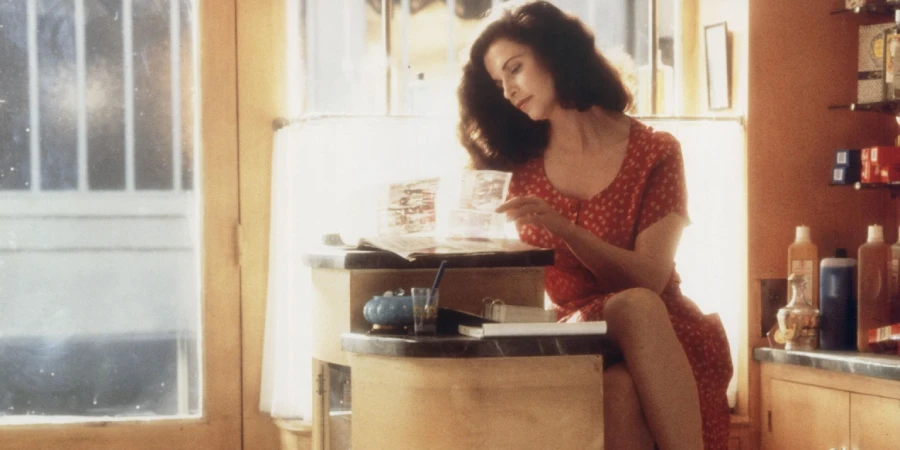
As an adult, Antoine, played by Jean Rochefort, walks into a hair salon and meets Mathilde, played by Anna Galiena. He watches her work, studies her movements, and falls for her immediately and completely. He proposes to her almost without preamble, with a directness that is either charming or alarming depending on your perspective.
Mathilde, remarkably, accepts. She sees something genuine in this odd, earnest man who asks for nothing complicated. Their courtship is brief; their commitment is total.
A Marriage Sealed in the Salon
Antoine and Mathilde build a life inside the salon itself. He sits in the corner, watching her work every day, listening to Arabic music, and performing his peculiar private dance. Their relationship is almost entirely self-contained, sealed off from the outside world.
Leconte presents this arrangement as genuinely idyllic rather than pathological. Antoine is not controlling or possessive in a threatening way; he is simply, entirely satisfied. Mathilde, in turn, finds his devotion beautiful rather than suffocating.
Cracks Beneath the Surface
However, Leconte subtly introduces unease. Mathilde begins to change in small ways. She grows quieter, more inward. Antoine notices but cannot name what is shifting.
In addition, the film drops hints that Mathilde carries a private fear Antoine does not share. She loves their happiness fiercely, but she does not trust it to last. For her, perfect happiness is not a destination; it is a countdown.

Movie Ending
Mathilde walks into the salon one morning and locks the door. Antoine waits outside, puzzled and then alarmed. She drowns herself in the basin used for washing customers’ hair.
She leaves Antoine no note of explanation, which is perhaps the most devastating detail of all. Her act is not born of misery in any conventional sense. She drowns herself precisely because she is too happy, because she cannot bear to watch that happiness erode over time, because she would rather end on a perfect note than survive its decline.
Antoine, consequently, is left to narrate this story from some point after her death. His voiceover frames the entire film as a bittersweet act of remembrance. He does not rage or collapse; he simply holds the memory of Mathilde as the defining truth of his life.
Leconte refuses to moralize or explain. He trusts the audience to sit with the ambiguity of Mathilde’s choice. Her suicide reads as both a profound act of love and a profound act of selfishness, and the film is wise enough to let both readings stand simultaneously.
Are There Post-Credits Scenes?
The Hairdresser’s Husband contains no post-credits scenes. Leconte closes the film with quiet finality; nothing follows.
Type of Movie
This is a French romantic drama with strong elements of melancholy and sensuality. Its tone is dreamlike and intimate, closer to a prose poem than a conventional narrative film. Some critics have also noted its fable-like quality, given how stylized and archetypal its characters feel.
It resists easy genre labels. Calling it a romance undersells its darkness; calling it a tragedy undersells its warmth.
Cast
- Jean Rochefort – Antoine (adult)
- Anna Galiena – Mathilde
- Roland Bertin – Antoine’s father
- Maurice Chevit – Ambroise
- Philippe Clevenot – Morvoisieux
- Jacques Mathou – M. Chardon
- Claude Aufaure – The customer
- Albert Delpy – Antoine’s father (younger scenes)
Film Music and Composer
Michael Nyman composed the score. Nyman, already widely recognized for his work on The Piano and his long collaborations with Peter Greenaway, brought his signature minimalist style to this project. His music pulses with quiet insistence, perfectly matching Leconte’s unhurried visual rhythm.
Notably, Arabic music also features prominently in the film. Antoine’s habit of dancing to it inside the salon gives those sequences a hypnotic, ritualistic quality that Nyman’s orchestral score complements rather than replaces.


Filming Locations
Leconte shot the film primarily in France. Much of the action unfolds inside a single hair salon, a deliberate choice that amplifies the story’s claustrophobic intimacy. By keeping the camera largely inside this one space, Leconte makes the salon feel like its own sealed universe.
This spatial confinement reinforces the thematic core of the film: Antoine and Mathilde have chosen to live entirely inside their own private world, and the location strategy makes that visible.
Awards and Nominations
The Hairdresser’s Husband earned Anna Galiena a César Award nomination for Most Promising Actress. The film also received international attention at various festivals, helping to cement Leconte’s reputation as a major voice in French cinema during the early 1990s.
Behind the Scenes Insights
- Patrice Leconte co-wrote the screenplay with Claude Klotz, drawing on deeply personal ideas about idealized desire and the nature of obsession.
- Jean Rochefort reportedly embraced the role’s stillness deliberately, choosing to underplay Antoine’s emotions rather than perform them, trusting the audience to feel what he did not show.
- Anna Galiena, an Italian actress, learned her role largely in French, adding an extra layer of foreignness to Mathilde that subtly heightens her mystique onscreen.
- Leconte has spoken about his desire to make a film that felt suspended in time, neither anchored to a specific decade nor concerned with contemporary social reality.
- Michael Nyman composed the score after the film was completed, working from the finished cut rather than a script or rough assembly.
Inspirations and References
Leconte drew inspiration from his own childhood memories and a fascination with how certain encounters in youth can permanently shape adult desire. He has described the film as an attempt to capture a feeling rather than tell a conventional story.
Thematically, the film echoes certain French literary traditions, particularly the idea of l’amour fou (mad love), in which romantic passion becomes all-consuming and ultimately fatal. Writers like André Breton explored this territory in Surrealist literature, and Leconte’s film operates in a similar emotional register.
Alternate Endings and Deleted Scenes
No credible information exists about alternate endings or significant deleted scenes from this production. Leconte’s filmmaking style tends toward precision and economy, and the film as released feels complete and deliberate in its construction.
Book Adaptations and Differences
The Hairdresser’s Husband is not based on a book or previously published source material. Leconte and Klotz wrote an original screenplay specifically for this project.

Memorable Scenes and Quotes
Key Scenes
- Young Antoine’s first visit to the female hairdresser, where he presses his face against her body and a lifelong obsession is born in a single, wordless moment.
- Antoine’s spontaneous, idiosyncratic dance in the salon, performed to Arabic music while Mathilde watches with open delight.
- Antoine’s marriage proposal to Mathilde, delivered with such blunt sincerity that it bypasses romance entirely and lands somewhere more honest.
- Mathilde locking the salon door before her suicide, shutting out Antoine and the world simultaneously in one quiet, irreversible gesture.
- Antoine’s closing narration, in which he holds the memory of Mathilde not with grief but with a kind of grateful reverence.
Iconic Quotes
- “I have everything I want. I don’t need anything else.” (Antoine, expressing his complete contentment with Mathilde and the salon.)
- “What if it doesn’t last?” (Mathilde, voicing the private terror that drives her toward her final act.)
Easter Eggs and Hidden Details
- Antoine’s dance reappears at multiple points in the film; each repetition is slightly different, suggesting that his ritual evolves even as he insists nothing changes.
- Leconte frames Mathilde almost exclusively through Antoine’s point of view, meaning the audience never fully accesses her interiority until her death forces a reinterpretation of everything seen before.
- Arabic music functions as a recurring motif tied specifically to Antoine’s private joy; when the music stops in the final act, it signals a shift before anything explicitly dramatic occurs.
- Mathilde’s increasing silences in the latter half of the film mirror the narrative structure: her dialogue decreases as her decision hardens, making her absence felt before it is made literal.
Trivia
- Jean Rochefort was already an established and beloved figure in French cinema before this role, but his performance here is widely considered among his finest and most restrained work.
- Leconte shot the film relatively quickly and with a small crew, preserving the intimate atmosphere that the story required.
- Anna Galiena was not a household name in France before this film; her performance as Mathilde launched her profile significantly in European cinema.
- The film runs approximately 84 minutes, an unusually brief runtime that suits its fable-like intensity.
- Leconte has returned to themes of obsession, solitude, and erotic fixation across much of his filmography, making this film a central text for understanding his broader body of work.
Why Watch?
The Hairdresser’s Husband offers something genuinely rare: a film about perfect happiness that makes you ache for it and fear it at the same time. Rochefort and Galiena create chemistry so specific and unusual that no other film quite replicates it. Furthermore, Leconte’s restraint and Nyman’s score combine to produce an experience that lingers long after the credits end.
Director’s Other Movies
- Monsieur Hire (1989)
- Ridicule (1996)
- The Girl on the Bridge (1999)
- The Man on the Train (2002)
- Intimate Strangers (2004)
Recommended Films for Fans
- Monsieur Hire (1989)
- Betty Blue (1986)
- The Piano (1993)
- Damage (1992)
- My Man (1996)
- An Affair of Love (1999)