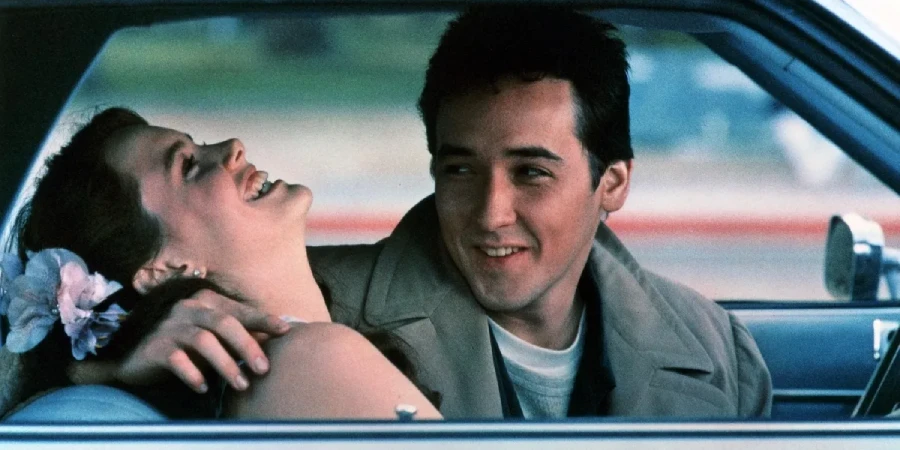

Lloyd Dobler holds a boombox over his head outside Diane Court’s window, and that single image has probably done more damage to real-world romantic expectations than any other frame in 1980s cinema. Cameron Crowe’s 1989 debut feature is smarter than that image suggests, though.
It earns the sentiment by spending most of its runtime showing two young people actually talking to each other, which turns out to be a radical act for a teen romance film.
Detailed Summary
Lloyd Dobler Asks Out the Valedictorian
Lloyd Dobler, a good-natured kickboxer with no clear career plan, decides after high school graduation that he wants to date Diane Court, the class valedictorian headed to a prestigious fellowship in England. His friends think he is reaching. His sister Constance thinks he is reaching. Lloyd does not care.
He calls Diane and asks her out with disarming directness. She says yes, mostly out of curiosity. Their first date stretches on for hours, and both of them seem genuinely surprised by how well it goes.
The Relationship Builds
Lloyd and Diane fall into a real, warm relationship. He picks up broken glass at a party so strangers do not cut their feet. She notices. Small gestures like that do more work in this script than any grand declaration.
Diane’s father James Court, played by John Mahoney, watches the relationship with polite unease. He has devoted his entire life to Diane’s future and views Lloyd as a distraction. His disapproval is gentle but firm.
Diane’s Father and the IRS Investigation
A subplot runs parallel to the romance: James runs an assisted-living facility, and federal investigators begin scrutinizing his finances. The audience gets scattered hints that something is wrong. James seems stressed, secretive, and evasive when Diane asks questions.
His relationship with Diane is genuinely loving, which makes what comes next hit harder. He is not a cartoon villain. He is a father who made terrible choices while telling himself he was doing it all for her.
The Breakup Scene
James pressures Diane to end things with Lloyd, framing it as a matter of focus before she leaves for England. Diane, who has always deferred to her father’s judgment, complies. She meets Lloyd in a parking lot and ends the relationship, handing him a pen as a parting gift.
Lloyd’s response, sitting in Constance’s car afterward, is one of John Cusack’s best moments in the film. He does not cry or shout. He just sits there and says, quietly, that she gave him a pen. The deflation in his voice does the work of a whole monologue.
The Boombox Scene
Unable to sleep and unwilling to accept the breakup, Lloyd stands outside Diane’s window in the early morning and holds a boombox above his head, playing Peter Gabriel’s In Your Eyes. Diane watches from her window. Nothing is resolved. Lloyd just wants her to know he is still there.
Crowe shoots this with patience. There is no swelling cutaway, no dramatic confrontation. Lloyd stands in the gray morning light and holds that heavy machine up as long as he can.
James Court’s Arrest
The IRS investigation closes in. James Court has been skimming money from his elderly residents, using their funds for personal gain while maintaining a facade of care and integrity. He is arrested. Diane, who idealized her father completely, is devastated.
This revelation reframes everything. Diane built her sense of right and wrong partly on her father’s example. Learning he was corrupt does not just break her heart; it destabilizes her entire moral framework. Crowe treats this seriously rather than using it as a simple plot device.
Diane Reaches Out to Lloyd
After her father’s arrest, Diane reaches out to Lloyd. He has been nursing the breakup by driving around and listening to sad music, but he agrees to see her. They reconcile. Lloyd decides to go with her to England.
His certainty is not naive. He has processed the rejection, sat with the pain, and chosen her anyway. That choice lands differently because we watched him hurt.

Movie Ending
Lloyd and Diane board a plane to England together. Diane is visibly anxious, scared about what her life looks like now without her father’s steady hand guiding every decision. Lloyd holds her hand and makes a small, practical promise: when the seatbelt sign turns off, it means they are safe and everything will be okay.
They wait. The camera holds on both of them in their seats. Diane stares at the seatbelt sign, and Lloyd watches her face. Then the ding sounds. Crowe cuts to black before we see their reactions.
That cut to black is a deliberate refusal to offer easy comfort. We do not get to see them smile or exhale or look at each other with relief. Crowe trusts the audience to sit in the same suspended uncertainty that Diane feels. The film commits to the idea that love is not a resolution; it is a willingness to keep showing up while the seatbelt sign is still on.
What makes the ending work is that it does not pretend the problems are solved. James is still facing federal charges. England is still uncertain territory. Lloyd still has no plan. Diane still has to rebuild her understanding of the man she trusted most. The plane takes off anyway. That is the whole argument of the film.
Are There Post-Credits Scenes?
Say Anything has no post-credits scenes. Crowe ends on the cut to black after the seatbelt chime, and that is exactly where the film should end. Sitting through the credits expecting more would miss the point of the ending entirely.
Type of Movie
Say Anything is a romantic drama with strong elements of coming-of-age storytelling. It carries the surface markers of a teen romance but operates at the emotional register of a much more serious film.
Its tone is warm without being saccharine, grounded without being dour. Crowe keeps genuine humor alive throughout, mostly through Lloyd’s self-aware rambling, but never lets it undercut the real stakes the characters face.
Cast
- John Cusack – Lloyd Dobler
- Ione Skye – Diane Court
- John Mahoney – James Court
- Lili Taylor – Corinne
- Amy Brooks – D.C.
- Pamela Segall – Rebecca
- Joan Cusack – Constance
- Jeremy Piven – Mark
- Eric Stoltz – Vahlere
- Loren Dean – Joe
Film Music and Composer
The score was composed by Anne Dudley, a member of the British group Art of Noise. Her work here is understated and supportive, never pushing emotions the scenes have not already earned. It is one of the more underrated elements of the film.
Peter Gabriel’s In Your Eyes is the film’s most famous piece of music, used during the boombox scene. Gabriel did not write it for the film; Crowe licensed an existing track. That choice turned out to be one of the most consequential music decisions in 1980s cinema, embedding the song permanently into pop culture memory.
Lili Taylor’s character Corinne writes and performs multiple songs about her ex-boyfriend Joe throughout the film. Taylor performed these songs herself, and they function as both comic relief and a surprisingly honest portrait of how young people process heartbreak through art.
Filming Locations
Say Anything was filmed primarily in and around Seattle, Washington. Crowe, a Seattle native, chose the city deliberately. The gray skies, the quiet suburbs, and the low-key Pacific Northwest atmosphere give the film a texture that a sunnier city would have ruined.
Seattle’s overcast palette matches the film’s emotional register. Nothing is glamorized. Lloyd’s world looks like the world most teenagers actually live in, not a Hollywood fantasy of teenage life.
Key scenes were filmed at actual high schools and residential neighborhoods in the Seattle area. That commitment to real locations grounds even the most romantic moments in a recognizable reality.
Awards and Nominations
Say Anything did not receive major awards attention during its initial release cycle, which remains a genuine critical injustice. John Cusack’s performance in particular deserved far more formal recognition than it received.
Behind the Scenes Insights
- Cameron Crowe wrote the screenplay based partly on his own experiences and observations of young people navigating love and uncertainty after high school.
- John Cusack and Joan Cusack, who play siblings in the film, are real-life siblings. Their ease and comfort on screen is not manufactured.
- Crowe pushed for John Cusack specifically for the role of Lloyd, having worked with him previously on The Sure Thing. The casting choice shaped the entire tone of the film.
- Ione Skye was relatively inexperienced at the time of filming, but Crowe worked closely with her to draw out Diane’s internal conflict in understated ways rather than big dramatic moments.
- The boombox scene was storyboarded carefully. Crowe wanted the shot to feel still and slightly absurd rather than conventionally romantic, which is why the camera does not move dramatically during it.
- Lili Taylor improvised and wrote some of the Joe songs herself, bringing genuine comedic and emotional authenticity to what could have been a throwaway subplot.
Inspirations and References
Crowe drew on his journalism background and his years writing for Rolling Stone magazine, where he developed a keen ear for how real people talk. Lloyd Dobler’s famous rambling speech about what he does not want to do with his life feels like something Crowe actually heard someone say.
The film connects to a broader tradition of 1980s coming-of-age stories, but Crowe was reacting against the glossy, wish-fulfillment version of that genre. His reference points were more literary than cinematic: honest portraits of young adults who are not yet sure who they are or what they want.
Alternate Endings and Deleted Scenes
No widely documented alternate endings for Say Anything exist in the public record. Crowe has spoken about the film in interviews over the years, but no significant alternate cut or major deleted scenes have entered public knowledge in a verifiable way.
The ending as released feels so precisely calibrated that imagining a different version is genuinely difficult. Cutting to black on the seatbelt chime is not an obvious choice; it is an earned one.
Book Adaptations and Differences
Say Anything is not based on a book, a play, or any previously existing source material. Cameron Crowe wrote the original screenplay directly for the screen. No comparison to a source text applies here.


Memorable Scenes and Quotes
Key Scenes
- The boombox scene: Lloyd stands motionless in the gray morning outside Diane’s window, arms raised, holding the boombox high while In Your Eyes plays. No words. No response shown. Just the image.
- The breakup in the parking lot: Diane hands Lloyd a pen as a goodbye gift. His quiet, devastated repetition of “she gave me a pen” in the car afterward is more affecting than any shouted argument would have been.
- Lloyd’s “I don’t want to sell anything” speech: Asked about his future plans at a dinner party, Lloyd lists everything he does not want to do before landing on wanting to be with Diane. It is funny and embarrassing and completely sincere.
- James Court’s confession to Diane: John Mahoney sits across from his daughter and tries to explain choices that have no good explanation. His face does enormous work in this scene.
- The glass-picking scene at the party: Lloyd kneels and picks up broken glass so barefoot partygoers will not get hurt. Diane watches him from across the lot. No dialogue. It tells you everything you need to know about who Lloyd is.
Iconic Quotes
- “I don’t want to sell anything, buy anything, or process anything as a career.” (Lloyd)
- “She gave me a pen. I gave her my heart and she gave me a pen.” (Lloyd)
- “I am looking for a dare to be great situation.” (Lloyd)
- “You must chill. You must chill.” (Lloyd)
- “Nobody thinks it will work, do they? … You just described every great success story.” (Lloyd and Diane)
Easter Eggs and Hidden Details
- The broken glass Lloyd picks up at the party is from a Jim Beam bottle, a small period-accurate detail Crowe included without calling attention to it.
- Corinne’s relentless songs about Joe accumulate throughout the film as a background joke, but if you count them, there are more than most viewers realize on a first watch.
- Lloyd wears a trenchcoat for most of the film. Crowe has noted that the coat was a character choice meant to signal Lloyd as someone slightly outside the social norms of his peer group without making him look like an outcast.
- The kick-boxing gym scenes are sparse and unglamorous by design. Crowe wanted Lloyd’s hobby to look like something a real teenager in a real suburb would actually do, not a movie version of martial arts.
Trivia
- Say Anything was Cameron Crowe’s directorial debut.
- John Cusack and Joan Cusack had worked together on screen before this film, but their dynamic as siblings here is widely considered their best on-screen pairing.
- Peter Gabriel’s In Your Eyes had been released in 1986 on the album So before Crowe chose it for the film. Its association with the boombox scene permanently altered how most listeners hear the song.
- Jeremy Piven, who plays Lloyd’s friend Mark, was a close friend of John Cusack’s in real life, having trained together at a Chicago theater company. Their on-screen comfort is genuine.
- Lili Taylor’s Corinne is a fan favorite despite being a supporting character. Taylor brought enough specificity to the role that Corinne became a fully realized person rather than comic relief background noise.
- The film’s title comes from a moment where Lloyd’s philosophy about honesty and openness in communication is distilled: the idea of being willing to say anything and mean it.
- Crowe shot the film in sequence as much as the production schedule allowed, which he believed helped the actors feel the relationship develop naturally rather than piecing it together in an editing room.
Why Watch?
John Cusack builds Lloyd Dobler through accumulation of small physical choices: the way he tilts his head when he listens, the slight pause before he says something he actually means. Watching him work opposite John Mahoney, who brings genuine weight to a role that could have been a stock obstacle, you realize you are watching two actors who care deeply about the same scene for different reasons. That tension is worth your time.
Director’s Other Movies
- Singles (1992)
- Jerry Maguire (1996)
- Almost Famous (2000)
- Vanilla Sky (2001)
- Elizabethtown (2005)
- We Bought a Zoo (2011)
Recommended Films for Fans
- Sixteen Candles (1984)
- The Breakfast Club (1985)
- Some Kind of Wonderful (1987)
- Almost Famous (2000)
- Before Sunrise (1995)
- Flirting (1991)
- Reality Bites (1994)