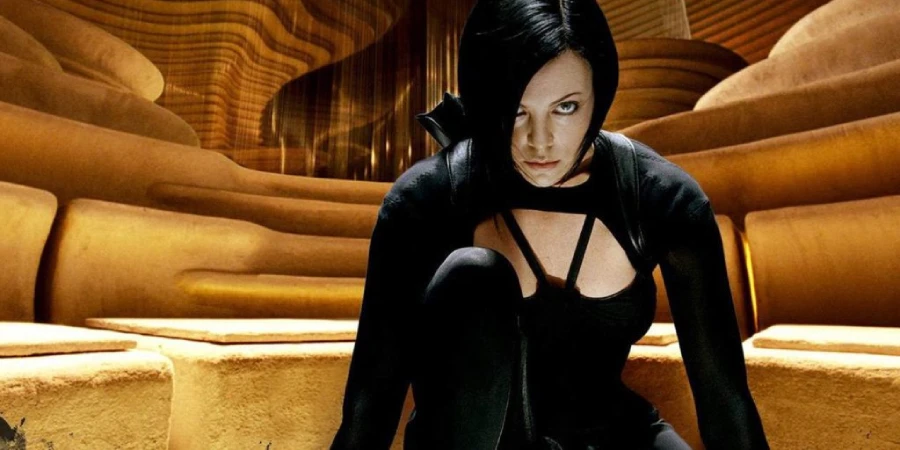

Charlize Theron in a skin-tight bodysuit, leaping across a dystopian cityscape while humanity’s darkest secret hides in plain sight: Aeon Flux (2005) promised a bold, cerebral sci-fi thriller and delivered something far more complicated. Based on Peter Chung’s boundary-pushing animated series, the film tackles cloning, genetic memory, and manufactured consent within a sleek, visually arresting package. However, beneath the acrobatic action sequences lies a genuinely provocative story about identity and survival that most viewers never gave it credit for.
Detailed Summary
A Perfect City With a Hidden Cost
Four hundred years in the future, a deadly virus has wiped out most of humanity. Bregna, a gleaming walled city, houses the last survivors under the iron governance of the Goodchild regime.
On the surface, Bregna looks utopian. Citizens live in comfort, order reigns, and the Goodchild family has maintained power for generations. However, people keep disappearing without explanation, and a resistance movement known as the Monicans operates in secret.
Aeon Flux, Agent of the Monicans
Aeon Flux is one of the Monicans’ deadliest operatives. She receives missions through a handler known as the Handler, who delivers orders via a strange sensory transmission.
Aeon is lethal, precise, and utterly committed to bringing down the Goodchild government. In addition, she carries personal grief: her sister Una was recently “disappeared” by the regime’s forces, which sharpens her motivation to a razor edge.
The Mission to Kill Trevor Goodchild
Monican leadership assigns Aeon a mission to assassinate Trevor Goodchild (Marton Csokas), the ruling chairman and chief scientist of Bregna. Aeon accepts without hesitation.
She infiltrates the heavily fortified government compound with extraordinary skill. Meanwhile, her fellow operative Sithandra, who has surgically replaced her feet with a second pair of hands, provides backup throughout the mission.
A Moment of Hesitation Changes Everything
Aeon corners Trevor and raises her weapon. For a brief but critical moment, something stops her: a powerful, inexplicable feeling of recognition and connection to this man she is supposed to kill.
She spares him. Consequently, Aeon becomes a liability to the Monicans, who turn on her and mark her for termination alongside Trevor.
The Truth Behind Bregna’s Population
Aeon and Trevor form a fragile, charged alliance. He reveals the secret that the Goodchild regime has kept buried for centuries.
After the virus destroyed humanity’s reproductive capability, Trevor’s ancestor Goodchild the First developed a cloning program to repopulate the species. Every citizen of Bregna has been cloned and reborn repeatedly across generations. As a result, the city’s population is essentially immortal in a cyclical sense, though none of them consciously know it.
The Memory in the Grass
Trevor’s science team has been quietly working to restore natural human reproduction. He explains that fragmentary genetic memories sometimes bleed through into new clone generations, manifesting as dreams or unexplained emotional connections.
Aeon’s feeling of recognition toward Trevor is one such bleed-through. In a previous cycle, she and Trevor were deeply bonded, which explains why she could not pull the trigger.
Sithandra’s Betrayal and the Keeper
Sithandra, Aeon’s closest ally, reveals herself as a traitor working within a faction that wants the cloning program destroyed entirely, even if it means the extinction of humanity. This faction believes that manufactured existence is not worth preserving.
Meanwhile, a mysterious figure known as the Keeper, who maintains the cloning apparatus deep beneath Bregna, guards the knowledge of humanity’s true situation. Aeon and Trevor seek him out to understand how to break the cycle without killing everyone.
Exposing the Council
Bregna’s real power structure becomes clearer as the story progresses. A council of handlers, operating above even the nominal leadership, has been manipulating both the resistance and the regime to maintain their own control.
Aeon confronts this council directly. She realizes that the Monicans themselves were never truly free agents; the council used them as controlled opposition to keep citizens afraid and compliant.

Movie Ending
Aeon fights her way to the Relical, the device that controls the cloning cycle and suppresses human reproductive function. Trevor has been working to complete a genetic cure that would restore natural reproduction to Bregna’s citizens, finally freeing humanity from its manufactured loop.
Sithandra attempts to destroy everything, preferring oblivion to continuation. Aeon defeats her in a brutal, personal fight that carries the full weight of their former friendship. For instance, the fight feels less like an action sequence and more like a grief-stricken reckoning.
Trevor activates the cure. Bregna’s citizens, for the first time in four centuries, gain the ability to reproduce naturally. The cloning apparatus goes dark permanently.
In the final moments, Aeon and Trevor stand in the Una Garden, a space named after Aeon’s sister and now a symbol of natural life returning. Seeds fall. Real growth begins. The film closes on this image of fragile, earned hope rather than triumphant spectacle.
What resonates most is what the ending refuses to explain away: the clones are real people with real lives, real bonds, and real grief, regardless of how they came into being. Trevor’s choice to restore natural reproduction is not just scientific, it is a moral statement about autonomy and humanity’s right to exist outside of manufactured control.
Are There Post-Credits Scenes?
Aeon Flux contains no post-credits scenes. Once the credits roll, there is nothing additional waiting for the audience. You can leave the theater (or stop the stream) without missing anything.
Type of Movie
Aeon Flux sits firmly in science fiction action territory, with strong threads of dystopian thriller running through its core. Its tone balances stylized, kinetic action with genuinely philosophical questions about identity, memory, and consent.
In contrast to pure action blockbusters, the film slows down regularly to let its ideas breathe. Admittedly, the pacing sometimes suffers for it, but the tonal ambition distinguishes it from typical early-2000s action fare.
Cast
- Charlize Theron – Aeon Flux
- Marton Csokas – Trevor Goodchild
- Sophie Okonedo – Sithandra
- Johnny Lee Miller – Oren Goodchild
- Frances McDormand – The Handler (referred to as the Keeper’s associate in some materials)
- Pete Postlethwaite – The Keeper
- Amelia Warner – Una Flux
Film Music and Composer
Graeme Revell composed the score for Aeon Flux. Revell, known for his electronic and industrial-influenced work, brought a cold, pulsing soundscape perfectly suited to Bregna’s sterile aesthetic.
His score leans heavily on synthesized textures layered over orchestral elements, creating a sound that feels simultaneously futuristic and melancholic. Furthermore, the music reinforces the film’s central tension between clinical control and suppressed human emotion.


Filming Locations
Production primarily took place in Berlin, Germany, with significant use of the city’s modernist and Brutalist architecture. Locations including the Olympic Stadium complex and various government-era buildings provided Bregna’s imposing, authoritarian visual language without requiring extensive set construction.
Berlin carries its own loaded history of divided spaces and ideological control, which adds an unspoken layer of meaning to every scene set within Bregna’s walls. Moreover, the lush surrounding greenery of Berlin’s parks contrasted beautifully with the cold structures, emphasizing the film’s theme of natural life straining against artificial order.
Some sequences also filmed in other parts of Germany. Overall, the practical locations gave the film a grounded, weighty look that purely studio-built sets would have struggled to achieve.
Awards and Nominations
Aeon Flux did not receive recognition from major awards bodies. It earned Razzie nominations, which reflected the critical community’s general dismissal of the film rather than any honest engagement with its more ambitious qualities.
Behind the Scenes Insights
- Charlize Theron trained extensively for the physically demanding role, working with choreographers to develop Aeon’s distinctively fluid, almost inhuman movement style.
- Theron suffered a serious neck injury during production when a stunt went wrong, requiring a period of recovery and briefly threatening to shut down filming entirely.
- Director Karyn Kusama pushed for a more cerebral, character-focused adaptation of the source material, seeking to honor the animated series’ philosophical complexity rather than simply replicating its aesthetic.
- Kusama has spoken about conflicts with the studio over the film’s tone and final cut, suggesting that the theatrical release did not fully represent her original vision.
- Sophie Okonedo underwent surgery within the film’s narrative logic (Sithandra’s hand-feet), a concept that required significant prosthetic and visual effects work to sell convincingly on screen.
- Creator Peter Chung expressed reservations about the film’s adaptation choices, feeling it did not capture the moral ambiguity central to his original animated series.
Inspirations and References
Aeon Flux draws directly from Peter Chung’s animated series of the same name, which aired on MTV’s Liquid Television and later as a standalone series in the mid-1990s. Chung’s work was itself influenced by a wide range of philosophical and aesthetic sources, including Cold War politics and post-structuralist ideas about power and identity.
The film’s cloning mythology echoes broader science fiction traditions surrounding manufactured humanity, with clear thematic resonance with works like Brave New World by Aldous Huxley. In addition, the visual design of Bregna owes a debt to modernist architectural utopias and the authoritarian aesthetics explored in films like THX 1138.
Alternate Endings and Deleted Scenes
Specific details about official deleted scenes and alternate endings for Aeon Flux are not extensively documented in widely available production records. Karyn Kusama’s reported conflicts with Paramount suggest that material was cut or altered during post-production.
However, no confirmed alternate ending has entered public record in precise enough detail to describe accurately here. Given Kusama’s stated frustrations with the final cut, it is reasonable to expect that a director’s cut would represent a meaningfully different film.
Book Adaptations and Differences
Aeon Flux is not based on a book. It adapts Peter Chung’s animated television series, which itself was never a literary property. A novelization of the film was released alongside its theatrical run, but the film is the original adaptation source.


Memorable Scenes and Quotes
Key Scenes
- Aeon infiltrating the Goodchild compound using parkour-style movement across razor-sharp grass blades, each of which hides a lethal biological defense mechanism.
- Aeon raising her weapon at Trevor and then lowering it, unable to explain her own hesitation, which serves as the film’s central pivot point.
- Sithandra demonstrating her hand-feet to Aeon, a quiet scene that underscores how far Monican operatives push their bodies in service of the resistance.
- Trevor explaining the cloning program to Aeon in a scene that reframes every prior moment in the film as something far more tragic than it first appeared.
- The final confrontation between Aeon and Sithandra, charged with betrayal and a shared history that makes every blow feel weighted.
- Aeon standing in the Una Garden as seeds fall, the film’s closing image of genuine renewal.
Iconic Quotes
- “We are the threat they deserve.”
- “I don’t want to be remembered. I want to be here.”
- “Everything in this city is a weapon.”
Easter Eggs and Hidden Details
- Bregna’s botanical gardens contain plant species visually designed to mirror the city’s surveillance mechanisms, blurring the line between nature and control in the film’s visual language.
- Aeon’s movement style during infiltration sequences subtly mirrors specific poses and motion patterns from Peter Chung’s original animation, a nod to longtime fans of the series.
- The naming of the Una Garden at the film’s close connects Aeon’s personal grief directly to humanity’s broader rebirth, giving the location a layered symbolic meaning beyond a simple tribute to her sister.
- Bregna’s color palette shifts gradually across the film: cold blues and whites dominate early scenes, while warmer, greener tones creep in as Trevor’s cure nears completion, visually tracking humanity’s return to natural life.
- The Keeper’s underground chamber contains visual references to archival scientific equipment, suggesting that someone has always known the truth and maintained it in careful isolation for centuries.
Trivia
- Peter Chung’s original animated series featured an Aeon Flux who frequently died at the end of episodes, a radical creative choice that the film could not replicate in a conventional feature narrative.
- Charlize Theron was already an Academy Award winner (for Monster, 2003) when she took on this role, making her one of the more decorated actors to anchor a major action-franchise attempt of this era.
- The film’s production budget was reported at approximately 62 million dollars, which was a significant investment given the relatively niche recognition of the source material outside animation enthusiasts.
- Karyn Kusama was one of relatively few women directing large-scale studio action films at the time of production, a fact that went largely unremarked upon in the film’s contemporary coverage.
- Sophie Okonedo received an Academy Award nomination for Hotel Rwanda (2004) in the same period she filmed Aeon Flux, making her one of the film’s most critically respected supporting players.
- Frances McDormand, a two-time Oscar winner, took the role of the Handler in what represented an unusually genre-oriented choice within her filmography.
Why Watch?
Aeon Flux rewards viewers willing to look past its mixed reputation and engage with its genuinely ambitious ideas about identity, memory, and manufactured consent. Charlize Theron commits completely to a physically and emotionally demanding performance. Furthermore, the film’s dystopian world-building holds up as one of the more visually inventive of its decade.
Director’s Other Movies
- Girlfight (2000)
- Jennifer’s Body (2009)
- The Invitation (2015)
- Destroyer (2018)