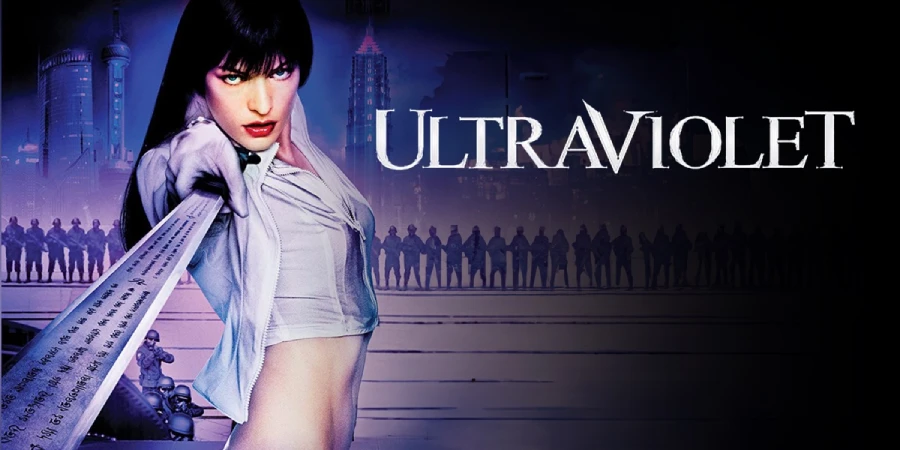

Ultraviolet is a film that somehow managed to look stunning and feel hollow at the same time, a feat that is genuinely difficult to pull off. Released in 2006 and directed by Kurt Wimmer, it follows a super-soldier infected with a vampire-like disease who blows up half a city to protect a child. Critics savaged it. Audiences largely ignored it. Yet it remains a fascinating artifact of mid-2000s sci-fi excess, worth dissecting in full.
Detailed Summary
The World of the Hemophages
In a near-future city, a government-engineered pathogen has created a sub-species of humans called Hemophages. These individuals develop superhuman strength, speed, and reflexes, but they carry a fatal disease that will eventually kill them. Society fears and persecutes them, treating them as second-class citizens marked for extermination.
Violet Song jat Shariff, played by Milla Jovovich, is a Hemophage operative who works as a courier and soldier for the underground resistance. She lost her unborn child after her husband infected her, and the government had her baby forcibly aborted. This backstory fuels her rage and informs every violent decision she makes for the rest of the film.
The Package and the Child
Violet accepts a mission to retrieve a biological weapon from the government. On the other hand, when she opens the case, she does not find a weapon. She finds a child, a young boy named Six, played by Cameron Bright.
Six carries an antigen in his blood that the government believes can destroy all Hemophages. Violet refuses to hand him over for termination and goes rogue. She decides to protect him, driven partly by her grief over the child she lost.
Violet Versus Everyone
From this point forward, the film accelerates into a near-constant action sequence. Violet fights government soldiers, her former allies, and the agents of Vice Cardinal Ferdinand Daxus, the chief antagonist played by Nick Chinlund. Daxus engineered the Hemophage virus himself and has been running a secret extermination program.
Violet seeks help from Garth, a Hemophage scientist played by William Fichtner. He analyzes Six and makes a disturbing discovery: Six does not actually carry an antigen. Instead, his body hosts a fast-acting pathogen designed to kill all Hemophages on contact, making him a living biological bomb.
The Resistance Turns Against Her
Violet’s own people want Six dead. Their logic is ruthless but understandable: the boy is a weapon, and eliminating him protects their entire population. Violet refuses to accept this and goes fully independent, fighting on two fronts simultaneously.
Meanwhile, Six has begun to bond with Violet in a way that mirrors the mother-child relationship she never got to experience. He is passive, quiet, and trusting, which makes Violet’s ferocious protectiveness feel earned rather than arbitrary.
Daxus Revealed as the True Monster
Garth reveals that Daxus did not just create the virus accidentally. He created it deliberately, then positioned himself as the enforcer of the resulting crisis. Moreover, Daxus is himself a Hemophage, which he has hidden through suppressants. His entire campaign of persecution is a cover for his own self-hatred and his desire to control both populations.
This revelation reframes the entire film as a story about institutional hypocrisy. Daxus profits from the disease he created. He eliminates Hemophages while secretly being one himself, a dynamic that gives the villain at least some conceptual weight.
Movie Ending
Violet delivers Six to Daxus after a brutal confrontation in which she appears to run out of options. Daxus, believing he has won, activates the pathogen in Six’s body. Consequently, Six dies, and Violet collapses, exposed to the same lethal agent.
Here is where the film pivots sharply. Garth had secretly administered a cure to Six before his death, altering the pathogen in his blood. As a result, the agent that killed Six also carried the cure for the Hemophage virus, meaning Violet and all surviving Hemophages are now free of their fatal disease.
Violet confronts Daxus in a final sword duel atop a futuristic skyscraper. She kills him, avenging Six, the resistance, and herself. Her own death, which had appeared imminent throughout the film due to advanced disease progression, is now reversed by the cure she absorbed.
Violet survives. She visits Six’s grave and mourns him as the child she was never allowed to have. This ending tries hard to be emotionally resonant, and in isolated moments, it almost lands. Specifically, Jovovich’s physicality and commitment sell the grief even when the script underserves it.
Audiences were largely confused by the logic of the cure-via-pathogen twist, since the film does not establish this possibility clearly beforehand. In contrast to most action finales of this era, the conclusion here prioritizes emotional closure over explosive spectacle, which is an unusual and somewhat admirable choice given the film’s tone throughout.
Are There Post-Credits Scenes?
Ultraviolet contains no post-credits scenes. Once the credits roll, the film is entirely finished. You can leave the theater, or stop the disc, without missing anything additional.
Type of Movie
Ultraviolet sits firmly in the science fiction action genre, with heavy stylistic borrowing from cyberpunk aesthetics. Its tone is relentlessly kinetic and visually hyperactive, prioritizing style over narrative coherence at almost every turn.
In addition, the film carries thin threads of dystopian drama beneath its surface, gesturing toward themes of bioethical persecution and state-sponsored violence. However, it never commits to these themes deeply enough to qualify as serious speculative fiction.
Cast
- Milla Jovovich – Violet Song jat Shariff
- Cameron Bright – Six
- Nick Chinlund – Vice Cardinal Ferdinand Daxus
- William Fichtner – Garth
- Sebastien Andrieu – Nerva
Film Music and Composer
The score for Ultraviolet was composed by Klaus Badelt, a German composer best known for his work on Pirates of the Caribbean: The Curse of the Black Pearl. His score here leans heavily on electronic textures and propulsive rhythmic percussion, matching the film’s relentless visual energy.
Badelt’s music functions largely as a delivery mechanism for momentum rather than emotional depth. It does its job without ever threatening to become memorable on its own terms.


Filming Locations
Ultraviolet was primarily filmed in Shanghai, China, which provided the futuristic urban architecture that forms the backbone of the film’s visual identity. Shanghai’s blend of ultra-modern skyscrapers and dense cityscapes gave the production a genuinely otherworldly backdrop without requiring entirely constructed sets.
Notably, many of these locations were then heavily augmented with digital post-processing, which sometimes made the real architecture look less convincing than it actually was. The heavy color grading and digital manipulation gave the film a washed-out, hyper-saturated palette that divided audiences sharply.
Awards and Nominations
Ultraviolet received no significant awards recognition and was not nominated for any major industry awards. Critics and industry bodies largely passed over it entirely upon its 2006 release.
Behind the Scenes Insights
- Director Kurt Wimmer reportedly had significant conflicts with the studio over the final cut of the film. Screen Gems took control of the editing and substantially shortened Wimmer’s original version.
- Wimmer’s preferred cut was reportedly around 30 minutes longer than the theatrical release, which runs approximately 88 minutes.
- Milla Jovovich performed a considerable amount of her own stunt work, continuing the physically demanding approach she had established on the Resident Evil franchise.
- Jovovich later expressed dissatisfaction with the final product, suggesting the studio’s cut did not represent the film she and Wimmer intended to make.
- The film’s striking color palette involved extreme post-production digital grading, which some crew members felt went further than originally planned during principal photography.
Inspirations and References
Wimmer drew openly from Japanese anime, particularly works defined by high-velocity action, hyper-stylized female warriors, and near-future dystopian settings. The visual language of the film owes a clear debt to titles popular in the early 2000s anime boom in Western markets.
Furthermore, the film’s Hemophage concept loosely parallels real-world fears about engineered pandemics and the social marginalization of disease carriers, reflecting anxieties present in early 2000s public discourse. Wimmer’s previous film Equilibrium similarly drew from dystopian literary traditions, and Ultraviolet continues that preoccupation with state-controlled populations.
Visually, the film references Hong Kong action cinema, particularly the fluid, choreography-first fight sequences associated with directors like John Woo and Tsui Hark. Wimmer had incorporated similar influences into Equilibrium with the fictional Gun Kata martial art.
Alternate Endings and Deleted Scenes
Because the studio overrode Wimmer’s cut, a substantial amount of footage exists that was never officially released. Reportedly, character development scenes for both Violet and Six were among the material removed, which would have strengthened the emotional logic of their bond.
No official director’s cut has been released commercially. Wimmer has discussed the existence of his longer version in interviews, but as of now, it remains unavailable to the public. Fans of the film have long requested its release without success.
Book Adaptations and Differences
Ultraviolet is not based on a book, comic series, or any pre-existing source material. Kurt Wimmer wrote the original screenplay specifically for this production. A novelization of the film was published to coincide with the theatrical release, but the film itself came first.

Memorable Scenes and Quotes
Key Scenes
- Violet single-handedly dismantles an entire government security checkpoint in the opening act, establishing her capabilities with kinetic efficiency.
- She opens the case expecting a weapon and instead finds Six curled inside, a moment that reorients the entire film’s emotional stakes in seconds.
- Garth’s laboratory scene, where he reveals Six is not an antigen carrier but a living bomb, flips the audience’s understanding of the mission completely.
- The color-shifting costume sequences, where Violet’s outfit and hair change color in real time, became the film’s most visually iconic recurring motif.
- Violet’s final sword duel with Daxus atop the skyscraper, stripped of the large-scale carnage of earlier sequences and reduced to something almost intimate.
- Violet visiting Six’s grave in the closing moments, the film’s clearest attempt at genuine emotional weight.
Iconic Quotes
- “I was born into a world you may not understand.” – Violet, opening narration
- “There’s a line that separates the living from the dead. I live on that line.” – Violet
- “You can’t protect him. You can’t even protect yourself.” – Daxus to Violet
Easter Eggs and Hidden Details
- Several background vehicles and architectural details in the Shanghai sequences carry fictional corporate logos that reference the Hemophage suppression program, visible only if you pause and look carefully.
- Violet’s blood type designation, visible briefly on a government document early in the film, uses a fictional classification system that quietly hints at the Hemophage biological hierarchy before the film explains it explicitly.
- Wimmer embedded references to his earlier film Equilibrium in the government propaganda posters visible in crowd scenes, a reward for viewers familiar with his prior work.
- Six’s name is never fully explained in the theatrical cut, but the implication in the longer material was reportedly that he was the sixth in a series of engineered children created as living biological weapons.
Trivia
- Ultraviolet was released on March 3, 2006, and opened to significant critical hostility, with many reviews describing it as visually impressive but narratively incoherent.
- Kurt Wimmer also wrote and directed Equilibrium in 2002, and many critics positioned Ultraviolet as a lesser follow-up to that cult favorite.
- Milla Jovovich was already well established as an action star through the Resident Evil franchise when she took this role, making her casting a logical commercial choice for the studio.
- Despite its poor critical reception, the film developed a modest cult following, particularly among fans drawn to its uncompromising visual style.
- Screen Gems’ editorial intervention on the final cut is widely cited by fans as the primary explanation for the film’s disjointed narrative structure.
- The theatrical runtime of approximately 88 minutes is unusually short for a science fiction action film of this scale, which reflects how heavily the studio trimmed it.
Why Watch?
If you surrender to its spectacle and stop demanding narrative coherence, Ultraviolet delivers something genuinely singular: a film that treats action choreography as visual art, with Jovovich committing completely to every frame. It also stands as a cautionary tale about studio interference overriding a director’s vision. For fans of stylized sci-fi action, it is an essential, if flawed, artifact.
Director’s Other Movies
- Equilibrium (2002)
- Salt (2010) (screenplay)
- Total Recall (2012) (screenplay)