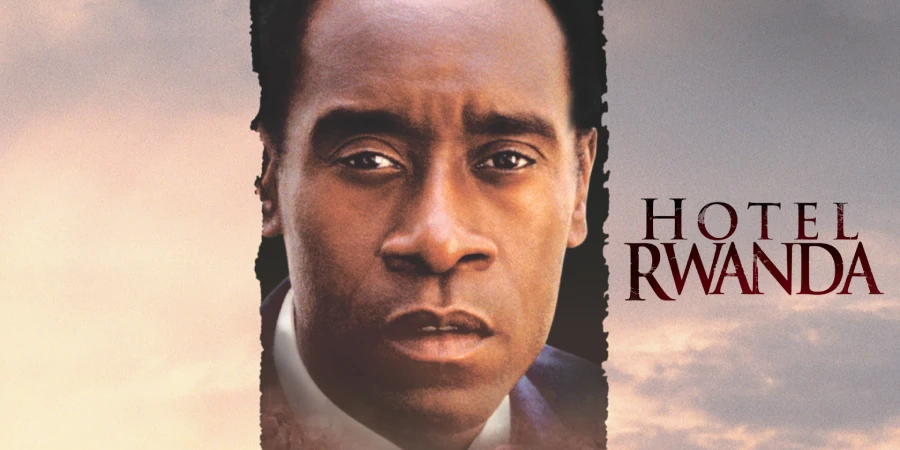
A hotel manager who just wants to keep his guests comfortable ends up saving over a thousand lives during one of the worst genocides of the twentieth century. Hotel Rwanda (2004) tells the true story of Paul Rusesabagina, a Hutu man who sheltered Tutsi refugees inside the Hotel des Mille Collines in Kigali as machetes and militia carved through the streets outside. Director Terry George refuses to let the audience look away, and Don Cheadle carries the whole weight of it on his face.
Detailed Summary
A Country on the Edge
Paul Rusesabagina manages the Hotel des Mille Collines with quiet pride. He sources fine cigars for Belgian executives, smooths over complaints, and understands that hospitality is a form of power. His Tutsi wife Tatiana, played by Sophie Okonedo, watches the political situation with growing dread while Paul reassures her that his connections will protect their family.
Hutu extremist radio already fills the airwaves with anti-Tutsi propaganda, calling Tutsis “cockroaches.” Paul dismisses it as noise. He is wrong.
April 6, 1994: Everything Breaks
When President Habyarimana’s plane is shot down, the Interahamwe militia launches its long-prepared killing campaign. Neighbors turn on neighbors. Bodies pile up on streets Paul drove through just days before. His general, General Bizimungu, a corrupt officer Paul has kept well-oiled with bribes and favors, suddenly represents his only thin thread of protection.
Paul’s neighborhood collapses overnight. He opens his home to Tutsi neighbors and eventually brings them all to the hotel, which technically operates under Belgian management and thus carries a fragile layer of international protection.
The Hotel Becomes a Refuge
Paul persuades hotel ownership, represented via fax from Belgium, to let him stay on as manager. He leverages the brand name and the illusion of Western oversight to buy survival time. Refugees flood in, sleeping on floors, in conference rooms, on stairwells.
Colonel Oliver, the UN peacekeeping commander played by Nick Nolte, tells Paul bluntly that the West will not intervene. Western nations are pulling their own citizens out and leaving Rwandans behind. That scene, where Nolte’s Oliver stares into his drink and says the world thinks Africans are not worth saving, lands like a punch and never fully leaves.
Bribery, Manipulation, and Survival
Paul works every angle available. He calls hotel suppliers, politicians, and Western business contacts, cashing in every professional favor he has accumulated over a career of careful relationship-building. He bribes Bizimungu with cash, liquor, and golf equipment. Every transaction feels like a man scraping the last coins out of a jar.
A photojournalist, Jack Daglish, played by Joaquin Phoenix, captures footage of machete killings. For one moment, Paul believes the images will force the world to act. Jack tells him quietly that people will say “how terrible” and go back to their dinner. He is right.
The Militia Arrives at the Gate
Interahamwe forces surround the hotel and directly threaten the refugees. Tension builds as militia members with machetes stand just beyond the entrance, drunk and unpredictable. Paul walks out and negotiates, stalling, flattering, and maneuvering with terrifying calm while over a thousand people wait inside.
One of the film’s most quietly devastating moments comes when Paul discovers what the morning fog outside concealed: a road covered in bodies. He nearly breaks. He goes back inside, locks himself in the bathroom, and weeps in silence. Then he straightens his tie, walks back out, and keeps managing.
Tatiana and the Children at Risk
Paul’s personal stakes sharpen when Tatiana and their children are separated from him during the chaos. A convoy of refugees is ambushed. Tatiana’s bus is turned back by militia. Paul goes nearly frantic, making calls, pulling strings, doing anything to get his family back to the hotel.
Sophie Okonedo’s performance during this stretch is consistently underrated in discussions of the film. She plays Tatiana not as a passive victim but as a woman of enormous quiet resolve, and her reunion with Paul carries genuine emotional force precisely because the film has earned it.
Movie Ending
Paul negotiates one final evacuation through a combination of bribery, desperation, and a last call to a Sabena Airlines contact in Belgium. General Bizimungu, drunk and increasingly erratic, demands money Paul no longer has. Paul threatens to expose Bizimungu’s war crimes to international courts if the general does not provide safe passage. It is an enormous gamble, and it works.
A convoy assembles. The refugees pack into buses and vehicles and begin driving toward UN-held Tutsi territory. Militia checkpoints appear on the road. Each stop feels like a potential massacre. Paul sits in the lead vehicle, motionless, watching soldiers count faces and check lists.
They make it through. The convoy reaches safety, and Paul’s family survives intact. His niece’s children, orphaned during the genocide, travel with them. Paul and Tatiana had already committed to raising those children as their own.
A title card closes the film: the genocide killed approximately 800,000 people in 100 days. Paul Rusesabagina saved 1,268 lives. The contrast between those two numbers is what the film leaves you holding. No triumphant score swells beneath it. Just the fact, sitting there.
Are There Post-Credits Scenes?
Hotel Rwanda contains no post-credits scenes. After the title cards provide context and outcome, the film ends. Stay for the credits if you want to sit with it, but nothing additional plays.
Type of Movie
Hotel Rwanda operates primarily as a historical drama with strong elements of a survival thriller. Its tension comes from real-world political machinery rather than cinematic invention.
The tone stays grounded and restrained throughout. George never tips into exploitation or sentimentality. It is a serious film for a serious subject, and it respects the audience enough not to oversimplify.
Cast
- Don Cheadle – Paul Rusesabagina
- Sophie Okonedo – Tatiana Rusesabagina
- Nick Nolte – Colonel Oliver
- Joaquin Phoenix – Jack Daglish
- Jean Reno – Sabena Airlines executive Dupont
- Desmond Dube – Dube
- Hakeem Kae-Kazim – George Rutaganda
- Tony Kgoroge – Gregoire
Film Music and Composer
Rupert Gregson-Williams composed the original score, which leans on subdued orchestral textures and sparse piano lines. It never overplays the tragedy. That restraint is a smart choice; louder scoring would have undercut the film’s refusal to sensationalize.
Rwandan-influenced musical motifs appear throughout, grounding the sound in the geography and culture of the story. The score supports rather than steers, which is exactly what a film this heavy needs.

Filming Locations
Principal photography took place in South Africa, primarily around Johannesburg and Kigali-adjacent environments recreated there. Production could not film in Rwanda itself due to a range of logistical and political complexities.
South Africa provided landscapes and architecture that could plausibly double for Kigali in 1994. The production design team worked to reconstruct the Hotel des Mille Collines faithfully, which matters because so much of the film’s claustrophobia depends on that single building feeling both safe and besieged.
Awards and Nominations
Hotel Rwanda received three Academy Award nominations: Best Actor for Don Cheadle, Best Supporting Actress for Sophie Okonedo, and Best Original Screenplay for Keir Pearson and Terry George. It won none of those Oscars, which remains one of the more baffling outcomes of the 2005 ceremony. Cheadle in particular gave one of the finest lead performances of that decade.
Okonedo won a Screen Actors Guild Award as part of the outstanding cast ensemble nomination. The film also received recognition from various critics circles and international awards bodies.
Behind the Scenes Insights
- Don Cheadle spent time with the real Paul Rusesabagina in preparation for the role, studying his speech patterns and mannerisms closely.
- Director Terry George, who co-wrote the screenplay with Keir Pearson, had previously examined ethnic conflict in Some Mother’s Son, which gave him a framework for handling politically charged true stories.
- Nick Nolte based his portrayal of Colonel Oliver partly on Canadian General Romeo Dallaire, the actual UN force commander in Rwanda, who famously pleaded for international intervention and was denied.
- Many of the refugee extras cast in the film were Rwandan survivors of the actual genocide, which brought an intensity to crowd scenes that no purely fictional casting could have replicated.
- The production faced significant pressure around how to depict the violence. George made a deliberate decision to suggest rather than show explicit gore, keeping the focus on human decisions rather than spectacle.
- Sophie Okonedo received her role after a strong audition process and was not originally the most high-profile name considered, which makes her Oscar nomination a genuine industry recognition of a performance that arrived from outside the usual spotlight.
Inspirations and References
The film draws directly from the real life of Paul Rusesabagina, who later wrote his memoir An Ordinary Man (2006). Screenwriter Keir Pearson first developed the project after researching the Rwandan genocide extensively and finding Rusesabagina’s story at its center.
General Romeo Dallaire’s own account of the genocide, Shake Hands with the Devil, provides crucial historical context that informed the film’s depiction of UN paralysis. Nick Nolte drew on that material directly.
Philip Gourevitch’s landmark journalism on Rwanda, collected in We Wish to Inform You That Tomorrow We Will Be Killed with Our Families, also shaped how the creative team understood the political mechanics of the killing.
Alternate Endings and Deleted Scenes
No widely documented alternate ending exists for Hotel Rwanda. Terry George has spoken about editing choices but has not publicized significantly different versions of the film’s conclusion.
Some scenes showing additional refugee interactions were reportedly shortened during editing to maintain pacing, but no major deleted scenes have entered public circulation or been released on home video packages in notable form.
Book Adaptations and Differences
Hotel Rwanda is not based on a single published book. It developed from original research and direct interviews. Paul Rusesabagina’s memoir An Ordinary Man actually appeared after the film, partly inspired by the attention the movie generated.
The film compresses and dramatizes certain events. Some figures are composites. Colonel Oliver draws on General Dallaire but is not a direct one-to-one portrayal. Jack Daglish does not correspond to a single identified real journalist.
Memorable Scenes and Quotes
Key Scenes
- Paul discovers the road of bodies through his windshield in the fog, the camera staying on his face as comprehension arrives slowly and completely.
- Colonel Oliver tells Paul that the West considers Africans less than human, and Nolte delivers the line with slumped-shoulder defeat rather than anger, which makes it worse.
- Paul walks out to negotiate with militia at the gate, his hands clasped behind his back, his voice carefully level, his eyes doing all the work that his body refuses to show.
- The bathroom scene: Paul locks the door, slides down the wall, and cries alone. Cheadle does not overplay this. He gives it thirty seconds and then puts the mask back on.
- The final convoy crawling through militia checkpoints, each soldier’s face at the window representing a coin flip between life and death.
Iconic Quotes
- “I think if people see this footage, they’ll say ‘Oh my God, that’s horrible,’ and then go on eating their dinners.” (Jack Daglish, on his own footage)
- “We are not Rwandans. We are Hutu and Tutsi.”
- “You’re black. You’re not even a nigger. You’re an African.” (Colonel Oliver to Paul, explaining Western indifference)
- “I am not a politician or a military man. I am a hotel manager.” (Paul Rusesabagina)
Easter Eggs and Hidden Details
- The Belgian flag visible near the hotel entrance throughout the film is a deliberate visual reminder of colonial history and the roots of the Hutu-Tutsi divide that Belgian administration helped entrench.
- Gregoire, Paul’s treacherous employee who reports refugee names to the militia, is shown early in the film receiving small favors and special treatment from Paul, which makes his later betrayal a quiet commentary on loyalty under pressure.
- Radio Mille Collines, the extremist station broadcasting kill orders, shares part of its name with the Hotel Mille Collines where refugees shelter. That irony is real, not invented for the film.
- Paul’s suits stay pristine for most of the film as a visual indicator of control. When he finally appears disheveled, the audience understands his psychological state without a word.
- The Western executives’ rapid departure from the hotel early in the crisis is played in a single brief scene, but their luggage takes up more screen space than their faces, which is a pointed visual editorial.
Trivia
- Don Cheadle was not the first actor approached for the role of Paul Rusesabagina. Various casting considerations shifted before Cheadle committed, and his performance subsequently made the role definitive.
- The real Paul Rusesabagina was initially supportive of the film. His relationship with its legacy became considerably more complicated in later years, particularly after his 2021 terrorism conviction in Rwanda, a verdict that drew sharp international debate.
- Terry George co-wrote the screenplay with Keir Pearson, who first brought the project to him. Pearson had been working on the story for years before the collaboration.
- General Romeo Dallaire publicly praised the film for bringing attention to what he witnessed in Rwanda, even though Colonel Oliver is a fictionalized version of events rather than a direct portrait.
- The film carries a rating of PG-13, which surprised some critics given its subject matter. George’s decision to suggest violence rather than depict it explicitly shaped both the film’s tone and its accessibility to younger audiences.
- Production designer Johnny Breedt recreated the Hotel des Mille Collines from photographs and architectural plans since filming at the actual location was not feasible.
Why Watch?
Watch it for Don Cheadle’s performance in that bathroom scene, thirty seconds of a man falling apart and then reassembling himself purely through professional reflex. No speech, no score, just a tie being straightened. That single moment does more to explain how ordinary people endure the unimaginable than most films manage in two hours.
Director’s Other Movies
- Some Mother’s Son (1996)
- In the Name of the Father (1993) – co-writer
- Reservation Road (2007)
Recommended Films for Fans
- Schindler’s List (1993)
- Sometimes in April (2005)
- Shooting Dogs (2005)
- The Killing Fields (1984)
- Shake Hands with the Devil (2007)
- The Pianist (2002)
- Blood Diamond (2006)
- Sound of Freedom (2023)
- Cry Freedom (1987)
- The Good Lie (2014)
- Tears of the Sun (2003)
- Beasts of No Nation (2015)