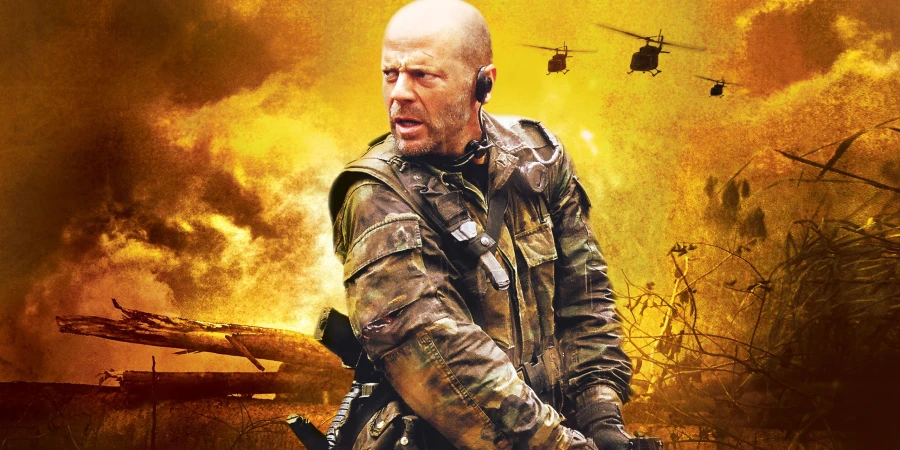

Antoine Fuqua’s 2003 war film drops you into a Nigerian jungle and refuses to let you breathe for nearly two hours. Bruce Willis plays a Navy SEAL lieutenant who disobeys direct orders to save a group of African refugees from a genocidal militia, and the film earns every ounce of its moral weight through sheer, grinding physicality.
Rain-soaked mud, long rifle shots through dense canopy, and a final sprint toward a Cameroonian border that feels genuinely punishing: this is a film that commits to its premise without flinching. It is not a perfect movie, but it is a serious one, and that seriousness sets it apart from most action films released in its era.
Detailed Summary
The Mission Briefing: Extract One, Leave the Rest
Lieutenant A.K. Waters (Bruce Willis) leads a unit of Navy SEALs called Task Force Alpha. His orders are narrow and cold: extract Dr. Lena Fiore Kendricks, an American citizen and doctor working at a Catholic mission in Nigeria, before rebel forces under General Yakubu overrun the region.
Waters is presented immediately as a man who compartmentalizes feeling. He stares at briefing maps with a flat affect. His commanding officer makes the mission’s limitations crystal clear: Waters extracts Kendricks, and only Kendricks. Everyone else at the mission stays behind.
Arrival at the Mission: A World About to Be Destroyed
When Waters and his team arrive, the mission is full of life. Wounded civilians fill cots. Nuns tend patients. Dr. Kendricks (Monica Bellucci) moves through it all with urgent purpose, her white coat already stained with the work she refuses to stop doing.
Waters delivers the evacuation order. Kendricks refuses to leave without her patients and the villagers sheltering there. Waters insists. His team watches the exchange and says nothing, but their body language does the arguing for them.
Extraction and the First Moral Pivot
Waters forcibly removes Kendricks and begins the march to the extraction helicopter. She pleads. She argues. She tells him these people will be slaughtered if he leaves them.
Waters keeps walking. His team loads into the helicopter. Below, through the open door, they watch militia soldiers pour into the village. What follows is not shown in graphic close-up, but you understand completely what is happening. Waters watches it too. Then he makes the decision that drives the rest of the film.
He orders the helicopter to turn back. He has no authorization. He tells his team they are going to escort the civilians to the Cameroonian border on foot. No one argues. Every SEAL follows without a word, which is one of the film’s quietly powerful choices.
The Jungle March: Attrition in Real Time
What follows is essentially a 90-minute foot chase through dense jungle terrain. Waters and his six SEALs shepherd roughly 70 civilians, including the sick and elderly, while Yakubu’s forces hunt them. Fuqua shoots this section with a restless handheld camera that keeps low to the ground.
Along the way, a critical revelation surfaces. One of the refugees, Arthur Azuka, is not who he appears to be. He is the son of a Nigerian political leader whose murder by Yakubu’s regime sparked the region’s conflict. Azuka’s presence is why Yakubu’s forces are pursuing the group with such intensity. His survival would give the opposition movement a legitimate heir.
Casualties and Cost
SEALs begin dying. Each death is staged without heroic slow motion. Red (Cole Hauser) takes fire protecting civilians at a river crossing. Zee (Eamonn Walker) fights with a ferocity that makes him the film’s most electrifying presence in every firefight.
Fuqua refuses to make these deaths feel cheap, but he also refuses to linger on them in ways that would aestheticize the violence. You register the losses because the film has given you just enough time with each man. Not enough time to grieve, which is probably the point.
The Village Massacre Scene
At one village, the team arrives too late. What they find is among the most harrowing sequences in the film: bodies, burned structures, evidence of organized brutality. The camera does not look away, but it also does not sensationalize. Fuqua shoots it wide and quiet.
Kendricks walks through the scene with her hand over her mouth. Waters stands very still. This is the scene that cements the film’s central argument: inaction has a body count, and pretending otherwise is a kind of moral cowardice.
Movie Ending
Yakubu’s forces catch up to the group near the Cameroonian border. What follows is an extended firefight in open terrain, with Waters and his surviving SEALs holding a rearguard position while the civilians run. Fuqua shoots this sequence with wide angles that emphasize how exposed and outnumbered the team is.
American air support, which had been withheld because the mission was unauthorized, finally arrives. F-18s pound Yakubu’s forces. The strike is visually extraordinary: multiple jets screaming low, ordnance detonating in long rolling lines across the jungle floor. Waters watches it happen and does not cheer.
Several SEALs do not make it. The ones who survive walk the remaining civilians across the border into Cameroon, where Cameroonian soldiers and international observers receive them. Arthur Azuka is alive. His survival is the reason Yakubu wanted the entire group dead.
Waters carries a wounded teammate across the border line. The final images are deliberately unheroic: exhausted men, traumatized civilians, and no triumphant score swelling underneath. Hans Zimmer’s music stays low and restrained at this point, which is the right call.
A title card at the end states that genocide and ethnic cleansing have claimed millions of lives in Africa. It grounds everything in documented historical reality. That card is what separates the ending from a standard action finale. The mission succeeded, some men died, and the larger catastrophe continues anyway. Fuqua does not let the audience off the hook with a clean resolution.
Are There Post-Credits Scenes?
No. Tears of the Sun contains no post-credits scenes of any kind. After the title card about African genocide, the credits roll and that is the end. Given the film’s tone, a post-credits scene would have been bizarre and wrong.
Type of Movie
Tears of the Sun is a military action drama with strong humanitarian thriller elements. Its tone is heavy, deliberate, and largely humorless, which will disappoint viewers expecting a conventional Bruce Willis action vehicle.
Fuqua shoots it more like a war film than an action film: long stretches of tension, brief explosions of violence, and a moral question that never fully resolves itself. Think less Die Hard and more Black Hawk Down.
Cast
- Bruce Willis – Lieutenant A.K. Waters
- Monica Bellucci – Dr. Lena Fiore Kendricks
- Cole Hauser – Red Atkins
- Eamonn Walker – Zee
- Tom Skerritt – Captain Bill Rhodes
- Nick Chinlund – Slo
- Charles Ingram – Demetrius “Doc” Kelley
- Johnny Messner – Kelly Lake
- Paul Francis – Flea
- Chad Smith – Spanky
Film Music and Composer
Hans Zimmer composed the score, with additional contributions from Lisa Gerrard, whose haunting vocal work gives several sequences a mournful, almost liturgical quality. Zimmer and Gerrard had previously collaborated on Gladiator, and that pairing clearly worked well enough to revisit.
The score favors restraint over bombast, which is the right choice for this material. Gerrard’s vocals surface most powerfully during the aftermath of the village massacre scene, layering grief over images that already carry their own weight.
For a film this commercially positioned, the music takes real artistic risks. Zimmer does not pump up the action sequences with conventional percussion-heavy scoring. He lets silence do a significant portion of the work.



Filming Locations
Principal photography took place in Hawaii, specifically on Oahu. The island’s lush jungle terrain served as a convincing stand-in for the Nigerian and Cameroonian landscapes depicted in the story.
Some additional sequences were filmed on sets. Fuqua and his cinematographer Mauro Fiore used the Hawaiian locations to maximum effect, keeping the camera deep in the foliage and shooting in available light wherever possible. This gives the film a texture that studio-built jungle sets simply cannot replicate.
The choice to shoot practical locations rather than relying heavily on backlot construction is one of the film’s underrated technical achievements. Mud is real. Rain is real. The physical exhaustion on the actors’ faces is not entirely acting.
Awards and Nominations
Tears of the Sun did not receive major awards attention upon release. It landed in that critical dead zone where the industry respected its intentions without fully rewarding its execution.
Behind the Scenes Insights
- Bruce Willis trained extensively with actual Navy SEALs before and during production to prepare for the physical demands of the role.
- Director Antoine Fuqua has spoken about his desire to draw attention to real atrocities occurring in Africa, treating the film as a vehicle for awareness rather than pure entertainment.
- The cast reportedly spent time in genuinely difficult outdoor conditions during the Hawaiian shoot, which contributed to the visible physical toll on screen.
- Mauro Fiore’s cinematography used long lenses and natural light sources to create a documentary-style intimacy during combat sequences.
- Fuqua came off the massive critical success of Training Day (2001) when he made this film, giving him more creative leverage with the studio.
- Monica Bellucci performed many of her own scenes in physical conditions that were reportedly grueling, including sequences shot in heavy rain.
Inspirations and References
Fuqua and the film’s writers drew from documented accounts of ethnic cleansing and genocide in sub-Saharan Africa during the 1990s and early 2000s. The fictional Nigerian conflict echoes real events in Sierra Leone, Rwanda, and Sudan.
The film’s title derives from a West African proverb: “God has left Africa and only the tears of the sun remain.” That phrase frames the film’s entire moral argument before a single frame rolls.
On a craft level, the film clearly absorbed lessons from Black Hawk Down (2001), particularly in its approach to staging combat in dense terrain and its commitment to depicting military procedure with some accuracy.
Alternate Endings and Deleted Scenes
No formally released alternate endings or documented deleted scene packages have been widely discussed in relation to this film. The theatrical cut appears to represent Fuqua’s primary vision for the project.
Some behind-the-scenes materials suggest that certain combat sequences were extended during editing and then trimmed for pacing, but no specific deleted scenes have been officially released or catalogued in detail.
Book Adaptations and Differences
Tears of the Sun is an original screenplay, not an adaptation of any novel or other source material. No book comparison applies here.

Memorable Scenes and Quotes
Key Scenes
- Waters watching the village burn from the helicopter doorway before ordering the pilot to turn back: the most important fifteen seconds in the film.
- The jungle village massacre discovery, shot wide and silent with Kendricks walking through wreckage in near-total stillness.
- Zee’s multiple firefight sequences, particularly his close-quarters engagement protecting the refugee column, where Eamonn Walker plays every second with coiled physical intensity.
- The final border crossing, with Waters carrying a wounded teammate while exhausted civilians stream around him: deliberately anti-heroic framing.
- The F-18 airstrike sequence, where jets tear across the frame at low altitude and the sound design does most of the dramatic work.
- Arthur Azuka’s identity revelation, staged as a quiet conversation that reframes everything the militia’s pursuit has meant from the film’s midpoint onward.
Iconic Quotes
- “God has already left Africa.” Spoken early in the film, it establishes the film’s moral geography immediately.
- “I didn’t leave anyone behind.” Waters, during his confrontation with Captain Rhodes after the unauthorized rescue. Willis delivers it flat and certain, with no request for approval.
- “Never again.” Zee, during one of the film’s most quietly devastating character moments, invoking the post-Holocaust promise that the world has repeatedly failed to keep.
Easter Eggs and Hidden Details
- Zee’s “Never again” line is a direct reference to the international community’s response to the Holocaust, deliberately placed to implicate modern inaction in African conflicts.
- Arthur Azuka’s surname and backstory are constructed to parallel real Nigerian political history, though the character himself is fictional.
- The Catholic mission setting is a deliberate echo of the documented role that churches and missions played as refugee shelters during real African conflicts, including Rwanda in 1994.
- Fuqua frames several overhead shots of the jungle canopy closing over the soldiers to visually reinforce the sense of being swallowed by terrain too vast for any individual mission to matter.
- The militia’s uniforms and weapons are designed to reflect the kind of mixed, improvised equipment actually used by West African armed groups during this period, rather than the clean, uniform-coded armies typical of Hollywood war films.
Trivia
- Antoine Fuqua directed this film immediately after winning widespread acclaim for Training Day, and the tonal shift between the two films is significant enough that some audiences found Tears of the Sun unexpectedly somber for a Bruce Willis vehicle.
- The film’s production design team conducted research into actual SEAL equipment and operational loadouts to ensure the unit’s gear was credible.
- Monica Bellucci’s casting as an Italian-American doctor was partly a commercial decision by the studio, but her physical commitment to the role under difficult shooting conditions earned genuine respect from the crew.
- Hans Zimmer recorded portions of the score using unconventional instrumentation to avoid the conventional war-film sound.
- Lisa Gerrard’s vocal contributions were recorded separately from the main orchestral sessions and layered in during post-production mixing.
- The film was one of the earlier major Hollywood productions to focus sustained dramatic attention on African civilian suffering rather than treating the continent purely as an action backdrop.
Why Watch?
Watch this film for Eamonn Walker’s performance as Zee, a SEAL whose one-line reference to the Holocaust reframes an entire action film as a meditation on selective conscience. Willis does his best understated work in years, and Fuqua never lets the firefights feel like fun. This is the rare case where a commercial studio war film actually earns its moral weight through craft rather than declaration.
Director’s Other Movies
- Training Day (2001)
- King Arthur (2004)
- Shooter (2007)
- Brooklyn’s Finest (2009)
- The Equalizer (2014)
- Southpaw (2015)
- The Magnificent Seven (2016)
- The Equalizer 2 (2018)
- The Equalizer 3 (2023)