
Imagine spending up to $200 million on a Michael Jackson biopic and ending it before Bad barely gets a verse. That is exactly what Michael (2026) does, and the choice split the world in two. Critics called it sanitized; audiences made it the highest-grossing biopic in history. Buckle up, because we are spoiling every frame of Antoine Fuqua’s glittering, controversial moonwalk through pop history.
Detailed Summary
A Family Band Forged in Gary, Indiana
In 1966, steel worker Joseph Jackson (Colman Domingo) drills his five sons into a performing unit called the Jackson 5, with little Michael on lead vocals. Rehearsals are brutal, and Joseph’s discipline crosses into physical abuse.
Young Michael (Juliano Krue Valdi) retreats to his room after one beating and reads Peter Pan under the covers with a flashlight. This quiet image plants the film’s central idea: a boy robbed of his childhood.
Motown Comes Calling
Talent executive Suzanne de Passe (Laura Harrier) discovers the brothers in Chicago in 1968. A year later, they sign with Motown, and the hits arrive fast.
Their albums top the charts, and sold-out shows follow across the country. As a result, the family trades their tiny Gary home for the Hayvenhurst mansion in Encino, California, in 1971. Motown boss Berry Gordy (Larenz Tate) quietly notes that Michael could be even bigger on his own.
Off the Wall and the First Taste of Freedom
By 1978, an adult Michael (Jaafar Jackson) signs with Epic Records and records Off the Wall with producer Quincy Jones (Kendrick Sampson). Success arrives, yet Joseph still holds the reins as manager and takes credit for everything.
Michael gets pushed into touring with his brothers on the Triumph Tour instead of building his solo career. Meanwhile, insecurity about his appearance grows as vitiligo develops, and he undergoes a rhinoplasty.
Bodyguard and confidant Bill Bray (KeiLyn Durrel Jones) urges him to carve his own path. In 1981, Michael hires attorney John Branca (Miles Teller) and has Joseph fired as manager by fax. Cold, brutal, and unforgettable.
Thriller Changes Everything
Michael visits children’s hospitals and sketches ideas for his next record. After watching news coverage of the Crips and Bloods gang war, he hires members of both gangs for the Beat It video, turning street conflict into choreography.
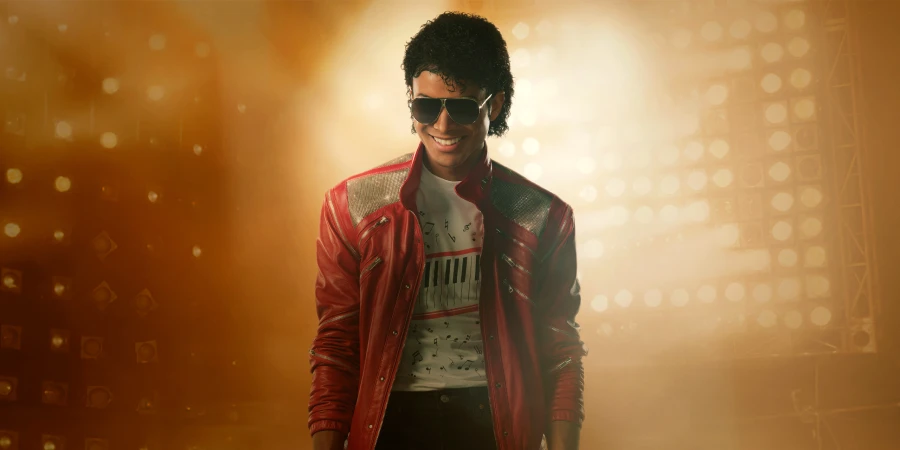
Thriller shatters worldwide sales records. Michael then delivers the legendary Motown 25 performance of Billie Jean, debuting the moonwalk in a scene the film recreates beat for beat.
However, MTV still refuses to play videos by Black artists. Michael and Branca confront CBS Records president Walter Yetnikoff (Mike Myers), who threatens to pull the entire CBS catalog from the network. MTV caves, and the videos change television forever.
The Pepsi Fire and the Victory Tour Trap
Joseph, desperate to stay relevant, meets boxing promoter Don King (Deon Cole) and pitches the 1984 Victory Tour to reunite his sons. King dangles a Pepsi sponsorship, but only if Michael joins, and Michael objects to being bargained away.
During the Pepsi commercial shoot, pyrotechnics ignite Michael’s hair. He suffers third-degree burns and nerve damage, and the film does not flinch from the horror of the moment.
Michael and Branca sue PepsiCo, then direct the settlement money to the burn center that treated him. While recovering, he visits fellow patients and weighs whether to tour with his family one last time. Ultimately, he says yes.
Movie Ending
Dodger Stadium, December 1984. The Jacksons close out the Victory Tour with electric performances of Human Nature and Working Day and Night, and Jaafar Jackson makes the sequence feel like a coronation.
Then comes the gut punch. Mid-show, Michael announces that this is the last time the Jacksons will ever perform together. Joseph watches from the wings in horror; his empire collapses in a single sentence, on his own stage, in front of tens of thousands of fans.
This is the emotional climax the entire film builds toward. Every beating, every fax, every argument leads to this public declaration of independence. Michael does not just leave the band; he severs the cord with the father who controlled him since age eight.
Consequently, the film jumps to 1988. Michael stands alone at Wembley Stadium on the Bad World Tour, greeted by an ecstatic crowd, framed as the superhero he always wanted to become. Freedom, fame, and solitude arrive in the same shot.
Why stop there? Reshoots removed the originally planned third act, which covered the 1993 abuse allegations, after a settlement clause forbidding dramatization of accuser Jordan Chandler surfaced. Ending at Wembley freezes Michael at his peak, before controversy, which is precisely why critics called the film sanitized.
Are There Post-Credits Scenes?
No, there is no scene after the credits, so you can safely leave when they roll. However, do not bolt too early.
Just before the credits begin, the screen cuts to black and a title card declares that his story continues. Lionsgate confirmed in May 2026 that a sequel covering Jackson’s later life is officially in development.
Type of Movie
Michael is a biographical musical drama with a coming-of-age spine. It charts a boy escaping his father’s shadow while becoming the most famous entertainer alive.
Tonally, it stays bright, celebratory, and crowd-pleasing. Darker threads exist, notably Joseph’s abuse and the Pepsi accident, but the film always swings back to spectacle. Think Bohemian Rhapsody energy rather than Rocketman introspection.
Cast
- Jaafar Jackson – Michael Jackson
- Juliano Krue Valdi – Young Michael Jackson
- Colman Domingo – Joseph Jackson
- Nia Long – Katherine Jackson
- Miles Teller – John Branca
- Laura Harrier – Suzanne de Passe
- Kendrick Sampson – Quincy Jones
- Larenz Tate – Berry Gordy
- Mike Myers – Walter Yetnikoff
- KeiLyn Durrel Jones – Bill Bray
- Jessica Sula – La Toya Jackson
- Deon Cole – Don King
- Joseph David-Jones – Jackie Jackson
- Jamal R. Henderson – Jermaine Jackson
- Rhyan Hill – Tito Jackson
- Tre Horton – Marlon Jackson
- Liv Symone – Gladys Knight
Film Music and Composer
Lior Rosner composed the original underscore, the connective tissue between the showstoppers. His cues stay deliberately understated, letting Jackson’s catalog carry the emotional weight.
That catalog does heavy lifting. The companion album, Michael: Songs from the Motion Picture, features thirteen tracks spanning the Jackson 5 era through Off the Wall, Thriller, and Bad, including Billie Jean, Beat It, Don’t Stop ‘Til You Get Enough, and Human Nature.
Interestingly, the vocals blend Jackson’s original recordings with new performances, so Jaafar’s physicality bleeds into songs you know by heart. It is one of the film’s smartest technical tricks.
Filming Locations
Principal photography ran from January to May 2024, based in California, with Los Angeles serving as the production hub. Under the state’s tax credit program, the film committed a record 120 million dollars in California spending.
Those choices matter to the story. Jackson’s rise happened largely in Los Angeles: the Encino mansion, the Motown 25 stage, and the Dodger Stadium finale all belong to the city’s geography. Shooting there let the production rebuild his world where it actually existed, while sets recreated the family’s humble Gary, Indiana beginnings.
Awards and Nominations
Michael has not collected major industry hardware so far, though it picked up nominations at mid-year ceremonies such as the 2026 Astra Midseason Movie Awards. Awards season chatter centers mostly on Jaafar Jackson’s breakout performance.
Behind the Scenes Insights
- Jaafar Jackson is Michael’s real nephew, the son of Jermaine Jackson, and won the role after a two-year casting search; this film marks his acting debut.
- Katherine Jackson publicly approved the casting, saying her grandson embodies her late son.
- The original cut ran roughly three and a half to four hours, and the studio seriously considered splitting it into two films.
- A settlement clause with accuser Jordan Chandler forced the removal of the entire planned third act, triggering 22 days of reshoots in June 2025.
- Rewrites hit another wall when screenwriter John Logan’s house was damaged in the Palisades Fire.
- Estimates put the final budget between 155 and 200 million dollars, ranking it among the most expensive biopics ever made.
- Michael’s son Prince Jackson served as an executive producer, while his daughter Paris Jackson publicly criticized an early script as sugar-coated.
- Janet Jackson declined to be depicted, which is why she, Randy, and Rebbie never appear.
- Director Antoine Fuqua repeatedly praised Jaafar’s uncanny resemblance to Michael in voice, dance, and presence.
Inspirations and References
Michael is not adapted from a book. Producer Graham King, who also produced Bohemian Rhapsody, developed it with the Michael Jackson estate and reportedly interviewed hundreds of people who knew the singer.
Peter Pan runs through the film as its guiding literary reference. Young Michael reads it while hiding from Joseph, foreshadowing the man who famously refused to grow up and later named his ranch Neverland.
Real events supply the rest: the Motown signing, the MTV standoff, the Pepsi accident, and the Victory Tour all draw directly from documented history, with some timelines compressed for drama.
Alternate Endings and Deleted Scenes
The most fascinating version of this movie sits on a hard drive somewhere. Fuqua originally opened the film in 1993, with Michael staring at his reflection as police raid Neverland Ranch, before flashing back through his life.
That cut’s third act dramatized the abuse allegations and their fallout. Derek Luke filmed scenes as attorney Johnnie Cochran, and a police raid sequence was fully shot; all of it got cut after the settlement clause emerged.
Kat Graham also filmed scenes as Diana Ross, which were removed over separate legal considerations. Reportedly, around 30 percent of the original long cut could resurface in the sequel, so this deleted footage may not stay deleted forever.
Book Adaptations and Differences
To be clear, Michael is not based on any book. John Logan wrote an original screenplay built from research, estate archives, and interviews rather than adapting Jackson’s memoir Moonwalk or any biography.
Memorable Scenes and Quotes
Key Scenes
- Young Michael reading Peter Pan by flashlight after one of Joseph’s beatings, the film’s quiet thesis statement.
- The Motown 25 recreation of Billie Jean, where the moonwalk debuts and the crowd loses its collective mind.
- The Beat It video shoot, with real rival gang members standing shoulder to shoulder.
- The Pepsi commercial fire, staged with terrifying immediacy as flames race across Michael’s scalp.
- Michael firing Joseph by fax, a breakup delivered through office equipment.
- The Dodger Stadium farewell, where one announcement ends the Jacksons and Joseph’s control simultaneously.
Iconic Quotes
- “His story continues” – the pre-credits title card that doubles as a sequel announcement.
- Michael’s Dodger Stadium declaration that the Jacksons have performed together for the last time, the single most devastating line in the film.
- Yetnikoff’s threat to yank the entire CBS catalog off MTV, the power move that gets Black artists on the network.
Easter Eggs and Hidden Details
- The Peter Pan book quietly foreshadows Neverland Ranch, which the film itself never gets to show.
- Asia Fuqua, the director’s daughter, plays Ola Ray, credited simply as “Thriller Girlfriend.”
- Ola Ray and director John Landis appear as characters during the Thriller video material, though both carry generic credit names for legal reasons.
- A studio scene about the Beat It mix nods to Eddie Van Halen’s famous uncredited guitar solo.
- Jaafar performing his uncle’s choreography creates a meta layer: Jackson family muscle memory, passed down a generation.
- Gladys Knight appears briefly, echoing her real-life role in the Jackson 5’s early Motown story.
Trivia
- Michael grossed over 977 million dollars worldwide, overtaking Oppenheimer as the highest-grossing biographical film ever.
- It also passed Bohemian Rhapsody to become the biggest musical biopic of all time and became Lionsgate’s highest-grossing release, ahead of The Hunger Games: Catching Fire.
- Its teaser trailer drew 116.2 million views in 24 hours, a record for any musical biopic or concert film.
- Critics and audiences split dramatically: Rotten Tomatoes sits at 38 percent, while CinemaScore audiences graded it an A minus.
- Opening weekend hit 97.2 million dollars domestically, the best debut ever for a music biopic, beating Straight Outta Compton.
- The film premiered in Berlin on April 10, 2026, two weeks before its US release.
Why Watch?
Watch it for Jaafar Jackson, full stop. His recreation of the moonwalk, the voice, and the stage presence borders on supernatural. Add lavish concert sequences, Colman Domingo’s chilling Joseph, and the wall-to-wall hits, and you get pure spectacle, flaws and all.
Director’s Other Movies
- Training Day (2001)
- Tears of the Sun (2003)
- King Arthur (2004)
- Shooter (2007)
- Brooklyn’s Finest (2009)
- Olympus Has Fallen (2013)
- The Equalizer (2014)
- Southpaw (2015)
- The Magnificent Seven (2016)
- The Equalizer 2 (2018)
- Infinite (2021)
- The Guilty (2021)
- Emancipation (2022)
- The Equalizer 3 (2023)
Recommended Films for Fans
- Bohemian Rhapsody (2018)
- Rocketman (2019)
- Elvis (2022)
- Straight Outta Compton (2015)
- Ray (2004)
- Walk the Line (2005)
- Get On Up (2014)
- Bob Marley: One Love (2024)
- A Complete Unknown (2024)
- Michael Jackson’s This Is It (2009)