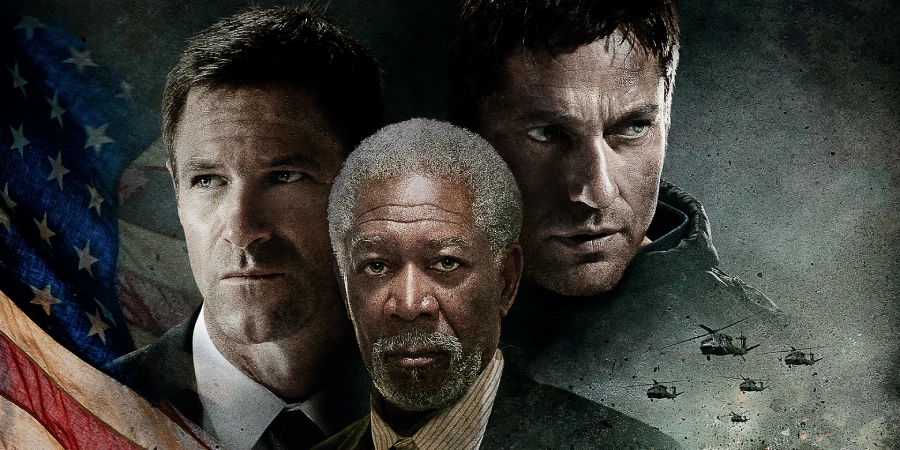

Gerard Butler punches a man with an American flag pin, and somehow that image captures everything Olympus Has Fallen wants to be. Antoine Fuqua’s 2013 action film drops a disgraced Secret Service agent into a full-scale terrorist siege of the White House, and it commits to that premise with an almost admirable lack of restraint. Bodies stack up fast, landmarks get demolished, and Butler scowls through every corridor like he personally owes the building something. It is loud, brutal, and frequently ridiculous, and that is precisely why it works.
Detailed Summary
The Accident at Camp David
The film opens eighteen months before the main siege. Secret Service agent Mike Banning is part of President Benjamin Asher’s personal detail. During a winter drive from Camp David, the presidential motorcade skids off an icy bridge over a ravine. Banning pulls the President to safety but cannot save First Lady Margaret Asher, who dies in the fall.
This opening does two things efficiently. It establishes Banning’s competence and his guilt. President Asher never blames him directly, but the grief makes Banning’s continued presence unbearable, so he gets reassigned to a desk job at the Treasury Department.
The Attack on the White House
Eighteen months later, South Korean Prime Minister Lee Tae-Woo visits Washington. A modified military cargo plane tears through Washington airspace, destroying a tourist helicopter and gunning down pedestrians on the National Mall. On the ground, a coordinated strike force disguised as part of the Prime Minister’s motorcade assaults the White House gates.
Fuqua stages this sequence with a genuine commitment to carnage. Secret Service agents drop one after another, and the film refuses to cut away from the violence. Banning, watching from his Treasury office window, runs toward the White House against the flow of everyone else fleeing.
He fights his way onto the White House grounds, eliminating multiple attackers, but he arrives too late to prevent the terrorists from breaching the building. The attack kills a significant portion of the Secret Service detail in under thirteen minutes. That thirteen-minute mark gets cited inside the film as a humiliation, and it earns it.
The Bunker Takeover
The terrorist leader is Kang Yeonsak, a North Korean-born radical played by Rick Yune. Kang’s cover is that he is part of the South Korean Prime Minister’s security detail. Once inside the Presidential Emergency Operations Center below the White House, Kang’s people kill the Prime Minister and take President Asher, Secretary of Defense Ruth McMillan, and the Chairman of the Joint Chiefs hostage.
Kang’s actual goal is to obtain the three-part access code to Cerberus, a fail-safe system that can remotely destroy America’s nuclear arsenal while the missiles are still in their silos. Getting all three codes means a catastrophic detonation on American soil. Each hostage holds one segment of the code.
Banning Goes to Work
With the White House locked down and all communications cut, Banning becomes the only American asset inside the building. He contacts the situation room, where Speaker of the House Allan Trumbull (played by Morgan Freeman) has assumed the role of acting President. General Edward Clegg and Secret Service Director Lynne Jacobs coordinate from outside.
Banning moves through the White House like a man with a floor plan tattooed on his memory. He picks off Kang’s guards one by one, communicates covertly with the President’s young son Connor who is hiding in a service tunnel, and feeds intelligence back to the situation room.
One of the film’s more satisfying sequences has Banning interrogating one of Kang’s men for information. He does not ask politely. The scene is brief, direct, and communicates exactly how far Banning is willing to go without lingering on it longer than necessary.
The Code Extraction
Kang tortures the hostages for their code segments. McMillan gives up her portion under duress. The Chairman of the Joint Chiefs refuses and Kang has him executed in front of a live camera feed to pressure Trumbull into withdrawing American forces from the Korean Peninsula.
President Asher makes the calculated decision to give Kang his own code segment, betting that Banning will stop Kang before Cerberus activates. It is a gamble that nearly destroys everything.
Kang now has all three segments. He enters them into the Cerberus system and begins the detonation sequence. The clock starts running.
Banning Reaches Kang
Banning fights his way down to the PEOC. He rescues Connor earlier in the film, getting him out through a service exit, which removes Kang’s leverage over the President and also removes an emotional complication that would have slowed the finale down. Smart screenwriting choice.
By the time Banning reaches the bunker level, most of Kang’s inner circle are dead or incapacitated. He confronts Kang directly in a brutal close-quarters fight. Rick Yune plays Kang as coldly methodical rather than theatrical, which makes him a more credible threat than a scenery-chewing villain would have been.

Movie Ending
Banning kills Kang with a knife to the skull, which is about as unambiguous as a film kill gets. With Kang dead, he still has to manually abort the Cerberus countdown. The system requires inputting a disarm code, and Banning has to pull it from a list with Trumbull guiding him remotely with seconds left on the clock.
He enters the correct sequence. Cerberus aborts. No nuclear detonations occur.
President Asher is alive, battered but functional. Banning carries him out of the PEOC and up through the ruins of the White House. They emerge into daylight in front of a crowd that includes what remains of the Secret Service, military personnel, and Trumbull. The image is deliberately patriotic: the American flag still flies, singed but intact, over a damaged but standing White House.
Asher reinstates Banning to his original post on the presidential detail. The film ends with Banning back at the job he was removed from at the start, guilt partially absolved through action. It is a clean, classical resolution, and Fuqua earns it because the film never pretended to be anything other than a delivery mechanism for exactly this moment.
Director Jacobs, who had been a consistent advocate for Banning throughout the crisis, survives the siege, which is worth noting because the film kills several named characters and does not protect everyone with a speaking role.
Are There Post-Credits Scenes?
Olympus Has Fallen has no post-credits scene. Once the credits roll, the film is done. No teasers, no setup for a sequel, nothing hidden at the end. You can leave when the title card hits.
Type of Movie
Olympus Has Fallen is a straightforward action thriller with heavy doses of military procedural tension. Its tone sits closer to a hard-R 1990s action film than to the slick PG-13 superhero template that dominated the era it was released in. It is violent, occasionally grim, and played almost entirely straight.
There is very little humor. Fuqua treats the premise with a seriousness it probably does not deserve on paper, and that sincerity is the film’s biggest asset.
Cast
- Gerard Butler – Mike Banning
- Aaron Eckhart – President Benjamin Asher
- Morgan Freeman – Speaker of the House Allan Trumbull
- Rick Yune – Kang Yeonsak
- Angela Bassett – Secret Service Director Lynne Jacobs
- Dylan McDermott – Dave Forbes
- Melissa Leo – Secretary of Defense Ruth McMillan
- Robert Forster – General Edward Clegg
- Finley Jacobsen – Connor Asher
- Ashley Judd – First Lady Margaret Asher
- Cole Hauser – Roma
Film Music and Composer
Trevor Morris composed the score. Morris came to the project with strong television credentials, having worked extensively on prestige drama series, and he brings a propulsive, brass-heavy sound to the film that suits its tone without calling too much attention to itself.
His score leans into traditional orchestral action music rather than electronic textures. It punctuates the siege sequences with urgency without overselling the emotion in quieter scenes. Morris is one of the more underrated elements of this film; his work keeps the pacing tight in moments where the screenplay pauses to breathe.

Filming Locations
Principal photography took place largely in Louisiana, with Shreveport and Baton Rouge providing much of the interior work. A significant portion of the White House interiors were built as sets rather than shot on location, which gave Fuqua control over the layout and lighting of Banning’s stealth sequences.
Some exterior Washington footage was captured on location, giving the aerial attack sequence and the Mall scenes a grounding in real geography. That contrast between real location and constructed set actually works in the film’s favor; the White House feels like a specific, navigable space rather than an abstraction.
Awards and Nominations
Olympus Has Fallen did not receive major awards recognition. It was largely treated as commercial entertainment by awards bodies, which is fair, and the film performed well enough at the box office that the lack of trophies was probably not a concern for anyone involved.
Behind the Scenes Insights
- Antoine Fuqua pushed for an R rating from the start, believing a sanitized version of this story would undercut its credibility. He got it.
- Gerard Butler trained extensively for the physical demands of the role, particularly the close-quarters combat sequences, which were choreographed to look messy and exhausting rather than elegant.
- Olympus Has Fallen went into production before a competing White House siege film, White House Down, which released the same year through a different studio. Fuqua’s film arrived first in theaters.
- Melissa Leo prepared her torture scenes with considerable seriousness, refusing to make McMillan’s resistance feel performative.
- The production built detailed replicas of key White House rooms, including the Oval Office, to maintain visual consistency across scenes that could not be shot on location.
Inspirations and References
The film draws most obviously from the Die Hard template: one resourceful man, an iconic structure under siege, communication with the outside world as a dramatic device, and a villain with a plan more elaborate than the immediate hostage situation suggests. Fuqua has acknowledged the influence of that film’s structure.
Thematically, the film taps into post-9/11 anxieties about the vulnerability of American symbols and institutions. The sight of the White House taking serious damage carries a specific cultural weight that the filmmakers understood and used deliberately.
Some critics also noted echoes of Air Force One (1997), another film that puts the American President in the hands of terrorists while a single capable agent works to save him from within a confined space.
Alternate Endings and Deleted Scenes
No officially documented alternate endings or significant deleted scenes have been widely reported for Olympus Has Fallen. The home release includes some additional content, but nothing that fundamentally changes the narrative arc or character resolutions of the theatrical cut.
Book Adaptations and Differences
Olympus Has Fallen is not based on a book. It is an original screenplay written by Creighton Rothenberger and Katrin Benedikt. A novelization was later produced to accompany the film’s release, but the screenplay came first and the story originated there.


Memorable Scenes and Quotes
Key Scenes
- The opening motorcade accident, which sets Banning’s guilt in motion with a single image of Margaret Asher’s hand slipping from his grip.
- The thirteen-minute White House siege, during which Fuqua holds nothing back and the body count climbs with grim efficiency.
- Banning running toward the White House while civilians flee in the opposite direction, framed against smoke and chaos on the National Mall.
- Secretary McMillan dragged through the White House corridor, refusing to cooperate with Kang’s people and taking the physical punishment for it. Melissa Leo plays the scene with a stubborn, quiet fury that is the best performance in the film.
- Banning locating Connor in the service tunnels and talking him through escape with a calm that costs him visibly to maintain.
- The final knife kill, staged in tight quarters with no musical fanfare, just the sound of a fight ending.
Iconic Quotes
- “Why don’t you and I play a game of ‘fuck off’? You go first.” (Banning to Kang over comms)
- “I’m going to kill them one by one.” (Kang, clinically, to the situation room)
- “Let’s play a game of fuck off. You go first.” (variant line in some edits)
- “For the record, I was never here.” (Banning, after handling a situation in the White House)
Easter Eggs and Hidden Details
- The cargo plane used in the attack bears markings that reference real military transport configurations, a detail that gave the sequence a surface plausibility that most critics acknowledged.
- Several White House room details in the set design were sourced from public architectural records and historical photographs, giving the interiors an accuracy that production designers cited in interviews.
- Banning’s desk at the Treasury Department is noticeably bare, a visual shorthand for a man who has not settled into his reassignment and does not intend to.
- A photograph of Banning with the President on the mantle of Banning’s apartment appears early in the film; it is angled slightly away from the viewer, a small staging choice that communicates distance without dialogue.
Trivia
- Olympus Has Fallen and White House Down both released in 2013, the only year in Hollywood history that two separate White House siege films competed at the box office simultaneously. Fuqua’s film won the race to theaters and significantly outperformed White House Down relative to production cost.
- Gerard Butler had not done a major action film in several years before this project, and producers took a calculated risk on him carrying a film that required audiences to accept him as a credible, grounded action lead rather than a comedic or romantic one.
- Morgan Freeman’s role as acting President was specifically written to give the outside perspective gravitas without requiring the actor to carry action sequences.
- Antoine Fuqua won an Academy Award for directing Training Day (2001), and Olympus Has Fallen represented his most commercially successful film at the time of its release.
- The film spawned two sequels: London Has Fallen (2016) and Angel Has Fallen (2019), both starring Butler as Banning.
- Rick Yune, who plays Kang, had previously played a Bond villain in Die Another Day (2002), which made his casting here feel like a deliberate signal about the kind of threat the filmmakers wanted to project.
Why Watch?
Butler’s performance as Banning is what makes this worth two hours: he plays the guilt in the opening with enough restraint that when he pivots to violence, it reads as catharsis rather than fantasy. Fuqua stages the White House siege with a brutality that puts most contemporary action sequences to shame. This is the rare big-studio action film that actually commits to its R rating.
Director’s Other Movies
- Training Day (2001)
- Tears of the Sun (2003)
- King Arthur (2004)
- Shooter (2007)
- Brooklyn’s Finest (2009)
- The Equalizer (2014)
- Southpaw (2015)
- The Magnificent Seven (2016)
- The Equalizer 2 (2018)
- The Guilty (2021)
Recommended Films for Fans
- Die Hard (1988)
- Air Force One (1997)
- Under Siege (1992)
- The Rock (1996)
- London Has Fallen (2016)
- Angel Has Fallen (2019)
- White House Down (2013)
- Training Day (2001)