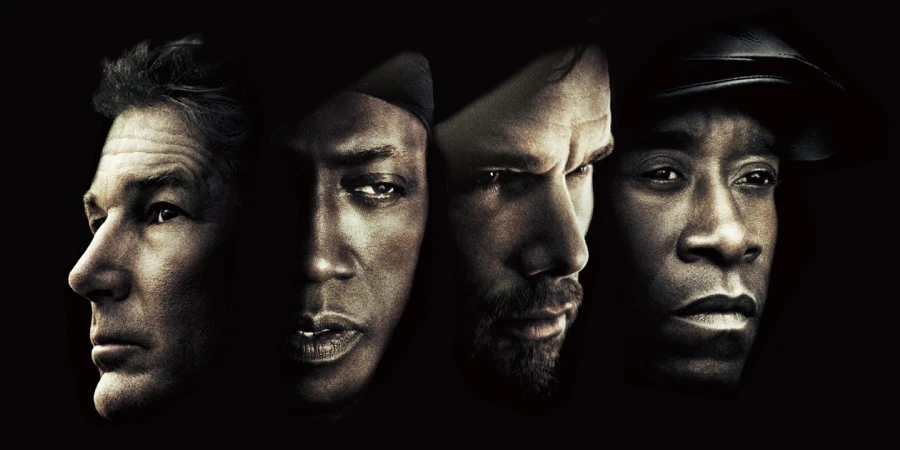

Three cops walk into Brooklyn and none of them come out clean. Antoine Fuqua’s Brooklyn’s Finest opens with a diner conversation about fate and free will, two men debating whether God deals the cards or we do, and then spends the next two hours proving it doesn’t matter either way. Richard Gere, Don Cheadle, and Ethan Hawke each carry a separate story that only collides at the very end, and that collision is deliberately ugly, morally incoherent, and completely honest about what police work does to a person.
Detailed Summary
Eddie’s Countdown to Retirement
Eddie Dugan (Richard Gere) is a beat cop with seven days left before retirement. He drinks a bottle of whiskey every morning before his shift, sleeps with a sex worker named Chantel, and carries an unloaded revolver he keeps meaning to use on himself.
His supervisors assign him to train younger officers, which forces him back into the Brownsville housing projects he has spent decades avoiding. He does almost nothing in each scene. That paralysis is the whole point.
Sal’s Desperate Faith
Sal Procida (Ethan Hawke) is a narcotics detective with a pregnant wife, three kids, black mold rotting through their walls, and no money to fix any of it. He needs a bigger house before the twins arrive. His solution is to steal cash from drug raids.
Sal frames his thievery as a Catholic bargain. He confesses, he prays, he tells himself God will forgive a man providing for his family. Hawke plays this self-deception with a twitchy, exhausted sincerity that makes Sal the most watchable character in the film.
Tango’s Impossible Loyalty
Clarence “Tango” Butler (Don Cheadle) has spent years undercover inside a Brooklyn drug operation run by Caz (Wesley Snipes). His supervisors want him to give up Caz. Tango refuses because Caz once saved his life and the two have a genuine friendship.
His handler and the department keep dangling a desk job as the reward for one final betrayal. Tango keeps stalling, buying Caz time while watching his own cover fray at the edges.
The Three Threads Tighten
Sal learns about a drug stash in an apartment connected to Caz’s crew. He plans to rob it during a raid. His colleagues are growing suspicious of where his money comes from, and one officer, Ronny, is actively building a case against him.
Eddie, meanwhile, forms a quiet attachment to Chantel, who wants out of prostitution. She needs money to relocate. His conscience slowly, painfully reactivates after years of numbness.
Tango reaches his breaking point when his supervisors arrange the murder of a drug dealer he was close to, demonstrating how little the department values anyone inside the operation. He decides to pull Caz out before the arrest happens.

Movie Ending
All three storylines converge in the same housing project at the same moment, and none of the characters know the others are there. Sal moves on the apartment to steal the drug money. Tango escorts Caz out through the building to safety. Eddie, responding to a call he didn’t have to take, enters the same corridor.
Sal kicks open the door to the stash apartment and finds Caz’s men inside. A firefight breaks out. Tango hears the shooting and runs toward it. He arrives to find Sal in danger and shoots the men attacking him, saving a colleague he has never met.
Then Sal, not recognizing Tango as a cop, shoots Tango. Tango dies in the hallway. It is the film’s most devastating beat because it is entirely accidental, a product of institutional failure rather than malice, and nobody is punished for it.
Eddie’s arc ends differently. He finds Chantel being assaulted by two men inside the building. Something finally switches on in him. He shoots both attackers, pulls Chantel out, and drives away. It is the one moment in the film that resembles anything close to redemption, and Fuqua earns it precisely because he made Eddie so passive for so long.
Sal survives. He gets away with the money. There is no justice delivered to him by the story, which is either the film’s most cynical choice or its most realistic one. Audiences tend to split on that, and the split feels intentional.
Are There Post-Credits Scenes?
Brooklyn’s Finest has no post-credits scene. Once the film ends, it ends completely. Fuqua offers no coda, no grace note, nothing to soften what just happened.
Type of Movie
Brooklyn’s Finest is a crime drama with strong elements of neo-noir. Its tone is relentlessly bleak, operating closer to The Wire‘s institutional fatalism than to any action thriller.
The film’s pacing is deliberate and slow-burning. Genre fans expecting shootouts will find long stretches of quiet, morally exhausted men staring at ceilings.
Cast
- Richard Gere – Eddie Dugan
- Don Cheadle – Clarence “Tango” Butler
- Ethan Hawke – Sal Procida
- Wesley Snipes – Caz
- Will Patton – Bill Hobarts
- Ellen Barkin – Agent Smith
- Vincent D’Onofrio – Ronny Rosario
- Shannon Kane – Chantel
- Lili Taylor – Angela Procida
Film Music and Composer
Marcelo Zarvos composed the score. His work here favors low strings, muted brass, and long, unresolved chords that mirror the film’s refusal to offer moral clarity. Nothing in the music tells you how to feel.
Zarvos worked previously on smaller dramatic features before this, and Brooklyn’s Finest gave him a wider canvas. The score never announces itself, which is exactly the right call for this kind of film.
Filming Locations
Principal photography took place in New York City, with significant shooting in Brooklyn and the surrounding boroughs. The Brownsville neighborhood, one of New York’s most historically underserved areas, features prominently in Eddie’s segments.
Fuqua chose real locations over sets wherever possible. Shooting in actual housing projects gives the film a documentary texture that glossy soundstage work would have destroyed entirely.
Awards and Nominations
Brooklyn’s Finest did not receive major awards recognition upon its initial release. Given Hawke’s performance in particular, that absence remains genuinely puzzling.
Behind the Scenes Insights
- Antoine Fuqua shot the film using a handheld camera style throughout, keeping the visual grammar unstable and close to the characters’ bodies rather than composing clean, authoritative shots.
- Wesley Snipes returned to a high-profile American film role after several years away from Hollywood productions, and his chemistry with Cheadle gives Tango’s arc its emotional weight.
- Fuqua drew on his own experiences growing up in Pittsburgh’s rough neighborhoods to shape the film’s attitude toward police and community relationships.
- The script by Michael C. Martin was his feature debut. Fuqua pushed the material toward a more fatalistic conclusion than earlier drafts apparently contained.
- Ethan Hawke reportedly researched the role by spending time with working detectives in New York, informing the physical restlessness he brings to every Sal scene.
Inspirations and References
The film draws clearly from the tradition of New York crime procedural storytelling established by writers like Richard Price, whose novels and screenplays track how institutions corrupt individuals rather than the reverse.
Fuqua has cited Sidney Lumet’s work as an influence, particularly Lumet’s interest in cops whose personal failings and institutional pressures become indistinguishable from each other. Serpico and Prince of the City cast a long shadow here.
The three-strand narrative structure echoes Amores Perros and Crash, though Brooklyn’s Finest is considerably less interested in engineering ironic coincidences. Its convergence feels earned rather than contrived.
Alternate Endings and Deleted Scenes
No officially released alternate endings or deleted scenes have been made widely available for Brooklyn’s Finest. Fuqua has discussed in interviews that earlier cuts of the film were longer and gave each storyline more breathing room.
Some reports suggest that Sal’s fate was reconsidered during editing, with a version existing where the consequences of his theft caught up with him more directly. The final cut’s decision to let him escape clean was a deliberate, uncomfortable choice.
Book Adaptations and Differences
Brooklyn’s Finest is not based on any book. Michael C. Martin wrote the original screenplay. No novelization of the film has been published.


Memorable Scenes and Quotes
Key Scenes
- The opening diner scene, where an older cop tells a younger one that no good deed goes unpunished, before a gun appears on the table. It frames every death that follows.
- Sal praying in his car outside a raid location, gripping his rosary while planning a robbery, his lips moving with what sounds like genuine anguish.
- Tango and Caz sharing a quiet meal and talking about the neighborhood as it used to be. Snipes plays the warmth completely straight, which makes the betrayal Tango is considering feel genuinely awful.
- Eddie sitting in his patrol car outside Chantel’s building, doing nothing, engine running, for what feels like an uncomfortably long time before driving away.
- The hallway shootout that kills Tango, staged in tight, cramped space with almost no dramatic music, just the sound of the gunfire and then silence.
Iconic Quotes
- “There’s no difference between good and bad. There’s just the time and the place.” (opening diner scene)
- “God, I know I’m not a good man.” Sal, in the car, before the raid.
- “One more.” Eddie, pouring another drink at the start of another pointless day.
Easter Eggs and Hidden Details
- Eddie’s revolver appears in several scenes before we learn it is unloaded. Fuqua frames it the same way in each shot, a visual repetition that quietly signals paralysis rather than threat.
- Sal’s house has visible water damage and mold in nearly every scene set there, a constant background detail reinforcing his desperation without any character ever mentioning it directly.
- Caz wears noticeably cleaner, more expensive clothing than anyone else in the film, including the federal agents pursuing him, a small visual joke about where the real money sits.
- The color palette in Eddie’s scenes skews toward gray and washed-out blue, while Sal’s scenes run warmer but dirtier. Tango’s scenes are the most visually unstable, shifting between both registers.
Trivia
- Brooklyn’s Finest premiered at the Sundance Film Festival in 2009 before receiving its wide theatrical release in 2010.
- Fuqua and Gere had not worked together before this film. Gere had spent much of the decade in quieter, smaller projects, and this role gave him his most physically and emotionally unglamorous part in years.
- Wesley Snipes completed the film while dealing with significant legal issues in his personal life, a fact that adds a strange biographical layer to Caz’s scenes about loyalty and institutional pressure.
- The three lead actors never share a scene together until the final sequence, which was a deliberate structural decision to preserve the sense of parallel isolation.
- Michael C. Martin based elements of the script on research into actual NYPD corruption cases and housing project drug operations in Brooklyn during the 1990s and 2000s.
Why Watch?
Ethan Hawke’s performance as Sal is the reason to sit down with this film. Watch the scene where he prays in his car: his hands shake, his jaw tightens, and he mouths words that sound like confession while his body is already halfway out the door to commit a crime. That seven-minute stretch contains more moral complexity than most crime films manage across two hours.
Director’s Other Movies
- Training Day (2001)
- Tears of the Sun (2003)
- King Arthur (2004)
- Shooter (2007)
- The Equalizer (2014)
- Southpaw (2015)
- The Magnificent Seven (2016)
- The Equalizer 2 (2018)