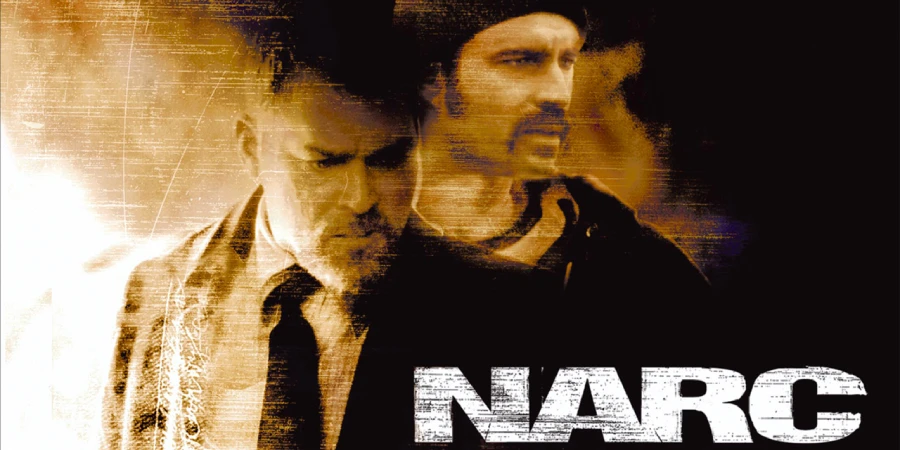

Joe Carnahan shot Narc on leftover film stock, in the dead of a Detroit winter, with a budget so tight it threatened to collapse the production entirely. What came out of that pressure cooker is one of the most brutally honest cop films of the 2000s, a movie that treats moral compromise not as a plot twist but as a weather condition. Ray Liotta gives what may be the single most ferocious performance of his career, and Jason Patric matches him beat for beat in a role that should have made him a household name.
Detailed Summary
The Cold Open: Nick Tellis Destroys His Own Career
Nick Tellis, an undercover narcotics officer played by Jason Patric, is sprinting through a Detroit housing project in a frantic foot chase. He fires his weapon trying to stop a drug-addled suspect, and the bullet strikes a pregnant bystander. She survives, but her baby is born prematurely and suffers serious complications.
Tellis is pulled from the field immediately. He spends the next eighteen months in a kind of professional and personal purgatory, suspended and estranged from the work that defined him. His wife Audrey, played by Krista Bridges, is trying to hold their family together while Nick barely functions.
The Cold Case: Officer Michael Calvess
Detroit PD brass approach Tellis with a deal. If he helps crack a dead-end investigation into the murder of undercover officer Michael Calvess, they will reinstate him. The case has gone nowhere, and the department is under pressure from Calvess’s widow and from internal affairs.
Tellis is paired with Henry Oak, Calvess’s former partner, played by Ray Liotta. Oak requested Tellis personally, citing his reputation for getting inside criminal circles. Tellis is wary of Oak from the first scene they share. Oak’s grief is not quiet or controlled; it radiates outward like heat.
Digging Into the Calvess Murder
Tellis and Oak start working the streets around where Calvess was killed. The investigation takes them through Detroit’s drug underworld, a grim parade of addicts, dealers, and people barely surviving in condemned buildings. Carnahan shoots these scenes with a desaturated, grainy texture that makes the city feel like it is decomposing.
Oak operates with barely concealed fury. He intimidates witnesses, bends procedural rules, and makes clear he views the law as a tool rather than a boundary. Tellis, already on thin ice professionally, keeps getting pulled further into Oak’s orbit.
Piecing Together Calvess’s Secret Life
As the two dig deeper, a more complicated picture of Calvess begins to form. He was not simply a heroic officer killed in the line of duty. Evidence suggests he had drifted into the same drug culture he was supposed to be policing.
Witnesses describe a man who had lost his way, who was using and dealing, and whose moral compass had been destroyed by years of deep cover work. Tellis starts connecting the dots between Calvess’s behavior in his final weeks and the night he died.
Oak’s Interrogation Tactics Cross Every Line
One of the film’s most uncomfortable stretches involves Oak running a violent, borderline sadistic interrogation on a suspect. He physically brutalizes the man, and Tellis watches, paralyzed between stopping it and needing the information. Liotta plays these scenes without vanity; there is nothing cool or stylized about Oak’s violence here.
These sequences force the audience to reckon with the same question Tellis is wrestling with: at what point does pursuing justice become its own form of predation? Carnahan never answers that cleanly, which is exactly the right choice.
Closing In on the Truth
Tellis’s investigation eventually points toward a drug dealer named Beery and his crew as central figures in what happened to Calvess. But the trail keeps looping back in unexpected directions. Witnesses are unreliable, the evidence is fragmentary, and Oak’s emotional investment is clearly distorting his judgment.
A key informant reveals that on the night Calvess died, things went badly wrong during a drug transaction gone sideways. Multiple parties were involved. The story Oak has been telling, both to investigators and to himself, starts to crack under scrutiny.

Movie Ending
Nick Tellis discovers the truth about Michael Calvess’s death, and it is far uglier than anyone in the department wanted to find. Calvess had become deeply compromised. On the night he died, he was present during a violent drug robbery, not as a cop working undercover but as a participant. The situation spiraled and Calvess ended up dead.
The most devastating revelation is what Henry Oak knew and when he knew it. Oak was aware that his partner had crossed into serious criminal territory. Rather than expose that truth, he has spent the entire investigation engineering a cover-up while appearing to pursue justice. His grief is real, but it is tangled with guilt and with a desperate need to protect Calvess’s legacy, and his own.
Tellis confronts Oak directly. In the film’s final, gut-punch sequence, Oak pulls his weapon. He cannot allow Tellis to expose what really happened. Tellis shoots first, killing Oak.
Tellis walks away from the scene with everything technically resolved and nothing actually healed. He got his reinstatement. He solved the case. He also killed the one person who understood, at a bone-deep level, what undercover work does to a human being. Carnahan frames the final moments not as victory but as a specific kind of wreckage: the case closed, the truth buried with Oak, Tellis left holding a career he may no longer want.
What makes this ending work is how thoroughly it implicates everyone. Calvess was corrupt. Oak was complicit. Tellis got the right answer and used it to destroy a man who, in another version of his life, might have been Tellis himself. The movie does not let the audience feel good about that.
Are There Post-Credits Scenes?
Narc has no post-credits scene. Once the film ends, it ends. Carnahan gives you no grace period.
Type of Movie
Narc is a neo-noir crime thriller, though “psychological procedural” fits almost as well. Its tone is unrelentingly grim, shot through with moral ambiguity and a sense of institutional rot. There is no humor here, no relief valve.
Think of it as a spiritual cousin to Serpico and Rampart, films that treat police corruption not as a genre convention but as a systemic disease. Carnahan is interested in what the job does to the people inside it, and this film follows that interest to its ugliest logical conclusion.
Cast
- Jason Patric – Nick Tellis
- Ray Liotta – Henry Oak
- Krista Bridges – Audrey Tellis
- Busta Rhymes – Beery
- Chi McBride – Captain Cheevers
- Alan Van Sprang – Michael Calvess
Film Music and Composer
The score for Narc was composed by Cliff Martinez, who by 2002 had already built a reputation for spare, unsettling electronic soundscapes through his work on Steven Soderbergh’s films. His work here fits the visual texture of the film precisely: cold, minimal, and quietly threatening.
Martinez does not write music that tells you how to feel. He writes music that makes the silence feel inhabited by something dangerous. In a film this dependent on dread and ambiguity, that restraint is exactly what the material needs.


Filming Locations
Narc shot primarily in Detroit, Michigan. Carnahan used real locations throughout the city, including housing projects, industrial areas, and streets that communicate genuine economic devastation without a single word of dialogue needing to explain them.
Detroit in 2001, when production took place, was already carrying decades of deindustrialization visibly on its face. That context is not incidental to the film; it is structural. The city becomes a character that explains, without narrating, why people in this story made the choices they made.
Shooting in genuine Detroit winter conditions also shaped the performances. The cold is not a backdrop in Narc; actors are clearly feeling it. That physical discomfort bleeds into the scenes in ways no production design could fully fake.
Awards and Nominations
Ray Liotta received significant awards attention for his performance, earning a Screen Actors Guild Award nomination for Outstanding Performance by a Male Actor in a Supporting Role. Jason Patric’s work was also recognized in various critics’ circles, though formal nominations for his performance were fewer than his work arguably deserved.
The film earned strong critical notices but was not a major presence in the mainstream awards conversation, partly because of its limited theatrical release and its refusal to make itself easy for awards voters.
Behind the Scenes Insights
- Joe Carnahan spent years trying to get Narc made and shot much of it on short ends, leftover film stock from other productions, which contributed directly to the grainy, unstable visual texture.
- The production ran out of money partway through filming and was in serious danger of shutting down before Tom Cruise stepped in as an executive producer, allowing the film to be completed.
- Ray Liotta’s performance required him to spend significant time with actual Detroit police officers to understand the particular exhaustion and hardness that long-term undercover work produces.
- Carnahan encouraged improvisation in several scenes, particularly during the interrogation sequences, which is part of why they carry such unpredictable energy.
- Jason Patric did extensive physical preparation for the opening chase sequence, which Carnahan shot in a frantic, disorienting style to put the audience inside Tellis’s panicked state immediately.
- The film was shot partly in sequence, which is unusual, and Carnahan has cited that as a reason the emotional arc of Patric’s performance feels genuinely cumulative rather than assembled in editing.
Inspirations and References
Narc is an original screenplay by Joe Carnahan, not an adaptation. Carnahan has cited gritty 1970s police films as the primary DNA, particularly the work of Sidney Lumet and William Friedkin. Serpico, Prince of the City, and The French Connection are the obvious ancestors.
Carnahan was also drawing on documented realities of undercover narcotics work in American cities, the well-established psychological toll it takes on officers, the rate of substance abuse and moral drift among deep cover agents. That research gives the film its specificity.
Alternate Endings and Deleted Scenes
No officially documented alternate ending for Narc has been confirmed. Carnahan has discussed the difficult editing process in interviews, given the production’s financial interruptions, but no specific deleted scenes have received wide public attention or formal release.
The film’s structure, particularly its use of non-linear sequencing in the early reels, suggests that significant editorial decisions shaped the final cut. What the assembly cut looked like before Carnahan locked picture remains undocumented in any detailed public source.
Book Adaptations and Differences
Narc is not based on a book or any previously existing source material. Joe Carnahan wrote the original screenplay. There is no source novel to compare it against.

Memorable Scenes and Quotes
Key Scenes
- The opening chase: Carnahan drops you into a frantic foot pursuit with zero orientation. The handheld camera is inches from Patric’s face as he runs, and when the gun fires and a woman drops, the film’s entire moral premise locks into place in under three minutes.
- Oak’s violent interrogation: Liotta physically erupts in this scene in a way that is genuinely frightening. He is not performing intimidation; he seems to be actually struggling to contain himself, and the threat of total loss of control is what makes it work.
- Tellis and Oak in the car at night: A quieter scene where the two men talk about what the job has cost them personally. It is the closest the film comes to tenderness, and Carnahan shoots it with almost no movement, two faces in near darkness, voices carrying the weight.
- The final confrontation: When Oak draws his weapon, Liotta does not play it as a villain’s reveal. He plays it as a man with no remaining options. The tragedy of that distinction is what separates this ending from a hundred generic thrillers.
Iconic Quotes
- “You want the truth? You couldn’t handle the truth if it was sitting right in front of your face.” (Oak, pressing Tellis on what they are really doing out there)
- “I’ve been under so long I don’t know what I am anymore.” (Tellis, in one of the film’s few moments of direct self-examination)
Easter Eggs and Hidden Details
- Carnahan uses visual grain levels deliberately; scenes set in the past or in memory are often noticeably grainier, reflecting the degraded, uncertain nature of recalled events, though this is done without calling attention to itself.
- The color palette shifts slightly warmer in the very few scenes featuring Tellis’s home life, a subtle visual cue that his domestic world and his professional world literally look different.
- Oak’s apartment, glimpsed briefly, contains photographs of Calvess that suggest Oak’s grief has become a kind of shrine-building. It is on screen for only seconds but tells you everything about what this investigation means to him personally.
- The film’s opening sequence is deliberately disorienting in its cutting rhythm, mimicking the disorientation of an officer losing control of a situation. Carnahan has discussed this structural choice in interviews as intentional scene design.
Trivia
- Narc was Joe Carnahan’s second feature film, following Blood, Guts, Bullets and Octane (1998).
- Tom Cruise saw an early cut and was sufficiently impressed to come on as an executive producer, which allowed Paramount Classics to pick up the film for distribution.
- The film’s budget was extremely low by studio standards, and Carnahan has described the shoot as one of the most challenging of his career due to constant resource limitations.
- Busta Rhymes appears in a dramatic role as Beery, a departure from his music career that drew some attention at the time of release.
- Jason Patric prepared for the role by spending time with actual narcotics officers in Detroit to understand the specific physical and psychological markers of their work.
- The film was shot during genuine Detroit winter conditions, and Carnahan deliberately kept takes long to capture the cumulative effect of cold on the actors’ bodies and faces.
- Ray Liotta has described the role of Oak as one of the roles he is most proud of in his career.
Why Watch?
Ray Liotta turns Henry Oak into something genuinely rare: a man whose love for a dead friend and whose capacity for violence are indistinguishable from each other by the end. That performance alone justifies two hours in the Detroit cold. Carnahan builds the whole film around the specific horror of a cop who has absorbed so much darkness that he can no longer tell himself apart from it.
Director’s Other Movies
- Blood, Guts, Bullets and Octane (1998)
- Smokin’ Aces (2006)
- The A-Team (2010)
- The Grey (2011)
- Stretch (2014)
- Copshop (2021)
Recommended Films for Fans
- Serpico (1973)
- Prince of the City (1981)
- The French Connection (1971)
- Rampart (2011)
- Dark Blue (2002)
- We Own the Night (2007)
- Prisoners (2013)