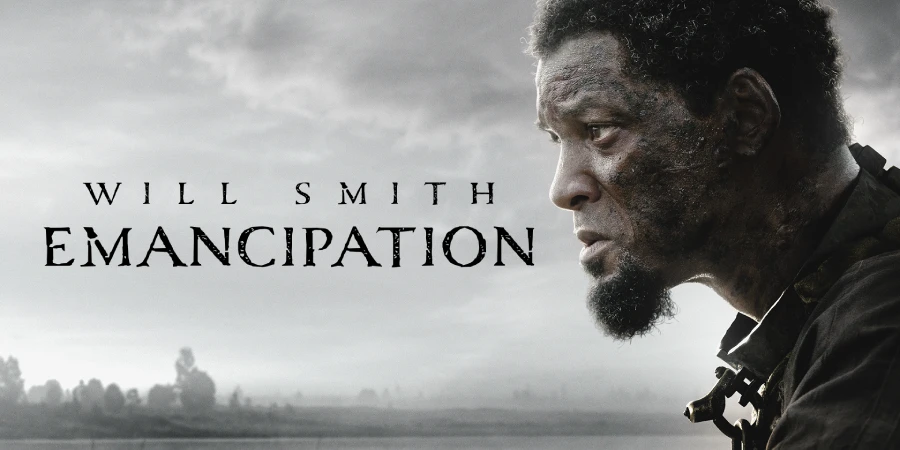

A photograph changed history. Taken in 1863, the image of a formerly enslaved man named Gordon, his back a roadmap of brutal scars, circulated across the world and put a human face on the horrors of American slavery. Director Antoine Fuqua transforms this real story into a visceral survival thriller, casting Will Smith in a role that demands everything and then some.
Detailed Summary
Peter Is Torn from His Family
Peter, a deeply religious enslaved man, lives on a Louisiana plantation with his wife Dodienne and their children. Confederate soldiers arrive and forcibly separate him from his family, conscripting him and other enslaved men to build fortifications for the Confederate Army near Baton Rouge.
This opening sequence establishes the film’s emotional core. Peter’s faith sustains him, but Fuqua makes clear that faith alone cannot protect a man from the machinery of a system built on dehumanization.
The Decision to Run
Peter witnesses firsthand the brutal conditions of the labor camp. Overseer Fassel, played with cold menace by Ben Foster, rules through terror and casual violence. Peter realizes that survival, and any hope of reuniting with his family, requires escape.
He flees into the Louisiana swamps alongside a small group of other enslaved men. Their goal is to reach Union Army lines far to the north, in Baton Rouge.
The Swamp Becomes a Battlefield
Fassel pursues Peter with relentless obsession, tracking him through the swamp with hounds and armed riders. Meanwhile, Peter faces the swamp itself as a second enemy: alligators, freezing water, and near-starvation threaten him at every turn.
His companions gradually fall. Some drown, some are recaptured, and some are killed. Peter pushes forward alone, drawing on scripture and the thought of his family to keep moving.
Peter Reaches the Union Lines
Battered, starved, and barely alive, Peter finally crosses into Union Army territory. Soldiers initially treat him with suspicion rather than compassion. However, a Union officer recognizes Peter’s knowledge of Confederate fortifications as valuable military intelligence.
Peter joins the Union Army. He fights not just for personal freedom but for the destruction of the system that enslaved him and his family.
Gordon’s Photograph
Union Army medical officers document the horrific scarring across Peter’s back, caused by years of whipping. A photographer captures the now-iconic image. In the film, this moment carries enormous weight because it transforms Peter’s private suffering into a public indictment.
The photograph circulates widely. Fuqua presents this as a turning point, a moment when the abstraction of slavery becomes impossible to ignore for those in the North.
Peter Fights Back
Peter participates in Union Army combat operations. His battlefield sequences are intense and chaotic, shot in Fuqua’s signature kinetic style. Consequently, the film shifts registers here from survival thriller to war film, broadening its scope.
Peter proves himself a formidable soldier. His fight is no longer just personal; it carries the weight of everyone still enslaved in the South.

Movie Ending
Peter survives the war. He returns to Louisiana after Union forces bring liberation to the region, walking back toward the life that was stolen from him at the film’s opening. This reunion is the emotional payoff Fuqua has been building toward across two hours of brutality and endurance.
He finds Dodienne and his children alive. Their reunion is quiet and restrained rather than melodramatic, which makes it hit harder. Peter simply holds his family, a man who refused to let a system designed to break him succeed.
Fassel’s fate is addressed before this reunion. Peter and Fassel confront each other in the film’s climactic violent encounter, and Peter kills him. It functions as both personal justice and a symbolic defeat of the ideology Fassel represents.
Title cards close the film by noting that the real Gordon, the man who inspired the story, survived the war and was reunited with his family. His photograph, the film argues, helped shift Northern public opinion and strengthened the abolitionist cause. Ultimately, Emancipation frames the photograph not just as a historical artifact but as a weapon against oppression.
Are There Post-Credits Scenes?
Emancipation does not include any post-credits scenes. Once the title cards finish and the credits roll, the film is over. You can leave the theater, or stop the stream, without missing anything additional.
Type of Movie
Emancipation is a historical survival thriller with strong elements of war drama. Its tone is unrelentingly serious and often brutal, never letting the audience settle into comfortable distance from the horrors it depicts.
Fuqua shoots the film almost entirely in desaturated near-black-and-white, with only selective splashes of color. This visual choice gives the film a haunting, almost timeless quality that reinforces its gravity.
Cast
- Will Smith – Peter
- Ben Foster – Fassel
- Charmaine Bingwa – Dodienne
- Gilbert Owuor – Tomas
- Mustafa Shakir – John
- Steven Ogg – Lartigue
- Jabbar Lewis – Gordon
- Aaron Moten – Corporal Doyle
Film Music and Composer
Marcelo Zarvos composed the score for Emancipation. His work on the film leans into tension and dread, using sparse instrumentation and low, rumbling tones to reflect Peter’s desperate circumstances in the swamp.
Zarvos has built a career scoring emotionally demanding films. His approach here avoids triumphalist swells in favor of something rawer and more unsettling, which suits Fuqua’s visual palette perfectly.

Filming Locations
Production took place primarily in Louisiana, which gives the film an immediate geographic authenticity. The actual swamps and bayous of Louisiana stand in for themselves, and their oppressive humidity and danger feel completely real on screen.
Shooting in the genuine landscape of the American South adds weight to every frame. In contrast to productions that recreate these environments on soundstages, Fuqua’s decision to film on location grounds the story in its actual historical setting.
Awards and Nominations
Emancipation received attention primarily for Will Smith’s performance, though the film’s release was complicated by the controversy surrounding Smith at the time of the 2023 awards season. It did not secure major awards traction despite strong individual reviews for Smith’s work.
Behind the Scenes Insights
- Will Smith underwent significant physical transformation for the role, losing weight to convincingly portray a man enduring starvation and extreme physical hardship.
- Antoine Fuqua and Smith had previously worked together on Southpaw (2015), which gave them an existing shorthand and mutual trust on set.
- The desaturated visual style was a deliberate creative decision by Fuqua and cinematographer Robert Richardson, intended to evoke both historical photographs and a sense of moral clarity.
- Robert Richardson is a multiple Oscar winner, and his work on this film represents one of the more visually distinctive choices of his recent career.
- Fuqua has spoken about feeling a deep personal responsibility to honor the real man behind the story, framing the production as an act of historical reclamation.
- Real Louisiana swamps were used during production, presenting genuine physical challenges for cast and crew, including wildlife and extreme heat.
Inspirations and References
Emancipation draws directly from the true story of a man known historically as Gordon, an enslaved man who escaped a Louisiana plantation in 1863. His photograph, sometimes called The Scourged Back, became one of the most reproduced images of the Civil War era.
Abolitionist publications distributed Gordon’s photograph widely. Moreover, it served as powerful propaganda for the Union cause, making the reality of slavery visceral for audiences who had never witnessed it directly.
The screenplay also engages with the broader historical record of enslaved people who fled to Union lines and subsequently enlisted in the United States Colored Troops. This context gives Peter’s individual story a collective resonance.
Alternate Endings and Deleted Scenes
No alternate endings or officially confirmed deleted scenes have been made public for Emancipation. Fuqua has not discussed significant cuts in available interviews. Therefore, there is nothing concrete to report in this area beyond the film as released.
Book Adaptations and Differences
Emancipation is not based on a book. It is an original screenplay inspired by the historical record surrounding Gordon’s escape and photograph. No source novel or memoir exists to compare against the finished film.



Memorable Scenes and Quotes
Key Scenes
- Peter’s separation from his family at the plantation, which sets the emotional stakes for everything that follows.
- The alligator attack in the swamp, a visceral sequence that demonstrates both Peter’s vulnerability and his survival instincts.
- The reveal of Peter’s scarred back during the Union Army medical examination, directly recreating the historical photograph.
- Peter’s final confrontation with Fassel, delivering the film’s most cathartic moment of violent justice.
- The reunion with Dodienne and the children, restrained and quiet but enormously powerful after everything the audience has witnessed.
Iconic Quotes
- “God put a fire in me that you can never put out.” – Peter, asserting his faith and will against his oppressors.
- “I will find you. I will always find you.” – Peter, to his family, establishing his driving motivation.
Easter Eggs and Hidden Details
- The film’s near-monochromatic color palette deliberately echoes Civil War era daguerreotypes and photographs, visually placing the story within its historical moment.
- Selective use of color, particularly warm golden tones in scenes involving Peter’s family, creates a visual shorthand: color signals humanity and hope, while gray signals dehumanization.
- Fuqua frames several shots of Peter’s scarred back to directly recreate the composition of the original 1863 photograph, making the connection between the character and the historical record explicit.
- The swamp sequences use natural lighting and minimal artificial sources, reinforcing the idea that Peter has no protection or infrastructure supporting him.
Trivia
- Emancipation was released on Apple TV+ in December 2022, making it one of the platform’s highest-profile prestige releases of that year.
- The film marked Will Smith’s first major screen appearance after the 2022 Academy Awards incident, which affected its awards season reception significantly.
- Antoine Fuqua is one of the few major Hollywood directors to shoot a historical drama with this degree of deliberate visual desaturation throughout an entire feature.
- Cinematographer Robert Richardson previously won Academy Awards for JFK, The Aviator, and Hugo, bringing extraordinary pedigree to the film’s visual approach.
- The real Gordon’s full name and personal history beyond the photograph remain incompletely documented, which gave the filmmakers creative latitude in constructing his story.
- Production required extensive coordination with Louisiana state authorities and historical consultants to ensure authentic representation of the period’s geography and conditions.
Why Watch?
Will Smith delivers one of his most committed and physically demanding performances, anchoring a film that refuses to soften one of history’s ugliest chapters. Fuqua’s visual style is genuinely striking, and the real history behind the story carries enormous moral weight. For anyone willing to sit with difficult material, this film rewards the effort.
Director’s Other Movies
- Training Day (2001)
- Tears of the Sun (2003)
- King Arthur (2004)
- Shooter (2007)
- Brooklyn’s Finest (2009)
- The Equalizer (2014)
- Southpaw (2015)
- The Magnificent Seven (2016)
- The Equalizer 2 (2018)
- The Guilty (2021)
Recommended Films for Fans
- 12 Years a Slave (2013)
- Django Unchained (2012)
- Glory (1989)
- Harriet (2019)
- Lincoln (2012)
- Amistad (1997)
- Selma (2014)
- The Birth of a Nation (2016)