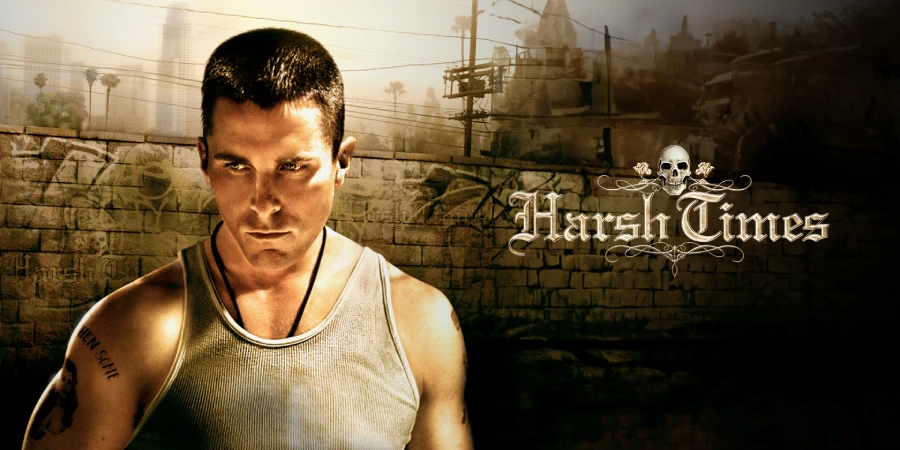

Christian Bale’s performance in Harsh Times is one of the most physically committed and morally uncomfortable pieces of acting in his career, and almost nobody talks about it. Jim Luther Davis is not a villain in any clean sense; he is a veteran sliding into something darker than PTSD, dragging his best friend down with him through the sunbaked streets of South Central Los Angeles. Writer-director David Ayer built this film as a kind of pressure cooker, and the lid blows off in the most irreversible way possible. If you have not seen it, everything below is a spoiler.
Detailed Summary
Jim Davis Returns Home
Jim Luther Davis, played by Christian Bale, comes back to Los Angeles after serving as an Army Ranger. He is haunted, volatile, and deeply in love with Marta, his girlfriend in Mexico. His plan is simple: get a law enforcement job, marry Marta, and build a life.
His best friend, Mike Alonzo, played by Freddy Rodriguez, is unemployed and under serious pressure from his girlfriend Sylvia to find work. The two men reconnect immediately, and their dynamic is warm, funny, and just slightly off from the start.
Days of Drifting and Drinking
Jim and Mike spend their days cruising the streets of South Central, drinking, smoking weed, and visiting old friends from the neighborhood. Bale plays Jim with a kind of manic cheerfulness that never quite covers the violence underneath. Every scene feels like a fuse burning.
Jim applies to the Los Angeles Police Department and various other agencies. He keeps getting rejected, partly because of psychological evaluations that flag something wrong. The rejections chip away at his optimism and fuel his instability.
The DHS Offer
Jim gets a surprising call from the Department of Homeland Security. They want him for a special operations role, apparently connected to his Army Ranger background. He goes through the process, and the job seems real, but it requires him to pass a drug test he knows he will fail.
Rather than clean up, Jim acquires clean urine to substitute during the test. He lies constantly, to Marta, to Mike, to himself. His self-deception is total and genuinely frightening to watch.
Jim’s Psychological Unraveling
Jim has recurring nightmares and waking visions connected to his time in the military, specifically to something traumatic in Guatemala. Ayer keeps the specifics deliberately murky. What matters is that Jim is not adjusting to civilian life; he is deteriorating inside it.
His behavior grows erratic. He pulls a gun on a group of gang members with startling ease. He shows no fear in situations where fear would be the rational response. Mike watches all of this and cannot quite bring himself to walk away.
Marta’s Visit and the Wedding Plan
Jim travels to Mexico to visit Marta and her family. He is genuinely tender with her, and those scenes briefly make you believe he might pull it together. Her family is skeptical, and for good reason.
Jim promises Marta he will bring her to the United States legally once the DHS job comes through. That promise becomes the emotional weight he carries for the rest of the film, and it is a weight he will not survive.
Spiraling Violence
Back in Los Angeles, Jim and Mike get deeper into dangerous territory. Jim begins selling drugs and carrying weapons more openly. A confrontation with a group of men escalates quickly because Jim refuses to de-escalate anything.
Mike keeps trying to pump the brakes. He has the job offer from Sylvia’s connections and a real future available to him. Jim makes staying in that reckless orbit feel like loyalty, and Mike buys it every time.
The DHS Job and the Final Deception
Jim gets the DHS job offer confirmed. For a moment, everything seems like it might work out. He calls Marta, he is elated, and Bale plays that elation with a raw desperation that makes it sad rather than hopeful.
Then Jim gets a phone call. The DHS has discovered he faked the drug test. The job is gone. Jim does not tell Mike immediately. He pretends everything is fine, and that silence is where the film’s final act ignites.


Movie Ending
Jim and Mike end up in a car together, and Jim finally confesses that the job fell through. What follows is one of the ugliest and most earned breakdowns in the film. Mike is furious, not just about the job, but about every lie Jim has told him across the entire story.
Jim pulls out a gun. The exact nature of what happens next is chaotic and fast. Jim shoots at pursuing police vehicles during a high-speed chase that Jim largely provokes by being Jim. The police shoot back.
Jim is killed in the gun battle, shot by police after he points his weapon at them. It is not framed as heroic or tragic in any cinematic sense; it is abrupt and unglamorous. Ayer does not let the audience grieve cleanly.
Mike survives. He is arrested at the scene. Sylvia watches the aftermath. Marta, across the border, never gets the life Jim promised her. Mike ends up in custody, his future with Sylvia almost certainly destroyed, collateral damage to a friendship he could not quit in time.
What makes the ending hit so hard is that it was always coming. Every scene before it was just Jim choosing the moment of ignition. Mike’s survival feels less like a gift and more like a sentence, because he has to live with having chosen Jim over everything that mattered to him.
Are There Post-Credits Scenes?
Harsh Times has no post-credits scene. Once the film ends, it ends. There is nothing waiting after the credits, which fits the movie’s blunt, unforgiving tone perfectly.
Type of Movie
Harsh Times is a crime drama with strong elements of psychological character study. It sits in the tradition of gritty Los Angeles street films, but its real interest is behavioral rather than plot-driven.
The tone is tense, darkly funny in places, and relentlessly pessimistic. This is not an action film, even though it contains action. It is a film about a man who is already broken before the story begins.
Cast
- Christian Bale – Jim Luther Davis
- Freddy Rodriguez – Mike Alonzo
- Eva Longoria – Sylvia
- Tammy Trull – Marta
- Chaka Forman – Darrell
- Terry Crews – Coates
Film Music and Composer
The score for Harsh Times was composed by Graeme Revell, a composer known for working on tense, urban-set films. His work here leans into low, percussive textures that complement the film’s street-level atmosphere.
The soundtrack also incorporates hip-hop and rap music consistent with the South Central setting, which grounds each scene in a specific cultural and geographic reality. Music in this film functions as environment, not commentary.


Filming Locations
Principal photography took place in Los Angeles, California, primarily in South Central and surrounding neighborhoods. David Ayer grew up in South Central, and that personal geography shows in every frame.
Sequences in Mexico were filmed to represent Jim’s visits to Marta, and they contrast visually with the harder, more concrete textures of the LA scenes. Those quieter, sun-warmed Mexican scenes are the only moments where Jim looks genuinely at peace, which makes them painful in retrospect.
Ayer’s decision to shoot on actual streets rather than controlled sets gives Harsh Times a documentary-adjacent quality. These are real corners, real storefronts, real neighborhoods. That specificity matters enormously to the film’s credibility.
Awards and Nominations
Harsh Times did not receive major awards recognition during its release cycle. Christian Bale’s performance attracted critical attention, but the film largely flew under the radar during awards season.
Behind the Scenes Insights
- David Ayer wrote the script based partly on his own experiences growing up in South Central Los Angeles, which gave the story an autobiographical texture.
- Christian Bale reportedly immersed himself deeply in preparation for the role, consistent with his well-documented approach to physical and psychological character work.
- Freddy Rodriguez, largely known at the time for television work, held his own against Bale in every scene, which is no small feat.
- The film was produced independently and shot on a relatively modest budget, which contributed to its rough, unpolished visual quality.
- Ayer had already written Training Day before directing Harsh Times, giving him strong credibility in the Los Angeles crime drama space.
Inspirations and References
David Ayer drew directly from his childhood in South Central, and that personal history is the film’s most important source material. Harsh Times is not an adaptation; it is an excavation of a specific place and demographic.
The film sits in conversation with earlier Los Angeles crime films, particularly those dealing with veterans and the difficulty of re-entry into civilian life. John Huston’s The Asphalt Jungle and films about disaffected masculinity in urban settings are spiritual predecessors, though Ayer’s approach is grittier and more personal.
The treatment of PTSD and military trauma also references a broader conversation about veterans returning from conflicts in the early 2000s, giving Jim’s psychology a political undercurrent that Ayer never overexplains.
Alternate Endings and Deleted Scenes
No widely documented alternate endings or significant deleted scenes from Harsh Times have entered public record. The theatrical cut appears to represent Ayer’s intended version of the story.
Given how cleanly the ending lands, it is hard to imagine a substantially different version existing. The finality of Jim’s death feels like the only logical conclusion to the screenplay Ayer wrote.
Book Adaptations and Differences
Harsh Times is an original screenplay written by David Ayer. It is not based on any novel, memoir, or other published source material. No book-to-film comparison applies here.



Memorable Scenes and Quotes
Key Scenes
- Jim and Mike cruising through South Central early in the film, laughing and drinking, establishing their chemistry before the darkness fully arrives.
- Jim pulling a weapon during a neighborhood confrontation with a casualness that stops every scene cold; Bale barely raises his voice, which is scarier than any shout would be.
- Jim’s visit to Marta in Mexico, particularly the quiet domestic scenes at her family’s home, where Bale physically softens in ways he does not allow anywhere else in the film.
- The moment Jim confesses to Mike that the DHS job is gone; Freddy Rodriguez’s reaction, furious and exhausted, is the most emotionally precise piece of acting in the film.
- The final chase and shooting, chaotic and brief, refusing to dramatize Jim’s death into anything meaningful.
Iconic Quotes
- “I’m a soldier. I go to war. That’s what I do.” Jim’s self-definition that explains everything and nothing about why he cannot stop.
- Jim repeatedly calling Mike by various terms of affection throughout the film, which lands differently by the end when you understand what that friendship cost Mike.
Easter Eggs and Hidden Details
- Ayer includes visual details from actual South Central neighborhoods that locals would recognize, grounding the fiction in documentary specificity.
- Jim’s psychological evaluation failures are referenced early and briefly, planting the seeds of his disqualification long before the DHS plot thread arrives.
- The contrast between Jim’s demeanor in Mexico versus Los Angeles is never explicitly commented on by any character, but the visual difference in Bale’s posture and eye contact is consistent and deliberate.
- Terry Crews appears in a relatively small role, but his physical presence in scenes with Bale creates an interesting tension between two performers known for intensity.
Trivia
- Harsh Times was David Ayer’s directorial debut feature, making it a significant entry in his filmography beyond its standalone merits.
- Christian Bale shot this film during a period when he was taking on a wide variety of character-driven roles, demonstrating range far beyond his blockbuster work.
- Freddy Rodriguez was cast partly against type, given his profile as a comedic and dramatic television actor rather than a street-level crime film lead.
- The film sat on the shelf for a period before receiving its theatrical release, which affected its commercial visibility.
- Eva Longoria was at the height of her Desperate Housewives fame when she appeared in this film, making her casting a minor piece of counter-programming against her public image at the time.
Why Watch?
Christian Bale plays Jim Davis with a grinning, sun-drunk menace that never tips into caricature, and watching him dismantle Freddy Rodriguez’s careful, hopeful Mike scene by scene is genuinely gutting. Ayer’s script trusts the audience to understand Jim’s damage without spelling it out in therapy-session dialogue. Those two choices alone make this a better film than its reputation suggests.
Director’s Other Movies
- Street Kings (2008)
- End of Watch (2012)
- Sabotage (2014)
- Fury (2014)
- Suicide Squad (2016)
- Bright (2017)
- The Beekeeper (2024)
Recommended Films for Fans
- Training Day (2001)
- End of Watch (2012)
- Boyz n the Hood (1991)
- Menace II Society (1993)
- The Wrestler (2008)
- Bringing Out the Dead (1999)
- Narc (2002)