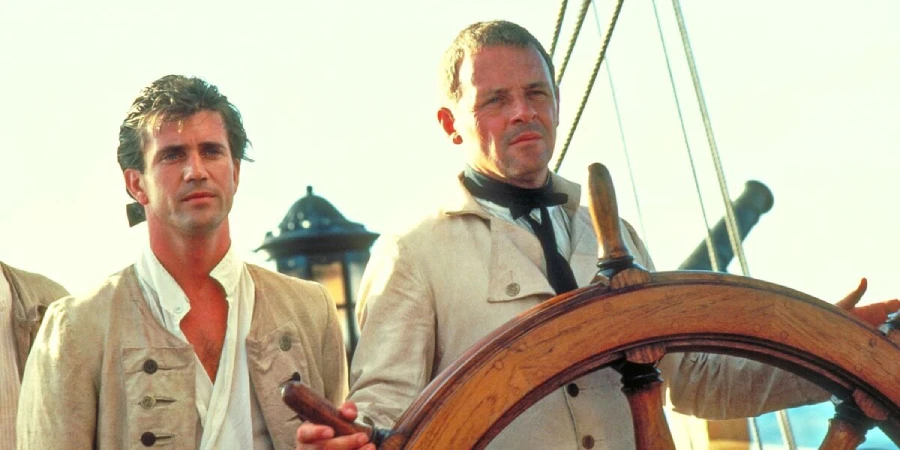

Mel Gibson plays Fletcher Christian as a man genuinely seduced by paradise, not simply a rebel with a grudge, and that single reframing makes The Bounty (1984) one of the most psychologically honest takes on one of history’s most retold mutinies. Director Roger Donaldson strips away the romanticized swashbuckling of earlier versions and gives us two men, Christian and Bligh, who are both right and both catastrophically wrong. Anthony Hopkins plays Bligh with a rigidity that earns your sympathy even as it infuriates you.
Detailed Summary
The Court-Martial Frame
The film opens at Bligh’s court-martial in England. He sits before naval officers and recounts the events aboard HMS Bounty, and Donaldson uses this framing device to signal that the film is interested in judgment, not spectacle. We know from the first scene that Bligh survived, which quietly shifts our anxiety toward Christian’s fate.
Departure and Early Tensions Aboard the Bounty
Bligh selects Fletcher Christian as his master’s mate, trusting him above most of the crew. Their friendship carries genuine warmth in these early scenes. Gibson and Hopkins share a relaxed chemistry that makes the later rupture feel genuinely costly.
Bligh runs a tight ship, but Donaldson is careful not to paint him as a monster. His discipline is calculated and, by the standards of the Royal Navy, relatively moderate. The crew chafes anyway.
The Voyage South and Cape Horn
Bligh’s first major decision drives a wedge between himself and the crew. He attempts to round Cape Horn in brutal weather, repeatedly pushing into storms that batter the ship and exhaust the men. After weeks of punishment, he turns back and charts a course around the Cape of Good Hope instead.
That reversal costs him credibility. Sailors read it as a sign of indecision. Christian says little, but Gibson lets exhaustion and doubt register in his posture and silence.
Tahiti and the Long Stay
Arrival in Tahiti changes everything. Donaldson photographs the island with a warmth and lushness that makes England feel like a grey dream barely worth remembering. The crew stays for months collecting breadfruit plants, and in that time the men weave themselves into the fabric of Tahitian life.
Christian falls into a genuine love affair with Mauatua, played by Tevaite Vernette. This is not a casual shore romance. He learns her language, shares her daily life, and the film makes clear that he is losing interest in ever going back.
Bligh, to his credit, does not forbid these relationships. His mistake is assuming that the crew can simply detach when the order comes to sail. He does not understand what he is asking them to give up.
Departure from Tahiti and the Slow Collapse of Discipline
Leaving Tahiti breaks something in the men. Donaldson shoots the departure with little music and lots of silence. Men stare back at the receding island. Gibson’s Christian looks like a man walking away from his own life.
Bligh’s discipline reasserts itself with force once they are at sea. He rations food, including the crew’s own provisions to protect the breadfruit. He publicly humiliates officers, including Christian, in front of the lower deck. That public shaming is the cruelest detail, and Hopkins plays it not with sadism but with cold administrative certainty.
The Mutiny
Christian does not plan the mutiny. That is the film’s most important argument. He wakes before dawn, grabs a weapon almost impulsively, and within minutes he has Bligh at knifepoint on the quarterdeck. Gibson plays the scene with shaking hands and wide eyes, not the controlled fury of a man executing a plan.
Bligh and the loyalists get bundled into an open launch with minimal supplies. Bligh, defiant and composed, stares back at Christian as the launch drifts away. Hopkins keeps Bligh’s face unreadable in that moment, which is the right call; the scene lands harder because of it.
Bligh’s Open-Boat Voyage
Donaldson devotes real screen time to Bligh’s survival ordeal. Crossing nearly 4,000 miles of open ocean with a handful of loyal men is presented as a feat of extraordinary seamanship. Hopkins carries these scenes with quiet, grinding authority. Bligh rations water by the spoonful, navigates by memory and instinct, and holds frightened men together through sheer force of will.
This is where the film genuinely complicates any simple reading of Bligh as the villain. He is tyrannical and brilliant, petty and heroic, often in the same breath.
The Mutineers Return to Tahiti
Christian sails the Bounty back to Tahiti. Some of the mutineers choose to stay on the island, knowing that Royal Navy pursuit is inevitable. Christian understands that staying means capture and execution. He recruits a smaller group, takes Mauatua and several other Tahitian men and women, and sails away to find a hiding place.


Movie Ending
Christian leads a small group to Pitcairn Island, a remote and largely uncharted outcrop in the South Pacific. They strip the Bounty of everything useful, then burn her to the waterline. Watching the ship burn, Christian knows there is no going back, literally and completely. Gibson plays the moment not with triumph but with a kind of hollow exhaustion, a man who made a choice and is now living inside the consequences of it.
Back in England, Bligh’s court-martial concludes. He is acquitted, and the film treats this outcome with careful ambiguity. The naval court praises his seamanship and survival. Nobody in that room discusses whether his command style provoked what happened. Institutional Britain closes ranks around its own.
Christian’s fate on Pitcairn is left open by the film, though history records that he died there, likely killed by Tahitian men in the community he built. Donaldson does not show this. He ends on the burning ship. That choice is deliberate and, in my view, correct. A depiction of Christian’s death would have turned the film into a morality tale. Ending on the fire keeps it a tragedy about appetite and belonging.
What the ending really asks is whether Christian won or lost. He escaped the Navy. He kept the woman he loved. He also destroyed his career, his country, his ship, and eventually himself. Donaldson refuses to answer the question for you.
Are There Post-Credits Scenes?
No. The Bounty has no post-credits scenes of any kind. Once the film ends, it ends.
Type of Movie
This is a historical drama with strong character-study elements. Its tone is serious, measured, and occasionally somber. Do not approach it expecting an adventure film; the pacing is deliberate and the film rewards patience rather than adrenaline.
There are action sequences, including the mutiny itself, but Donaldson frames them as psychological events rather than set pieces. This film sits much closer to a courtroom drama than to a swashbuckler.
Cast
- Mel Gibson – Fletcher Christian
- Anthony Hopkins – Lieutenant William Bligh
- Laurence Olivier – Admiral Hood
- Edward Fox – Captain Greetham
- Daniel Day-Lewis – John Fryer
- Bernard Hill – William Cole
- Liam Neeson – Charles Churchill
- Wi Kuki Kaa – King Tynah
- Tevaite Vernette – Mauatua
Film Music and Composer
Vangelis composed the score. His synthesizer-driven style might seem like an odd pairing for an eighteenth-century naval story, but it works. The music gives the Tahitian sequences a dreamy, almost hallucinatory warmth that acoustic period instruments could not have achieved.
Vangelis had come off his Oscar-winning score for Chariots of Fire when he took this project. His approach leans into texture and atmosphere over melody, which suits a film more interested in mood and psychology than in narrative momentum.
The score’s most effective passages accompany the open-boat sequences. Sparse, cold, and quietly ominous, the music mirrors Bligh’s situation without over-explaining it emotionally.

Filming Locations
Principal photography took place in Tahiti and the surrounding French Polynesian islands. Donaldson filmed in the actual landscape where much of the historical story unfolded, which gives the Tahitian sequences a grounded, documentary weight.
A full-scale replica of the HMS Bounty was constructed for filming. Sea sequences were shot in genuinely open water, which meant unpredictable conditions and physically demanding work for the cast and crew.
Some interior and court-martial sequences were filmed in England, providing a stark visual contrast to Tahiti. The grey, enclosed spaces of the English scenes make the Pacific sequences feel even more like another world.
Awards and Nominations
The Bounty received a BAFTA nomination for Anthony Hopkins for Best Actor in a Supporting Role. It did not collect major awards, which remains a mild injustice given the quality of the central performances.
Behind the Scenes Insights
- The project had a long and complicated development history. David Lean was originally attached to direct, and his vision would have produced a far longer and more epic-scaled film. When Lean departed, Donaldson came aboard with a leaner approach.
- Mel Gibson was relatively early in his international career when he took the role of Christian. His casting brought a restless physical energy that the role needed.
- Anthony Hopkins prepared extensively for Bligh, researching the historical record and the actual court-martial documents. His portrayal is specifically informed by Bligh’s own logs.
- Daniel Day-Lewis appears in a supporting role as John Fryer. It is a small part, but watching it now, knowing what Day-Lewis would become, gives the film an accidental curiosity value.
- Liam Neeson also appears in an early role, part of a remarkable ensemble of future major stars assembled almost by accident in a single production.
- Shooting on open water created genuine physical hardship. Cast members reported exhausting and occasionally dangerous conditions during the sea sequences.
- The replica Bounty built for the film was a significant practical undertaking. The production invested heavily in historical authenticity for the ship’s design and rigging.
Inspirations and References
The film draws directly from the historical record of the 1789 mutiny aboard HMS Bounty. It is specifically adapted from Richard Hough’s book Captain Bligh and Mr. Christian, which offered a revisionist and more sympathetic reappraisal of Bligh compared to earlier popular accounts.
Hough’s research challenged the villainous Bligh of earlier films, particularly the 1935 version with Charles Laughton and Clark Gable. The Bounty (1984) deliberately positions itself against that earlier mythology.
Bligh’s actual logbooks and the records of his court-martial also informed the screenplay, which Robert Bolt wrote. Bolt had previously written A Man for All Seasons and Lawrence of Arabia, and his interest in men trapped between conscience and institution runs through all three projects.
Alternate Endings and Deleted Scenes
No officially released alternate endings or significant deleted scenes have been made public for The Bounty. Given David Lean’s original involvement, an entirely different and substantially longer film existed at one point in development, but those materials have not surfaced in any accessible form.
Robert Bolt’s screenplay reportedly covered more of the Pitcairn Island story than what appears in the final cut. The decision to end on the burning ship rather than dramatizing Christian’s eventual death appears to have been a late editorial choice.
Book Adaptations and Differences
The film adapts Captain Bligh and Mr. Christian by Richard Hough. Hough’s book is a thorough historical reassessment that draws on primary sources, and the film follows his argument closely: Bligh was not a villain, Christian was not a hero, and the mutiny was a psychological event as much as a practical one.
The book covers the Pitcairn settlement in greater detail than the film does. It also addresses the later fates of the mutineers who remained on Tahiti and were eventually captured by the Navy. The film largely skips this material to stay focused on the two central figures.
Hough’s account of Bligh’s open-boat voyage is particularly detailed, and the film condenses this section significantly while preserving its essential drama.
Memorable Scenes and Quotes
Key Scenes
- Bligh publicly dressing down Christian in front of the crew on the open deck, his voice controlled and precise, Christian standing rigid with humiliation while the lower-deck sailors watch.
- Christian seizing Bligh at gunpoint before dawn, hands visibly unsteady, the whole scene lit in grey pre-dawn half-darkness that makes it feel impulsive and irreversible.
- Bligh in the open launch, rationing water with a spoon while men around him barely hold themselves together, Hopkins sitting straight-backed in an open boat on genuinely open ocean.
- The departure from Tahiti, shot in near-silence, men staring back at the island as it shrinks behind them, no score, no dialogue, just wind and water.
- The Bounty burning at Pitcairn, Christian watching from the beach as the ship he hijacked and the life he knew disappear into smoke together.
Iconic Quotes
- “I am not a violent man, Mr. Christian. But I will use whatever force is necessary to complete this voyage.” (Bligh, asserting authority early in the voyage)
- Bligh to the mutineers from the launch: “I’ll see you all hang.”
Easter Eggs and Hidden Details
- Watch the court-martial scenes carefully: the framing keeps Bligh small within grand naval architecture, visually suggesting that the institution dwarfs the individual even as it supposedly judges him.
- Donaldson uses color temperature as a consistent storytelling device. England and the ship are shot in cool blues and greys. Tahiti shifts into warm yellows and deep greens. Once the mutineers leave Tahiti for the last time, the warm palette begins bleeding away even on the open ocean.
- Gibson’s Christian speaks less and less as the film progresses. Early scenes show him as talkative and engaged. By the time he seizes Bligh, his dialogue has dwindled almost entirely to commands and single words. The screenplay quietly tracks his psychological retreat.
- The replica Bounty was rigged with period-accurate detail, and sailors with historical knowledge will notice that the production took the authenticity of the rigging seriously rather than approximating it for camera convenience.
Trivia
- Robert Bolt suffered a stroke during the production, which complicated the later stages of filmmaking and may have affected the final shape of the script.
- David Lean’s version was planned as a two-part epic. The single theatrical feature that resulted is significantly shorter than Lean’s vision would have been.
- This was the third major Hollywood adaptation of the Bounty story, following the 1935 version with Charles Laughton and Clark Gable and the 1962 version with Trevor Howard and Marlon Brando.
- Anthony Hopkins and Mel Gibson would later appear together again in The Edge (1997), where their dynamic is almost inverted from this film.
- Vangelis composed the score without visiting any of the filming locations, working entirely from the footage sent to him.
- The production used Tahitian performers and community members extensively in the island scenes, lending authenticity to the Polynesian cultural depictions.
- Liam Neeson, Daniel Day-Lewis, and Mel Gibson all appearing in the same film makes the cast an accidental snapshot of a particular generation of leading men before any of them reached full stardom.
Why Watch?
Watch this film specifically for Anthony Hopkins, who makes Bligh the most complicated figure in the room without ever asking for your sympathy directly. His performance in the open-boat sequences, back straight, voice measured, rationing water by the spoonful, is the kind of acting that makes you forget you are watching acting. Gibson matches him more than most reviews credit.
Director’s Other Movies
- Sleeping Dogs (1977)
- Smash Palace (1981)
- No Way Out (1987)
- Cocktail (1988)
- Cadillac Man (1990)
- White Sands (1992)
- The Getaway (1994)
- Species (1995)
- Dante’s Peak (1997)
- Thirteen Days (2000)
- The Recruit (2003)
Recommended Films for Fans
- Mutiny on the Bounty (1935)
- Mutiny on the Bounty (1962)
- Master and Commander: The Far Side of the World (2003)
- A Man for All Seasons (1966)
- Lawrence of Arabia (1962)
- The Mission (1986)
- Gallipoli (1981)
- Papillon (1973)