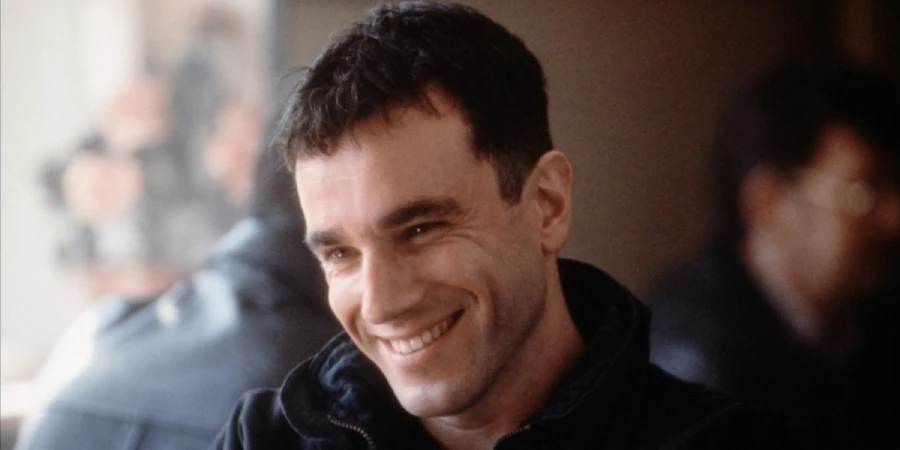

Daniel Day-Lewis spent fourteen years in prison for a crime tied to the IRA, and when he walks out in Jim Sheridan’s The Boxer, his shoulders carry every single one of those years. This is a film about a man trying to live without sides, in a city that punishes exactly that. Sheridan shoots Belfast with a grey, bruised palette that makes the peace process feel not like hope, but like an exposed nerve. Day-Lewis and Emily Watson together are simply one of the most quietly devastating screen pairings of the late 1990s.
Detailed Summary
Danny Flynn Walks Free
Danny Flynn (Daniel Day-Lewis) is released from prison after serving fourteen years for IRA-related offenses. He never gave up names. That silence bought him his sentence, and he accepts it without bitterness.
He returns to his old Belfast neighborhood and finds a world that has moved on without him. His former girlfriend, Maggie (Emily Watson), is now the wife of an imprisoned IRA man named Liam, and therefore off-limits under republican community rules. She also has a son, Liam Jr., from that marriage.
Rebuilding at the Holy Family Gym
Danny reconnects with his old trainer, Ike Weir (Ken Stott), and together they reopen the Holy Family Boxing Club in the heart of a republican area. Their explicit goal is to make it nonsectarian, open to both Catholic and Protestant boys. In 1990s Belfast, this is not a neutral act; it is a provocation to people who profit from division.
Danny’s commitment to the gym is his way of building a life outside politics. He wants to box, train kids, and stay clear of the IRA. Both activities, the gym and his relationship with Maggie, make that impossible.
Joe Hamill and the Fragile Ceasefire
Joe Hamill (Brian Cox) is a senior IRA leader and Maggie’s father. He supports the ongoing peace negotiations and sees the ceasefire as the only viable path forward for his community. Cox plays Hamill as a man genuinely exhausted by violence, navigating the politics of a movement that contains people who would rather fight than win.
Opposing him is Harry (Gerard McSorley), a hardline republican who views the peace talks as surrender. Harry resents Danny’s return and sees the nonsectarian gym as an insult. McSorley plays Harry as coiled, mean, and certain, which makes him the film’s most believable antagonist.
Danny and Maggie Circle Each Other
Danny and Maggie’s relationship rebuilds slowly and carefully. Watson plays Maggie as a woman trapped between love and loyalty, aware that any move toward Danny could destroy her father’s political position and endanger Danny’s life. Their scenes together are studies in restraint, two people communicating through proximity and hesitation rather than declarations.
A particularly strong moment comes when Danny watches Maggie from across a street. He does not move toward her. He just watches, and Day-Lewis holds his jaw tight and lets his eyes do everything.
The Gym Becomes a Target
Harry and his faction view the Holy Family gym with increasing hostility. When Protestant boys train alongside Catholic boys under Danny’s roof, it becomes a symbol of everything the hardliners reject. Ike gets beaten. The gym is attacked. Danny keeps showing up anyway.
Danny also resumes his boxing career at a serious level, fighting in bouts that showcase Sheridan’s precise, unglamorous depiction of the sport. These are not Rocky-style crowd pleasers. The fights are short, brutal, and deeply physical, with Day-Lewis moving in a style that clearly reflects genuine training.
Harry Moves Against Danny
Harry orchestrates a bomb attack that kills British soldiers and derails the ceasefire negotiations Hamill has been carefully nurturing. This is partly a political act and partly personal: Harry wants chaos, and chaos will swallow Danny along with everything else. Hamill is furious, but his authority within the movement is not absolute.
Harry’s faction kills a British officer in a carefully staged provocation. Hamill confronts Harry and the tension between them escalates to the point where Hamill orders Harry’s execution to protect the peace process. It is a cold, political decision, and Cox delivers it with a stillness that makes it land harder than any explosion.
Danny’s Biggest Fight
Danny gets a high-profile boxing match that draws attention from outside Belfast. His performance impresses and confirms he could have had a real professional career if his youth had not been swallowed by the Troubles. Day-Lewis reportedly trained for two years to reach the level of physical credibility on display here, and it shows in every combination he throws.

Movie Ending
With Harry dead and the ceasefire in renewed jeopardy, Hamill faces a choice between protecting his community’s political future and protecting his daughter’s happiness. He decides, quietly and with visible grief, to release Maggie from her obligations. He tells her she has the right to live her life.
Danny and Maggie finally allow themselves to be together openly. It is not a triumphant romantic finale. Sheridan frames it as something tentative, a beginning made under enormous pressure, with no guarantee it survives the politics still churning around them. Their final scene together is lit softly, almost washed out, as if the film is afraid to commit too hard to optimism.
What Sheridan argues in the closing minutes is that peace is not a destination; peace is a daily, costly choice made by people who absorb punishment for it. Danny’s fourteen years of silence, Hamill’s willingness to order a killing to protect negotiations, Maggie’s years of loneliness: all of it feeds into a fragile ending that feels earned rather than happy. The film does not promise these characters safety. It promises them a chance.
Are There Post-Credits Scenes?
The Boxer has no post-credits scene. When the film ends, it ends completely. Sit with it.
Type of Movie
The Boxer is a political drama with elements of romance and sports. Its tone is restrained, grey, and melancholic. Sheridan never lets the boxing become metaphor in an obvious way; he respects the sport as the sport, and lets the political material carry the weight of the themes.
Viewers expecting a conventional boxing film will find something much quieter and more demanding. Those who connect with it will find it genuinely moving.
Cast
- Daniel Day-Lewis – Danny Flynn
- Emily Watson – Maggie
- Brian Cox – Joe Hamill
- Ken Stott – Ike Weir
- Gerard McSorley – Harry
- Ian McElhinney – Danny’s Father
- Ciaran Fitzgerald – Liam Jr.
- Kenneth Cranham – Matt MacGreevy
Film Music and Composer
The score was composed by Gavin Friday and Maurice Seezer, who had previously collaborated with Sheridan on In the Name of the Father. Their music for The Boxer leans into atmosphere rather than sentiment, using sparse instrumentation that matches the film’s emotional restraint.
Friday and Seezer avoid the temptation to sweeten difficult scenes with swelling strings. Their score feels like it belongs to Belfast’s streets rather than to a cinema orchestra pit, which is exactly the right instinct for this material.

Filming Locations
Principal photography took place in Belfast, Northern Ireland. Shooting in the actual city rather than a studio recreation gives the film a texture that no production design budget could replicate. The murals, the terraced housing, the wet grey light: all of it is real.
Some sequences were also filmed in Dublin. Shooting during the mid-1990s, as the peace process was genuinely unfolding, added an urgency and authenticity to the production that Sheridan acknowledged shaped how the crew approached the material on a daily basis.
Awards and Nominations
Emily Watson received a Golden Globe nomination for Best Actress in a Drama. The film received modest recognition during the 1997-1998 awards season but did not secure major wins at the top ceremony level.
Behind the Scenes Insights
- Daniel Day-Lewis trained seriously as a boxer for approximately two years before filming began, working with professional coaches to reach a credible competitive level.
- Jim Sheridan and Day-Lewis had previously collaborated on My Left Foot and In the Name of the Father, making The Boxer the third film in their working partnership.
- Sheridan conducted extensive research into the Northern Ireland peace process and consulted people directly involved in the political situation of the period.
- Emily Watson prepared for the role by spending time in Belfast to absorb the rhythms of the community she was portraying.
- Shooting in Belfast during a politically sensitive period required careful coordination with local communities and awareness of real-world tensions that occasionally mirrored the film’s story.
Inspirations and References
The Boxer draws directly on the social and political reality of Northern Ireland during the mid-1990s peace process. Sheridan and co-writer Terry George (who also co-wrote In the Name of the Father) built the story around characters navigating a specific historical moment rather than a generic conflict backdrop.
The nonsectarian boxing club at the center of the story has real-world precedents. Community sports programs in Belfast genuinely served as spaces where division could be, at least temporarily, suspended. Sheridan uses that context to ground Danny’s project in something recognizable to Belfast audiences.
Thematically, the film shares DNA with Sheridan’s ongoing preoccupation with Irish identity, state violence, and personal integrity under political pressure, threads he pulled through My Left Foot and In the Name of the Father before arriving here.
Alternate Endings and Deleted Scenes
No officially documented alternate endings or deleted scenes for The Boxer have been released or widely reported. Sheridan is not a director known for extended home video supplements or alternate cut releases, and no significant cut content from this film has entered the public record.
Book Adaptations and Differences
The Boxer is not based on a book. Sheridan and Terry George wrote an original screenplay. No source novel or memoir underpins the story.


Memorable Scenes and Quotes
Key Scenes
- Danny’s release from prison: He walks out, squints at daylight, and says almost nothing. Day-Lewis communicates fourteen years of compressed feeling through posture alone.
- The Holy Family gym reopening: Protestant and Catholic boys train together in a room still bearing the marks of sectarian damage. The scene is quiet and its significance deliberately understated.
- Danny watching Maggie from across the street: He stands still, jaw set, hands at his sides. Watson glances up and holds the look for just a beat. No words. No movement. Among the best two seconds in either actor’s career.
- Hamill ordering Harry’s execution: Cox delivers the order without raising his voice. The camera stays on his face after he speaks, and the exhaustion there is absolute.
- Danny and Maggie’s final scene: Tentative, lit almost without contrast, refusing to perform joy. Sheridan trusts the audience to feel it without underlining it.
Iconic Quotes
- “I’m not your enemy.” – Danny Flynn
- “Fourteen years and you never gave a name. That’s not nothing.” – Joe Hamill
Easter Eggs and Hidden Details
- The murals visible in background shots during Belfast street scenes are authentic political murals from the period, not set dressing, giving viewers a documentary-style record of the visual landscape of 1990s republican Belfast.
- The Holy Family gym’s name carries quiet religious weight in a film deeply concerned with community identity, though Sheridan never draws explicit attention to the symbolism.
- Some of the extras in crowd and street scenes are Belfast residents, which gives the community scenes a density and authenticity that professional extras would not produce.
- Day-Lewis’s footwork and guard position in the boxing sequences reflect a specific amateur Irish boxing style rather than a generic Hollywood approximation, a detail that serious boxing fans notice immediately.
Trivia
- The Boxer was the third consecutive collaboration between Daniel Day-Lewis and Jim Sheridan, following My Left Foot (1989) and In the Name of the Father (1993).
- Day-Lewis is widely reported to have trained to a standard where he could hold his own against professional fighters, a claim consistent with the footage on screen.
- Emily Watson had broken out internationally just the previous year in Lars von Trier’s Breaking the Waves, making her casting here a statement about the kind of emotional register Sheridan wanted from the role of Maggie.
- Brian Cox, who plays Hamill with such measured authority, had spent years in both British theatre and American film by this point, and brings a particular quality of practiced control to a role that demands exactly that.
- Terry George, Sheridan’s co-writer, went on to direct Hotel Rwanda (2004), demonstrating a consistent authorial interest in political conflict and moral courage under pressure.
Why Watch?
Day-Lewis’s physicality here is specific in a way that almost no other actor would attempt: he throws combinations with genuine weight transfer, and his body between rounds tells you more about Danny’s psychology than any monologue could. Watson matches him scene for scene with a stillness that is genuinely difficult to achieve on camera. If you want to watch two of the finest screen performances of the 1990s working in near-silent dialogue, this is the film to choose.
Director’s Other Movies
- My Left Foot (1989)
- The Field (1990)
- In the Name of the Father (1993)
- In America (2002)
- Get Rich or Die Tryin’ (2005)
- Brothers (2009)
Recommended Films for Fans
- In the Name of the Father (1993)
- Breaking the Waves (1996)
- Michael Collins (1996)
- Bloody Sunday (2002)
- Hunger (2008)
- ’71 (2014)