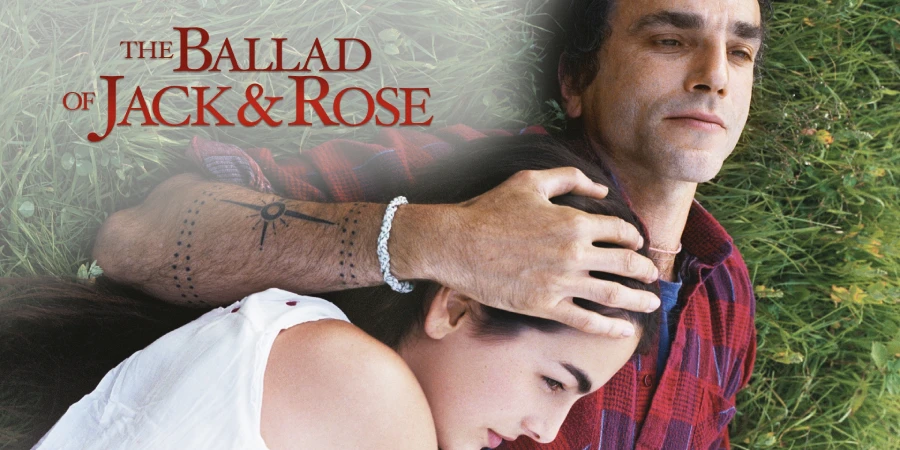

A father and daughter live alone on a crumbling commune in the American Northeast, and that isolation is already unsettling before the film introduces a girlfriend, two teenage stepdaughters, and a slow-burning catastrophe of desire. The Ballad of Jack and Rose (2005), written and directed by Rebecca Miller, is the kind of film that makes you hold your breath not because something violent is coming, but because you sense the emotional damage accumulating in real time.
Daniel Day-Lewis plays Jack Slavin with a gauntness that reads as spiritual exhaustion, a man who built a utopia and then stayed too long after everyone else left. This is a small, daring film that most audiences missed entirely, and that is their loss.
Detailed Summary
The Commune at the End of the World
Jack and his teenage daughter Rose (Camilla Belle) live alone on what remains of a 1960s commune on a barrier island. Jack has a serious heart condition, and it is clear he will not live much longer. He has kept Rose entirely isolated from the outside world, homeschooling her, raising her on idealistic principles, and unwittingly making himself the center of her entire emotional universe.
Rose knows nothing outside her father. She shoots small animals with a bow and arrow, wanders the property barefoot, and watches with suspicion as a nearby developer begins bulldozing land to build cookie-cutter houses. Jack sabotages one of the construction sites early in the film, and Rose assists him eagerly. Their bond feels less like a healthy parent-child relationship and more like two survivors clinging to each other on a shrinking raft.
Kathleen and Her Daughters Arrive
Alarmed by Rose’s isolation and by his own deteriorating health, Jack invites his girlfriend Kathleen (Catherine Keener) to move onto the commune with her two sons, Thaddeus (Paul Dano) and Rodney (Ryan McDonald). Rose is immediately, ferociously hostile. She sees Kathleen as an intruder contaminating the sacred space she shares with her father.
Kathleen is practical, warm, and slightly overwhelmed. She tries to connect with Rose and mostly fails. Her sons bring an entirely different energy: Thaddeus is sullen and passive, while Rodney is louder and more sexually aggressive. The commune suddenly has the chaotic atmosphere of a blended family nobody actually agreed to form.
Rose’s Dangerous Fixation
Rose’s jealousy curdles into something darker as the film progresses. She decides, with a teenager’s lethal single-mindedness, to seduce Thaddeus. Her goal is not really desire; it is disruption. She wants to blow up the new domestic arrangement and reclaim her father entirely.
She succeeds in manipulating Thaddeus into a sexual encounter. He is clearly uncomfortable, uncertain, and easily led. Paul Dano plays the scene with a slumped passivity that makes it quietly disturbing rather than lurid. Rose weaponizes her own inexperience, and the film does not let any party off the hook cleanly.
The Revelation About Rose’s Mother
One of the film’s most quietly devastating turns arrives when Rose learns that her mother is not dead, as she had essentially been led to believe. Her mother, Anika (Beau Bridges plays the outside male world; the mother is played by Jena Malone in an early cameo-length appearance), had left the commune and Jack years earlier. Jack’s silence on this subject amounts to a profound act of erasure.
Rose tracks down her mother, and the meeting is cold, strange, and deeply unsatisfying for Rose. Her mother has moved on, has her own life, and cannot give Rose the miraculous reconnection she craved. This encounter pushes Rose further into desperation. She returns to the commune more unmoored than ever.
Jack’s Decline and the Final Confrontation
Jack’s health deteriorates visibly across the second half of the film. He sleeps more, moves slower, and his arguments about the commune’s purpose grow more philosophical and detached from practical reality. Day-Lewis plays this physical diminishment with exact care: the man’s body becomes a kind of archive of all the choices he made.
Rose, watching her father fade, grows increasingly erratic. She burns down one of the newly constructed development houses in a rage. The act feels both political and personal, a scream at everything threatening to replace what she loves. Jack does not stop her; he is too weak, and some part of him still shares her fury at what is encroaching.
Movie Ending
Jack dies near the end of the film, and the manner of it is quiet and devastating. He dies at the commune, on his own land, which is the only ending he ever wanted. Rose is present. The scene does not dramatize his death with swelling music or heavy dialogue; director Rebecca Miller simply lets it happen in front of the camera with minimal ornamentation, and Day-Lewis makes every labored breath count.
What makes the ending genuinely difficult is what Rose must do next: live. Jack built a world that required his presence to function, and without him it immediately begins to dissolve. Kathleen and her sons leave. Rose stands at the edge of a property that represents both her entire childhood and a kind of psychological prison she never chose to enter.
In the film’s final passages, Rose steps, for the first time, into a version of ordinary life. She has a brief interaction with the outside world that carries none of the charged symbolism of her commune existence. It is deliberately anti-climactic. Miller refuses to offer catharsis or rescue. Rose is damaged, unformed, and young, and the film closes on that uncomfortable truth rather than resolving it.
What audiences most often puzzle over is whether Rose will be okay. Miller’s answer seems to be: possibly, but not easily, and not soon. The film earns its ambiguity because it spent every prior scene showing us exactly what Jack’s devotion cost his daughter.
Are There Post-Credits Scenes?
No. The Ballad of Jack and Rose has no post-credits sequence of any kind. Once the film ends, it ends. Given the film’s deliberately understated register, a post-credits scene would be jarring anyway.
Type of Movie
This is a drama with strong elements of psychological character study. It sits comfortably alongside films about isolation, generational damage, and the unintended consequences of idealism. The tone is mournful and tense, with occasional lyrical stretches of natural beauty that feel genuine rather than decorative.
It is not a thriller, though it carries low-grade dread throughout. Some critics have labeled it a family drama, which is technically accurate but undersells how strange and uncomfortable the film actually is.
Cast
- Daniel Day-Lewis – Jack Slavin
- Camilla Belle – Rose Slavin
- Catherine Keener – Kathleen
- Paul Dano – Thaddeus
- Ryan McDonald – Rodney
- Jena Malone – Tara
- Beau Bridges – Gray
Film Music and Composer
The score for The Ballad of Jack and Rose was composed by Michael Rohatyn. His work leans acoustic and folk-adjacent, which suits the commune setting and the film’s period-tinged sensibility. The music does not push emotional moments; it frames them and then retreats.
Folk and acoustic songs from the 1960s and 1970s also thread through the film, reinforcing the sense that Jack and Rose are living inside a memory of a movement that already ended. Music on the soundtrack functions almost as archaeological evidence of a vanished era.


Filming Locations
The film was shot primarily on Prince Edward Island, Canada. The island landscape, flat, windswept, and surrounded by water, gives the commune the quality of a place genuinely cut off from mainstream society. It is visually perfect for a story about people who chose to stop the clock.
Using an actual island reinforces the story’s central metaphor at every turn. Rose cannot simply walk away; departure requires effort and intention. That geography makes her isolation feel physical rather than merely psychological.
Awards and Nominations
The Ballad of Jack and Rose did not receive major awards recognition despite strong notices for Day-Lewis and Keener. It premiered at the Sundance Film Festival and generated critical attention there, but wider awards bodies largely overlooked it during its cycle.
Behind the Scenes Insights
- Rebecca Miller wrote the screenplay herself, drawing on personal themes related to idealism, parenthood, and the counterculture.
- Daniel Day-Lewis and Rebecca Miller are married in real life, which adds an unusual layer of creative intimacy to the production.
- Camilla Belle prepared extensively for the physical demands of the role, including archery and outdoor survival skills that her character uses throughout the film.
- Miller chose to shoot on Prince Edward Island partly for its visual isolation and partly to keep the production small and controlled.
- Day-Lewis reportedly lost weight for the role to physically embody Jack’s declining health, continuing his well-documented commitment to physical transformation for characters.
Inspirations and References
Rebecca Miller has spoken about her interest in utopian communities and the American counterculture of the 1960s as foundational to the script. Jack is not a cartoon hippie; he is a man who genuinely believed, and the film treats that belief with both sympathy and criticism.
The film echoes literary traditions around fathers who dominate their children’s emotional worlds, from Gothic American fiction to certain strands of European cinema about suffocating parental love. Ingmar Bergman’s influence on Miller is visible in how she frames intimate conversations, especially those involving power imbalances between adults and children.
There are also clear thematic resonances with stories about people who cannot survive the death of an idea. Jack is not just dying physically; he is the last living embodiment of a communal philosophy that the world moved past decades earlier.
Alternate Endings and Deleted Scenes
No alternate endings or significant deleted scenes have been publicly documented or released for The Ballad of Jack and Rose. Miller keeps a fairly close creative hold on her projects, and no substantial cut material has surfaced in interviews or home video releases.
Book Adaptations and Differences
The Ballad of Jack and Rose is an original screenplay written by Rebecca Miller. It is not based on a novel, short story, or any previously published source material. All characters and events originate with Miller’s script.
Memorable Scenes and Quotes
Key Scenes
- Jack and Rose lie in the grass watching the stars in an early scene; the physical closeness between them registers as both tender and faintly alarming, and Miller frames them from above so the audience sees what neither character can.
- Rose seduces Thaddeus in a scene notable for its complete lack of romance; both actors play discomfort rather than desire, and the silence in the room is louder than any score cue.
- Rose meeting her mother for the first time produces one of the film’s most quietly wrecking moments; Belle’s face does almost all the work, cycling through hope, recognition, and deflation without a word of expository dialogue.
- Jack burns with quiet fury when confronting the housing development, and Day-Lewis delivers it in a near-whisper that carries more threat than shouting would.
- Jack’s death scene, underlit and static, holds the camera on Rose’s face after he goes; Belle does not cry immediately, and that delay is the most honest thing in the film.
Iconic Quotes
- “You are the best thing I ever made.” (Jack to Rose, a line that is at once loving and deeply possessive.)
- “I used to think if I could just get the structure right, everything else would follow.” (Jack, summarizing both his commune philosophy and his failure as a father.)
Easter Eggs and Hidden Details
- The gradual encroachment of the housing development in the background of outdoor shots tracks Jack’s physical decline; as he weakens, more houses appear on the horizon without drawing attention to themselves.
- Rose’s bow and arrows are a quiet visual motif: early in the film she uses them with confidence, but by the third act she sets them down and never picks them up again, marking a shift in her identity.
- Kathleen’s practical, modern clothing contrasts with Rose’s earth-toned, handmade-looking wardrobe in nearly every shared scene, a costume design choice that keeps their conflict visible even in dialogue-free moments.
- The commune’s greenhouse, shown as flourishing early in the film, appears increasingly neglected as Jack’s health declines, mirroring the relationship between his life force and the commune’s viability.
Trivia
- Rebecca Miller and Daniel Day-Lewis began their relationship during production of Miller’s earlier film The Crucible (1996), on which Day-Lewis starred.
- Camilla Belle was a teenager during filming, which made the film’s more psychologically complex scenes a notable challenge for a relatively young actress at that stage of her career.
- Paul Dano filmed his role here around the same period as his breakout work in Little Miss Sunshine (2006), making this a fascinating snapshot of the early Dano.
- The film’s title deliberately echoes the form of a folk ballad, a narrative song genre built around tragedy, loss, and doomed love, framing the story before a single image appears.
- Catherine Keener, who plays Kathleen, was already well established as one of American independent cinema’s most reliable actresses, and her grounded, unshowy performance here is among the most underrated elements of this film.
Why Watch?
Day-Lewis does something in this film that most actors never attempt: he makes a man’s dying ideology legible in posture alone, in the way Jack holds a tool or stares at a cleared field. Keener’s sharp, unglamorous warmth as Kathleen provides the film’s moral compass. These two performances, in a film most people have never seen, make a compelling argument for tracking it down.
Director’s Other Movies
- Angela (1995)
- Personal Velocity: Three Portraits (2002)
- The Private Lives of Pippa Lee (2009)
- Maggie’s Plan (2015)
Recommended Films for Fans
- Beasts of the Southern Wild (2012)
- Hanna (2011)
- Shotgun Stories (2007)
- Winter’s Bone (2010)
- Mud (2012)
- Personal Velocity: Three Portraits (2002)
- Anywhere but Here (1999)