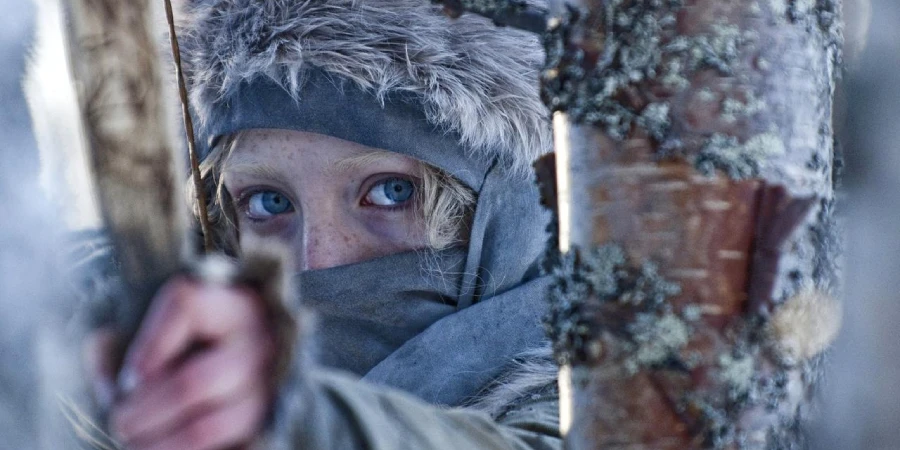

A teenage girl shoots a reindeer in the chest, walks over to the twitching body, and says, “I just missed your heart.” That line is not a throwaway. It is the thesis of Hanna (2011), Joe Wright’s ice-cold thriller about a girl engineered to kill who has never once been allowed to simply exist. Saoirse Ronan plays Hanna with a stillness that is genuinely unsettling, and the film around her is sharp, propulsive, and more interested in identity than in action choreography.
Detailed Summary
The Forest and the Training
Hanna Heller has grown up entirely off-grid, raised in the Finnish wilderness by her father Erik, a former CIA operative played by Eric Bana. Erik has trained her to fight, track, survive, and kill. He has also raised her on a fabricated cover story about her mother dying in a car accident.
She speaks multiple languages and can recite encyclopedias from memory, yet she has never heard music and has never seen a television. Wright frames the isolation visually: wide shots of white birch forests, frozen lakes, a tiny cabin dwarfed by landscape. Hanna is physically competent and emotionally blank in equal measure.
Flipping the Switch
Erik keeps a transponder device hidden in a box. Activating it will alert the CIA to their location. He tells Hanna that when she is ready, she can flip the switch herself. She does it.
This is a crucial character beat. Hanna chooses to enter the world. Erik does not push her. That decision will haunt everything that follows because, unlike Erik, Hanna does not fully understand what she is walking into.
The CIA and Marissa Wiegler
Marissa Wiegler, played with coiled menace by Cate Blanchett, runs the CIA program that originally created Hanna. She receives the transponder signal and sends agents to capture Erik and Hanna. Blanchett gives Marissa a fastidious, almost obsessive quality: she brushes her teeth until her gums bleed, she wears immaculate clothes in sterile settings. Every physical choice Blanchett makes signals a woman who controls everything in her environment because she is afraid of what she cannot control.
Marissa sends a body double into Hanna’s holding cell to be “killed,” buying herself time while Hanna escapes into Morocco. It is a cold, calculated move, and the film does not editorialize about it. Marissa simply does it.
Capture and Escape
Hanna is taken to a CIA detention facility beneath the Moroccan desert. She dispatches her guards efficiently, snapping necks and dodging surveillance with a mechanical precision that is genuinely difficult to watch. Wright shoots these action sequences without glamour. Hanna does not smile. She does not breathe hard. She just works.
Her escape leads her into a world she has never experienced: sunlight, crowds, music, color. A Moroccan marketplace overwhelms her. Wright cuts between her face and the assault of stimuli around her, and Ronan lets the character’s composure crack just slightly, eyes wide, hands gripping the fabric of her clothes.
The Grimm Family
Hanna attaches herself to a British family traveling through Morocco: parents Sebastian and Rachel, and their teenage daughter Sophie. Sophie, played by Jessica Barden, is chatty, curious, and completely oblivious to danger. She becomes Hanna’s first genuine peer.
These scenes are some of the film’s best. Hanna tries to navigate normal adolescent conversation and fails in small, specific ways: she does not understand flirting, she cannot read social cues, she watches Sophie’s family interact with visible hunger. A boy named Miles tries to kiss Hanna and she almost breaks his wrist before catching herself. That moment gets a laugh and then immediately stops being funny.
Erik’s Parallel Journey
Erik is not captured. He fights his way through the ambush and begins moving toward Berlin, where he and Hanna have a rendezvous point. His path takes him through snowy European landscapes and puts him in conflict with Marissa’s hired operative, Isaacs, played by Tom Hollander.
Isaacs is one of the film’s strangest and most memorable characters. He wears tracksuits, whistles to himself, and murders people with cheerful detachment. Hollander plays him as genuinely odd rather than theatrical, and it works precisely because the film never over-explains him.
The Truth About Hanna
Hanna eventually learns what Marissa knows and what Erik has been hiding. Hanna is not a naturally born child. She was genetically engineered from the DNA of women who were part of a discontinued CIA program called UTRAX. Erik did not father her biologically. He rescued her from the program, raised her as his own, and fabricated the story about her mother to give her a human identity to hold onto.
Her real mother was one of the UTRAX subjects, killed when the program was shut down. Marissa personally ordered those killings. This is the information Erik has been protecting Hanna from, and it reframes every warm moment between them as a layered act of both love and deception.
Berlin and the Fairy Tale Architecture
Hanna makes her way to Berlin and finds a contact Erik had set up, an old woman named Knepfler. She also reconnects with Sophie’s family briefly before the situation collapses. Marissa closes in. Erik arrives in Berlin but Isaacs tracks him to a subway station and kills him in a brutal, unglamorous fight that the film refuses to score heroically.
Erik’s death is a gut punch because Wright does not build to it with swelling music. It happens fast, in a fluorescent-lit tunnel, and then it is over. Bana carries every scene he is in with a quiet authority, and losing him a full act before the ending is a genuinely bold structural choice.
Movie Ending
Hanna tracks Marissa to an abandoned theme park on the outskirts of Berlin. The location is deliberate: the park features oversized fairy tale set pieces, giant plaster figures, crumbling castles. Grimm’s fairy tales, about children who navigate violent adult worlds and survive through cunning, have been threaded through the film, and Wright pays that off visually here.
Hanna pursues Marissa through the park alone. Marissa is armed and dangerous, but Hanna is faster. She corners Marissa in a large artificial cave structure. Marissa tries to bargain, or at least to pause long enough to level her weapon. Hanna is quicker. She puts an arrow through Marissa’s chest with a compound bow, the same weapon she used on the reindeer in the opening scene.
Marissa falls. Hanna stands over her, and the film’s final line pays off the opening directly: “I just missed your heart,” Marissa had said earlier, echoing Hanna’s own words. Now Hanna says nothing. She lowers the bow. She has done what she was built to do.
What makes this ending work is the absence of triumph. Ronan’s face does not signal relief or victory. Erik is dead. Hanna has no family, no home, no clear identity beyond the program that made her. She has completed a mission, but the film asks whether completing a mission equals a life. It does not answer that. It just cuts to credits.
Are There Post-Credits Scenes?
Hanna has no post-credits scene. Once the credits roll, the film is over. You can leave.
Type of Movie
Hanna is a thriller with strong elements of action and coming-of-age drama. Its tone sits in an unusual register: cold and clinical in its action sequences, almost dreamlike in its European travelogue passages, and occasionally darkly funny when Hanna collides with ordinary teenage life.
It is not a standard spy film. It shares DNA with fairy tales, with arthouse European cinema, and with the kind of female-protagonist action film that takes its lead character’s interiority seriously rather than treating her as a spectacle.
Cast
- Saoirse Ronan – Hanna Heller
- Eric Bana – Erik Heller
- Cate Blanchett – Marissa Wiegler
- Tom Hollander – Isaacs
- Jessica Barden – Sophie
- Olivia Williams – Rachel
- Jason Flemyng – Sebastian
Film Music and Composer
The Chemical Brothers composed the score, and it is the most underrated element of this film. Tom Rowlands and Ed Simons built a propulsive, electronic soundscape that functions as a second nervous system for the movie. Drums punch in exactly when Hanna moves. Silence drops in exactly when she stops.
The track “Hanna’s Theme” is particularly striking: it starts sparse and almost childlike, then layers into something mechanical and urgent. It mirrors Hanna’s own dual nature perfectly. The score received widespread critical praise and remains one of the best uses of electronic music in a thriller from that decade.
Filming Locations
Principal photography took place across multiple countries, which is part of why the film feels so geographically alive. The opening Finnish wilderness sequences were shot in Finland, giving Hanna’s childhood world a genuine bleakness and scale.
Morocco provided the sun-blasted detention facility and marketplace sequences. The contrast between the Arctic cold of Finland and the overwhelming heat and color of Morocco is not accidental: it maps directly onto Hanna’s psychological displacement.
Berlin features prominently in the final act, including real Berlin locations and the abandoned theme park, Spreepark, a former East German amusement park that had been sitting derelict for years. Choosing Spreepark was inspired. A crumbling remnant of a socialist-era entertainment complex, full of rotting fairy tale imagery, is the perfect arena for the film’s final confrontation.
Awards and Nominations
The Chemical Brothers won a BAFTA Award for Best Original Score for Hanna. The score also received significant recognition from various critics’ circles. Beyond that, the film did not collect major awards traction, which feels like a genuine oversight given Ronan’s performance.
Behind the Scenes Insights
- Saoirse Ronan underwent extensive physical training for the role, including combat choreography, to make Hanna’s fighting style feel mechanical rather than stylized.
- Joe Wright had previously worked with Ronan on Atonement (2007), and he cast her in Hanna partly because of her ability to project intelligence without conventional expressiveness.
- Cate Blanchett reportedly developed Marissa’s Southern American accent for the role, adding a layer of artificiality to a character who is fundamentally all performance.
- Tom Hollander’s character Isaacs was not in early drafts of the script at the same level; his role expanded during development because the creative team found him so unsettling in early reads.
- The Spreepark location required significant logistical coordination because the site was not a conventional film set and had structural concerns.
- Wright wanted the action sequences to feel unglamorous, specifically directing Ronan to keep her face neutral during fights rather than adopting an action-hero expression.
Inspirations and References
Grimm’s fairy tales run through the film as a structural and visual motif. Hanna is explicitly reading a book of Grimm stories, and the film frames her situation through that lens: a child alone in a dangerous adult world, navigating threats through cleverness and inherited skills.
The UTRAX program draws loosely on real Cold War-era programs involving genetic research and psychological conditioning, though the film is not based on any specific declassified operation. Films like La Femme Nikita (1990) and Leon: The Professional (1994) are clear touchstones: the figure of a young woman trained as a weapon is a well-established genre archetype, and Wright leans into that lineage consciously.
The coming-of-age dimension also connects to classic European arthouse road movies, where identity formation happens through geographic displacement rather than stable domestic settings.
Alternate Endings and Deleted Scenes
No officially released alternate ending exists for Hanna. The film’s theatrical cut is the version Wright intended. Some deleted and extended scenes surfaced with home release editions, primarily involving the Grimm family’s travel sequences and additional interaction between Hanna and Sophie, but none fundamentally alter the film’s plot or conclusion.
Book Adaptations and Differences
Hanna is not based on a book. Seth Lochhead wrote the original screenplay, which he developed as part of a screenwriting program. David Farr later collaborated on revisions. A novelization of the film exists but derives from the screenplay, not the other way around.


Memorable Scenes and Quotes
Key Scenes
- The opening deer hunt, where Hanna tracks and shoots a reindeer, delivers the film’s thesis in under two minutes without dialogue.
- Hanna’s escape from the underground CIA facility, shot as one extended, nearly unbroken sequence with the Chemical Brothers score driving every step, is the film’s most purely kinetic stretch.
- Hanna’s first experience of electricity: she turns a lamp on and off repeatedly in her holding cell, alone, fascinated, and the shot holds on her face long enough to become genuinely sad.
- The near-kiss with Miles where Hanna’s combat reflex fires before her social instinct can override it, capturing her entire condition in one small moment.
- Erik’s death in the Berlin subway tunnel, lit harshly in fluorescent white, scored only with ambient sound.
- The final confrontation in Spreepark, Hanna moving through crumbling fairy tale sculptures with a compound bow, closing the film’s central metaphor.
Iconic Quotes
- “I just missed your heart.” (Hanna, spoken twice: once over the dying reindeer, once as the film’s closing line callback)
- “Adapt or die.” (Erik, drilling Hanna during training)
- “I want to sleep. I want to meet people. I want to see the world.” (Hanna, explaining to Erik why she is ready to flip the switch)
Easter Eggs and Hidden Details
- Hanna’s bedtime reading throughout the film is a copy of Grimm’s fairy tales; specific stories she reads foreshadow events in the plot, including tales about children who outwit dangerous adults.
- Marissa’s habit of brushing her teeth until her gums bleed is a quiet signal that her self-control has a violent underside, a mirror of Hanna’s own conditioning.
- Isaacs whistles a consistent tune throughout the film; the tune is never identified but recurs as an audio signature every time he appears, functioning like a leitmotif before the Chemical Brothers score takes over.
- Spreepark, the film’s final location, was a real East German amusement park that closed and fell into disrepair; its presence connects the film’s Cold War espionage backstory to its physical setting in a way that rewards close attention.
- The film’s color palette shifts markedly by geography: Finland is white and gray, Morocco is ochre and amber, Berlin is gray-green. Each palette corresponds to a phase of Hanna’s self-discovery.
Trivia
- Saoirse Ronan was 16 years old during principal photography.
- The Chemical Brothers had not previously scored a feature film before Hanna; Wright approached them specifically because he wanted the score to feel like it came from outside conventional film music.
- Eric Bana performed many of his own fight sequences.
- Director Joe Wright had made his name primarily with literary adaptations (Pride and Prejudice, Atonement) before Hanna, making this film a significant stylistic departure.
- Spreepark, the Berlin amusement park used in the finale, had a notably strange real-world history involving its former operator attempting to smuggle drugs inside theme park rides.
- The film was produced partly with UK Film Council support and shot across three continents.
Why Watch?
Ronan’s performance is the specific reason to sit with this film. Watch how she holds her arms slightly away from her body in crowd scenes, as if her own physicality is unfamiliar to her. That one physical choice tells you more about Hanna’s alienation than any line of dialogue could. Wright and the Chemical Brothers build a world around that performance worth inhabiting.
Director’s Other Movies
- Pride and Prejudice (2005)
- Atonement (2007)
- The Soloist (2009)
- Anna Karenina (2012)
- Pan (2015)
- Darkest Hour (2017)
- Cyrano (2021)
Recommended Films for Fans
- La Femme Nikita (1990)
- Leon: The Professional (1994)
- Haywire (2011)
- Salt (2010)
- Kick-Ass (2010)
- We Need to Talk About Kevin (2011)
- Beasts of the Southern Wild (2012)
- Brave (2012)