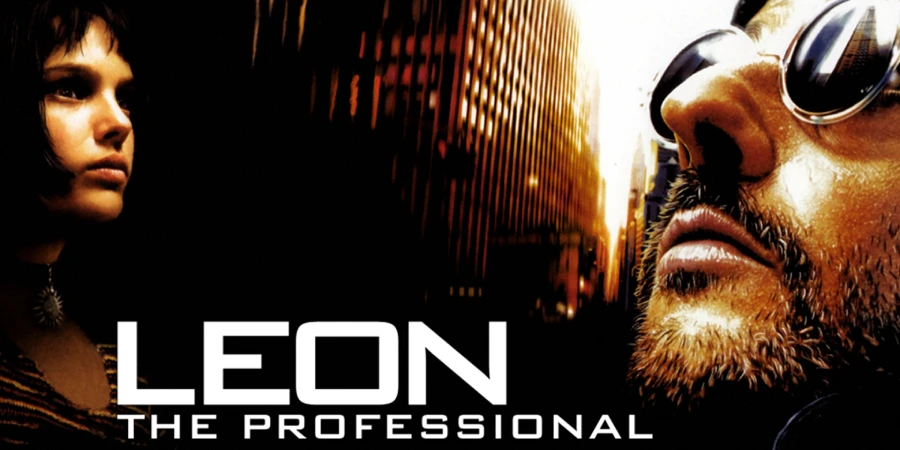

A twelve-year-old girl knocks on a hitman’s door with a bruised face and a milk carton, and somehow that image never stops being heartbreaking. Luc Besson’s Léon: The Professional (1994) is a film that refuses to behave. Jean Reno plays a contract killer with the emotional vocabulary of a potted plant, Natalie Portman makes her screen debut at age twelve and absolutely owns every scene, and Gary Oldman chews through the film like a man who was told the set was made of candy.
Detailed Summary
Léon Does His Job
We open on a stunning wide shot of New York City, then cut to Léon (Jean Reno) sitting in a diner, calmly waiting to kill someone. He does it cleanly, efficiently, and without expression. This opening sequence tells you everything about who Léon is before a single word of dialogue is exchanged.
Léon works as a cleaner for a small-time Italian mob boss named Tony (Danny Aiello). Tony holds Léon’s money, feeds him jobs, and quietly exploits the fact that Léon cannot read and has no real understanding of the world outside his apartment.
The Reno Family Gets Massacred
Léon’s neighbor is a man named Reno, a low-level drug courier who has been skimming product from a corrupt DEA agent named Norman Stansfield (Gary Oldman). Stansfield is not just corrupt; he is genuinely unhinged. He shows up at the apartment with a small squad, listens to Beethoven on a personal stereo, and executes the entire family without visible remorse.
Twelve-year-old Mathilda (Natalie Portman) survives because she happens to be out buying groceries when Stansfield arrives. She comes back to find her family dead and, with nowhere to go, she knocks on Léon’s door. He hesitates. He lets her in. That pause is the moral center of the whole film.
Léon and Mathilda Build an Unlikely Life
Mathilda is not a passive victim. She is sharp, wounded, and furiously alive. She starts cleaning Léon’s apartment, doing his laundry, and absorbing everything about how he operates. Léon begins teaching her the basics of his trade, partly because she pushes him to, partly because he genuinely does not know how to say no to her.
Their domestic routine is oddly tender. Léon does his one-armed push-ups, drinks his milk, tends to his plant, and watches old musicals on television. Mathilda learns to shoot and smoke cigarettes. Besson frames all of this with a strange warmth that makes it feel sweet rather than sinister, which is a genuinely audacious directorial gamble.
The Revenge Plan
Mathilda is not interested in survival. She wants to kill Stansfield. She sneaks into DEA headquarters disguised as a maid, hoping to get close to him, and nearly gets herself killed in the process. Léon rescues her and the two of them have their biggest argument in the film.
This scene is where Portman shows exactly what kind of actress she already is at twelve. She does not cry on cue; she rages. Her face goes through five different emotions in ten seconds, and none of them feel performed.
The Hotel Scene and Its Complications
Mathilda tells Léon she loves him, not as a father figure but romantically. The film does not ignore this; it sits with it, uncomfortably, and Léon gently refuses to act on it. Besson handles this as carefully as the material allows, though it remains the film’s most contested element among critics and audiences.
Léon redirects her feelings without cruelty and without making her feel foolish. Jean Reno plays these scenes with a stillness that communicates something close to wisdom, even though the character is functionally illiterate in every emotional sense.
Stansfield Closes In
Stansfield eventually traces Mathilda back to Léon’s building. He brings what looks like half of New York’s corrupt law enforcement with him. Léon sends Mathilda out through the ventilation system while he holds off Stansfield’s men from inside the apartment.
What follows is one of the best-staged siege sequences in 1990s action cinema. Besson shoots it with real spatial clarity; you always know where everyone is and what the stakes are. Léon fights like a man who has nothing left to lose, which, by this point, is exactly what he is.


Movie Ending
Léon disguises himself as a wounded SWAT officer and slips through Stansfield’s cordon. He almost makes it out of the building. Stansfield spots him at the last moment and shoots him in the back, fatally. As Léon falls, he presses something into Stansfield’s hand and tells him it is from Mathilda. It is the pin of a grenade. Léon has rigged himself with explosives. He detonates them, and both he and Stansfield die in the blast.
Mathilda is waiting outside. She does not know he is dead until she sees it happen. Portman plays this moment with her whole body; she does not scream or collapse, she just goes completely still, which is somehow far worse to watch.
She goes to a boarding school in New Jersey, the one Léon had apparently arranged for her. She plants his beloved houseplant in the school’s garden, placing its roots in the earth for the first time. She says, quietly, that they will be okay here.
That final image, Léon’s plant finally in open ground, is the film doing everything right. It suggests growth, freedom, roots, and continuation without spelling any of it out. Léon gave Mathilda a reason to keep moving, and she gives his plant a permanent home. It is one of the better endings in 1990s cinema, and it earns its sentiment because the film has spent ninety minutes refusing cheap emotion everywhere else.
One critical question audiences often raise: does Léon genuinely love Mathilda, and if so, in what sense? Besson’s answer seems deliberate in its ambiguity. Léon protects her, sacrifices himself for her, and arranges her future before his own. Whether that reads as paternal love, romantic feeling, or simply the first genuine human attachment he has ever formed is left open. The film is wise enough not to resolve it cleanly.
Are There Post-Credits Scenes?
Léon: The Professional has no post-credits scene of any kind. Once the garden sequence ends and the credits roll, that is the film. Do not sit through the credits expecting a coda.
Type of Movie
This is an action thriller with a very strong dramatic core. Calling it a pure action film undersells how much time Besson spends on character. It fits comfortably in the tradition of the French crime film while feeling distinctly shaped by New York.
Tonally, it is a strange mixture: violent and tender, darkly comic in places and genuinely devastating in others. Oldman’s Stansfield tilts the film toward something almost surreal whenever he appears. Reno and Portman pull it back toward something quiet and real.
Cast
- Jean Reno – Léon
- Natalie Portman – Mathilda
- Gary Oldman – Norman Stansfield
- Danny Aiello – Tony
Film Music and Composer
Eric Serra composed the score. Serra was Besson’s regular collaborator through this period, having also scored La Femme Nikita (1990) and The Fifth Element (1997). His work on Léon leans heavily on electronic textures layered over orchestral elements, giving the film an almost dreamlike sonic quality that fits its morally ambiguous world.
The most recognizable piece on the soundtrack is Sting’s “Shape of My Heart,” which plays over the closing credits. Its melancholy, precise lyrics about a gambler who plays cards not for money but for some private inner reason map onto Léon with uncomfortable accuracy. Besson’s choice to use that specific song is one of the smartest pieces of music supervision in the decade.


Filming Locations
Principal photography took place in New York City, particularly in the Little Italy neighborhood and on the Upper West Side. Léon’s apartment building on West 72nd Street is a real location, and Besson shot extensively on actual New York streets rather than studio sets.
Shooting in real New York locations gives the film a texture that no studio backlot could replicate. The grime, the tight corridors, the specific quality of light in those apartment hallways; all of it makes the story feel grounded even when Stansfield’s behavior tips into the theatrical.
Some interior scenes and additional photography took place in France, reflecting the Franco-American co-production structure of the film. Besson himself is French, and the film carries a distinctly European sensibility despite its American setting.
Awards and Nominations
Natalie Portman received a Saturn Award nomination for Best Performance by a Younger Actor for her debut performance. The film performed well commercially, particularly in Europe and Japan, but it did not receive significant attention from American awards bodies during its original release.
Behind the Scenes Insights
- Léon: The Professional was Natalie Portman’s first feature film. She auditioned after responding to a casting call that Besson circulated through her school.
- Jean Reno learned English specifically for this role. His accent and occasional awkwardness with the language actually serve the character’s sense of displacement.
- Gary Oldman reportedly brought significant improvisational energy to the role of Stansfield. His “bring me everyone” tirade has become one of the most quoted scenes in the film, and it reportedly grew in intensity during rehearsals.
- Besson wrote the script specifically with Jean Reno in mind, having worked with him previously on La Femme Nikita.
- The film exists in two cuts: the American theatrical release and the longer International Cut (sometimes called Léon without the subtitle), which includes additional scenes that deepen the relationship between Léon and Mathilda, including more explicit moments that American distributors removed before release.
- Danny Aiello’s Tony is a more complex figure in the original cut. Some of the scenes clarifying his exploitation of Léon were trimmed for the American version.
Inspirations and References
Besson drew on the tradition of the French polar, the hard-boiled French crime film pioneered by directors like Jean-Pierre Melville. Melville’s Le Samouraï (1967), with its lone, emotionally blank professional killer, is an obvious spiritual predecessor to Léon as a character.
The film also draws from the American urban thriller of the 1970s, particularly films set in a gritty, lived-in New York City. Besson’s affection for American genre cinema from that era runs through every production design choice.
Besson’s own earlier film La Femme Nikita (1990) planted seeds for this story. Both films deal with killers trained into their profession who develop unexpected emotional attachments that complicate their survival.
Alternate Endings and Deleted Scenes
The International Cut is substantially different from the American theatrical version. It runs longer and contains scenes that push the Léon-Mathilda dynamic into territory that American distributor Gaumont chose to cut. In one additional scene, Mathilda actually carries out a professional hit, which deepens her arc considerably and makes her final choice to attend school feel more earned.
There is also a deleted scene extending the relationship between Tony and Léon that reveals more clearly how deliberately Tony has kept Léon financially dependent and uneducated. Its removal from the American cut softens Tony’s role as an exploiter, which is a shame because it adds genuine darkness to Léon’s situation.
No officially released alternate ending for the film’s final act appears to exist in any known version. The garden sequence remains intact across all cuts.
Book Adaptations and Differences
Léon: The Professional is not based on a book. Luc Besson wrote the original screenplay. A novelization was published around the time of the film’s release, but the film is the original source material, not an adaptation.


Memorable Scenes and Quotes
Key Scenes
- The opening hit: Léon neutralizes a room full of armed men without a single wasted movement. Besson keeps the camera close and the editing precise, establishing in three minutes exactly how dangerous this quiet man is.
- Mathilda at Léon’s door: She leans against the wall, casual and terrified at the same time, while we watch Léon’s eye appear at the peephole. He sees her bruises. He waits. He opens the door.
- The DEA headquarters intrusion: Mathilda walks through a federal building with a cleaning cart and a handgun, and the scene is somehow both tense and darkly funny. Portman plays it completely straight, which is exactly right.
- Stansfield’s Beethoven entrance: Oldman’s character arrives at the Reno apartment with his headphones in, swaying slightly to the music, while his men prepare to commit murder. He talks about Beethoven before he kills anyone. It is the most chilling piece of character establishment in the film.
- The final siege: Léon sends Mathilda through the ventilation shaft and then turns back toward the men trying to kill him. He does not hesitate for a single frame.
- The garden ending: Mathilda plants Léon’s houseplant in open soil. She pats the dirt down with her palms. She speaks to it quietly. The film cuts to black.
Iconic Quotes
- Mathilda: “Is life always this hard, or is it just when you’re a kid?” Léon: “Always like this.”
- Stansfield: “Bring me everyone.” Benny: “What do you mean, everyone?” Stansfield: “EVERYONE.”
- Mathilda: “I want you to teach me.” Léon: “Teach you what?” Mathilda: “Cleaning.”
- Stansfield: “I like these calm little moments before the storm.”
Easter Eggs and Hidden Details
- Léon’s plant, which he carries everywhere and tends with great care, never has roots in soil until the final scene. It lives in water throughout the film. Read that how you like.
- Gary Oldman’s Stansfield takes prescription pills throughout the film, popping them before acts of violence. Besson never explains what they are or why, which makes him more unnerving than any backstory could.
- The film’s color palette shifts subtly whenever Stansfield is on screen. His scenes carry a cooler, more fluorescent quality compared to the warmer tones of Léon and Mathilda’s domestic scenes.
- Léon’s wardrobe barely changes across the entire film. He owns almost nothing. The one concession to personal style is the knitted cap he wears on jobs, which functions almost like a mask.
- Tony’s office is decorated with images and objects that signal Italian-American crime culture, but he never directly acknowledges being in the mob. Besson leaves it coded rather than stated.
Trivia
- Natalie Portman was twelve years old during filming. Her parents negotiated specific conditions with Besson to protect her from the most uncomfortable content, some of which ended up in the longer International Cut anyway.
- Jean Reno’s signature look in the film, the round sunglasses, the wool cap, the long coat, became one of the most imitated character visual templates in 1990s pop culture.
- The film was a massive commercial success in France and Japan, far outpacing its American box office performance. Japan in particular developed a devoted following for the film that persists today.
- Luc Besson shot Léon and The Fifth Element in relatively quick succession, establishing him as one of the most commercially successful European directors working in English-language cinema during the 1990s.
- Gary Oldman has cited Stansfield as one of his favorite roles. His approach to the character involved treating every scene as if Stansfield genuinely believed he was the hero of his own story.
- “Shape of My Heart” by Sting had been released several years before the film. Besson heard it and held it specifically for the closing credits.
Why Watch?
Portman’s debut performance alone justifies the two hours. Watch her face in the scene where she returns to find her family dead: no visible weeping, just a jaw that sets slightly, a stillness that signals a child deciding not to break. Besson surrounds that performance with some of the decade’s most confidently staged action and a villain so gleefully unhinged that Oldman seems to be operating in a slightly different movie, to the benefit of both.
Director’s Other Movies
- Le Dernier Combat (1983)
- Subway (1985)
- The Big Blue (1988)
- La Femme Nikita (1990)
- The Fifth Element (1997)
- The Messenger: The Story of Joan of Arc (1999)
- Angel-A (2005)
- Lucy (2014)
- Valerian and the City of a Thousand Planets (2017)
Recommended Films for Fans
- La Femme Nikita (1990)
- Le Samouraï (1967)
- Heat (1995)
- Grosse Pointe Blank (1997)
- Columbiana (2011)
- Hanna (2011)
- John Wick (2014)
- Ghost Dog: The Way of the Samurai (1999)