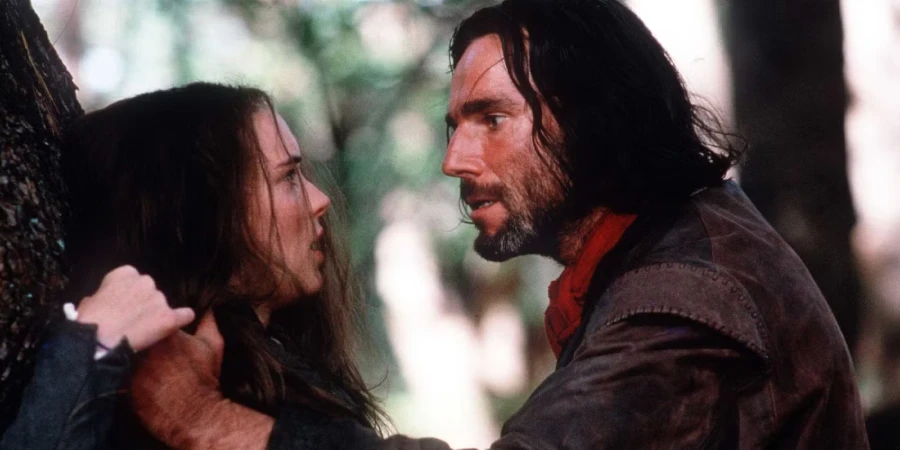

Salem, 1692: a teenage girl writhes on a courtroom floor, and an innocent man chooses a noose over a lie. Nicholas Hytner’s 1996 adaptation of Arthur Miller’s play earns every ounce of its fury. Daniel Day-Lewis and Winona Ryder pull the story in opposite directions with a ferocity that makes the courtroom scenes feel like a physical confrontation. This is a film about moral cowardice dressed up as religious conviction, and it does not flinch once.
Detailed Summary
Dancing in the Woods
At night, in a forest outside Salem, a group of young girls gather around a fire. Abigail Williams leads them in a ritual dance, and their servant Tituba calls spirits from the dark.
Reverend Parris catches them. Shock and panic set in immediately. Several girls fall into a strange, catatonic state, and the entire community braces for an explanation.
Abigail’s Obsession
Abigail Williams had an affair with John Proctor while working as a servant in his household. His wife Elizabeth discovered it and dismissed her. Abigail still burns for Proctor, and that hunger becomes the fuel for everything that follows.
Proctor knows the affair was wrong. He tries to put distance between himself and Abigail. She refuses to accept that distance.
The Accusations Begin
With the community already frightened, Abigail and her circle of girls begin naming names. Tituba confesses under pressure and accuses others, which opens the floodgates. Salem’s existing grudges, land disputes, and social resentments suddenly have a sanctioned outlet.
Judge Danforth arrives with the full authority of the court behind him. His presence shuts down any rational resistance. Accusation becomes functionally equivalent to guilt.
John and Elizabeth
John Proctor lives under the weight of his own guilt at home. His marriage to Elizabeth is cold and careful, damaged by what he did. She watches him with a quiet, devastating suspicion she cannot fully voice.
When Elizabeth learns that Abigail named her as a witch, John decides he must act. He knows Abigail is lying. Going to court means exposing himself, but he goes anyway.
The Court Turns Against Reason
Proctor brings Mary Warren, one of the accusing girls, to recant before the court. She is terrified but willing, at first. Danforth listens, skeptical and hostile from the start.
Abigail then stages a brilliant, calculated counter-performance. She and the other girls pretend that Mary Warren’s spirit is attacking them in the courtroom. They mimic her every word, shaking and screaming until Mary breaks completely and turns on Proctor.
It is one of the most chilling sequences in the film. Winona Ryder plays Abigail’s manipulation with a cold precision that is genuinely unsettling. She never overplays the hysteria; she watches, calculates, and then performs on cue.
Proctor’s Confession and Its Consequences
Proctor finally exposes himself. He confesses his affair with Abigail in open court, arguing that she is motivated by revenge and jealousy rather than godly witness. This is the moment the film has been building toward.
Danforth calls Elizabeth in to confirm or deny the adultery. Elizabeth, trying to protect her husband’s reputation, lies and says it never happened. She does not know that John has already confessed. Her love destroys the one weapon they had.
The Spiral Toward Death
With the adultery defense collapsed, Danforth presses Proctor to sign a written confession of witchcraft. Signing would save his life. Proctor wrestles with this publicly and brutally.
He signs, then tears the document apart. He cannot bear to have his name posted on the church door as a confessed witch. A signed lie would hollow out everything he has left.
Movie Ending
Proctor walks to the gallows alongside Rebecca Nurse and others who refused to confess. Elizabeth stands outside, watching. She does not try to stop him, because she finally understands that his refusal is the one honest act he has left.
Day-Lewis plays the final walk without histrionics. His face is exhausted and resolved, not at peace exactly, but finished with compromise. That restraint is the best directorial choice in the film; Hytner lets the silence do the work rather than scoring the moment into the ground.
Abigail flees Salem. Her disappearance carries no punishment and no dramatic confrontation. That lack of resolution is deliberately uncomfortable. Ryder’s Abigail walks away into an ambiguous future while good people hang, and the film refuses to tidy that injustice up.
Elizabeth’s final moment is the one that lingers. She watches John die, and when someone nearby says he has “his goodness now,” she nods, crying but composed. It is a line straight from Miller’s play, and it lands with full weight because Pertee plays it with almost no expression, just a slow, private acknowledgment.
Are There Post-Credits Scenes?
No. There are no post-credits scenes of any kind. The Crucible ends on Elizabeth’s face, and the film simply closes. Stay if you want to absorb the silence, but nothing extra awaits you.
Type of Movie
The Crucible is a historical drama with the tension structure of a courtroom thriller. Its tone is relentlessly grim and morally serious. There are no moments of relief or levity, which is both a strength and a commitment to its source material.
It functions partly as political allegory, as Miller always intended. The McCarthy-era parallel is explicit for anyone who knows the play’s origins, though the film never over-explains the connection.
Cast
- Daniel Day-Lewis – John Proctor
- Winona Ryder – Abigail Williams
- Paul Scofield – Judge Danforth
- Joan Allen – Elizabeth Proctor
- Bruce Davison – Reverend Parris
- Rob Campbell – Reverend Hale
- Jeffrey Jones – Thomas Putnam
- Peter Vaughan – Giles Corey
- Karron Graves – Mary Warren
- Charlayne Woodard – Tituba
Film Music and Composer
George Fenton composed the score. Fenton draws on sparse, austere instrumentation to match Salem’s Puritan severity. There is very little warmth in the music, which is entirely the right choice.
Fenton uses strings and choir elements that suggest both religious ceremony and creeping dread. He avoids anything that would feel anachronistic or emotionally manipulative. The score stays out of the way and lets the performances breathe.


Filming Locations
Principal photography took place on Hog Island in Essex County, Massachusetts, and in the surrounding coastal region of Ipswich. These locations gave the production genuine New England landscape without resorting to studio backlot approximations.
Shooting in Massachusetts mattered enormously. The grey skies, rocky coastlines, and harsh light give the film a physical authenticity that no set build could replicate. You feel the cold. You feel the isolation.
The actual village structures built for the production reinforced a sense of constriction. Small spaces, limited sight lines, communities pressed together: all of this amplifies the paranoia that the story depends on.
Awards and Nominations
Joan Allen received an Academy Award nomination for Best Supporting Actress, which was entirely deserved. Her performance is the most underrated element of the film by some distance, and the nomination confirmed that at least some voters were paying attention.
The film also received a Golden Globe nomination for Allen in the same category.
Behind the Scenes Insights
- Arthur Miller wrote the screenplay himself, adapting his own stage play for the screen. This gave the project an unusual degree of fidelity to the source material’s intent.
- Daniel Day-Lewis and Winona Ryder were in a real-life relationship during production, which informed the charged dynamic between Proctor and Abigail on screen.
- Director Nicholas Hytner came from a theater background, having directed the original London stage production of The Crucible. His familiarity with the material shaped his approach to blocking and performance.
- Hytner deliberately opened up the play’s action beyond the courtroom, shooting outdoors to give the story a physical scale the stage version cannot achieve.
- The production used period-accurate Puritan costume and set design to ground the supernatural accusations in a world of genuine material hardship.
- Paul Scofield brings a measured, almost bureaucratic menace to Danforth that reportedly came from Scofield’s own research into the psychology of institutional authority.
Inspirations and References
The Crucible film is a direct adaptation of Arthur Miller’s 1953 stage play of the same name. Miller wrote the original play as a response to McCarthyism and the House Un-American Activities Committee investigations into suspected communists in American life.
Miller himself had been called before HUAC. His refusal to name names mirrored the moral dilemma he gave to Proctor. That autobiographical dimension gives the story its emotional authority.
The Salem witch trials of 1692 are the historical bedrock. Miller researched the court records extensively when writing the play, though he acknowledged that some characters and events were compressed or dramatized.
Alternate Endings and Deleted Scenes
No alternate ending or significant collection of deleted scenes has entered the public record for this production. Given that Miller wrote the screenplay himself and Hytner had directed the play before, the project had an unusually clear creative direction from the start.
Any scenes cut during editing have not surfaced in home video releases or documented interviews in a way that allows confident reporting here.
Book Adaptations and Differences
The Crucible adapts a stage play rather than a prose novel. Miller’s screenplay stays close to the play’s structure, dialogue, and thematic concerns, but the film opens up several scenes that the play keeps offstage or simply implies.
The forest opening is the most significant addition. On stage, the dancing happens before the action begins and exists only in testimony. On screen, Hytner shoots it as a vivid, energetic prologue that immediately establishes Abigail as the instigating force.
Some of Miller’s longer expository monologues get trimmed or redistributed. The film also amplifies the physical landscape of Salem in a way no stage production can match.
Memorable Scenes and Quotes
Key Scenes
- The opening forest ritual, where Abigail drinks blood and the girls dance wild around the fire before Parris’s lantern swings into frame.
- Mary Warren’s collapse in the courtroom, where the other girls slowly begin mimicking her every syllable until she shatters completely.
- Proctor’s confrontation with Abigail on the beach, where Day-Lewis physically restrains her and she looks up at him with an expression that is part love and part threat.
- Elizabeth’s lie to the court about the adultery, shot in close-up on Joan Allen’s face as she chooses the wrong truth at the worst possible moment.
- Proctor tearing up his signed confession, crumpling it and handing the pieces to Danforth in a gesture that seals his fate.
- The final walk to the gallows, filmed in long shot against the grey Massachusetts sky with almost no musical accompaniment.
Iconic Quotes
- “Because it is my name! Because I cannot have another in my life!” (John Proctor, on refusing to sign the confession)
- “I have given you my soul; leave me my name.” (John Proctor)
- “God is dead!” (John Proctor, in the courtroom)
- “He have his goodness now. God forbid I take it from him.” (Elizabeth Proctor, in the final moments)
Easter Eggs and Hidden Details
- The costuming for Abigail subtly shifts across the film. Early on her colors are dark and restrained; as her power grows, her outfits become slightly more assertive in cut and detail.
- Hytner frames Danforth repeatedly in doorways and archways, physically placing authority structures around him in almost every shot.
- The fire in the forest opening uses real flame without heavy post-production enhancement, giving the scene a flickering, unstable quality that reinforces the chaos to come.
- In the courtroom scenes, the camera frequently stays on the faces of onlookers rather than cutting to the person speaking, reflecting how public performance and audience reaction drive the trials.
- Giles Corey’s stubborn, almost amused defiance in his scenes plants a quiet contrast to Proctor’s anguish, suggesting that different personalities meet the same injustice in radically different ways.
Trivia
- Arthur Miller was in his late seventies when he wrote this screenplay, returning to his most famous work nearly four decades after its premiere.
- Daniel Day-Lewis and Winona Ryder’s off-screen relationship ended around the time of the film’s production and release.
- Nicholas Hytner later became the director of the National Theatre in London, one of the most prestigious theater leadership roles in the world.
- Paul Scofield’s film appearances were relatively rare throughout his career despite his enormous stage reputation, making his Danforth one of the more notable screen performances of his later years.
- The real Abigail Williams was approximately eleven or twelve years old during the Salem trials. Miller aged the character up significantly for dramatic purposes, a change he acknowledged openly.
- Joan Allen prepared for the role by researching Puritan domestic life and the social expectations placed on women in seventeenth-century New England.
Why Watch?
Joan Allen’s Elizabeth Proctor is the reason to see this film twice. She barely raises her voice across two hours, yet her single lie to the court carries more dramatic weight than any of the film’s screaming courtroom scenes. Day-Lewis commands attention, but Allen quietly dismantles you.
Director’s Other Movies
- The Madness of King George (1994)
- The Object of My Affection (1998)
- Center Stage (2000)
- The History Boys (2006)
- The Lady in the Van (2015)
Recommended Films for Fans
- Witchfinder General (1968)
- The Witch (2015)
- Good Night, and Good Luck. (2005)
- Amistad (1997)
- A Man for All Seasons (1966)
- Reversal of Fortune (1990)