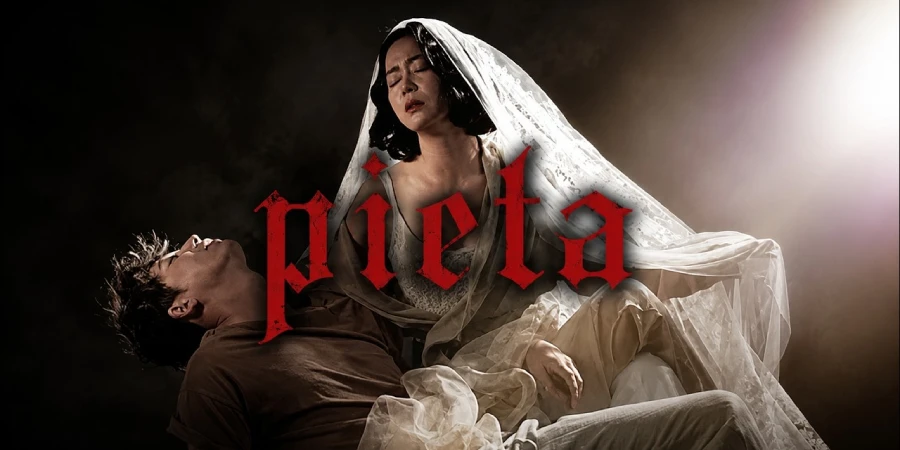

Kim Ki-duk made a film where a loan shark’s fake mother seduces him into tenderness, then destroys him from the inside out, and the whole thing unfolds in Seoul’s iron-forging slums with a matter-of-fact brutality that feels almost biblical. Pieta won the Golden Lion at Venice in 2012, putting Korean extreme cinema on the world stage in a way that even its most devoted fans did not fully expect. This is not a revenge thriller or a melodrama in any conventional sense. It is a trap, and the audience walks into it willingly.
Detailed Summary
Meet Gang-do: A Man Without Mercy
Lee Kang-do works as a debt collector in Seoul’s Cheonggyecheon industrial district. His method is simple and monstrous: when debtors cannot pay, he deliberately maims them so they can collect disability insurance, then takes the payout for his employer.
He breaks hands, crushes legs, shoves men into machinery. No emotion crosses his face. He lives alone in a cramped apartment and has no relationships, no apparent past, no softness anywhere.
A Woman Appears at His Door
One day a middle-aged woman, Mi-sun, shows up claiming to be his long-lost mother who abandoned him as a newborn. Gang-do does not believe her. He is violent and sexually abusive toward her in the early scenes, testing her with degradation to make her leave.
She stays through all of it. Her persistence is unsettling before it becomes moving, and Kim Ki-duk holds that ambiguity deliberately.
Gang-do Breaks and Accepts Her
Slowly, Gang-do’s defenses crack. He starts calling her “Mother.” He cooks for her. He sleeps beside her. For the first time in the film, his face carries something resembling human warmth.
He even begins to feel guilt about his victims. One man he crippled earlier in the film becomes a haunting presence, building miniature figures in his workshop, cursing Gang-do with quiet, exhausted hatred.
The Victims Strike Back
As Gang-do softens, his victims begin retaliating. One man’s pregnant wife confronts him. Another debtor, whose hands Gang-do destroyed, commits suicide by jumping off a bridge, taking Gang-do’s arm with him as he falls, because he grabbed Gang-do’s arm on the way down.
Gang-do survives but is shaken. Mi-sun witnesses his unraveling. Their bond deepens precisely because he is becoming more vulnerable.
Mi-sun Is Taken
Gang-do returns home one day to find Mi-sun gone. A ransom note leads him on a frantic search. He tears through the city, desperate in a way he has never been about anything.
He finds her dead. A bag over her head. His grief is not performed; it is physical, ugly, total. The man who maimed people for a living collapses over a woman he knew for only weeks.

Movie Ending
Gang-do discovers the truth in fragments. Mi-sun was not his real mother. She was the mother of one of his victims, a young man whose hands Gang-do crushed, leaving him unable to work, leading directly to his suicide. She had planned the entire relationship as a long revenge. She gave Gang-do the thing he never had, genuine maternal love, so that losing her would hurt him the way her son’s death had hurt her.
It is a cold, elegant cruelty. She did not just endure his abuse; she calculated every moment of tenderness as a weapon. The fact that she also seemed to genuinely develop feeling for him makes it worse, not better.
Gang-do, now hollow, ties himself up with a rope attached to the back of a vehicle and lies on the road. He positions himself so the car will drag him to death when it pulls forward. It does. His body is dragged through the street in a final image that is both punishment and surrender.
Kim Ki-duk frames this ending without sentimentality. Gang-do gets exactly what he gave: his body used as a means to someone else’s end. The symmetry is brutal and precise. One reading is that Mi-sun’s plan worked perfectly. Another is that Gang-do chose this, that the brief taste of being loved made everything else unbearable.
Are There Post-Credits Scenes?
Pieta has no post-credits scenes. Nothing follows the final image. Kim Ki-duk gives you no relief and no epilogue. The film ends and stays ended.
Type of Movie
Pieta is a South Korean psychological drama with strong elements of thriller and tragedy. Its tone is relentlessly grim, occasionally tipping into body-horror territory during the maiming sequences.
It belongs loosely to the tradition of Korean extreme cinema alongside directors like Park Chan-wook, but Kim Ki-duk’s style is rawer and more stripped-back. No stylized action, no slick cinematography. Just pressure, applied steadily until something breaks.
Cast
- Lee Jung-jin – Kang-do
- Jo Min-su – Mi-sun
- Woo Gi-hong – Debtor who commits suicide
- Kang Eun-jin – Pregnant debtor’s wife
Film Music and Composer
Park In-young composed the score for Pieta. The music is sparse and functions more like an absence than a presence. Long stretches of the film play without any score at all, letting the industrial noise of the Cheonggyecheon district carry the emotional weight.
When music does appear, it tends toward low strings and minimal piano lines. Kim Ki-duk has always preferred silence to underscoring, and Pieta takes that instinct further than most of his films.



Filming Locations
Cheonggyecheon, the industrial and metalworking district of Seoul, is almost a character in the film. Small workshops line narrow alleys. Workers hammer iron by hand. Disability is not abstract here; it is a professional hazard these people already live with.
Shooting on location rather than on sets gives the film a documentary weight. Gang-do’s route through the district feels like a real neighborhood, which makes his violence against its residents feel like a genuine community violation.
Kim Ki-duk chose this area deliberately to connect the film’s economic argument to its visual texture. These are people already at the bottom of South Korea’s financial system, squeezed further by loan sharks operating just outside the law.
Awards and Nominations
Pieta won the Golden Lion at the Venice International Film Festival in 2012, the top prize at one of cinema’s most prestigious competitions. It was Kim Ki-duk’s first Golden Lion and a significant moment for South Korean cinema internationally.
South Korea selected Pieta as its submission for the Academy Award for Best Foreign Language Film that year.
Behind the Scenes Insights
- Kim Ki-duk shot Pieta on a very low budget and a tight schedule, consistent with his preference for fast, instinct-driven production.
- Jo Min-su has spoken about the physical and emotional toll of the early scenes, where her character endures sustained abuse from Gang-do.
- Kim Ki-duk wrote the script himself, as he does with virtually all his films.
- The director returned to filmmaking after a period of withdrawal and reflection following personal and professional difficulties, and Pieta was seen as his comeback film.
- Much of the filming took place in actual working metal shops, not dressed sets, which meant the cast and crew worked around real industrial equipment.
Inspirations and References
The film’s title references Michelangelo’s famous sculpture of Mary cradling the dead Christ. Kim Ki-duk uses this image to frame the mother-son relationship at the story’s center, but then inverts it completely. Mi-sun cradles Gang-do not in grief but in manufactured love designed to produce grief.
Kim Ki-duk has cited his broader interest in South Korea’s debt and loan shark culture as a starting point. The Cheonggyecheon district’s real economic conditions gave the premise its grounding.
Thematically, the film engages with biblical ideas of vengeance and an eye for an eye, filtered through a specifically Korean economic context. Mi-sun’s revenge is proportional in an almost Old Testament sense.
Alternate Endings and Deleted Scenes
No officially documented alternate endings or deleted scenes for Pieta have been confirmed in public record. Kim Ki-duk’s fast production style typically means the final cut is close to what he intended from the start.
Book Adaptations and Differences
Pieta is not based on a book, short story, or any previously existing source material. The screenplay is an original work by Kim Ki-duk.


Memorable Scenes and Quotes
Key Scenes
- The opening sequence: Gang-do forces a disabled debtor onto his own grinding machine. No music, no cutaway. The camera watches it happen and so do we.
- Mi-sun’s arrival and abuse: Gang-do degrades her in ways designed to make her flee. She stays on her knees on his floor and does not leave. Jo Min-su’s stillness in this scene is extraordinary work.
- Cooking together: A quiet domestic scene that feels almost ordinary, which makes everything that follows more devastating. Gang-do smiles.
- The bridge suicide: A debtor grabs Gang-do’s arm as he jumps. The moment is sudden and physical, and Gang-do’s face when he pulls free shows something new, fear mixed with something like shame.
- Gang-do finds Mi-sun’s body: He tears the bag off her head. His howl is not a movie howl. Lee Jung-jin collapses forward over her body like his skeleton has been removed.
- The final death: Gang-do arranges his own killing with a rope and a car. No music. No dialogue. He lies down in the street and waits.
Iconic Quotes
- “I want to go back into your womb.” Gang-do to Mi-sun, at the height of their bond, a line that is tender and deeply disturbing in equal measure.
- “Now you know how I felt.” Mi-sun’s confession to Gang-do after he discovers the truth, a line that carries the entire moral architecture of the film in six words.
Easter Eggs and Hidden Details
- The miniature figures built by one of Gang-do’s crippled victims function as a visual motif for helplessness. A man whose hands are destroyed still tries to make things with them.
- The Michelangelo Pieta is never shown directly, but the final pose of Gang-do’s body on the street echoes a deposition or lamentation composition, a broken figure laid out flat.
- Gang-do’s apartment is almost entirely empty of personal objects at the film’s start. As Mi-sun moves in, small domestic items appear. After her death, those items remain, a visual record of her absence.
- Several of Gang-do’s victims are shown continuing to work despite their injuries. Kim Ki-duk places them in the background of later scenes without calling attention to them, a quiet accumulation of consequence.
- Mi-sun’s clothing gradually shifts from plain, dark tones to slightly warmer colors as her relationship with Gang-do deepens, then reverts before her disappearance.
Trivia
- Pieta was Kim Ki-duk’s eighteenth feature film.
- Kim Ki-duk is largely self-taught as a filmmaker. He did not attend a formal film school in the conventional sense and came to directing through painting and writing.
- The Golden Lion win at Venice was the first time a Korean film had taken the top prize at that festival.
- Lee Jung-jin had to undergo significant physical preparation to portray Gang-do’s menacing physicality, as well as his eventual emotional collapse.
- Kim Ki-duk wrote, directed, and produced the film himself, maintaining near-complete creative control.
- The film runs under 100 minutes, which is typical for Kim Ki-duk, who distrusts padding and cuts aggressively.
Why Watch?
Jo Min-su gives one of the decade’s most controlled performances in a role that asks her to be simultaneously a victim, a con artist, and a grieving mother, sometimes in the same shot. Kim Ki-duk builds his revenge premise on an economic reality, loan shark debt culture in working-class Seoul, that most international thrillers would use as mere backdrop but here becomes the film’s actual subject. If you have ever wanted a revenge film that punishes its audience as thoroughly as its characters, this is the one.
Director’s Other Movies
- Bad Guy (2001)
- The Isle (2000)
- Spring, Summer, Fall, Winter… and Spring (2003)
- 3-Iron (2004)
- Time (2006)
- Breath (2007)
- Arirang (2011)