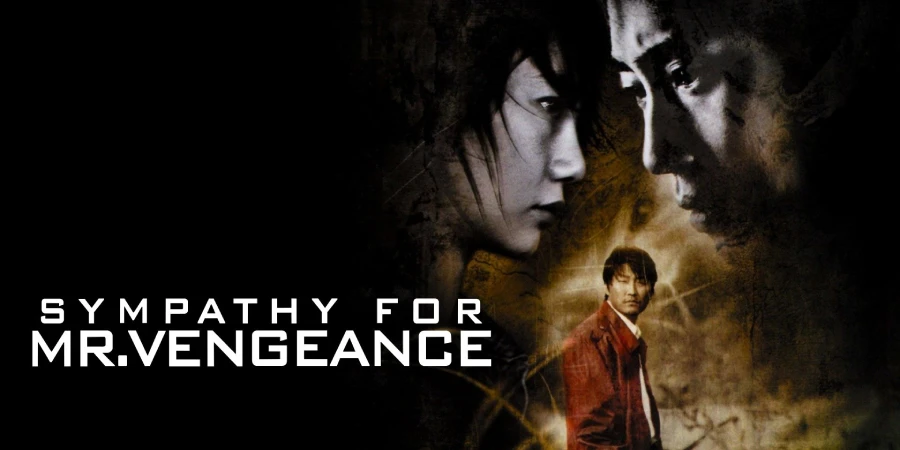

Park Chan-wook’s first entry in his Vengeance Trilogy is the slowest, the quietest, and arguably the cruelest. Sympathy for Mr. Vengeance (2002) tracks two desperate men whose grief pushes them past every moral boundary, and it refuses to let the audience side with either one. Where most revenge films let you cheer, this one makes you sick. A deaf-mute factory worker and a bereaved industrialist destroy each other in a cycle so pitiless that the film’s green-tinted color palette starts to feel like nausea made visible.
Detailed Summary
Ryu’s Desperation and the Black Market Deal
Ryu (Shin Ha-kyun) is a deaf-mute young man working in a factory. His older sister is dying of kidney failure and needs a transplant. Ryu’s blood type does not match hers, so a legitimate donation is impossible.
He contacts black market organ dealers. They promise to find a compatible kidney, but they want his own kidney as payment plus ten million won. Ryu agrees, undergoes the surgery, and wakes up in an empty lot. His kidney is gone. His money is gone. The dealers have vanished.
Shortly after, the hospital informs Ryu that a legitimate donor kidney has become available. He no longer has the money to pay for the operation.
The Kidnapping Plan
Ryu’s girlfriend, Yeong-mi (Bae Doona), is a radical leftist activist. She suggests kidnapping the daughter of Park Dong-jin (Song Kang-ho), the owner of the factory that recently laid Ryu off. Their plan is simple: collect enough ransom to pay for the sister’s transplant surgery, then return the child unharmed.
Ryu kidnaps the little girl, Yu-sun. He treats her gently. He plays with her, feeds her, and carries her around on his back. Nothing about his behavior toward her is violent. The child does not appear terrified.
The Sister’s Suicide
Ryu’s sister discovers the truth about the kidnapping. She cannot bear the idea that her brother committed a crime for her sake. While Ryu is away, she slits her wrists and bleeds to death in the apartment.
Ryu returns to find her body. He is shattered. With his sister dead, the entire purpose of the kidnapping has evaporated. There is no surgery to pay for anymore.
Yu-sun’s Drowning
Ryu decides to return Yu-sun to her father. He takes her to a riverbank, a spot he associates with his sister. While he buries his sister’s body nearby, he leaves Yu-sun momentarily unsupervised near the water. She falls in and drowns.
This is the scene that defines the film’s entire moral architecture. Ryu did not intend to kill the girl. He loved his sister and meant no real harm to anyone. Yet the child is dead all the same, and intention means nothing against that fact.
Park Dong-jin’s Grief and Hunt
Park Dong-jin receives news of his daughter’s death. Song Kang-ho plays this grief with a terrifying stillness. His face barely moves. He stares at the small body and says almost nothing. From this moment, he commits himself entirely to finding the people responsible.
Park hires a private investigator. He also contacts the police but grows impatient with their pace. Piece by piece, he traces the crime back to Ryu.
Park’s Acts of Vengeance
Park captures Yeong-mi first. He interrogates her. She refuses to cooperate and clings to her political ideology, insisting the kidnapping was a justified act against capitalist exploitation. Park kills her by slashing her Achilles tendons and leaving her to die.
He then tracks down Ryu. Park does not rush. He waits, watches, and plans his approach with cold patience. When he finally confronts Ryu, the violence is methodical.
Ryu’s Own Vengeance
Ryu has his own parallel quest. He hunts the organ traffickers who robbed him of his kidney and his money. He finds them, and he kills them. Park Chan-wook films this violence with the same flat affect as everything else. No music swells. No catharsis arrives.
Ryu’s revenge against the dealers does nothing to bring back his sister. It does nothing to undo Yu-sun’s death. It is simply more blood on the pile.

Movie Ending
Park Dong-jin catches Ryu. He drags him to the same riverbank where Yu-sun drowned. In a scene of agonizing deliberateness, Park slices Ryu’s Achilles tendons, crippling him, and then drowns him in the shallow water. Ryu does not struggle much. His face, already a mask of grief and exhaustion, barely registers surprise.
Park’s revenge is complete. But Park Chan-wook has no interest in letting anyone walk away clean. As Park stands over Ryu’s body, a group of radical activists, friends of Yeong-mi, approach him. They stab Park to death. He dies at the same river, steps from where his daughter drowned and where Ryu just died.
Nobody wins. Nobody survives. Every act of vengeance spawns the next, and the cycle ends only when everyone involved is dead. Park Chan-wook holds the camera on the aftermath without commentary. No music. No swelling score. Just water and bodies and silence. It is the bleakest conclusion in a trilogy famous for bleak conclusions.
What makes this ending so devastating is its structural symmetry. Ryu kidnapped to save a life. Park killed to avenge a life. Both men acted out of love, and both men destroyed everything they touched. The film does not ask which man was right. It suggests the question itself is irrelevant once violence enters the equation.
Are There Post-Credits Scenes?
No. Sympathy for Mr. Vengeance has no post-credits scene. Once the final image fades, that is it. Park Chan-wook has never been interested in stingers or sequel teases, and this film’s ending is too final to need one.
Type of Movie
Sympathy for Mr. Vengeance is a revenge thriller with heavy drama elements. It sits squarely in the Korean New Wave movement that gained international attention in the early 2000s.
The tone is deliberately cold. Park Chan-wook strips out most of the genre pleasures that revenge films typically offer. There are no triumphant kills, no righteous monologues, no cathartic payoffs. Instead, the film operates more like a tragedy in the Greek sense, where flawed people make understandable choices that lead inevitably to ruin.
Violence arrives in sudden, unglamorous bursts. Some viewers expecting the stylized flair of Oldboy will find this film much harder to sit through, not because it is more graphic but because it is more hopeless.
Cast
- Shin Ha-kyun – Ryu
- Song Kang-ho – Park Dong-jin
- Bae Doona – Yeong-mi
- Lim Ji-eun – Ryu’s Sister
- Han Bo-bae – Yu-sun
Film Music and Composer
Cho Young-wuk composed the score. His work here is intentionally sparse. Long stretches of the film play with no music at all, forcing the audience to sit with ambient sounds: water, footsteps, the hum of factories.
When music does appear, it leans toward minimalist, almost industrial textures. Cho would go on to become Park Chan-wook’s regular composer, scoring Oldboy and Lady Vengeance as well. His restraint in this film is one of its most underrated elements; a bigger score would have given the audience emotional cues the director clearly wanted to withhold.

Filming Locations
The film was shot in and around Seoul, South Korea. Many scenes take place in working-class industrial areas, cramped apartments, and anonymous urban landscapes. Park Chan-wook chose these locations to emphasize the economic desperation that drives Ryu’s choices.
The river where several key scenes unfold becomes the film’s central location. Its shallow, unremarkable appearance makes it all the more disturbing as a site of death. This is not a dramatic gorge or a raging waterfall. It is an ordinary body of water where a child could easily slip and drown, which is exactly the point.
Awards and Nominations
Sympathy for Mr. Vengeance screened at the Cannes Film Festival in 2002 as part of the Directors’ Fortnight sidebar. It received recognition at various Korean film awards, though it was commercially unsuccessful on its initial release in South Korea. Its reputation grew considerably after Oldboy turned Park Chan-wook into an international name.
Behind the Scenes Insights
- Shin Ha-kyun spent significant time preparing for the role of a deaf-mute character. He learned sign language and worked to convey emotion almost entirely through his eyes and body language, since the character cannot speak.
- Park Chan-wook conceived the Vengeance Trilogy not as a continuous narrative but as three thematically linked films exploring revenge from different angles. Sympathy for Mr. Vengeance was the first, followed by Oldboy (2003) and Lady Vengeance (2005).
- The film’s green-heavy color grading was a deliberate choice. Park Chan-wook and his cinematographer, Kim Byung-il, used the palette to create a sickly, uneasy atmosphere distinct from the warmer or more saturated tones of typical Korean dramas.
- Song Kang-ho was already one of South Korea’s biggest stars when he took this role. His decision to play a character who commits torture and murder, without any redemptive arc, showed considerable artistic bravery.
- Bae Doona, who would later gain international fame through films like Cloud Atlas and the Netflix series Sense8, was relatively early in her career. Her performance here as a passionate but dangerously naive activist remains one of her sharpest turns.
Inspirations and References
Park Chan-wook has cited Greek tragedy as a structural influence on the film. Characters pursue goals that seem rational in isolation, yet every action triggers an equal and opposite reaction until everyone is destroyed. This echoes the fatalism of Euripides and Sophocles more than it does any modern thriller template.
The film also draws from the economic anxieties of late-1990s and early-2000s South Korea. The 1997 Asian financial crisis devastated the Korean middle class, and mass layoffs at factories became a national trauma. Ryu’s dismissal from his job is not just a plot device. It is a reflection of a real social wound.
Park Chan-wook has also discussed Dostoevsky’s interest in how moral people rationalize immoral acts. Ryu and Yeong-mi convince themselves the kidnapping is justified because the target is wealthy. Park Dong-jin convinces himself that torture is justified because his child was murdered. Both rationalizations are understandable and both are monstrous.
Alternate Endings and Deleted Scenes
No widely documented alternate endings exist for this film. Park Chan-wook’s DVD commentary does not reference any significantly different version of the final sequence. The ending as released appears to be the one he always intended.
Book Adaptations and Differences
Sympathy for Mr. Vengeance is not based on a book, short story, or any previously published source material. Park Chan-wook developed the screenplay as an original work.

Memorable Scenes and Quotes
Key Scenes
- The organ theft: Ryu wakes up in an empty lot, shirtless, with a fresh surgical scar and no money. The camera stays on his confused, groggy face for an uncomfortably long time before he realizes what has happened. It is one of the most quietly horrifying scenes in the film.
- Yu-sun’s drowning: Park Chan-wook keeps the camera at a distance. We see Ryu digging his sister’s grave while the tiny figure of Yu-sun plays near the river’s edge. The drowning itself happens almost offscreen, a small splash that Ryu cannot hear because he is deaf. This directorial choice is gutting; the violence is in what Ryu cannot perceive.
- Park discovering his daughter’s body: Song Kang-ho delivers grief through absolute physical rigidity. His hands hang at his sides. His mouth stays closed. His eyes do all the work. It is the best single moment of acting in the entire film.
- Yeong-mi’s death: Park Dong-jin’s methodical approach to killing Yeong-mi marks the moment his character crosses from grieving father to something far darker. He does not lose control. He is precise. That precision is what makes the scene so disturbing.
- The final riverbank sequence: Three deaths occur in quick succession at the same location. Park Chan-wook stages them with an almost ritualistic formality. Bodies accumulate. Water flows. Nobody is coming to stop any of it.
Iconic Quotes
- Because Ryu is deaf-mute, much of the film’s emotional weight falls on sign language and physical gesture rather than dialogue. Spoken lines are sparse by design.
- Yeong-mi’s political speeches about class inequality provide the film’s most verbal passages, though Park Chan-wook frames her ideology as sincere but fatally detached from the human consequences of her plan.
- Park Dong-jin’s few words carry enormous weight precisely because he says so little. His silence mirrors Ryu’s in a way that binds the two men together as dark reflections of each other.
Easter Eggs and Hidden Details
- The green color palette shifts subtly throughout the film. Scenes involving Ryu’s sister lean toward warmer greens, while the revenge sequences push into colder, more toxic tones. It is easy to miss on first viewing.
- Ryu’s sign language includes moments of tenderness toward Yu-sun that a hearing audience might not fully register without subtitles. Park Chan-wook built emotional beats into these silent exchanges that reward close attention.
- Water appears in nearly every major scene, from the river to Ryu’s apartment to the rain. It functions as a recurring visual motif linking life (the sister’s need for medical care) to death (Yu-sun’s drowning, Ryu’s drowning).
- A television broadcast about labor strikes plays in the background of several scenes, quietly reinforcing the economic themes without ever drawing attention to itself.
Trivia
- The film underperformed at the Korean box office upon release. Only after Oldboy became an international sensation did audiences return to this earlier film and reevaluate it.
- Shin Ha-kyun and Song Kang-ho share remarkably little screen time together. Park Chan-wook deliberately kept the two leads apart for most of the runtime, building toward their confrontation with the patience of a slow fuse.
- Park Chan-wook originally considered making Oldboy before this film but chose to start the trilogy with the quieter, more grounded story.
- Bae Doona reportedly found the political monologues her character delivers challenging because Yeong-mi’s convictions had to feel genuine even as the film undercuts their practical application.
Why Watch?
Song Kang-ho and Shin Ha-kyun deliver two performances built almost entirely out of silence and physical stillness, and the tension between their parallel grief is more unsettling than any explicit violence. Park Chan-wook constructs every scene to deny you the satisfaction revenge films usually promise. If you want catharsis, look elsewhere. If you want something that will sit in your stomach for days, start here.
Director’s Other Movies
- Joint Security Area (2000)
- Oldboy (2003)
- Lady Vengeance (2005)
- I’m a Cyborg, But That’s OK (2006)
- Thirst (2009)
- Stoker (2013)
- The Handmaiden (2016)
- Decision to Leave (2022)