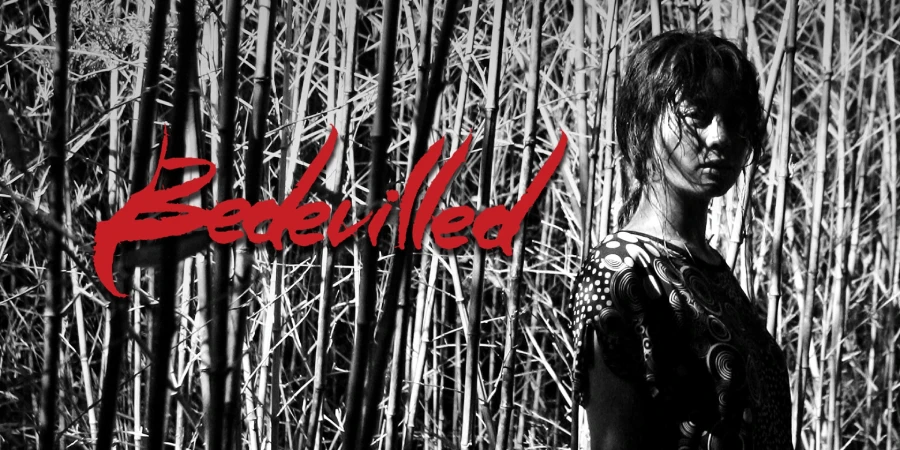

A woman gets beaten, raped, overworked, and humiliated for years on an island with almost no one to help her, and the film’s central question is not whether she will snap but how spectacularly she will do it. Bedevilled (2010), directed by Jang Cheol-soo, is a South Korean revenge thriller that earns every drop of its violence by front-loading nearly an hour of sustained, suffocating cruelty. Hae-won, a Seoul banker visiting the remote island of Moo-do, watches it all happen and does nothing. That cowardice is the film’s real subject.
Detailed Summary
Hae-won’s Cold Life in Seoul
We meet Hae-won (Ji Sung-won) as a frigid, detached bank worker in Seoul. She witnesses a street assault on a woman and refuses to give a police statement, turning her back without a flicker of guilt.
Her supervisor, irritated by her interpersonal coldness, forces her to take a vacation. She reluctantly travels to Moo-do, a tiny, almost uninhabited island she grew up on.
Arriving on Moo-do and Reuniting with Bok-nam
On the island, Hae-won reconnects with her childhood friend Bok-nam (Seo Young-hee). Bok-nam is visibly thrilled to see her, chattering about Seoul and begging Hae-won to take her and her daughter Yeon-hee away from the island.
Bok-nam’s daily life is immediately horrifying. Her husband Man-jong beats her regularly, rapes her, and shares her sexually with his brother Jong-kil. She does essentially all the physical labor that keeps the island running.
The Cruelty of the Island Community
Moo-do’s elderly female residents are almost as culpable as the men. They watch the abuse with cold indifference, sometimes actively enabling it, dismissing Bok-nam as property rather than a person.
Bok-nam tries once to call the police from the island’s single phone. Man-jong catches her and destroys that possibility immediately. She has no exit and no ally.
Hae-won Watches and Does Nothing
This is the section of the film that is genuinely uncomfortable to sit with. Hae-won sees beatings. She hears screaming at night. She witnesses the community’s casual cruelty toward Bok-nam up close.
She does nothing. She deflects, avoids, and retreats into passivity. Bok-nam pleads directly with her to help arrange an escape to Seoul, and Hae-won offers empty non-answers. Her inaction is not passive; it is a choice the film refuses to let off the hook.
Yeon-hee’s Death
Bok-nam’s young daughter Yeon-hee, the only pure source of joy in her life, falls from a cliff while trying to follow Hae-won’s boat as Hae-won prepares to leave the island without her.
This is the film’s point of no return. Bok-nam screams at Man-jong to call for a helicopter, and he refuses. Yeon-hee dies. Man-jong shows zero remorse and instead blames Bok-nam, calling the child a burden anyway.
Bok-nam Begins the Killing
Bok-nam grabs a scythe. She kills Man-jong first, hacking at him with a fury that Seo Young-hee plays without theatrics, just a flat, exhausted determination that makes it more chilling than any screaming performance would. She then moves through the island killing Jong-kil and the old women who stood by for years.
Each killing carries the weight of a specific, remembered cruelty. This is not random violence; it is an itemized accounting. Director Jang does not glamorize the bloodshed, but he does not look away from it either.
Hae-won Hides
Bok-nam finds Hae-won cowering in a house. She does not kill her immediately. Something in Bok-nam still reaches toward the friend she once loved, even as her hands carry a scythe.
Hae-won, still paralyzed, does not fight back or try to help. Her passivity continues even while people die around her. She is a bystander in the middle of a massacre she partly caused through inaction.


Movie Ending
Bok-nam and Hae-won end up face to face after the carnage has cleared the island of almost everyone else. Bok-nam, bleeding and spent, makes one final appeal to her oldest friend. Hae-won, in what is arguably the film’s defining moment of moral failure, still cannot reach out to her.
Bok-nam attacks her. Hae-won fights back and stabs Bok-nam fatally. It is a horrible, messy struggle with no dignity on either side. The woman Hae-won kills is the same woman she could have saved at any of a dozen earlier points.
Hae-won escapes the island by boat. Back in Seoul, she sits in her apartment surrounded by the same detached urban silence she left. A package arrives: it is Yeon-hee’s drawings, mailed earlier by Bok-nam before everything collapsed. Hae-won looks at them. We watch her face finally crack.
That cracking face is the film’s real ending. Not the violence, not the escape. Hae-won spent the entire film refusing to feel anything, and now she cannot stop. Guilt arrives late, as it usually does for people like her. The film refuses to give her a redemption arc; it simply shows consequence landing at last.
Audiences often ask whether the ending suggests Hae-won will change. It does not. Jang Cheol-soo offers grief, not growth. That distinction is what makes the conclusion so difficult to shake.
Are There Post-Credits Scenes?
Bedevilled has no post-credits scene. Once the final image fades, the film is done. It would be almost offensive to the tone of the film if there were one.
Type of Movie
Bedevilled sits at the intersection of revenge thriller, social drama, and psychological horror. Its first half operates almost entirely as slow-burn drama; the second half shifts into something closer to a slasher film, but one with genuine moral weight behind every kill.
The tone is relentlessly grim. There is dark irony running through it, but no levity, no relief valve. It belongs in the same conversation as South Korean social revenge cinema like Sympathy for Lady Vengeance (2005) and A Tale of Two Sisters (2003), though it is rawer and more grounded than either.
Cast
- Seo Young-hee – Bok-nam
- Ji Sung-won – Hae-won
- Park Jeong-hak – Man-jong
- Back Soo-ryun – Yeon-hee
- Choi Jeong-hak – Jong-kil
Film Music and Composer
The score for Bedevilled was composed by Jang Young-gyu, a South Korean musician with roots in indie rock and film scoring. His work here leans into acoustic simplicity, using sparse string arrangements and silence as much as actual music.
The contrast between Bok-nam’s folk-song humming on the island and the colder, more industrial sonic texture of Seoul sequences is one of the film’s most underrated craft choices. That musical contrast does real storytelling work without being obvious about it.


Filming Locations
Bedevilled was shot primarily on Chuja Island (Chujado), a real remote island off the southwestern coast of South Korea. Its genuine isolation, rocky shorelines, and small population make it feel less like a location and more like a trap.
Choosing a real island rather than a constructed set was a smart decision. You feel the distance from civilization in every frame. The sea surrounding Moo-do is not scenic; it is a border Bok-nam cannot cross.
Awards and Nominations
Bedevilled competed at the Cannes Film Festival 2010 in the Critics’ Week section, where Seo Young-hee won the Gan Foundation Award for Distribution, a prize recognizing films with strong theatrical distribution potential. The film also received significant attention from South Korean film awards circuits, with Seo Young-hee picking up recognition for her performance domestically.
Behind the Scenes Insights
- Director Jang Cheol-soo deliberately cast non-professional elderly women from the actual island community for the supporting roles of the old women, which adds enormous authenticity to their indifferent cruelty on screen.
- Seo Young-hee reportedly prepared extensively for the physically demanding second half, including the scythe work and the extended chase sequences across difficult terrain.
- Bedevilled was Jang Cheol-soo’s feature directorial debut, which makes the film’s tonal control and structural confidence all the more striking.
- The production team chose Chuja Island partly because its actual demographic reality (an aging, shrinking population) matched the script’s vision of an isolated community frozen in time.
- Ji Sung-won has spoken in interviews about the challenge of playing passivity convincingly, since Hae-won’s entire arc requires the actor to suppress rather than express.
Inspirations and References
Bedevilled draws on a long tradition of Korean social critique about the invisibility of rural women’s suffering. The film reflects genuine sociological realities about isolated island communities in South Korea, where traditional patriarchal structures persisted far longer than in urban centers.
Jang Cheol-soo has cited the broader South Korean revenge film tradition as a touchstone, but his specific interest was in flipping the genre’s typical male protagonist template. Putting a woman at the center of both the suffering and the revenge was a deliberate structural choice.
Thematically, the film echoes the work of writers and filmmakers who explore how bystander apathy enables systemic abuse, a subject with roots in both Korean feminist literature and international drama.
Alternate Endings and Deleted Scenes
No confirmed alternate endings or officially released deleted scenes for Bedevilled are publicly documented. Jang Cheol-soo has not publicly discussed major structural changes made during editing.
Book Adaptations and Differences
Bedevilled is not based on a book or pre-existing literary source. It is an original screenplay. No adaptation comparison applies here.



Memorable Scenes and Quotes
Key Scenes
- Bok-nam’s first beating witnessed by Hae-won: Hae-won stands at a window, watching Man-jong strike Bok-nam in the courtyard below. She does not move. The camera holds on her face, not the violence, which is the cruelest possible framing choice.
- Yeon-hee’s fall: Shot from a distance, almost clinical in its brevity. The child is there, then gone. Bok-nam’s scream carries across the water toward a boat that keeps moving.
- The first kill: Bok-nam raises the scythe on Man-jong. Seo Young-hee’s face is bone-dry and quiet. No tears, no rage-face, just a woman doing a necessary task after years of waiting.
- Bok-nam singing to Yeon-hee: One of the few genuinely tender moments in the film. Her voice is rough and unpolished, and that imperfection makes it more moving than any technically skilled performance would be.
- The final confrontation between Bok-nam and Hae-won: Two women in a blood-soaked room, and the film refuses to let you root cleanly for either one. It is the payoff of an hour and a half of carefully constructed moral complexity.
Iconic Quotes
- “I want to go to Seoul. Just me and Yeon-hee. Please.” Bok-nam to Hae-won, pleading with the simplest possible request and receiving nothing in return.
- “You saw everything and you did nothing.” A line that functions as the film’s moral verdict, directed at Hae-won and, by implication, at the audience that watched passively alongside her.
Easter Eggs and Hidden Details
- Hae-won’s opening scene in Seoul, where she refuses to witness for an assault victim, directly mirrors her behavior on the island. The film plants its thesis in the first five minutes.
- Bok-nam’s daughter Yeon-hee draws pictures throughout the film. Her drawings appear naive and cheerful, a deliberate visual contrast to the darkness surrounding her. The drawings mailed to Hae-won at the film’s end are almost certainly among these.
- The island’s landscape is framed with wide, open shots during the first half, suggesting freedom and natural beauty. After Yeon-hee’s death, the framing tightens. The same spaces feel smaller and more claustrophobic without any set change.
- Bok-nam’s clothing is almost always practical and worn, while Hae-won arrives in clean urban clothes. That wardrobe contrast quietly codes their class and social gap before a single word of dialogue makes it explicit.
Trivia
- Seo Young-hee was largely unknown before Bedevilled. Her performance here launched her into South Korean mainstream cinema and television.
- This was director Jang Cheol-soo’s first feature film.
- The film’s Korean title is Kimbok-nam salinsageonui jeonmal, which translates roughly to “The Whole Story of Kim Bok-nam’s Murder.” That title centers Bok-nam in a way the English-language retitle does not.
- Chuja Island’s real population at the time of filming was aging and small, which meant the production had significant visual access to genuinely uninhabited-looking landscapes without extensive set dressing.
- South Korean critics frequently place Bedevilled in discussions of feminist cinema alongside more internationally recognized titles, though it received less Western press than contemporaries like A Single Man or other 2010 arthouse releases.
Why Watch?
Seo Young-hee’s performance in the scythe sequence alone justifies the runtime: she plays a woman committing multiple murders with the exhausted focus of someone finishing a shift, and it is far more disturbing than any wide-eyed frenzy would be. Bedevilled is worth watching because it weaponizes your discomfort with Hae-won’s inaction against you, making you complicit in the same way the island’s old women are.
Director’s Other Movies
- Scarlet Innocence (2014)