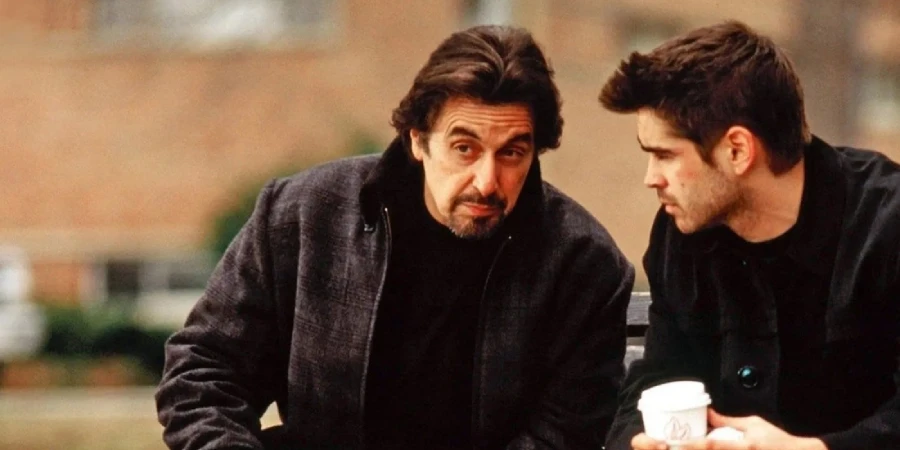

Al Pacino stares across a diner table and tells Colin Farrell, “Nothing is what it seems.” It sounds like a throwaway spy-movie line, but The Recruit has the nerve to mean it literally, twice over. Roger Donaldson’s 2003 thriller runs on misdirection the way a car runs on gas, and it earns a surprising amount of goodwill by committing fully to its own paranoid logic. This is a film where the mentor is the villain, the love interest is an asset, and every moment of trust is a setup for betrayal.
Detailed Summary
James Clayton Gets Recruited
James Clayton, played by Colin Farrell, is a brilliant MIT graduate who writes software and carries a quiet obsession with his father’s disappearance. His father reportedly died in a plane crash in Peru, but James suspects CIA involvement. Walter Burke, played by Al Pacino, approaches James at a bar and hints that his father was actually a CIA operative.
Burke dangles the possibility that James can learn the truth about his father by joining the Agency. James takes the bait. He reports to The Farm, the CIA’s training facility in Virginia.
Life at The Farm
Training sequences form the spine of the film’s first half. James endures sleep deprivation, interrogation drills, psychological pressure, and surveillance exercises. He proves himself unusually sharp, which earns Burke’s attention and some resentment from fellow recruits.
James meets Layla Moore, played by Bridget Moynahan, another trainee he quickly becomes attracted to. Their relationship develops against the backdrop of constant mutual suspicion, which the film treats as both romantic tension and professional hazard. Every conversation between them carries an undercurrent of “are you running me right now?”
The Mole Hunt Assignment
Burke tells James he has failed out of the program — a calculated deception meant to move him into a covert assignment. Privately, though, Burke recruits him as a NOC officer and hands him a real mission: identify a mole inside the CIA who has stolen Ice-9, a piece of software capable of attacking critical infrastructure.
Burke tells James that Layla is the primary suspect. James must get close to her outside The Farm and confirm whether she is passing secrets. This puts James in a brutal position, because he has genuine feelings for her.
James Runs Layla
James re-enters civilian life and reconnects with Layla. He genuinely cares about her, which makes the surveillance feel queasy and morally compromised. He watches her, tracks her movements, and reports back to Burke.
Layla appears to be doing exactly what Burke suspected. She contacts outside parties and handles suspicious items. James grows more conflicted as the evidence mounts against someone he loves.
The Twist Unfolds
Here is where The Recruit earns its money. James eventually discovers that Burke himself is the real traitor. The entire mole-hunt scenario was a fabrication, designed to use James as an unwitting courier and as cover. Even the surveillance of Layla was orchestrated to keep him occupied and off the scent.
Burke has been working to sell Ice-9 to outside buyers. He used James’s emotional investment in the father-mystery to control him from the start. Every warm mentor moment Burke performed was a manipulation, and Pacino plays the reveal with a reptilian calm that retrospectively recontextualizes every earlier scene.
Movie Ending
Burke takes James to a remote location under the pretense of completing the mission. He intends to kill James once Ice-9 changes hands. James, who has finally pieced together Burke’s betrayal, goes in wired and prepared.
A confrontation plays out between the two men in a parking garage. Pacino delivers his “nothing is what it seems” callback with the weary confidence of a man who has run this play before. Farrell’s James looks gutted, not because he is outmatched physically, but because the person who hinted his father might still be alive was using that hope as a leash.
James outmaneuvers Burke. CIA backup arrives, and Burke is taken down. Before he dies, Burke tells James his father really was CIA, a final ambiguous gift that James can neither confirm nor dismiss. It is a deliberately unsatisfying answer, and that is the point. James wanted closure. He gets a maybe.
Layla is cleared. The Ice-9 software is secured. James presumably continues with the Agency, though the film does not linger on triumphant celebration. It ends on James absorbing the fact that the institution he joined, and the man he trusted most inside it, both lied to him throughout.
What makes the ending land is not the action mechanics but the emotional accounting. James got played by a surrogate father figure while searching for his real one. That specific wound gives the climax actual sting beyond the genre formula.
Are There Post-Credits Scenes?
The Recruit has no post-credits scene. Once the final frame lands, the film is done. You can leave when the credits roll.
Type of Movie
The Recruit is a spy thriller with strong elements of psychological drama. Its tone sits closer to paranoid procedural than action-heavy blockbuster. Think less Mission: Impossible and more a stripped-down version of John le Carré adapted for a mainstream audience that wants some Pacino theatrics along the way.
The pacing is methodical in the first two acts and tightens considerably in the third. Roger Donaldson keeps the violence relatively restrained, letting the tension come from information and deception rather than gunplay.
Cast
- Al Pacino – Walter Burke
- Colin Farrell – James Clayton
- Bridget Moynahan – Layla Moore
- Gabriel Macht – Zack
- Karl Pruner – Dennis Slayne
- Eugene Lipinski – Husky
Film Music and Composer
Klaus Badelt composed the score for The Recruit. Badelt was fresh off Pirates of the Caribbean: The Curse of the Black Pearl when this film released, and his work here is notably more restrained than that bombastic adventure score. He strips back the orchestral flourishes in favor of tense, minimal cues that suit the film’s mood of creeping mistrust.
The score never calls attention to itself, which is exactly right for this kind of film. A thriller about deception benefits from music that refuses to telegraph emotion. Badelt’s choices keep the audience slightly off-balance, which is a smart alignment of craft and story.


Filming Locations
Principal photography took place primarily in Ottawa, Ontario, Canada. Several locations in Ottawa stood in for Washington, D.C., a common production decision driven by budget efficiency and Canadian tax incentives.
Camp Peary, the real CIA training facility in Virginia known informally as The Farm, was obviously not available for filming. Production designers built and adapted locations to approximate its atmosphere. The isolated, institutional quality of the training sequences reads convincingly on screen despite the substitution.
Some scenes were filmed in the United States as well. The dual-location production gives the film a slightly generic visual geography, which actually suits a story about a world where nothing is where it appears to be.
Awards and Nominations
The Recruit did not receive significant awards attention during its release cycle. It was a commercially minded thriller and was treated as such by awards bodies.
Behind the Scenes Insights
- Colin Farrell was coming off a high-profile run that included Minority Report and Phone Booth. His casting here positioned him as the go-to intense young lead of early 2000s thrillers.
- Roger Donaldson reportedly did extensive research into CIA recruitment and training practices to give the Farm sequences procedural credibility.
- Al Pacino’s performance as Burke was designed to be warmly persuasive first, so the villain reveal would feel like a genuine gut punch rather than a telegraphed twist.
- The production worked with technical consultants familiar with intelligence community culture to shape the training montage authenticity.
- Bridget Moynahan later described the physical demands of the training sequences as genuinely exhausting despite the scenes being staged.
Inspirations and References
The Recruit draws on a rich tradition of Cold War paranoia thrillers, though it updates the anxiety from East vs. West to insider betrayal within American institutions. The mentor-as-villain structure owes an obvious debt to John le Carré’s worldview, where the most dangerous enemy wears a familiar face and carries institutional authority.
The concept of CIA training and the psychological conditioning of recruits also reflects real documented elements of Agency culture, which Donaldson leaned into for authenticity. Films like Three Days of the Condor clearly cast a long shadow over this story’s DNA.
Alternate Endings and Deleted Scenes
No officially documented alternate endings or significant deleted scenes have been widely publicized for The Recruit. Roger Donaldson has not discussed major structural changes to the film in interviews that are part of the public record.
The theatrical cut appears to be the version Donaldson and the studio settled on without substantial deviation from the original design.
Book Adaptations and Differences
The Recruit is not based on a book or any previously published source material. The screenplay was written by Roger Towne, Kurt Wimmer, and Mitch Glazer as an original work. No adaptation comparison applies here.


Memorable Scenes and Quotes
Key Scenes
- The bar recruitment scene: Burke slides into a seat near James, drops hints about his father, and slowly reels him in. Pacino plays it almost casually, which makes it more unsettling than any hard sell would.
- James’s interrogation at The Farm: Strapped to a chair under harsh light, James is worked over psychologically by instructors. He grips the armrests, jaw tight, cycling through controlled panic. It is the film’s most viscerally uncomfortable stretch.
- Burke reveals the real assignment: Pacino leans forward across a table and tells James he never actually washed out. The camera sits close on Farrell’s face as he recalibrates everything he thought he knew.
- The parking garage confrontation: Burke and James face each other with the warmth fully drained. Pacino keeps his voice low and even, which is far more chilling than shouting would be.
- James surveilling Layla: He watches her through a lens while she moves through her apartment, unaware. His face shows guilt, not satisfaction, which makes the scene genuinely uncomfortable rather than cool.
Iconic Quotes
- “Nothing is what it seems.” Burke to James, said early as philosophy and later as threat.
- “We are the CIA, and we do not lie, cheat, steal, or go against the interests of the United States of America.” Burke, delivering this with exactly the right amount of irony in retrospect.
- “Your whole life is bait.” Burke to James, which is the most honest thing he says in the entire film.
Easter Eggs and Hidden Details
- The software weapon is named Ice-9, a reference to the fictional catastrophic substance in Kurt Vonnegut’s novel Cat’s Cradle. In that book, Ice-9 destroys all life on Earth once released. Naming a cyberweapon after it signals just how seriously the film wants you to take the stakes.
- Several background details in the Farm sequences reflect real documented CIA training philosophy, including the use of constructed false environments to test recruit judgment under pressure.
- Burke’s consistent use of the word “seems” throughout the film is not accidental. Track it across his dialogue and a pattern emerges: he is always gesturing toward ambiguity while projecting certainty.
- James’s laptop work in early scenes foreshadows his eventual usefulness in the Ice-9 plot. Burke chose him partly because of his technical profile, not just his emotional vulnerability.
Trivia
- Colin Farrell and Al Pacino had no prior working relationship before this film, yet their mentor-student chemistry reads as entirely lived-in from their first scene together.
- The film opened in January 2003, a release window often associated with studio confidence in commercial viability over awards competition.
- Roger Donaldson previously directed No Way Out (1987), another Washington-set thriller built around a devastating third-act twist, making The Recruit feel like a natural entry in his personal genre catalog.
- Bridget Moynahan’s character Layla is deliberately written to be readable as either guilty or innocent throughout the film’s second act, a scripting choice that makes the audience share James’s confusion rather than sit ahead of it.
- The film’s production was completed and released within roughly a year, a brisk timeline for a studio thriller of its scope.
Why Watch?
Watch it for Pacino’s Burke, one of his more controlled and therefore more dangerous performances from that era. He never chews scenery; he withholds, and that restraint makes every warm smile feel like a loaded weapon pointed at Farrell’s chest. Farrell holds his own, and their final confrontation delivers because both actors have been building toward it honestly.
Director’s Other Movies
- No Way Out (1987)
- Cocktail (1988)
- Dante’s Peak (1997)
- Thirteen Days (2000)
- The Bank Job (2008)