Hitler lost the war, so cinema got to judge him almost immediately. Stalin won it. He died in his bed in 1953, his portrait still hanging in every Soviet classroom, and for decades the only films about Joseph Stalin that existed were the ones he had personally approved. That single fact makes Stalin movies a stranger and, in some ways, richer body of work than their Hitler counterparts: the honest films had to be smuggled past censors, buried on shelves until glasnost, or made abroad by people who were never allowed to show them at home.
The result is a filmography that argues with itself. There is state propaganda that casts Stalin as a serene demigod, a Georgian allegory that was banned before it was released, a Russian art film so dense it was booed at Cannes, and a British comedy that turned the dictator’s death into farce. Some of the best movies about Stalin never show his face at all; they show the terror through a knock at the door, a missing husband, or a famine that the outside world chose not to report.
This list ranks ten films about Stalin that, taken together, tell the whole story: the cult, the purges, the paranoia, and the morning his inner circle found him on the floor and were too frightened to call a doctor. Each entry notes how the film handles Stalin himself, on screen or off, and who it is really for.
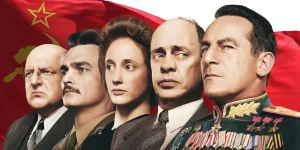
1. The Death of Stalin (2017)
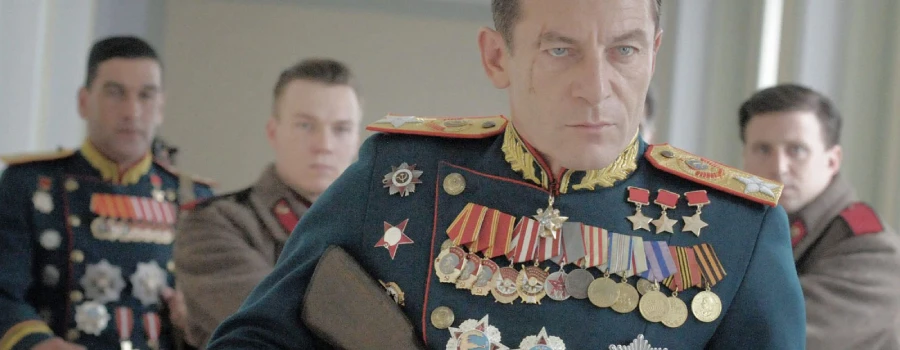
Directed by Armando Iannucci · Stalin: Adrian McLoughlin · UK/France
Stalin collapses on his bedroom floor and lies in a puddle of his own urine for hours, because every guard outside the door is more afraid of waking him than of letting him die. From that opening, Iannucci, the creator of Veep and The Thick of It, builds a comedy of pure terror: Khrushchev (Steve Buscemi), Beria (Simon Russell Beale) and Malenkov (Jeffrey Tambor) scramble for power while pretending to grieve, and every joke is also a confession about how the system actually worked.
The cast speak in their own accents, Buscemi’s Brooklyn and Jason Isaacs’s broad Yorkshire Zhukov included, which sounds like a gimmick until you realize it is the point: these are not exotic foreigners but ordinary careerists, and that is what makes them frightening. Russia banned the film two days before release.
The Stalin factor: On screen for ten minutes, then a corpse the others step around. The film is about the vacuum he leaves, and the men who rush to fill it.
Watch it if: You think a Stalin movie cannot be funny. It can, and the laughter curdles fast.
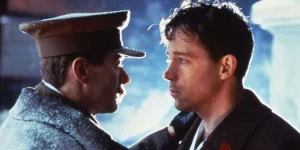
2. The Inner Circle (1991)
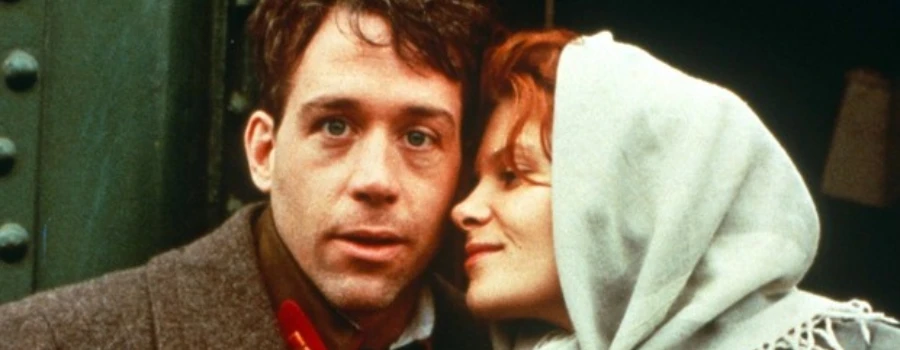
Directed by Andrei Konchalovsky · Stalin: Aleksandr Zbruev · Italy/USSR/USA
Ivan Sanchin (Tom Hulce) is a nobody, a KGB projectionist, until the night he is pulled from his wedding bed to run a film for Stalin. For the next fourteen years he screens westerns and musicals for the dictator, worshipping a man who can make his wife’s Jewish neighbors disappear and then ask, warmly, how the family is doing. Based on the real projectionist Aleksandr Ganshin, and shot inside the actual Kremlin just as the Soviet Union was collapsing.
Konchalovsky’s genius is to keep Stalin small and pleasant. Zbruev plays him as a tired grandfather with a soft Georgian accent; the monster of the piece is Bob Hoskins’s Beria, grinning, groping, and signing death lists between courses. The film quietly asks the question that haunts the whole list: how did so many decent people love this man?
The Stalin factor: Seen entirely through the eyes of a true believer, which makes him more disturbing, not less.
Watch it if: You want to understand the cult of personality from the inside, rather than be told about it.
3. Stalin (1992)
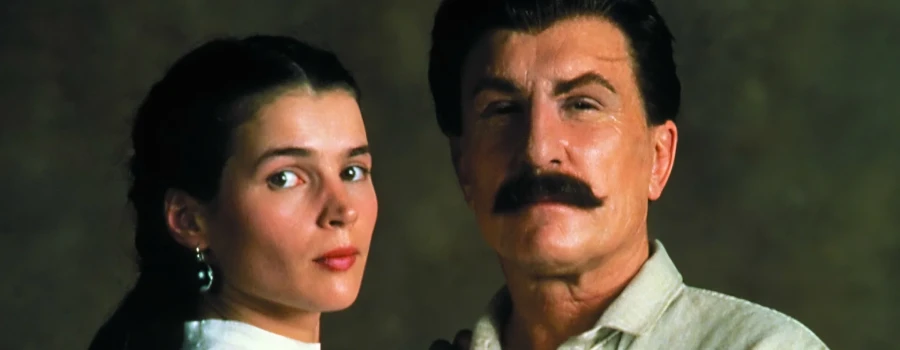
Directed by Ivan Passer · Stalin: Robert Duvall · USA (HBO)
The only full-length biopic on this list, and still the most ambitious attempt to put the whole life on screen: from the 1917 revolution to the stroke in 1953, told through the memory of his daughter Svetlana. HBO got unprecedented access to Kremlin interiors and shot in Moscow, and the supporting cast is a who’s who of the period: Maximilian Schell as Lenin, Julia Ormond as Stalin’s doomed second wife Nadya, Joan Plowright as his mother-in-law.
Duvall, under heavy prosthetics, resists every temptation to rant. His Stalin is quiet, patient and permanently offended, a man who files away every slight for later settlement. The film won the Golden Globe for Best Miniseries and Duvall took Best Actor, and the three-hour running time lets it do what features cannot: show how the Great Terror grew out of decades of small, personal grudges.
The Stalin factor: Front and center for every minute. The definitive English-language portrayal.
Watch it if: You want the complete chronology before diving into the stranger films below.
4. Burnt by the Sun (1994)
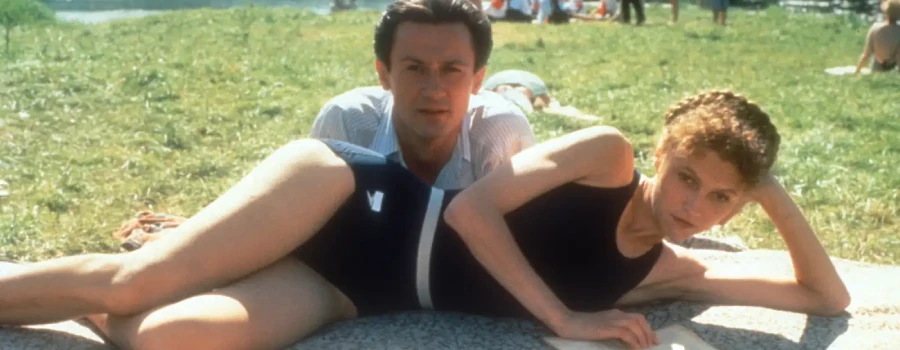
Directed by Nikita Mikhalkov · Stalin: a portrait · Russia/France
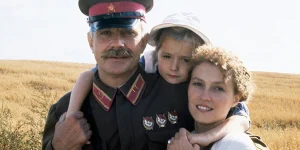
One golden summer day in 1936, at a dacha outside Moscow. Colonel Kotov (Mikhalkov himself), a hero of the revolution with Stalin’s personal phone number, plays with his small daughter in the river while his wife’s charming ex-lover Mitya arrives for an unexpected visit. Nothing in the first ninety minutes looks like a Stalin movie. Then you understand why Mitya is really there.
Mikhalkov won the Oscar for Best Foreign Language Film and the Grand Prix at Cannes for what remains the most beautiful film ever made about the purges, precisely because it refuses to be grim. The terror arrives in sunlight, with a picnic basket. The final image, a gigantic portrait of Stalin rising on a balloon over the wheat fields as a car drives away, says everything the film has carefully left unsaid.
The Stalin factor: Never appears in person. He is a voice on the telephone and a face in the sky, which is exactly how most Soviet citizens experienced him.
Watch it if: You want to feel the Great Terror rather than study it.
5. Repentance (1984)
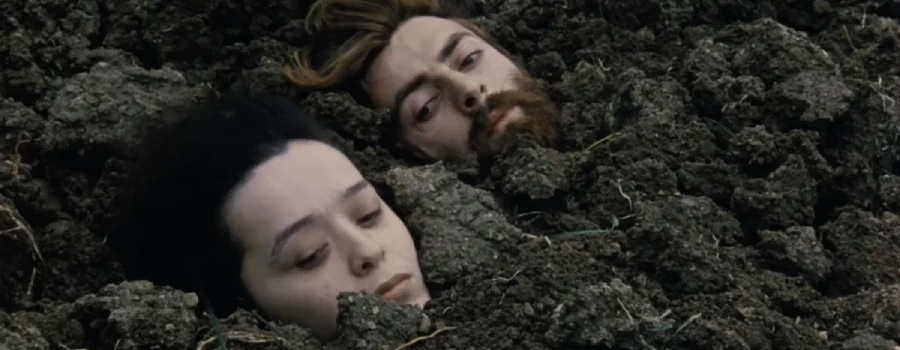
Directed by Tengiz Abuladze · Stalin: Avtandil Makharadze, as “Varlam Aravidze” · Soviet Georgia
The mayor of a small Georgian town is buried with full honors. The next morning his corpse is sitting in the garden. It is reburied; it comes back. A woman is finally caught digging it up, and at her trial she explains why: as long as that man lies in the ground, his victims have no graves at all. Abuladze shot this in 1984, when it was unthinkable, and it sat on a shelf until Gorbachev personally allowed its release in 1987. Soviet audiences queued around the block.
Varlam Aravidze is never named as Stalin, and that is the film’s weapon. He has Beria’s pince-nez, Mussolini’s black shirt, Hitler’s moustache and Stalin’s grin, a composite dictator for a country that still could not say the name out loud. The film won the Grand Jury Prize at Cannes and is usually credited with opening the floodgates of glasnost cinema.
The Stalin factor: Everywhere and nowhere. The closest cinema has come to the dictator as a nightmare rather than a man.
Watch it if: You want the film that Soviet citizens themselves watched to begin reckoning with their past.
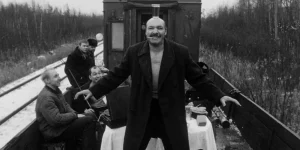
6. Khrustalyov, My Car! (1998)
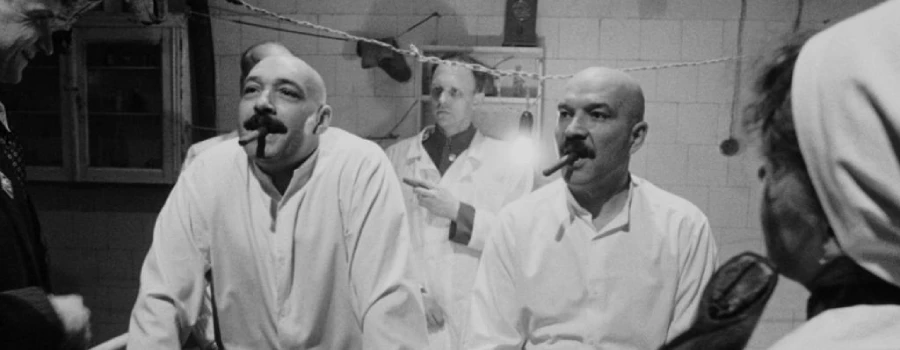
Directed by Aleksei German · Stalin: seen only on his deathbed · Russia/France
Moscow, February 1953. General Klensky, a celebrated brain surgeon, is about to be swept up in the “Doctors’ Plot,” Stalin’s final purge, aimed at Jewish physicians. He is arrested, raped in the back of a truck, and then, without explanation, cleaned up and driven to a dacha to try to save the life of a stroke victim lying in his own filth. The patient is Stalin. The title is the line Beria barks at his driver the moment the dictator stops breathing.
German’s film is nearly unwatchable in the best sense: a two-and-a-half-hour black-and-white fever dream, shot in long takes crammed with shouting, snow and chaos, in which nobody explains anything because nobody in 1953 understood anything either. It was booed at Cannes and is now routinely called one of the greatest Russian films of the decade. Both reactions are correct.
The Stalin factor: A dying body on a sofa, farting and clutching at the doctor’s hand. The least dignified Stalin ever filmed, and the most honest.
Watch it if: You have seen everything else on this list and want the hardest, deepest cut.
7. Mr. Jones (2019)
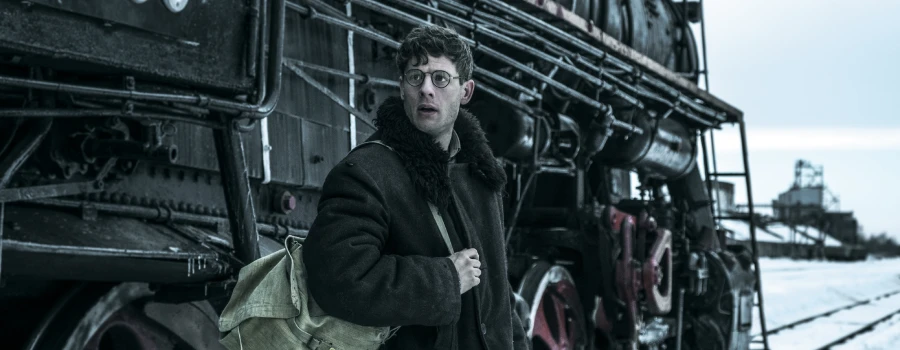
Directed by Agnieszka Holland · Stalin: off screen · Poland/UK/Ukraine
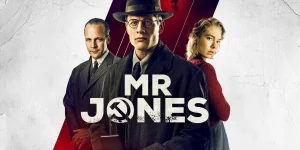
In 1933 a young Welsh journalist named Gareth Jones (James Norton) talks his way into the Soviet Union, slips his minders, and walks into Ukraine to find out how Stalin is paying for his industrial miracle. The answer is that he is not paying for it; he is starving millions of peasants to death and selling their grain abroad. Jones comes home and reports it. Almost nobody believes him, least of all the Pulitzer-winning Moscow correspondent of the New York Times, Walter Duranty (Peter Sarsgaard), who assures readers that there is no famine.
Holland, a veteran of Polish cinema under communism, films the Holodomor sequences in near-silence and bleached color: empty villages, children singing about hunger, bark stripped from trees. The framing device, a certain George Orwell typing the opening lines of Animal Farm, is a little neat, but the central story is one of the great untold ones of the twentieth century, and the film tells it plainly.
The Stalin factor: Never seen. His policy is the villain, and the Western press that covered for him is the accomplice.
Watch it if: You want the Stalin movie that is really about how the truth gets buried.
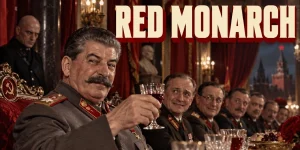
8. Red Monarch (1983)
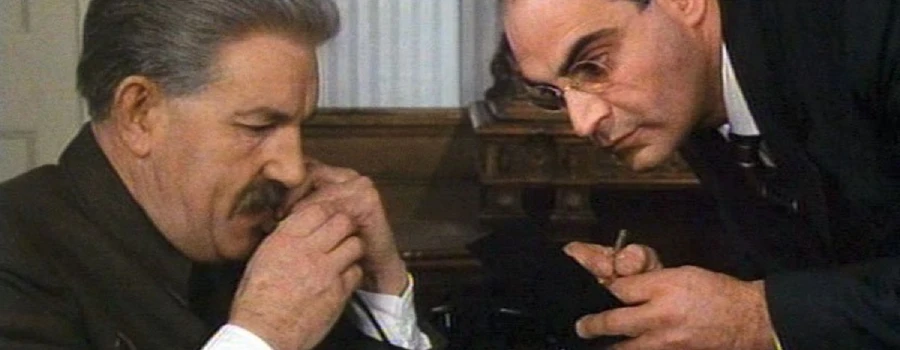
Directed by Jack Gold · Stalin: Colin Blakely · UK
Thirty-four years before The Death of Stalin, British television got there first. Written by Charles Wood from the stories of Yuri Krotkov, a Soviet writer who defected in 1963, Red Monarch is a series of sketches from the last years of the court: Stalin bullying his generals, humiliating Chairman Mao on a state visit, ordering an execution and then forgetting he ordered it. Colin Blakely plays him as a bored, vicious old man who refers to himself in the third person, and David Suchet, years before Poirot, is a genuinely frightening Beria.
The Georgians all speak with Irish accents, a joke about outsiders ruling an empire that lands better the more you know. The film has almost vanished (no streaming, rare DVD), which is a shame, because it is sharper and crueler than its reputation suggests.
The Stalin factor: A full comic portrait of the man at home, and surprisingly accurate about his habits and cruelty.
Watch it if: You liked The Death of Stalin and want to see where Iannucci’s tone came from.
9. Katyń (2007)
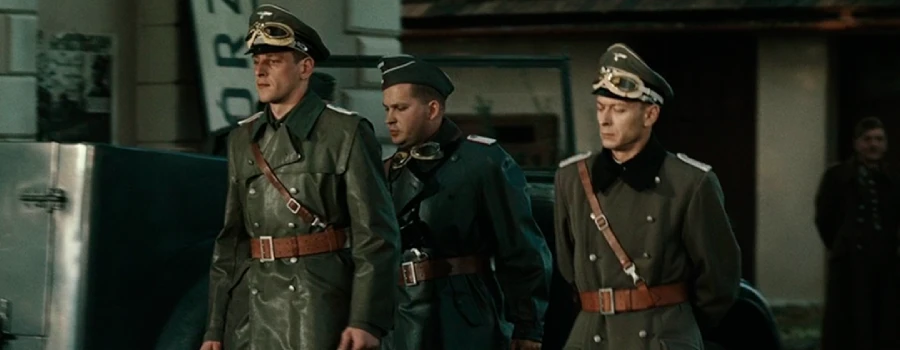
Directed by Andrzej Wajda · Stalin: a signature on a document · Poland
In the spring of 1940, on Stalin’s written order, the NKVD shot roughly 22,000 Polish officers, policemen and intellectuals and buried them in mass graves, then blamed the Germans for fifty years. One of the dead was Andrzej Wajda’s father. The director waited until he was eighty, and until Poland was free, to make this film, and it plays like a debt finally paid.
Wajda follows the wives and mothers who wait, and then the survivors who are forced, under the postwar communist regime, to repeat the official lie or lose everything. The massacre itself is held back until the final fifteen minutes, filmed with a procedural coldness that is almost unbearable: a name read out, a pistol, a bulldozer. The film was nominated for the Academy Award for Best Foreign Language Film.
The Stalin factor: Absent, except as the signature that set the machine in motion. The film is about what a state does to the memory of a crime.
Watch it if: You want to understand why Stalin’s shadow over Eastern Europe did not lift in 1953.
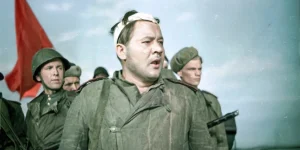
10. The Fall of Berlin (1950)
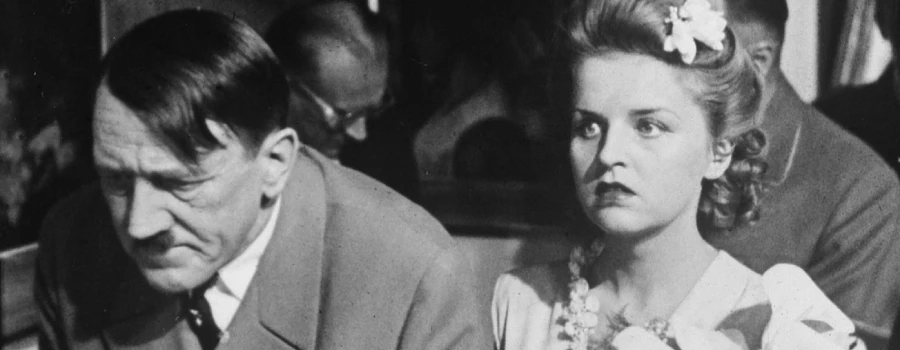
Directed by Mikheil Chiaureli · Stalin: Mikheil Gelovani · USSR
Every other film on this list is trying to tell the truth about Stalin. This one was made to lie, and that is exactly why it belongs here. Produced for his seventieth birthday with a Shostakovich score and a cast of thousands, The Fall of Berlin follows a steelworker who meets Stalin at his garden (the dictator is pruning roses, naturally), goes off to fight, and ends up in Berlin just as Stalin lands by plane in a gleaming white uniform to be greeted by the cheering soldiers of a dozen nations. Stalin never went to Berlin. It didn’t matter.
Gelovani, a fellow Georgian who played Stalin in over a dozen films, gives him the calm of a saint; Hitler, by contrast, is a shrieking clown in a bunker. Watch it today and the cult of personality stops being an abstract phrase: this is what it looked like, in color, on every screen in the country. Khrushchev had the film banned after his secret speech in 1956.
The Stalin factor: Maximum. The purest expression of how Stalin wanted to be seen, made while he could still approve the script.
Watch it if: You want to understand the lie before you watch the nine films that dismantle it.
Three Ways to Film a Man Who Was Never Defeated
Look back over the list and a pattern emerges. The films about Stalin fall into three families, and each one exists because of what the filmmakers were allowed to say at the time.
The cult: The Fall of Berlin is the only survivor on this list from the years when Stalin controlled the camera. It shows the image the rest of the films spend their running time taking apart.
The indirect approach: Burnt by the Sun, Repentance, Katyń and Mr. Jones barely show him at all. Some of that was censorship; Abuladze could not name him in 1984. But it is also a choice. Stalin’s power was felt as absence: the empty chair at the table, the neighbor who was there yesterday.
The portrait: Stalin, The Inner Circle, Red Monarch, Khrustalyov and The Death of Stalin put him in the room, and almost all of them arrive at the same discovery. Up close he is small, petty and funny, and the horror lies in how that smallness scaled to a nation of two hundred million people.
Where to Start
If you only watch one, make it The Death of Stalin; it is the most accessible film here and it sends you to the history books afterward. If you want the full story in one sitting, the HBO Stalin is three hours well spent. And if you want a double bill that explains the whole phenomenon, watch The Fall of Berlin and Repentance back to back: the dream, and then the waking up.
The best movies about Stalin are not really about one man. They are about what a country does when it cannot say the obvious thing out loud, and how long it takes to start saying it. That is not a question that stopped mattering in 1953.