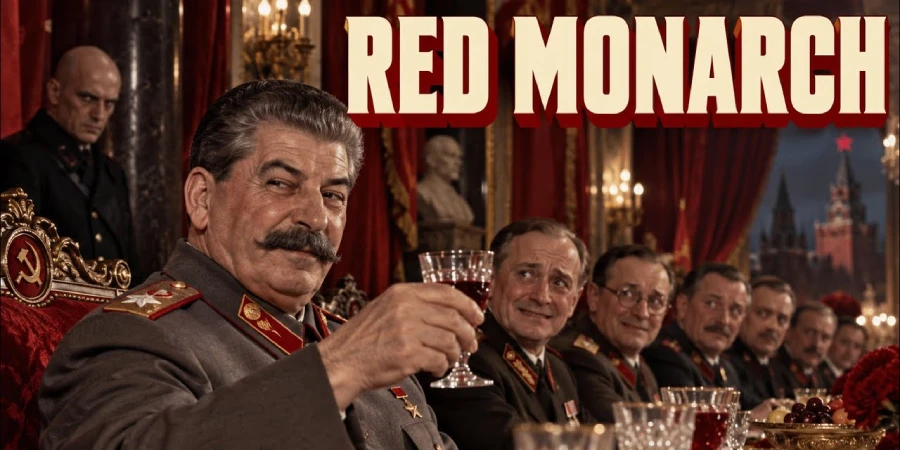

Stalin wakes from a stroke to find his Politburo dancing with joy outside his bedroom door. He spits out a single word of contempt, and then his secret police chief strangles him. Red Monarch (1983) treats the most feared man of the twentieth century as a sadistic prankster running a court of terrified jesters. Decades before The Death of Stalin, this British television film got there first.
Detailed Summary
A Court of Fear
The film satirizes Stalin’s inner circle as the court of an absolute monarch, where abuse of power and poisonous distrust rule every interaction. Stalin, played by Colin Blakely, dispenses death sentences with a shrug. His lieutenants, Molotov, Malenkov, Khrushchev, and the rest, flatter him and wait for the axe.
Beria the Jester
Beria, played by David Suchet, runs the secret police and preys on women across Moscow. Whenever his master seems ready to dispense with him, he rolls with the jokes and humiliates himself like a frightened clown. His survival depends entirely on reading Stalin’s moods.
Westerns in the Kremlin
Behind the terror, Stalin spends his evenings absorbed in his favorite hobby: watching American westerns, while millions of political prisoners languish in the camps. A nervous projectionist keeps the reels running. These screenings become a recurring motif, as the dictator who denounces the West cannot get enough of its cowboys.
Vasily the Drunk
Stalin’s son Vasily, played by David Threlfall, careens through the film as a drunken embarrassment. He trades on his father’s name while fearing his father’s temper. Their scenes together show the dictator’s cruelty turned inward on his own family.
Mao Comes to Dinner
Mao Tse-tung visits for Stalin’s seventieth birthday, and the two dictators, unable to communicate, stuff themselves with hard-boiled eggs. Neither trusts the other. Consequently, the summit of world communism plays out as a silent, awkward meal.
Loyal to the End
An old Bolshevik is led before a firing squad. Even then, he keeps faith with the creed, insisting that mistakes happen in the best democracy. Charles Wood’s script treats this misplaced loyalty as both pathetic and oddly moving.
The Noose Tightens
As Stalin ages, his paranoia grows. He begins to see everyone around him as untrustworthy, and the Politburo realizes that none of them will survive another purge. Beria, more than anyone, understands that his own time is running out.
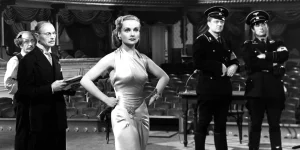
Movie Ending
Stalin collapses. The Politburo gathers outside his door, hoping against hope that he may already be dead. Nobody dares go in. Years of fear have trained them to wait for permission even now.
Then the tyrant opens his eyes and sees his marionettes jigging for joy. He manages one word, “Idiot!”, before Beria sinks to his knees and throttles him. Whether the insult targets his courtiers or himself remains deliberately unclear.
The final beat shifts register entirely. A reading from Yevgeny Yevtushenko’s poem “The Heirs of Stalin” closes the film, warning that the threat of totalitarianism is always present. The poet will not feel safe while Stalin’s heirs still occupy the Kremlin.
Why end a comedy this way? Wood and Gold spend ninety minutes making Stalin absurd, then remind the viewer that absurd men kill millions. Beria’s strangling is a joke and a crime at once, and the poem refuses to let the audience laugh it off.
Are There Post-Credits Scenes?
No. The Yevtushenko reading is the film’s last word, and the credits follow without any additional footage. For a 1983 television production, that was entirely standard.
Type of Movie
Red Monarch is a black comedy with strong satirical and political-drama elements. It runs up and down the comic scale, from pure absurdity to macabre horror. Expect farce one minute and a firing squad the next.
Cast
- Colin Blakely – Joseph Stalin
- David Suchet – Lavrentiy Beria
- David Threlfall – Vasily Stalin
- Carroll Baker – Ellen Brown
- Ian Hogg – Shaposhnikov
- David Kelly – Sergo
- Jean Heywood – Sopha
- Glynn Edwards – Vlasek
- Nigel Stock – Molotov
- Brian Glover – Nikita Khrushchev
- Wensley Pithey – Voroshilov
- George A. Cooper – Kaganovich
- Peter Woodthorpe – Malenkov
- Freddie Earlle – Mikoyan
- Jane Galloway – Svetlana
- Fred Lee Own – Mao Tse-tung
Film Music and Composer
Music plays a modest role in Red Monarch. As a television production built on dialogue and performance, the film leans on its double act rather than a sweeping score. Reliable credits for the composer are hard to confirm, so this article does not name one.
Filming Locations
Red Monarch is a British television film, and the production recreated Stalin’s Kremlin and dachas on British sets rather than traveling to the Soviet Union, which was closed to a project like this in 1983. The claustrophobic interiors suit the story. Nearly every scene unfolds in rooms where the dictator can hear everything.
Awards and Nominations
Red Monarch did not collect major awards. Goldcrest Films invested £553,000 and recouped only £292,000, a loss of £261,000.
Behind the Scenes Insights
- David Puttnam produced the film through his Enigma banner during the Goldcrest boom years.
- Blakely used his own natural accent for Stalin, while Suchet adopted the same accent for Beria. In effect, the two Georgians appear as distrustful Ulstermen.
- Mike Fash served as director of photography.
- Film4 commissioned the project in its early days, when the channel sought original and quirky titles.
- An American release followed in April 1984.
- Director Jack Gold came from a documentary and realist background before turning to satire.
Inspirations and References
The screenplay draws on The Red Monarch: Scenes from the Life of Stalin, a collection of short critical essays by Yuri Krotkov, a Russian dissident and former KGB agent. His insider vantage gave the film its mix of gossip and dread.
In addition, the closing poem anchors the satire in real literary dissent. Yevtushenko wrote “The Heirs of Stalin” during Khrushchev’s thaw, and quoting it in 1983 pointed a finger at the Brezhnev-era Kremlin.
Alternate Endings and Deleted Scenes
No alternate ending or deleted scenes have been released. The film arrived on Channel 4 in a single cut and has circulated in that form ever since. Its strangling finale was always the intended climax.
Book Adaptations and Differences
Red Monarch adapts Krotkov’s essay collection rather than a novel. Krotkov wrote discrete vignettes; Charles Wood stitched them into a loose narrative culminating in Stalin’s death. The film adds the heightened double act between Stalin and Beria, which the source material only sketches.
Memorable Scenes and Quotes
Key Scenes
- Stalin screening a western while the projectionist sweats.
- Beria groveling on the floor to keep his job and his life.
- The egg-eating summit with Mao.
- The old Bolshevik’s last words before the firing squad.
- The Politburo’s gleeful dance outside the sickroom.
- Beria’s hands closing around his master’s throat.
Iconic Quotes
- Stalin’s dying “Idiot!”, aimed at his courtiers, or perhaps at himself.
- The condemned Bolshevik’s insistence that even a fine democracy makes errors (paraphrased).
- Yevtushenko’s closing warning that Stalin’s heirs still haunt the Kremlin (paraphrased).
Easter Eggs and Hidden Details
- The shared Ulster accent quietly frames the Kremlin as a provincial family feud.
- Stalin’s love of cowboys mirrors his real documented taste for Hollywood films.
- The jigging Politburo echoes the marionette imagery the film uses throughout.
- Mao’s visit is dated to Stalin’s seventieth birthday, matching the real December 1949 trip.
- The Yevtushenko poem was itself suppressed after Khrushchev’s fall, adding a layer of irony to its use here.
Trivia
- The film premiered on 16 June 1983.
- It runs roughly 101 minutes.
- David Suchet made this film years before his long run as Hercule Poirot.
- Colin Blakely died in 1987, making this one of his final leading roles.
- It sat alongside Local Hero and The Dresser in Goldcrest’s 1983 slate.
- The BFI revived it in 2016 as part of a Jack Gold retrospective.
Why Watch?
Watch it for the double act. Blakely and Suchet turn tyranny into vaudeville without ever letting you forget the bodies. It is sharper and stranger than its obscurity suggests. If you loved The Death of Stalin, meet its forgotten ancestor.
Director’s Other Movies
- The Bofors Gun (1968)
- The Reckoning (1970)
- The National Health (1973)
- Man Friday (1975)
- The Naked Civil Servant (1975)
- Aces High (1976)
- The Medusa Touch (1978)
- Charlie Muffin (1979)
- The Chain (1984)
- Escape from Sobibor (1987)
- Goodnight Mister Tom (1998)
Recommended Films for Fans
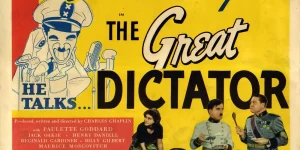
- The Great Dictator (1940)
- Dr. Strangelove (1964)
- The Inner Circle (1991)
- Stalin (1992)
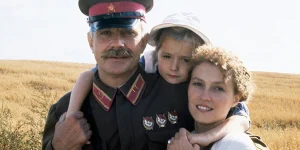
- Burnt by the Sun (1994)
- The Death of Stalin (2017)
- Mr. Jones (2019)