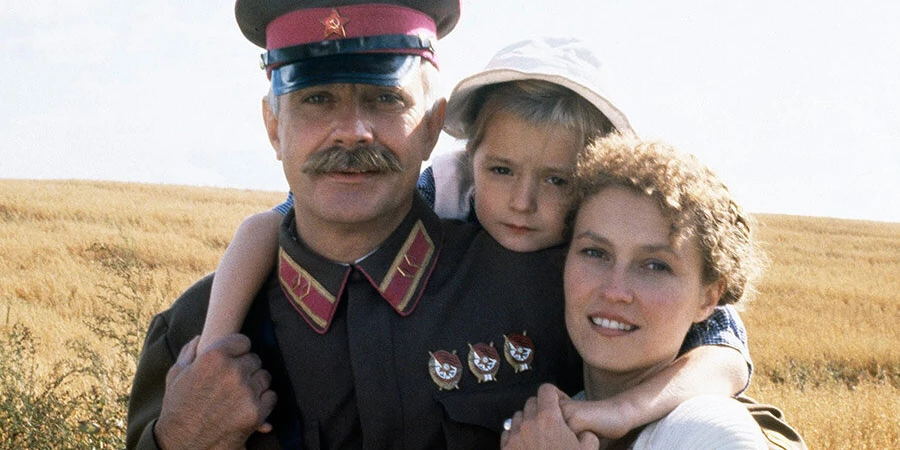

Ball lightning drifts through an open window, scorches a family photograph, and floats out across a sunlit field. Burnt by the Sun (1994) is a film about one perfect summer day in 1936 and the terror waiting at the end of it. Nikita Mikhalkov plays a Red Army hero who believes his medals can protect him. The man who arrives at dawn knows better.
Detailed Summary
A Stranger in Moscow
Mitya, a handsome man with hollow eyes, wakes in a Moscow apartment, plays Russian roulette with himself, and takes a phone call. He must drive to a dacha outside the city. His mission goes unspoken, but his face says enough.
Kotov and the Tanks
At the dacha, Colonel Sergei Kotov, a celebrated Civil War commander, lounges in the bathhouse with his young wife Marusya and their daughter Nadya. Villagers burst in: army tanks on exercises are crushing their wheat. Kotov rides out, pulls rank with a single phone call, and the tanks withdraw.
The House Full of Relatives
Marusya’s family fills the dacha with chatter: her grandfather, her aunts, the maid Mokhova, the clownish Kirik, and a French tutor. They belong to the old intelligentsia, and they tolerate the peasant-born colonel because he married one of theirs.
A Blind Beggar Who Can See
A figure in dark glasses and rags stumbles into the house playing a blind man. The family screams, then laughs: it is Mitya, who lived with them years ago. Marusya goes white. He was her first love, and he vanished without a word.
The Longest Afternoon
Mitya plays the piano, swims in the river, and charms Nadya with a fairy tale about a boy who lost everything. Marusya tries to understand why he returned. In the story’s margins, a lost truck driver wanders the roads all day asking for a village nobody can find.
The Fairy Tale’s Real Meaning
Mitya’s tale is his own life. He fought for the Whites, fled abroad, and was recruited by Kotov to inform on fellow émigrés for the secret police. In exchange, Kotov sent him away and took Marusya for himself. Mitya now serves the NKVD.
Kotov Learns Why He Came
In the bathhouse, Mitya tells Kotov plainly: a car will arrive to arrest him. Kotov laughs. He is a legend, Stalin knows him personally, and no one would dare. Mitya replies that Kotov will sign anything they put in front of him.
Movie Ending
Afternoon fades into gold. Kotov takes Nadya rowing, and she asks about the tiny grooves on his feet, about the future, about everything. He answers each question as though the day will never end.
A black car rolls up to the gate. Kotov tells the family he must go to Moscow and takes Nadya along for the ride, letting her sit in front with the driver. She waves to the house, thrilled by the adventure. At the crossroads the agents drop her off, and the car continues.
Then the mask falls. The agents beat Kotov savagely in the back seat, smashing his face and reducing him to a sobbing wreck. The lost truck driver finally flags them down to ask directions again, and an agent shoots him dead on the spot.
Over the fields, a huge portrait of Stalin rises on a balloon. Kotov weeps beneath it while Mitya sits in silence. Back in Moscow, Mitya lies in his bathtub and opens his wrists, the Stalin anthem playing on the radio.
Title cards deliver the rest. Kotov was shot in 1936. Marusya received ten years and died in the camps. Nadya spent her youth in prison and exile before rehabilitation, and the three of them were cleared only decades later.
Why does it land so hard? Mikhalkov spends two hours making the audience love this family, then takes everything in fifteen minutes. The balloon reveals the sun that burned them: not Mitya, not the agents, but the smiling face above the wheat.
Are There Post-Credits Scenes?
No. The epilogue cards about the fate of Kotov, Marusya, and Nadya close the film, followed by standard credits.
Type of Movie
Burnt by the Sun is a historical drama and a political tragedy disguised as a pastoral comedy. For most of its length the tone is warm, sun-drenched, and Chekhovian. The final act turns the same light cold.
Cast
- Nikita Mikhalkov – Colonel Sergei Kotov
- Oleg Menshikov – Mitya
- Ingeborga Dapkūnaitė – Marusya
- Nadezhda Mikhalkova – Nadya
- Vyacheslav Tikhonov – Vsevolod Konstantinovich
- Svetlana Kryuchkova – Mokhova
- Vladimir Ilyin – Kirik
- André Oumansky – Philippe
- Avangard Leontiev – Truck driver
Film Music and Composer
Eduard Artemyev, famous for his work with Tarkovsky on Solaris and Stalker, composed the score. His music here is tender and nostalgic, built around strings and piano rather than electronics.
The emotional anchor, however, is a prewar tango. The Russian song that gives the film its title, adapted from a Polish hit by Jerzy Petersburski, drifts through the dacha and becomes a lament for the lost summer.
Filming Locations
Mikhalkov shot the dacha sequences in the countryside near Nizhny Novgorod, where old wooden houses and open fields recreated a 1936 summer retreat. The river and wheat fields are real locations rather than sets.
Moscow bookends the story. The city appears only in Mitya’s grim apartment, so the contrast between urban dread and rural light is baked into the geography.
Awards and Nominations
Burnt by the Sun won the Academy Award for Best Foreign Language Film at the 1995 ceremony. It also took the Grand Prix at the 1994 Cannes Film Festival, sharing the honor with Zhang Yimou’s To Live.
Behind the Scenes Insights
- Mikhalkov cast his own daughter, Nadezhda Mikhalkova, as Nadya, which gives their scenes together unforced intimacy.
- He co-wrote the screenplay with Rustam Ibragimbekov, his collaborator on Urga.
- The film is a Russian and French co-production.
- Ball lightning appears as a motif throughout, a visual sign of a force that strikes without warning.
- Mikhalkov later made two sequels, Burnt by the Sun 2: Exodus and Citadel, which resurrected Kotov and were received far more coldly.
- Oleg Menshikov learned enough piano to make Mitya’s playing scenes convincing on camera.
Inspirations and References
The film draws on the Great Terror of 1936 to 1938, when Stalin’s purge consumed the Red Army’s own heroes. Kotov resembles real commanders who were shot despite their revolutionary credentials.
Similarly, the dacha setting invokes Chekhov, with idle intelligentsia talking over tea while history gathers outside. Mitya’s recruitment as an informer among émigrés reflects genuine OGPU operations in 1920s Paris.
Alternate Endings and Deleted Scenes
No alternate ending has been released. Mikhalkov’s cut has remained unchanged since Cannes. Material he wanted to explore further became the basis for the sequels rather than a revised edition.
Book Adaptations and Differences
Burnt by the Sun is not based on a book. Mikhalkov and Ibragimbekov wrote an original screenplay, and the title borrows from the tango rather than a novel.
Memorable Scenes and Quotes
Key Scenes
- Kotov on horseback turning back a column of tanks.
- The “blind beggar” revealing himself at the dacha.
- Mitya’s fairy tale told to Nadya on the riverbank.
- The bathhouse confrontation.
- Kotov and Nadya rowing in the golden hour.
- The beating in the car.
- The Stalin balloon rising over the wheat.
- Mitya in the bathtub.
Iconic Quotes
- Kotov’s insistence that Stalin knows his name and will never allow his arrest (paraphrased).
- Mitya’s prediction that Kotov will confess to anything (paraphrased).
- Nadya’s innocent farewell as she climbs out of the car (paraphrased).
Easter Eggs and Hidden Details
- The scorched family photo foreshadows the fate written in the epilogue.
- The truck driver’s search for a village that may not exist mirrors a country losing its bearings.
- Kirik’s slapstick masks a man who, like everyone else, survives by not noticing.
- The tango recurs in different arrangements, cheerful early and mournful late.
- Mitya’s Russian roulette in the opening tells the audience how he will end.
Trivia
- Mikhalkov accepted the Oscar with Nadezhda on his shoulders.
- The film runs about two and a quarter hours in its standard cut.
- It became one of the most internationally successful Russian films of the 1990s.
- Ingeborga Dapkūnaitė is Lithuanian and later built a career in Western productions.
- Vyacheslav Tikhonov, who plays the grandfather, was a Soviet screen legend from Seventeen Moments of Spring.
- The French co-financing helped secure the film’s European festival run.
Why Watch?
Burnt by the Sun lets you fall in love with a family before showing you the machine that devours it. Every joke in the first half deepens the grief in the second. It is lush, funny, and finally devastating. No film captures the seduction and horror of Stalinism with such warmth.
Director’s Other Movies
- At Home Among Strangers (1974)
- A Slave of Love (1976)
- An Unfinished Piece for Mechanical Piano (1977)
- Five Evenings (1979)
- Oblomov (1979)
- Kinfolk (1981)
- Dark Eyes (1987)
- Urga (1991)
- The Barber of Siberia (1998)
- 12 (2007)
- Burnt by the Sun 2: Exodus (2010)
Recommended Films for Fans
- Repentance (1984)
- The Inner Circle (1991)
- To Live (1994)
- Khrustalyov, My Car! (1998)
- Katyń (2007)
- The Death of Stalin (2017)
- Dear Comrades! (2020)