Rocky Balboa shuffling through a youth detention center in the film’s opening minutes is not a triumphant image, and the movie knows it. Creed (2015) opens with a young Adonis Johnson behind bars, already throwing punches at anyone who looks at him sideways, already carrying a name that could destroy him or define him.
Director Ryan Coogler and co-writer Aaron Covington built something genuinely surprising here: a sports film that treats legacy as a burden first and a gift second. Sylvester Stallone’s return as Rocky is not the headline, even if it earned him the loudest applause.
Detailed Summary
Young Adonis and the Weight of a Name
We meet Adonis Johnson (played as a child by Alex Henderson) in 1998, locked up in a Los Angeles youth detention facility. He is the illegitimate son of former heavyweight champion Apollo Creed, who died in the ring before Adonis was born. Mary Anne Creed (Phylicia Rashad) visits him, adopts him, and gives him every privilege she can.
Adonis grows up wealthy and educated, but none of it quiets the need to fight. He secretly trains and competes in Tijuana underground bouts, winning all of them.
Leaving Los Angeles for Philadelphia
Adult Adonis (Michael B. Jordan) works a day job at a securities firm in Los Angeles. He quits to pursue boxing full time, asking the trainers at the Delphi Boxing Academy, the gym his late father funded, to take him on. They refuse, unwilling to be responsible if something goes wrong with Apollo’s son.
Adonis packs his things and drives to Philadelphia. He wants Rocky Balboa, the man who was once his father’s greatest rival and closest friend, to train him. Rocky lives alone above the Italian restaurant he runs, visiting Adrian’s grave regularly, quietly waiting out his years.
Rocky’s Reluctance
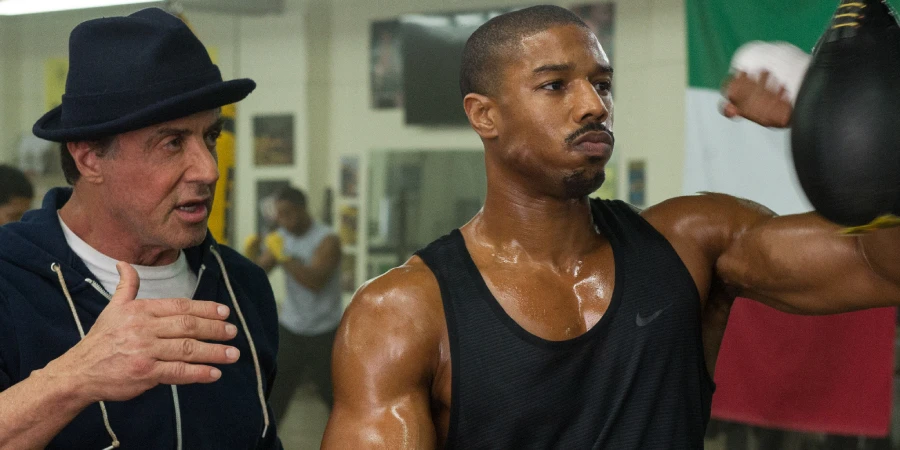
Rocky refuses at first. He is not a trainer, he says. He also barely knew Apollo’s son. Adonis sleeps in the gym anyway and Rocky, watching him work, changes his mind.
Their early sessions are rough and honest. Rocky does not coddle Adonis. He makes him run the streets of Philadelphia, study film, and spar against fighters who are bigger and more experienced. The training montage here is one long, unbroken Steadicam shot following Adonis through the neighborhood streets, dirt bikes riding alongside him, and it is the single most exciting stretch of pure filmmaking in the movie.
Bianca and a New Life in Philly
Adonis moves into an apartment and meets his downstairs neighbor, Bianca (Tessa Thompson), a musician performing in local bars. She has progressive hearing loss, a detail the film handles without making it her defining trait. Adonis asks her out, she pushes back, and they circle each other with the exact kind of stubborn-attractive energy that actually works on screen.
Their relationship deepens steadily. Bianca attends his fights. Adonis attends her performances. Their dynamic gives Adonis something to fight for beyond his father’s shadow.
Rocky’s Diagnosis
Rocky visits his doctor and receives a non-Hodgkin lymphoma diagnosis. He does not tell Adonis immediately. He visits his old friend Duke and reflects on the friends he has buried. For a stretch of the film, Rocky resists treatment entirely, citing his age and his isolation.
Adonis eventually discovers the diagnosis and pushes Rocky hard to pursue chemotherapy. Rocky agrees. His treatment runs parallel to Adonis’s training, and Coogler cuts between both men grinding through physical suffering, which makes the parallel explicit without being heavy-handed.
The Identity Leak
A local Philadelphia newspaper runs a story revealing that Adonis Johnson is actually Adonis Creed, Apollo’s son. Adonis had kept his last name hidden deliberately. He wanted to earn his reputation without his father’s name carrying him.
Word reaches Pretty Ricky Conlan‘s team. Conlan (Tony Bellew) is the world light heavyweight champion, currently facing a prison sentence, and his team needs a high-profile opponent for his final fight before incarceration. Adonis, now famous by association, becomes the perfect choice.
Adonis Accepts the Conlan Fight
Adonis accepts the fight even though it is a massive step up in competition. Rocky has reservations but agrees to stay in his corner. The location is Liverpool, Conlan’s home turf, inside a hostile arena packed with British fans.
Before they leave for England, Adonis has a breakthrough sparring session that feels like a turning point. He stops fighting angry and starts fighting smart. Rocky notices.
Movie Ending
Liverpool is exactly as hostile as promised. Conlan enters to a stadium roar and Adonis enters to jeers. Rocky, still weakened by chemotherapy but standing in his corner, ties Adonis’s gloves and gives him one last instruction: make him respect you.
Round one is a lesson in power. Conlan staggers Adonis early, and the crowd erupts. Adonis survives, adapts, and by the middle rounds he is landing combinations that visibly shake Conlan. The crowd goes quieter. This was not supposed to happen.
Conlan drops Adonis in the later rounds. Adonis gets up. He gets dropped again. He gets up again. Each time he rises, it feels less like a sports movie beat and more like something personal between this kid and the ghost of his father.
In the final round, Adonis staggers Conlan badly. The fight goes the full twelve rounds. Judges score it a split decision in favor of Conlan, which means Adonis loses on paper. What the film argues, and what the crowd in the arena seems to agree with, is that Adonis won something more important than a belt.
After the fight, Rocky and Adonis climb the famous Philadelphia steps together. Rocky is winded and slow. Adonis matches his pace. Two men hauling themselves upward, neither of them entirely whole, both of them choosing to keep going. It is the film’s best image and it earns every second of its sentiment.
Adonis has accepted his name, literally and emotionally. He fights his last round as Adonis Creed, announced to the entire arena, and he does not flinch. That is the real ending.
Are There Post-Credits Scenes?
Creed does not include any post-credits scenes. Once the steps sequence ends and the credits roll, the film is finished. You can leave the theater without missing anything.
Type of Movie
Creed is a sports drama with strong elements of family legacy and character study. Its tone is grounded and earnest, never campy, and far more emotionally restrained than most entries in the Rocky franchise.
It functions as both a standalone film and a continuation. New viewers with zero knowledge of the Rocky series can follow it without confusion. Fans of the original films will catch deeper layers in every scene involving Stallone.
Cast
- Michael B. Jordan – Adonis Johnson/Creed
- Sylvester Stallone – Rocky Balboa
- Tessa Thompson – Bianca
- Phylicia Rashad – Mary Anne Creed
- Tony Bellew – Pretty Ricky Conlan
- Wood Harris – Tony “Little Duke” Evers
- Graham McTavish – Tommy Holiday
- Ritchie Coster – Pete Sporino
Film Music and Composer
Ludwig Goransson composed the score. At the time, he was a relatively emerging voice in film music, and Creed showcased a compositional approach that blended orchestral weight with hip-hop production textures. The result is a score that feels genuinely modern without abandoning emotional directness.
Bill Conti’s classic Rocky theme does appear, used sparingly. Goransson holds it back until the moment it will hit hardest, which is the right call. Bianca’s original songs, performed by Tessa Thompson, also appear in the film and give her character a distinct sonic identity.
Filming Locations
Principal photography took place in Philadelphia, Pennsylvania. The city is not just backdrop here. Coogler shoots the neighborhoods as living, breathing places, and the community that runs alongside Adonis during his training sequence is actual Philadelphia.
The famous Rocky Steps at the Philadelphia Museum of Art appear in the film’s closing moments. Their presence carries enormous emotional freight for anyone who grew up with the franchise, and Coogler uses that deliberately.
The climactic fight was shot in Liverpool, England, at Goodison Park. Using a real English venue gave the crowd scenes an authenticity that a soundstage simply could not replicate. The hostility from the extras feels genuine because many of them were actual football supporters who knew Tony Bellew.
Awards and Nominations
Sylvester Stallone received a Golden Globe Award for Best Supporting Actor for his performance as Rocky Balboa. He also received an Academy Award nomination in the same category, his first Oscar nomination in decades, which gave the film a significant awards-season spotlight.
Ryan Coogler and the film received broader critical recognition, including nominations from various critics circles. The film did not win the Academy Award for Best Supporting Actor, but Stallone’s nomination alone felt like a statement from the industry.
Behind the Scenes Insights
- Ryan Coogler wrote the original screenplay on spec and brought it to Sylvester Stallone directly. Stallone was initially surprised by the pitch but quickly came on board.
- The long unbroken Steadicam shot during Adonis’s first official fight required extensive rehearsal. Cinematographer Maryse Alberti executed the shot with the actors and stunt coordinators working in tight coordination inside a real gym with a live crowd.
- Michael B. Jordan underwent a serious physical transformation for the role, training with real boxers to develop authentic movement in the ring rather than just a convincing physique.
- Tony Bellew is an actual professional boxer, not an actor. His casting brought real ring presence to the Conlan character and made the fight choreography feel less staged.
- Stallone has said publicly that the role of Rocky in this film affected him more personally than many of his earlier performances, partly because of how the character’s illness mirrored his own awareness of aging.
- Coogler shot portions of the film in his hometown of Oakland before relocating production to Philadelphia, drawing on a personal relationship to place throughout the project.
Inspirations and References
The most direct inspiration is the original Rocky (1976), written by Stallone himself. Coogler consciously rhymes story beats: a reluctant trainer, a long-shot fight, a protagonist proving something to himself rather than winning a title. The echoes feel intentional and earned.
Coogler has cited real conversations with his own father, who was ill during the film’s development, as shaping the emotional core of Rocky’s storyline. That biographical honesty gives the illness subplot a weight it might not otherwise carry.
The tradition of legacy sequels and passing-the-torch narratives in sports cinema also shaped the project, though Creed is more self-aware about that structure than most films in that tradition.
Alternate Endings and Deleted Scenes
No officially released alternate ending exists for Creed. Coogler and Stallone have discussed in interviews that the decision to have Adonis lose the fight by split decision was deliberate and written into early drafts. A clean victory would have undercut the film’s argument about what success actually means.
Some deleted scenes appeared on home video releases, primarily involving extended character moments between Adonis and Bianca. None of them alter the film’s plot or themes in significant ways.
Book Adaptations and Differences
Creed is not based on a book. It is an original screenplay written by Ryan Coogler and Aaron Covington. It exists within the fictional universe established by the Rocky film series, but no source novel or non-fiction book underlies it.

Memorable Scenes and Quotes
Key Scenes
- The one-take fight scene: Adonis’s fight against a local Philadelphia contender, shot in a single continuous take. The camera weaves through the ring, into the crowd, and back again without a single cut. No other scene in the film comes close to matching it technically.
- The training run: Adonis runs through Philadelphia streets while a pack of dirt bikes surrounds him. Goransson’s score pulses underneath. This is the sequence that announces Coogler as a filmmaker operating at a high level.
- Rocky’s diagnosis scene: Rocky reads his chart alone in the doctor’s office, and Stallone plays it with almost no dialogue. His face does the work. It is the most affecting moment Stallone has put on screen in years.
- The steps: Rocky and Adonis climbing the Museum steps together at the end, both of them struggling, neither stopping. The image is simple and it hits hard.
- Adonis announced as Creed: When the ring announcer calls Adonis by his father’s name in Liverpool, Jordan’s expression does not erupt into triumph. He breathes. He nods. That restraint is the right choice.
Iconic Quotes
- “One step at a time. One punch at a time. One round at a time.” – Rocky Balboa
- “I’m not a mistake.” – Adonis Creed
- “If I fight, you fight.” – Rocky Balboa
Easter Eggs and Hidden Details
- Rocky’s restaurant is named after Adrian, his late wife from the original films. Her name appears on the signage in the background when Adonis first visits.
- Photographs and memorabilia from Apollo Creed’s career line the walls of Mary Anne’s home, including images that echo the visual design of the original Rocky films.
- During Adonis’s training, Rocky teaches him a specific combination that Apollo once used against Rocky himself in their fights. It is a small detail but a pointed one.
- The dirt bikes in the training run are not extras hired for the scene. Coogler’s crew encountered a real riding group in Philadelphia and incorporated them into the shot.
- Rocky wears a hat and scarf during his chemotherapy sessions that echo the worn, bundled-up look he had during winter training scenes in earlier films.
Trivia
- Ryan Coogler was 29 years old when Creed was released, making him one of the younger directors to helm a major studio franchise continuation.
- Michael B. Jordan and Ryan Coogler had previously collaborated on Fruitvale Station (2013). Their working relationship clearly deepened between the two films.
- Sylvester Stallone had not played Rocky Balboa since Rocky Balboa (2006), a gap of nearly a decade before returning for this film.
- Tony Bellew was a real-life WBC cruiserweight champion, lending his fight scenes a credibility that professional fight coordinators confirmed made their job easier.
- The film was a major commercial success, earning significantly more than its production budget during its theatrical run.
- Tessa Thompson learned to perform music specifically for this role. Her scenes as a performing musician were not entirely pre-existing skills she brought to the part.
Why Watch?
Watch it for the one-take fight scene alone, a single unbroken shot that makes every other boxing sequence in modern film look timid by comparison. Jordan carries real physical and emotional credibility in every round, and Stallone’s quiet work as a dying man who chooses to show up anyway is genuinely moving. Coogler earns his sentiment.
Director’s Other Movies
- Fruitvale Station (2013)
- Black Panther (2018)
- Black Panther: Wakanda Forever (2022)
- Creed II (2018) – (produced by Coogler; directed by Steven Caple Jr.)
- Sinners (2025)