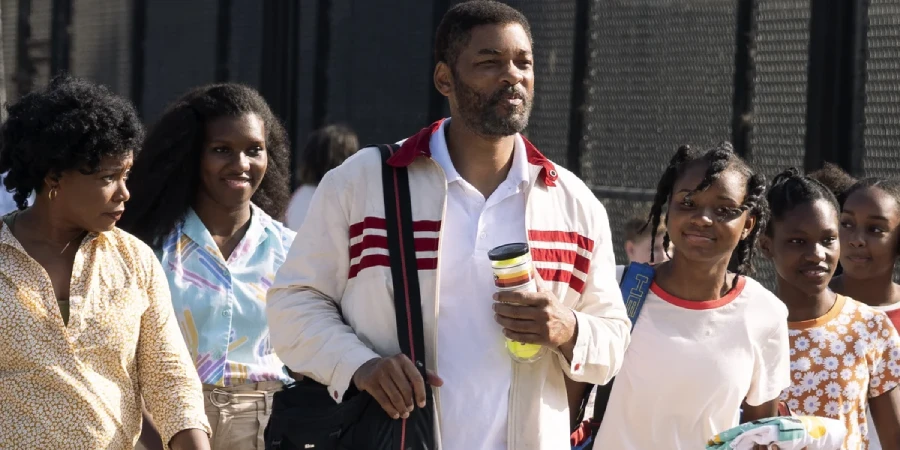

King Richard is not really a tennis movie. At its core, it is a film about a stubborn, flawed, visionary father who decided his daughters would be legends before they could even hold a racket, and then willed that dream into reality through sheer, occasionally maddening, force of personality. Will Smith delivers one of his finest performances, and the story behind Venus and Serena Williams turns out to be far more complicated, far more human, and far more gripping than any highlight reel could suggest.
Detailed Summary
The Plan That Started Before Birth
Richard Williams opens the film by explaining his master plan: a 78-page document he wrote before Venus and Serena were even born, outlining exactly how he would raise two world-class tennis players. He drills his daughters on the public courts of Compton, California, battling gang members, bad weather, and skeptics at every turn.
Richard is not a trained coach. However, he carries absolute conviction, and that conviction becomes the engine that drives everything forward. His wife, Oracene “Brandy” Price, supports the girls while quietly managing Richard’s more combustible impulses.
Getting Through the Door
Richard drives Venus to a professional match and cold-approaches Paul Cohen, a respected coach, directly in the parking lot. Cohen is skeptical but agrees to train Venus after seeing her play. This is a pivotal turning point, because it confirms that Richard’s instincts about Venus’s talent are not delusion.
Meanwhile, Richard keeps Serena off Cohen’s radar, insisting she is not ready. His reasoning is strategic: he wants Venus established first. Oracene quietly coaches Serena on the side, ensuring she keeps pace.
The Saddler Pitch and the Nike Letter
Richard also arranges a meeting with Rick Macci, a prominent Florida coach who runs a tennis academy. He sends Macci a VHS tape of Venus playing, and Macci is intrigued enough to visit Compton in person. Richard orchestrates a performance that seals the deal, and Macci agrees to train both Venus and Serena at his academy in Florida.
Macci offers to cover the family’s relocation costs, which is significant given the family’s financial struggles. In addition, Richard has written a letter to Nike seeking sponsorship, demonstrating his understanding that elite sport requires corporate backing as much as raw talent.
Florida and Growing Pains
In Florida, Richard’s controlling nature creates friction. Macci wants to enter Venus in professional junior tournaments to build her ranking and exposure. Richard refuses, insisting Venus needs more development time and that the junior circuit would burn her out. Their conflict escalates repeatedly throughout this section of the film.
Richard also pulls Venus and Serena out of the academy regularly for what he calls “real life” experiences, taking them fishing and to cultural events. Macci finds this infuriating, but Richard never wavers. He sees tennis as a vehicle, not a destination.
The Decision to Turn Pro
Richard eventually agrees to let Venus enter a professional event, the Bank of the West Classic, despite Macci’s preference for a more gradual introduction. Venus, at fourteen years old, faces Arantxa Sanchez Vicario, one of the top players in the world at the time. She pushes Sanchez Vicario to a competitive match before losing, but her performance shocks the tennis establishment.
Consequently, major sponsors and media outlets flood the Williams camp with attention. Richard, however, insists on controlling the pace. He commits to playing Venus in only a handful of events per year to protect her development and her childhood.
Serena’s Frustration
Throughout the film, Serena watches from the sidelines as Venus receives most of the public attention and professional opportunities. Her frustration is visible and heartfelt. Notably, the film is careful to frame this not as sibling rivalry but as a young girl watching her own dreams be deliberately managed and delayed.
Oracene advocates quietly for Serena, pushing Richard to acknowledge her readiness. Richard eventually promises Serena that her time is coming, though the film wisely avoids resolving this tension too neatly.

Movie Ending
Venus returns to professional competition and faces Steffi Graf at the Lipton Championships, one of the premier events on the women’s tour. Graf was ranked number one in the world at the time. Venus wins the first set, stunning everyone watching, before ultimately losing the match in three sets.
However, the loss is framed as a triumph. Venus has proven, at a major professional event against the best player alive, that she belongs at the very top of the sport. Richard rushes onto the court mid-match in a spontaneous moment of pride that creates controversy but also perfectly captures his character: impulsive, emotional, and utterly devoted to his daughter.
In contrast to the competitive pressure surrounding the match, the film’s final act focuses on what the moment means for the family. Text cards reveal that Venus went on to win seven Grand Slam titles and reach the number one ranking, and that Serena surpassed even that, winning 23 Grand Slam singles titles and becoming widely regarded as the greatest tennis player of all time.
A closing dedication from Venus and Serena themselves acknowledges their father’s vision and their mother’s steady strength. The film ends not on a championship trophy but on a family portrait, which is exactly the point Richard would have wanted to make all along.
Are There Post-Credits Scenes?
King Richard does not include any post-credits scenes. Audiences can leave the theater once the closing text cards and dedication finish. There is no bonus footage or teaser hidden after the credits.
Type of Movie
King Richard is a biographical sports drama. It carries the emotional warmth of an inspirational family film while also engaging seriously with themes of race, class, ambition, and parental control. The tone is largely uplifting but never sanitizes the conflict within the Williams family or the systemic barriers they faced.
For instance, scenes in Compton dealing with gang intimidation ground the story in a social reality that many sports biopics would simply skip over. The film balances celebration with honesty, and that balance is one of its greatest strengths.
Cast
- Will Smith – Richard Williams
- Aunjanue Ellis – Oracene “Brandy” Price
- Saniyya Sidney – Venus Williams
- Demi Singleton – Serena Williams
- Jon Bernthal – Rick Macci
- Tony Goldwyn – Paul Cohen
- Dylan McDermott – Bill Baldauf
Film Music and Composer
Kris Bowers composed the score for King Richard. Bowers is a versatile composer and jazz pianist whose previous work includes the score for Bridgerton and Green Book. His music for this film blends soulful strings with percussive energy, mirroring the tension between family tenderness and athletic drive.
Beyonce contributed the original song “Be Alive” for the film, which plays over the closing credits. The song earned significant awards attention and reinforced the film’s emotional landing. Its lyrics speak directly to the Williams family’s journey from Compton to the world stage.

Filming Locations
Production filmed on location in Compton, California, capturing the actual neighborhood where Richard Williams raised his daughters. Shooting in Compton was a deliberate creative choice, grounding the story in genuine geography rather than approximating it on a studio backlot.
The production also filmed in Florida to represent the Macci Academy sequences. Tennis sequences used real courts that matched the visual and atmospheric texture of the period. Shooting on authentic locations gave the film a documentary-style credibility that reinforced its biographical weight.
Awards and Nominations
Will Smith won the Academy Award for Best Actor for his performance, making it one of the most discussed Oscar wins in recent memory for reasons both cinematic and otherwise. Aunjanue Ellis received a nomination for Best Supporting Actress at the same ceremony.
“Be Alive” by Beyonce received a nomination for Best Original Song at the Academy Awards. The film also received a Best Picture nomination at the Oscars, alongside nominations at the Golden Globes, Screen Actors Guild Awards, and Critics Choice Awards, among others.
Behind the Scenes Insights
- Venus and Serena Williams served as producers on the film, giving them direct creative input over how their story and family were portrayed.
- Will Smith trained extensively in tennis mechanics to make Richard’s coaching scenes feel authentic, even though Richard himself was never a professional player.
- Director Reinaldo Marcus Green conducted extensive research and interviews to capture the family dynamics accurately, particularly the relationship between Richard and Oracene.
- Saniyya Sidney trained for over a year to convincingly portray Venus on court, working with tennis coaches to replicate her distinctive playing style.
- Richard Williams himself was involved in the project and expressed his approval of Will Smith’s portrayal.
- Aunjanue Ellis has spoken in interviews about wanting to ensure Oracene was not reduced to a passive supporting figure, and her performance reflects that commitment.
Inspirations and References
The film draws directly from the real lives of Richard Williams, Venus Williams, and Serena Williams. Screenwriter Zach Baylin conducted extensive research, including studying interviews Richard had given over the years and consulting with the Williams family.
Richard Williams’s own autobiography, Black and White: The Way I See It, provided significant source material for understanding his perspective, philosophy, and the specific decisions he made during Venus and Serena’s early careers. In addition, archival footage and documented accounts of the Bank of the West Classic and the Lipton Championships informed the film’s recreation of those events.
Alternate Endings and Deleted Scenes
No officially confirmed deleted scenes or alternate endings have been released or widely documented for King Richard. Warner Bros. has not published an extended cut or a home release with significant additional footage at the time of writing.
Given the film’s relatively tight narrative focus and its producers’ personal investment in the story, major structural changes during editing seem unlikely to have been extensive. Nonetheless, no confirmed information exists, so speculation would be inappropriate here.
Book Adaptations and Differences
King Richard is not an adaptation of a single book. It is an original screenplay inspired by real events, drawing on multiple sources including interviews, documented history, and Richard Williams’s memoir.
As a result, comparisons to a single source text are not applicable. Baylin’s screenplay synthesizes a range of perspectives rather than translating one narrative document to screen.


Memorable Scenes and Quotes
Key Scenes
- Richard confronting gang members on the Compton courts to protect his daughters’ practice sessions, establishing his fearlessness and absolute prioritization of the plan.
- Venus’s audition for Rick Macci, where Richard deliberately has her ride a bicycle to the court and then transforms into a focused athlete, revealing her ability to code-switch on command.
- Richard and Macci’s escalating argument over tournament strategy, which lays bare the fundamental tension between Richard’s long-game thinking and conventional sports management.
- Venus facing Arantxa Sanchez Vicario at the Bank of the West Classic, pushing a former world number one to her limits as a fourteen-year-old professional debutant.
- Richard rushing onto the court during the Lipton Championships match against Steffi Graf, an impulsive act that horrifies the tennis world but crystallizes who he is as a father.
- Serena watching Venus practice from a distance, her expression carrying volumes about ambition, patience, and the peculiar loneliness of being the second daughter in a two-daughter plan.
Iconic Quotes
- “Somewhere down the line, people gonna know the Williams sisters.” – Richard Williams, articulating his unshakeable belief before the world shares it.
- “You got to have a plan.” – Richard, the line that functions almost as a thesis statement for his entire approach to life and fatherhood.
- “I ain’t never seen nothing like her in my life.” – Rick Macci, after watching Venus play for the first time, validating years of Richard’s stubbornness.
Easter Eggs and Hidden Details
- The film briefly shows Richard carrying a worn folder of documents, a visual nod to his famous 78-page plan, which anchors the story’s opening monologue.
- Oracene’s coaching of Serena in background shots is easy to miss but rewards attentive viewers, subtly reinforcing that Serena’s development never stopped even when the spotlight was elsewhere.
- Period-accurate details in the Florida academy sequences, including equipment, court surfaces, and clothing, reflect specific visual research into early 1990s professional tennis culture.
- Richard’s car, seen throughout the Compton sequences, is deliberately worn and unreliable, reinforcing the family’s financial circumstances without the film ever needing to state them explicitly.
- Serena is frequently framed slightly behind or beside Venus in wide shots during public and competitive scenes, a compositional choice that mirrors her narrative position in the story.
Trivia
- Will Smith’s Oscar win for this role became one of the most talked-about moments in Academy Awards history, though for reasons unrelated to the film’s quality.
- Saniyya Sidney and Demi Singleton, who play Venus and Serena, both trained intensively in tennis specifically for their roles and performed most of their own on-court scenes.
- Director Reinaldo Marcus Green had previously directed Monsters and Men, and King Richard represented a significant step up in scale and profile for him.
- Beyonce’s “Be Alive” was performed live at the Academy Awards ceremony in a segment filmed on the courts in Compton where Venus and Serena originally trained.
- Venus and Serena’s involvement as producers meant the film had to earn their trust, which reportedly shaped how honestly it portrayed their father’s more difficult qualities.
- Richard Williams has said publicly that he always believed both daughters would be number one in the world simultaneously, a goal that eventually came true.
Why Watch?
King Richard works because it refuses to make its central figure a simple hero. Will Smith plays a man whose vision was real and whose methods were sometimes wrong, and that complexity makes the triumph feel earned. Aunjanue Ellis, moreover, is exceptional in a role that could have been sidelined. Few sports biopics balance family drama, social commentary, and athletic excitement this cleanly.
Director’s Other Movies
- Monsters and Men (2018)
- Joe Bell (2020)
Recommended Films for Fans
- Borg vs McEnroe (2017)
- Battle of the Sexes (2017)
- Creed (2015)
- The Blind Side (2009)
- Hustle (2022)
- Ali (2001)