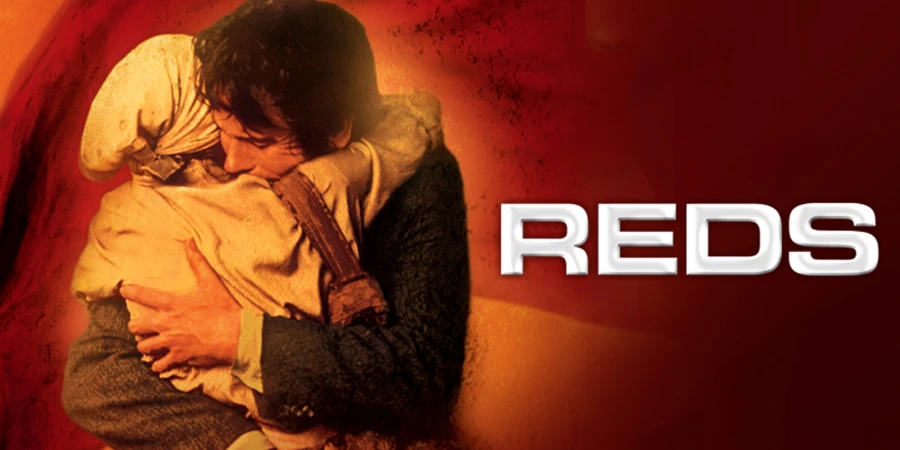

Warren Beatty spent a decade of his life making Reds, and it shows in every frame. This 1981 epic follows real-life radical journalist John Reed through love, revolution, and ideological collapse, refusing to romanticize any of it. At over three hours long, it is one of the most ambitious American films ever produced, blending documentary testimony with grand dramatic storytelling. Few Hollywood productions have dared to center a Communist as their hero.
Detailed Summary
John Reed and Louise Bryant Meet in Portland
The film opens in Portland, Oregon, where journalist and activist John Reed meets Louise Bryant, a frustrated, artistically ambitious woman stuck in a conventional marriage. Their intellectual chemistry ignites immediately. Reed represents everything her small-town life lacks: passion, purpose, and radical politics.
Louise leaves her husband and follows Reed to Greenwich Village in New York City. There, she immerses herself in a bohemian world of writers, artists, and leftist thinkers. However, she quickly realizes she wants to be recognized as a writer in her own right, not simply as Reed’s companion.
Greenwich Village and the Radical Circles
In Greenwich Village, Reed and Bryant move through a vibrant social world that includes playwright Eugene O’Neill, anarchist Emma Goldman, and various Socialist Party figures. O’Neill, played with brooding intensity by Jack Nicholson, falls deeply in love with Louise. This triangle becomes one of the film’s central emotional tensions.
Meanwhile, Reed throws himself into labor journalism and Socialist Party politics. His reporting on strikes and workers’ struggles earns him national attention. In contrast, Louise struggles to publish her own work and assert her creative identity separate from Reed’s fame.
Provincetown and Personal Turbulence
Reed and Bryant spend time in Provincetown, Massachusetts, where the Provincetown Players theatre group operates. Louise stages her own play there, marking a genuine step toward her independent artistic identity. O’Neill’s obsession with her deepens during this period.
Reed and Louise’s relationship fractures repeatedly. His political obsessions leave little room for her emotional needs. As a result, she briefly turns to O’Neill, and the affair, though not fully consummated on screen, carries real dramatic weight throughout the film.
Marriage, Mexico, and Growing Political Commitment
Reed and Louise eventually marry, though their union remains stormy. Reed travels to cover political unrest in various parts of the United States, and Louise pursues her own reporting ambitions. Consequently, their relationship becomes as much a professional partnership as a romantic one.
Reed’s commitment to radical socialist politics intensifies. He becomes increasingly involved with the Socialist Party of America and its internal factional battles. These conflicts foreshadow the ideological fractures that will consume him in Russia.
The Russian Revolution
Reed and Bryant travel to Russia in 1917 to witness the Bolshevik Revolution firsthand. This section of the film is genuinely electrifying. Beatty stages the revolutionary chaos with enormous scale, capturing the euphoric sense that history is physically happening around these two Americans.
Reed becomes a passionate witness and advocate for the revolution. His experiences during this period become the basis for his landmark book, Ten Days That Shook the World. For Reed, this moment represents the fulfillment of everything he believed politically.
Return to America and Factional Battles
Back in America, Reed plunges into the fractured American left. The Socialist Party splits, and Reed helps found the Communist Labor Party. However, this triumph quickly turns exhausting, as ideological battles and government persecution consume his energy.
Louise watches Reed deteriorate under the pressure. His health weakens, and his revolutionary idealism collides painfully with the messy reality of political organizing. Furthermore, federal authorities target him under wartime sedition laws, adding legal danger to his personal strain.
Return to Russia and Deterioration
Reed returns to Russia to seek Comintern recognition for his Communist Labor Party. He finds the Soviet bureaucracy cold, suspicious, and politically manipulative. In contrast to the revolutionary fire of 1917, this second visit reveals a hardening, institutionalized system indifferent to his idealism.
His health collapses in Russia. Stricken with typhus and exhausted, Reed becomes trapped in the Soviet Union as his body fails. Louise, desperate to reach him, makes a harrowing journey across war-torn Europe and hostile territory to find him.
Movie Ending
Louise’s journey to reach Reed is one of cinema’s most emotionally grueling sequences. She crosses dangerous borders, endures hostile interrogations, and pushes through sheer physical and emotional exhaustion. When she finally reaches him, it is almost too late.
Reed dies in Moscow in October 1920, at just 32 years old. Louise holds him as he goes, and Beatty plays Reed’s final moments with quiet devastation rather than melodrama. The restraint makes it far more painful than any dramatic death scene could achieve.
Before Reed dies, the film gives their reunion a bittersweet emotional honesty. Their relationship, fractured so many times by ego, politics, and infidelity, ultimately resolves into something tender and irreplaceable. Notably, the film refuses to give audiences a clean romantic catharsis; instead, it lets grief sit uncomfortably.
Interspersed throughout the entire film are interview segments with real elderly witnesses called “The Witnesses,” people who actually knew Reed and Bryant. These figures, including writer Henry Miller and others, offer contradictory memories, uncertain recollections, and opinionated commentary. Consequently, the film deliberately undermines any single authoritative version of events.
This structural choice pays off most powerfully at the end. As Louise grieves, audiences carry the weight of those competing testimonies. History, the film insists, is messy, personal, and irreducibly human. That is ultimately Reds‘ most radical argument: that even revolutionary lives are mostly just lives.
Are There Post-Credits Scenes?
Reds contains no post-credits scenes. The film ends with its emotional conclusion, and nothing follows the credits. This is a 1981 prestige drama, not a franchise installment.
Type of Movie
Reds is a biographical epic drama with strong romantic and political dimensions. Its tone balances intimate character study with sweeping historical spectacle. At its core, it functions as a love story set against the backdrop of radical politics and global revolution.
In contrast to cold, didactic political films, Reds stays deeply invested in its characters’ emotional lives. It is long, serious, and demanding, but never dry. Beatty keeps human feeling at the center of every scene, even the most ideologically charged ones.
Cast
- Warren Beatty – John Reed
- Diane Keaton – Louise Bryant
- Jack Nicholson – Eugene O’Neill
- Maureen Stapleton – Emma Goldman
- Edward Herrmann – Max Eastman
- Jerzy Kosinski – Grigory Zinoviev
- Paul Sorvino – Louis Fraina
- Gene Hackman – Pete Van Wherry
Film Music and Composer
Stephen Sondheim composed original songs for the film, while Dave Grusin handled the score. Sondheim’s contributions are subtle but emotionally precise. His songs weave through the film without overwhelming its dramatic texture.
Grusin’s orchestral score supports the film’s tonal shifts between intimate romance and large-scale historical drama. The music never tells audiences how to feel; instead, it creates space for the performances to breathe. For a film of this scope, that restraint is a real achievement.
Filming Locations
Production shot across multiple countries to capture the film’s geographical sweep. Locations included England, Finland, and Spain, which stood in for various European and Russian settings. Finland proved particularly useful for its architectural and environmental resemblance to early Soviet-era Russia.
Scenes set in Greenwich Village and Provincetown were shot in authentic American locations, grounding the domestic sections of the story in real historical geography. These real settings give the American sequences a documentary texture that contrasts meaningfully with the more stylized European footage. Moreover, the contrast reinforces Reed’s journey from American bohemian to international revolutionary.
Awards and Nominations
Reds received twelve Academy Award nominations, winning three. Warren Beatty won Best Director, Maureen Stapleton won Best Supporting Actress, and Vittorio Storaro won Best Cinematography.
The film also received nominations for Best Picture, Best Actor for Beatty, and Best Actress for Diane Keaton, among others. Losing Best Picture to Chariots of Fire remains one of the more debated Oscar outcomes of that era. Stapleton’s win was widely considered overdue recognition of a major talent.
Behind the Scenes Insights
- Warren Beatty spent approximately ten years developing, researching, and producing Reds before cameras rolled.
- Beatty personally interviewed many of the elderly witnesses featured in the film, building relationships with them over several years.
- Diane Keaton and Beatty were in a real romantic relationship during much of the film’s production, which added genuine emotional texture to their on-screen dynamic.
- Beatty served simultaneously as producer, director, co-writer, and lead actor, a combination that strained the production’s schedule considerably.
- Maureen Stapleton reportedly lobbied strongly for the role of Emma Goldman and delivered her lines with a directness that impressed everyone on set.
- Jack Nicholson took a supporting role at a point in his career when he could demand leading roles, reflecting genuine respect for the project.
- Cinematographer Vittorio Storaro used natural light extensively, particularly in the Russian sequences, to create a gritty, unstaged visual quality.
- The production faced significant budget pressures, with costs escalating well beyond initial estimates over the lengthy shoot.
Inspirations and References
The film draws directly from the life of John Reed, whose 1919 book Ten Days That Shook the World remains one of the most vivid firsthand accounts of the Bolshevik Revolution. Reed’s own writings shaped how the film portrays the revolutionary sequences. His perspective was that of an idealistic outsider who became a true believer.
Louise Bryant’s own writing and activism also informed the screenplay. Furthermore, biographies and historical accounts of the American radical left in the early twentieth century provided crucial context for the political scenes. Beatty and co-writer Trevor Griffiths worked extensively with historical sources throughout the development process.
Alternate Endings and Deleted Scenes
No widely documented alternate endings for Reds have entered the public record. Given Beatty’s controlling creative approach, significant alternative versions seem unlikely to exist in any formal sense. However, a film with this lengthy a production almost certainly generated substantial cut material.
The theatrical cut runs over three hours, and earlier cuts were reportedly longer. Scenes developing secondary characters and political contexts were trimmed to maintain narrative focus. Nonetheless, no officially released extended cut or deleted scene compilation has become publicly available.
Book Adaptations and Differences
Reds is not based on a single book or literary adaptation. Instead, it draws on historical record, personal testimonies, and primary source material. The screenplay by Beatty and Griffiths synthesizes multiple sources rather than adapting any one text.
Reed’s own Ten Days That Shook the World serves as a spiritual source text, particularly for the Russian sequences. However, the film’s focus on the Reed-Bryant relationship goes far beyond anything Reed himself wrote about his personal life. Beatty deliberately foregrounded the human story over pure political biography.



Memorable Scenes and Quotes
Key Scenes
- Reed and Bryant’s first charged conversation in Portland, establishing their intellectual and physical attraction immediately.
- Louise staging her play in Provincetown, asserting her creative independence for the first time.
- The Bolshevik Revolution sequences in Russia, with crowds surging and banners rising against a cold sky.
- Reed’s anguished speech at the fractured Socialist Party convention, watching the movement he loves tear itself apart.
- Louise’s desperate, exhausting journey across hostile territory to reach the dying Reed in Moscow.
- Reed and Louise’s final reunion, played with quiet tenderness as his life slips away.
- The recurring witness interviews, cutting against the dramatized scenes and complicating every romantic and political moment.
Iconic Quotes
- “I’m not your adjunct.” – Louise Bryant, asserting her independence to Reed.
- “I want to be with you, Louise. I want to marry you.” – Reed, in one of his more vulnerable moments.
- Emma Goldman challenging Reed on whether the Bolsheviks actually represent the workers they claim to liberate.
Easter Eggs and Hidden Details
- Several of the real witnesses interviewed in the film were genuine historical figures with direct personal connections to Reed and Bryant, giving their contradictions and lapses of memory an authentic documentary weight.
- Beatty’s casting of novelist Jerzy Kosinski as Grigory Zinoviev carries a pointed irony, given Kosinski’s own complicated relationship with Eastern European political history.
- The film’s visual grammar shifts subtly between the American and Russian sections, with Storaro’s lighting becoming colder and less forgiving as Reed moves deeper into Soviet bureaucracy.
- Provincetown scenes were designed to reflect the actual historical atmosphere of the Provincetown Players, with period-accurate staging details in the theatre sequences.
- The witness interviews are edited so that their commentary sometimes directly contradicts what audiences have just watched, a deliberate structural choice that rewards attentive viewers.
Trivia
- Reds was the first film in decades to feature a Communist protagonist as a sympathetic hero in a mainstream American production.
- Warren Beatty became only the second person in Oscar history to receive nominations for Best Picture, Best Director, Best Actor, and Best Screenplay for the same film.
- Maureen Stapleton dedicated her Academy Award win to “everyone I have ever met in my entire life,” a moment that became instantly memorable.
- John Reed is one of only a few Americans buried in the Kremlin Wall in Moscow, a fact the film acknowledges in its historical framing.
- The film’s three-plus-hour runtime made distributors nervous, but Beatty refused to shorten it significantly for release.
- Diane Keaton prepared extensively for her role by reading Louise Bryant’s actual writings and published journalism.
- Gene Hackman appears in a relatively small supporting role, reflecting the film’s deep bench of talent willing to work with Beatty.
Why Watch?
Reds offers something genuinely rare: a Hollywood epic with real intellectual courage, anchored by performances of remarkable depth. Beatty’s direction balances political history and personal heartbreak without sacrificing either. Few films of any era give you this much to think about while also making you care this deeply about two flawed, fascinating people.
Director’s Other Movies
- Heaven Can Wait (1978)
- Dick Tracy (1990)
- Bulworth (1998)
- Rules Don’t Apply (2016)