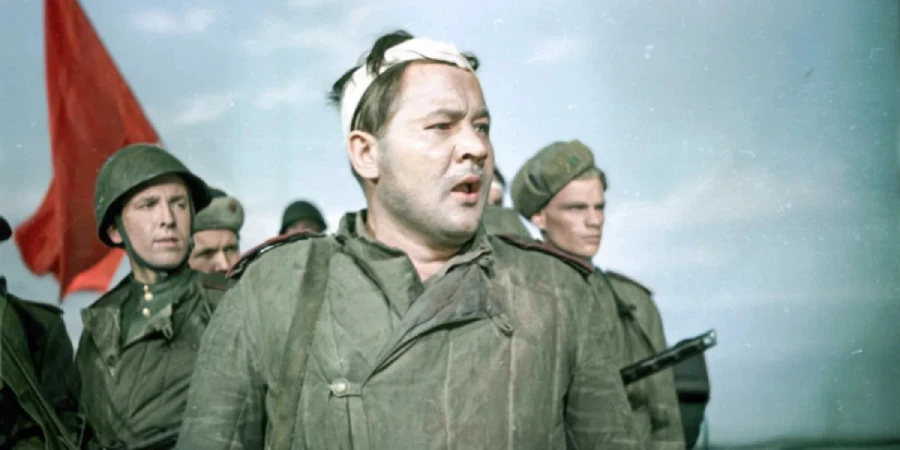

Stalin steps off a plane in a gleaming white uniform, and all of Berlin erupts in song. That moment never happened, yet The Fall of Berlin (1950) stages it as the grand finale of the Second World War. Mikheil Chiaureli‘s two-part epic fuses a factory romance with a full-blown cult-of-personality fantasy. Few films reveal so much about the era that produced them.
Detailed Summary
Alexei Ivanov Sets a Steel Record
Alexei Ivanov, a burly steelworker, smashes a production record at his plant. His coworkers celebrate, but he stays bashful and tongue-tied. He also harbors feelings for Natasha Rumyantseva, the local schoolteacher, though he cannot bring himself to say so.
A Summons to Stalin’s Garden
Alexei receives a state honor and travels to meet Stalin in person. He finds the leader tending plants at his dacha, calm and grandfatherly. Stalin asks about his life, learns of the shy romance, and gently urges him to speak his heart. Alexei returns home a changed man.
Love Among the Wheat Fields
Back home, Alexei and Natasha walk through golden fields and finally confess their feelings. Happiness lasts only moments, however. German planes roar overhead on June 22, 1941; bombs flatten the town, the blast wounds Alexei, and invading troops drag Natasha away.
Hitler’s War Council
Meanwhile, the film cuts to Berlin. Hitler rants to his generals, with Göring, Goebbels, and Keitel in attendance, about crushing the Soviet Union within weeks. Chiaureli plays these scenes as grotesque comedy; Hitler stamps, shrieks, and bullies his staff.
Stalin Holds Moscow
Stalin stays in the capital as German armies approach. He calmly directs the defense while Zhukov and other commanders take notes. Troops march straight from the November 1941 parade on Red Square to the front, and Alexei, now recovered, joins them.
Natasha in Captivity
Natasha endures forced labor in Germany. Guards beat prisoners, and women collapse from exhaustion. She never loses faith that the Red Army will come for her.
Yalta and the Road to Berlin
Part 2 opens at the Yalta Conference. Stalin, Roosevelt, and Churchill debate the postwar order, and Chiaureli paints Stalin as the only clear-headed statesman in the room. In the field, Soviet armies grind westward toward the Oder.
Hitler’s Bunker
Hitler retreats underground as the capital crumbles. His generals lie to him about phantom armies that will rescue the city. In a chilling sequence, he orders the Berlin subway flooded to slow Soviet troops, drowning German civilians sheltering below.
Movie Ending
Soviet artillery pounds Berlin as Zhukov’s armies close the ring. Alexei’s unit fights street by street toward the Reichstag, with his comic sidekick Kostya Zaichenko cracking jokes under fire. Every block costs lives.
Inside the bunker, Hitler marries Eva Braun in a grim little ceremony. Shortly afterward, both take poison. General Krebs crosses into Soviet lines to negotiate, but the Soviet command demands nothing less than unconditional surrender.
Soldiers raise the Victory Banner over the Reichstag dome. Freed prisoners of every nationality pour into the streets, and Alexei scans the crowd in desperation. He spots Natasha on the steps, and the lovers finally embrace amid the ruins.
Then comes the moment the whole film builds toward. A plane lands on a Berlin airfield, and Stalin descends in a white uniform while thousands cheer. Natasha, overwhelmed, asks permission to kiss him, and a massive choir sings a hymn to his glory as he wishes the world peace.
Why does this matter? Stalin never flew to Berlin in 1945. By inventing the trip, the film hands him a personal victory lap and pushes Zhukov, the general who actually took the city, into the background. That distortion is precisely why the film vanished from Soviet screens a few years later.
Are There Post-Credits Scenes?
No. The film ends with the choral finale and a simple “The End” title card, as was standard for Soviet cinema of the period. Nothing follows.
Type of Movie
The Fall of Berlin is a war epic and a propaganda film in the Soviet “artistic-documentary” style, which blended staged drama with the look of newsreel history. Its tone shifts wildly. Scenes with Stalin feel reverent and hushed; scenes with Hitler play as savage satire; the Alexei and Natasha thread is pure melodrama.
Cast
- Mikheil Gelovani – Joseph Stalin
- Boris Andreyev – Alexei Ivanov
- Marina Kovalyova – Natasha Rumyantseva
- Vladimir Savelyev – Adolf Hitler
- Maria Novakova – Eva Braun
- Yuri Timoshenko – Kostya Zaichenko
- Viktor Stanitsyn – Winston Churchill
- Oleg Frelikh – Franklin D. Roosevelt
- Jan Werich – Hermann Göring
- Fyodor Blazhevich – Georgy Zhukov
- Vladimir Kenigson – Hans Krebs
- Sofia Giatsintova – Alexei’s mother
Film Music and Composer
Dmitri Shostakovich composed the score, catalogued as his Op. 82. He wrote it in 1949, barely a year after the Zhdanov decree had publicly condemned his “formalist” music. Film work offered him a path back into official favor.
Moreover, the score is enormous in scale. It features full orchestra, organ, and choir, climaxing in the hymn to Stalin with lyrics by Yevgeny Dolmatovsky. Lev Atovmyan later arranged a concert suite from the material, which is how most listeners encounter it today.
Filming Locations
Mosfilm Studios in Moscow housed the interior sets, including Stalin’s dacha, the Kremlin offices, and Hitler’s bunker. These controlled environments let Chiaureli stage his tableaux with painterly precision.
Berlin itself still lay in ruins when production began in 1949. The shattered cityscape gave the battle sequences a scale and authenticity no backlot could match, and the real devastation underscores the film’s message that Soviet arms broke the Nazi capital.
Awards and Nominations
The film received the Stalin Prize, First Class, in 1950, the highest honor Soviet cinema could bestow at the time. Unsurprisingly, a film about Stalin’s genius did very well in Stalin’s awards system.
Behind the Scenes Insights
- Mikheil Gelovani, a Georgian actor, had played Stalin on screen since The Great Dawn (1938) and became the leader’s preferred screen double.
- Chiaureli and screenwriter Pyotr Pavlenko had already perfected the Stalin-worship formula with The Vow (1946).
- Production used captured German Agfacolor stock, giving the film its distinctive saturated palette.
- Release was timed to the celebrations surrounding Stalin’s seventieth birthday in December 1949, with the premiere following in January 1950.
- Czech comic actor Jan Werich brought an outsider’s flair to the role of Göring.
- After Khrushchev’s 1956 “Secret Speech” denounced the cult of personality, Soviet authorities withdrew the film from circulation.
Inspirations and References
Pavlenko and Chiaureli wrote an original screenplay rooted in the events of 1941 to 1945. Specifically, they drew on the Battle of Moscow, the Yalta Conference, and the storming of the Reichstag, reshaping each to center Stalin.
The flag over the Reichstag also echoes the famous wartime photographs of the Victory Banner, images every Soviet viewer knew. In addition, the film owes a structural debt to The Vow, which established the pattern of a humble citizen meeting Stalin face to face.
Alternate Endings and Deleted Scenes
No official alternate ending exists. Instead, the whole film became the deleted scene. Following the 1956 denunciation of Stalin, it disappeared from Soviet distribution for decades and only resurfaced after the collapse of the USSR, when historians and film archives revived interest in it.
Book Adaptations and Differences
The Fall of Berlin is not based on a book. Pavlenko and Chiaureli wrote it directly for the screen, and no novelization followed.
Memorable Scenes and Quotes
Key Scenes
- Stalin pruning roses at his dacha while coaching a nervous steelworker on love.
- The wheat-field confession shattered seconds later by Luftwaffe bombs.
- Hitler’s screaming war council, staged like a farce.
- The subway flooding, one of the few moments where the film’s horror feels real.
- Hitler’s wedding and death by poison in the bunker.
- The Victory Banner rising over the Reichstag.
- Stalin’s arrival in Berlin, swelling choir included.
Iconic Quotes
- Stalin’s gentle advice to Alexei that a man who can tame steel should not fear a schoolteacher (paraphrased from the Russian).
- Natasha’s breathless request to kiss Stalin on the airfield, a line that embarrassed later Soviet audiences.
- Hitler’s boast that the Soviet Union would collapse within weeks, delivered as unhinged bluster.
Easter Eggs and Hidden Details
- Stalin’s spotless white uniform in the finale matches his real Generalissimo dress uniform, a rank created for him in 1945.
- Casting Stalin as a gardener nods to the official image of him as the “gardener” of Soviet happiness.
- Liberated prisoners in the final crowd wear the dress of many nations, signaling the USSR as liberator of all Europe.
- Zhukov appears mostly silent and deferential, a quiet visual demotion of the war’s most famous Soviet commander.
- Hitler’s bunker scenes pair him with an aquarium and ornate decor, contrasting his decadence with Stalin’s austere study.
Trivia
- Stalin only ever flew once in his life, to the Tehran Conference in 1943, which makes the airborne finale doubly fictional.
- The film runs well over two and a half hours across its two parts.
- Shostakovich was composing his oratorio Song of the Forests in the same period, another work praising Stalin’s projects.
- Gelovani played Stalin so often that audiences struggled to picture the leader any other way.
- Eastern Bloc countries and China screened the film widely in the early 1950s.
- Boris Andreyev, the film’s romantic lead, was one of the most popular Soviet stars of the decade.
Why Watch?
Watch it as a time capsule. No documentary explains the Stalin cult as vividly as this film does by simply believing in it. The battle scenes impress, Shostakovich’s score thunders, and the finale remains one of cinema’s strangest spectacles. You will not forget it.
Director’s Other Movies
- Khabarda (1931)
- The Last Masquerade (1934)
- Arsen (1937)
- The Great Dawn (1938)
- Giorgi Saakadze (1942)
- The Vow (1946)
- The Unforgettable Year 1919 (1951)
- Otar’s Widow (1957)
Recommended Films for Fans
- The Vow (1946)
- The Cranes Are Flying (1957)
- Ballad of a Soldier (1959)
- Ivan’s Childhood (1962)
- Liberation (1970)
- Come and See (1985)
- Downfall (2004)
- The Death of Stalin (2017)