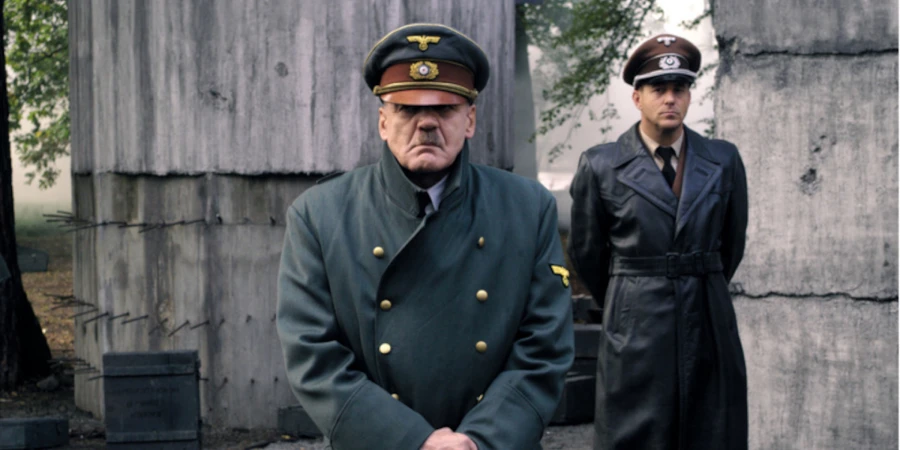

Downfall (Der Untergang) is the film most people picture when they imagine Hitler’s final days. Its bunker scenes have been quoted, parodied, and studied for two decades. For many viewers, the movie has quietly replaced the history. So it makes sense to ask a simple question: how much of it actually happened?
The short answer is reassuring. Downfall is one of the most carefully sourced dramas ever made about the Third Reich, and most of its key events are documented. However, it is still a drama, and it makes choices. Some are tiny, and some change the emotional shape of the story. This article walks through both.
Where the Facts in Downfall Come From
Producer and screenwriter Bernd Eichinger did not write the film from scratch. Instead, he built it on two books published in 2002. The first was Inside Hitler’s Bunker by historian Joachim Fest. The second was Until the Final Hour, the memoir of Traudl Junge, one of Hitler’s secretaries.
He also drew on several other eyewitness accounts. These included Albert Speer’s Inside the Third Reich, Gerhard Boldt’s Hitler’s Last Days, a memoir by bunker doctor Ernst-Günther Schenck, and Siegfried Knappe’s Soldat.
Why the sources matter
Fest’s book sits firmly in the historical mainstream. It used some evidence that surfaced after the Soviet archives opened, but it largely confirmed Hugh Trevor-Roper’s 1947 account, The Last Days of Hitler. In other words, the film’s backbone is the standard version of events, not a fringe theory.
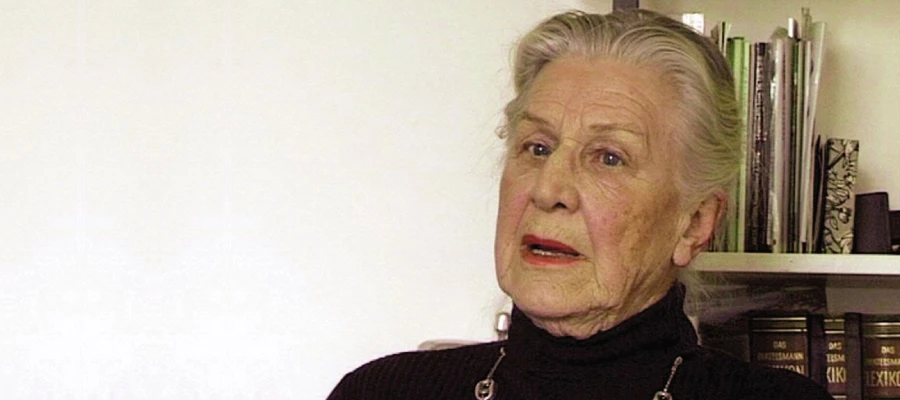
The real Traudl Junge appears at the start and end of the film. That footage comes from the 2002 documentary Blind Spot: Hitler’s Secretary. Junge died of cancer in Munich on 10 February 2002, at the age of 81. As a result, she never saw the finished movie.
Bruno Ganz and the Voice of Hitler
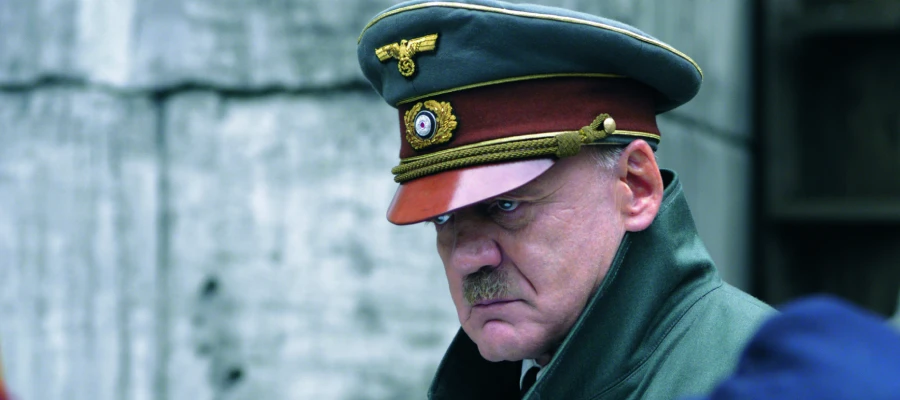
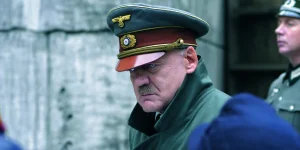
Much of the film’s credibility rests on Bruno Ganz. His preparation was unusually thorough. For four months, he studied the so-called Hitler and Mannerheim recording, a tape made in Finland in 1942. It is the only known recording of Hitler speaking in a normal, conversational voice rather than a rally voice. That is exactly the register the bunker scenes need.
Ganz also watched newsreel footage and noticed Hitler’s shaking movements. He concluded that Hitler had Parkinson’s disease, and he visited a hospital to observe patients with the condition.
What historians said about the performance
Hitler biographer Sir Ian Kershaw praised the film in The Guardian. He called it a marvellous historical drama and said Ganz captured Hitler’s voice almost perfectly. Among the many portrayals in movies about Hitler, including those by Alec Guinness and Anthony Hopkins, Kershaw found this the only compelling one.
Still, Kershaw added an important caveat. He argued that cinema is far better at making history felt than at explaining it. In his view, the film added little new insight into Hitler as a person. Even so, he called its emotional approach entirely legitimate.
What Downfall Gets Right
The broad sequence of events matches the historical record. Consider the list of things the film shows:
- Hitler’s 56th birthday on 20 April 1945, as Soviet artillery reaches Berlin
- Himmler’s departure and his secret contact with the Western Allies
- Göring’s telegram and his dismissal
- General Weidling’s death sentence, followed by his promotion to defend Berlin
- Speer’s final visit and his admission that he ignored the scorched-earth order
- Fegelein’s execution
- Hitler dictating his testament to Junge
- The wedding to Eva Braun
- The cyanide test on the dog Blondi
- The suicides on 30 April and the cremation in the garden
- General Krebs’s failed talks with Chuikov
All of these appear in the standard histories.
The bunker itself
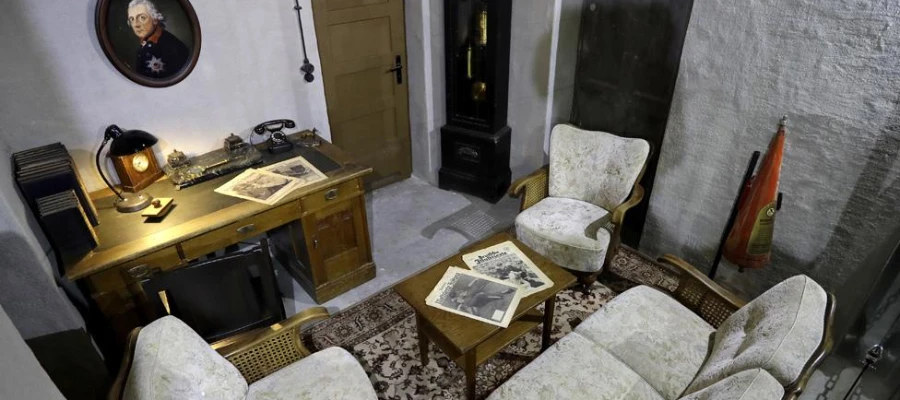
The production rebuilt the bunker and the Wolf’s Lair at Bavaria Studios in Munich, under production designer Bernd Lepel. Only the ruined Reich Chancellery used CGI. Director Oliver Hirschbiegel deliberately limited digital effects and stage sets. He felt they made war films feel like cardboard.
Details straight from Junge’s memoir
Some small moments survive almost unchanged. For example, Junge wrote that she was playing with the Goebbels children on 30 April when a shot rang out. Everyone fell silent. Young Helmut Goebbels, not understanding, shouted that it was a bull’s-eye. The film stages the scene just as she described it.
Even the people who lived through it were broadly satisfied. Bunker nurse Erna Flegel praised the film. She said it got a few small details wrong but was generally right, and she even recognized herself as one of the nurses.
What Downfall Changes or Invents
This is where the film earns the label “dramatization.” None of these changes alter the outcome. However, they do alter how the story feels.
Peter Kranz never existed
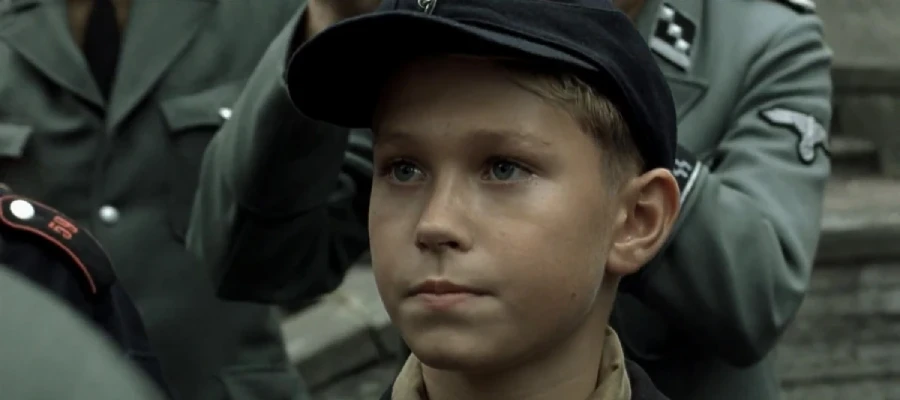
The boy who wins an Iron Cross, loses his parents, and escapes with Junge is fictional. The character loosely draws on Alfred Czech, a 12-year-old who rescued a dozen wounded soldiers near his village. There is also a timing shift. Hitler’s last public appearance, where he awarded Iron Crosses to twenty Hitler Youth members, appeared in the final Deutsche Wochenschau newsreel released on 22 March 1945. That was about a month before his birthday. The film moves the ceremony into the birthday sequence and hands the moment to an invented boy.
Traudl Junge’s escape was much harder
On screen, Junge and Peter walk past Soviet soldiers and ride away on a bicycle. The truth was longer and grimmer. On 1 May, Junge left the bunker with a group led by SS general Wilhelm Mohnke. She, Gerda Christian, and Else Krüger reached the River Elbe, while Soviet troops found the rest of the group hiding in a cellar.
Unfortunately, Junge could not cross to the western Allied lines. She returned to Berlin about a month later and lived briefly under a false name. On 9 June, Soviet officials arrested her and held her for interrogation. She was released in December 1945 but confined to the Soviet sector. Only in early 1946 did she reach Bavaria, where the Americans questioned her again before freeing her. The film’s hopeful ending compresses roughly a year of captivity into one sunlit shot.
The Goebbels children
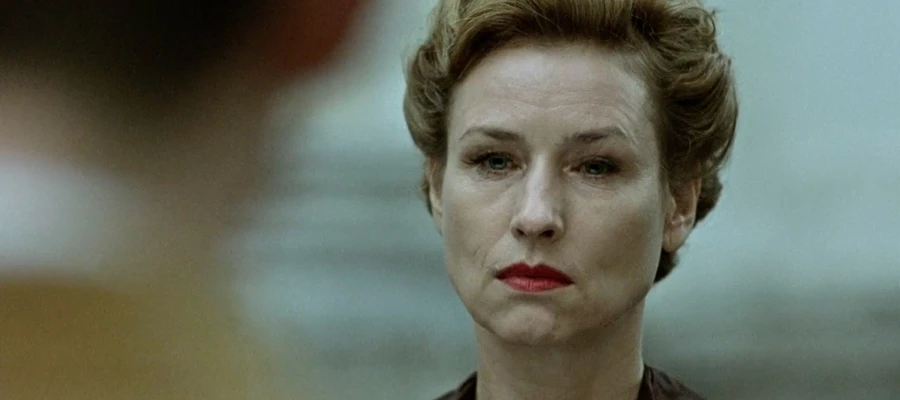
The murder of the six children is historical. However, the film presents it as a joint decision by the couple. Rochus Misch, Hitler’s bodyguard and telephone operator, remembered it differently. According to Misch, Magda Goebbels insisted the children stay in the bunker, and she alone decided they should die when she and her husband did.
Was the bunker really that loud?
Misch raised a broader objection too. In a 2005 interview, he called the film factually accurate but “Americanized.” He claimed Hitler never screamed in the bunker and that the place was generally quiet. That said, eyewitnesses did record Hitler’s furious outburst over Steiner’s failed attack. So the famous tirade rests on testimony, but the overall volume may be higher on screen than it was in life.
Sympathetic SS officers
Author Giles MacDonogh criticized the portrayals of Wilhelm Mohnke and Ernst-Günther Schenck as too kind. He pointed out that Mohnke faced accusations of murdering British prisoners of war in the Wormhoudt massacre. Hirschbiegel responded that those allegations, and claims that Schenck ran unethical medical experiments, were unproven. Either way, the film’s Schenck serves as its moral center, and viewers should know the real man’s record remains disputed.
The Holocaust is absent by design
Eichinger chose not to mention the Holocaust because it was not the film’s subject. He also believed the camps could not be shown properly on screen. This is not an error in the strict sense. The bunker’s occupants were not discussing the camps. Nevertheless, it limits what “accurate” can mean here. The film is accurate about ten days in April 1945, not about the regime as a whole.
The Bigger Debate: Realism Versus Perspective
Most criticism of Downfall was never about dates or dialogue. Instead, it was about what the film’s realism leaves out. Wim Wenders, writing in Die Zeit, argued that the film had no clear point of view on Hitler, which made him harmless. He even compared it unfavorably to Resident Evil: Apocalypse, where the audience at least knows who the villain is. Other critics linked the filmmakers’ wish to “tell” rather than “interpret” history to a naive, nineteenth-century approach.
The defenders had an answer. David Denby of The New Yorker noted that the film’s Hitler repeatedly says the German people deserve to perish for failing him. Those are hardly recruiting slogans. Denby called him as degraded a human being as the screen has ever shown. Likewise, Kershaw found it hard to imagine anyone outside the neo-Nazi fringe sympathizing with Hitler in his final days.
Hirschbiegel has never shifted his position. Years later, he said the critics simply got it wrong. Bad people, he argued, do not walk around with claws, however comforting it might be to think so.
The Verdict
Measured against the written record, Downfall holds up remarkably well. The chronology is right. The key decisions and betrayals are documented. The set was rebuilt from eyewitness accounts, and the central performance grew out of the only recording of Hitler’s private voice. Survivors like Erna Flegel and Rochus Misch quibbled with details, not with the substance.
Its liberties are the liberties of storytelling. A fictional boy gives the audience a way into the streets above the bunker. A bicycle ride replaces a year of captivity. A family murder becomes a shared decision. And the bunker is louder than the people who lived there remember.
Therefore, treat Downfall as a faithful reconstruction of ten days in April 1945, and as a film that had to decide, scene by scene, how to make history watchable. The best way to watch it is with Junge’s memoir or Fest’s book nearby. That way, you can see where the drama stops and the documentation begins.