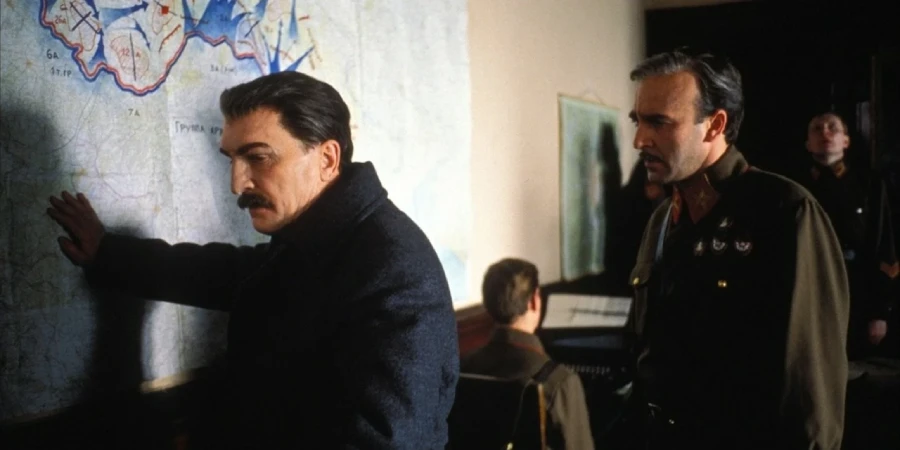
Robert Duvall spent months studying newsreels of the dictator, then spent nearly three hours on screen barely moving his face. Stalin (1992) is HBO’s grand attempt to put the whole life of Joseph Stalin on television, and its crew walked the actual halls of the Kremlin to do it. The result is lavish, uneven, and fascinating as a time capsule of the moment the Soviet Union died.
Detailed Summary
A Daughter Remembers
Svetlana, Stalin’s daughter, narrates the story, framing the film as a memoir of a family destroyed by the man at its head. Her voice carries the audience from the revolution to the deathbed.
1917 and the Return of Lenin
Lenin arrives back in Russia, and the Bolsheviks seize power. The young Stalin, a rough Georgian organizer, positions himself close to the leader. Meanwhile, the brilliant and arrogant Trotsky commands the Red Army and treats Stalin as a provincial nobody.
Marrying Nadya
Stalin takes refuge with the Alliluyev family and marries their teenage daughter Nadya. Her parents, Sergei and Olga, welcome him. The marriage begins warmly, but Stalin’s coldness and cruelty surface as his power grows.
Lenin’s Warning
Lenin suffers strokes and, before dying, dictates a testament warning the party against Stalin’s growing power. Stalin suppresses it. With Lenin gone, he outmaneuvers Trotsky, Zinoviev, and the rest, one alliance at a time.
Trotsky Expelled
Trotsky is forced out of the party and eventually out of the country. Stalin now controls the apparatus, backed by loyalists such as Molotov, Voroshilov, and Sergo Ordzhonikidze.
Nadya’s Despair
Collectivization brings famine, and Nadya hears what is happening in the countryside. After a public humiliation at a Kremlin banquet in 1932, she shoots herself. Stalin treats her death as a betrayal rather than a tragedy.
The Kirov Murder and the Purges
In 1934, the popular Leningrad party chief Kirov is assassinated, and Stalin uses the killing to launch the Great Terror. Yagoda, then Yezhov, then Beria run the secret police as the show trials consume old comrades, including Bukharin.
War and Family
Hitler invades in 1941, catching Stalin unprepared. His son Yakov is captured by the Germans, and Stalin refuses to trade him for a German field marshal. Yakov dies in captivity, and Svetlana drifts further from her father.
Movie Ending
Stalin’s final years unfold in paranoia. He suspects his doctors, his generals, and his own family. Beria, the last and most dangerous of his police chiefs, hovers at his side, waiting.
Then the stroke comes. Stalin lies on the floor of his dacha, unable to speak, while his lieutenants hesitate to summon doctors. Beria leans over the dying man and wishes him suffering, a final act of contempt from the courtier who feared him most.
Stalin dies in March 1953. The film ends with the dictator lying in state and notes that his crimes caused the deaths of millions of Soviet citizens. Svetlana’s narration closes the circle: the daughter who inherited his name and spent her life trying to escape it.
Why end on the catafalque? The film opens and closes with the body, bracketing the whole life between the moment of death and the mourning. Passer wants the audience to measure the monumental funeral against the human wreckage the film has just shown.
Are There Post-Credits Scenes?
No. The closing text about Stalin’s victims and Svetlana’s later defection to the United States is the final content, followed by standard credits.
Type of Movie
Stalin is a biographical political drama made for television, with elements of political thriller and family tragedy. Its tone is grave and sweeping, more history pageant than character study.
Cast
- Robert Duvall – Joseph Stalin
- Julia Ormond – Nadya Alliluyeva
- Maximilian Schell – Vladimir Lenin
- Jeroen Krabbé – Nikolai Bukharin
- Joan Plowright – Olga Alliluyeva
- Frank Finlay – Sergei Alliluyev
- Roshan Seth – Lavrentiy Beria
- Daniel Massey – Leon Trotsky
- Jim Carter – Sergo Ordzhonikidze
- Miriam Margolyes – Nadezhda Krupskaya
- András Bálint – Grigory Zinoviev
- John Bowe – Kliment Voroshilov
- Murray Ewan – Nikita Khrushchev
- Kevin McNally – Sergei Kirov
- Clive Merrison – Vyacheslav Molotov
- Colin Jeavons – Genrikh Yagoda
- Ravil Isyanov – Yakov Dzhugashvili
- Joanna Roth – Svetlana Alliluyeva
Film Music and Composer
Stanislas Syrewicz composed the score. Polish-born and based in Britain, he was a frequent composer for European television and film.
His music leans on heavy orchestral themes to match the scale of the subject. Choral passages evoke Russian liturgical tradition, and the score swells most during the funeral and purge sequences.
Filming Locations
Filming took place in Budapest and Moscow, with extraordinary access to Kremlin buildings in the weeks surrounding the dissolution of the Soviet Union in December 1991. Producer Mark Carliner secured permission to shoot inside the Kremlin thanks to the openness of the glasnost era, making this the first feature film to do so.
Budapest supplied additional interiors and period streets. Cinematographer Vilmos Zsigmond, himself a refugee from Soviet-controlled Hungary, gave the sets a dark, convincing grandeur.
Awards and Nominations
The film won four Primetime Emmy Awards, including Outstanding Made for Television Movie, along with three Golden Globes. The Golden Globe wins went to Robert Duvall for Best Actor, Maximilian Schell for Supporting Actor, and Joan Plowright for Supporting Actress; it was also nominated for Best Miniseries or Television Film.
Behind the Scenes Insights
- The production shot from 20 October to 21 December 1991, finishing days before the Soviet flag came down.
- Its budget was about $10 million, enormous for a television movie of the period.
- Duvall approached the role as the greatest challenge of his career, devoting long hours to reading about Stalin and watching newsreel footage.
- The script came from Paul Monash, a veteran producer and screenwriter.
- Director Ivan Passer was a Czech émigré who had fled after the 1968 Soviet invasion.
- Zsigmond’s Emmy win for cinematography carried personal weight; he had filmed the 1956 Hungarian uprising before escaping to the West.
- The film is an American, Russian, and Hungarian co-production.
Inspirations and References
The screenplay draws on the historical record of Stalin’s life from 1917 to 1953: Lenin’s testament, Trotsky’s exile, Nadya’s suicide, the Kirov assassination, the show trials, and the wartime refusal to exchange Yakov.
Moreover, the framing device echoes Svetlana Alliluyeva’s memoirs, written after her defection in 1967. Her perspective on her father’s household shaped how the film presents the private Stalin.
Alternate Endings and Deleted Scenes
No alternate ending exists. Running times vary slightly between broadcast and home video listings, but the content is the same cut. HBO did not release deleted scenes.
Book Adaptations and Differences
Stalin is not based on a single book. Paul Monash wrote an original teleplay drawing on biographies and memoirs, with Svetlana’s writings as a notable influence rather than a direct source.
Memorable Scenes and Quotes
Key Scenes
- Lenin choosing Stalin over Trotsky, the decision that shapes everything.
- Nadya’s final banquet and the gunshot that follows.
- Stalin receiving news of Kirov’s death and seeing opportunity.
- Bukharin’s last meeting with the man who will have him shot.
- The refusal to trade Yakov.
- Beria’s whispered curse over the dying dictator.
- The body lying in state.
Iconic Quotes
- Lenin’s dictated warning that Stalin has too much power in his hands (paraphrased).
- Stalin’s dismissal of Yakov’s capture, refusing to exchange a soldier for a marshal (paraphrased).
- Beria wishing his master pain in his final hours (paraphrased).
Easter Eggs and Hidden Details
- Real Kremlin corridors appear in the background of scenes that would have been unthinkable to stage there a few years earlier.
- Duvall’s deliberately stiff, masklike performance mirrors the official portraits that hung in every Soviet building.
- Beria’s spectacles and soft voice signal menace long before he takes power.
- The film follows Soviet historiography in making Lenin’s choice of Stalin over Trotsky the hinge of the century.
- The opening image of the lying in state is paid off only in the final minutes.
Trivia
- The HBO premiere fell on November 21, 1992, the seventy-fifth anniversary year of the revolution.
- Critics praised Duvall while questioning the film’s thin psychological portrait of its subject.
- Julia Ormond’s role as Nadya came shortly before her Hollywood breakthrough.
- Roshan Seth, best known for Gandhi, took on Beria.
- The British supporting cast included future stars Jim Carter and Kevin McNally.
- Konchalovsky’s The Inner Circle was shot in Moscow at nearly the same time, so two Western Stalin films used the Kremlin within months of each other.
Why Watch?
Watch Stalin for Duvall’s unnerving stillness and for the real Kremlin on screen. It compresses thirty-six years of terror into one long evening. The film is a doorway, not the final word, but it is a doorway few television movies have ever opened.
Director’s Other Movies
- Intimate Lighting (1965)
- Born to Win (1971)
- Law and Disorder (1974)
- Cutter’s Way (1981)
- Creator (1985)
- Haunted Summer (1988)
- Nomad: The Warrior (2005)