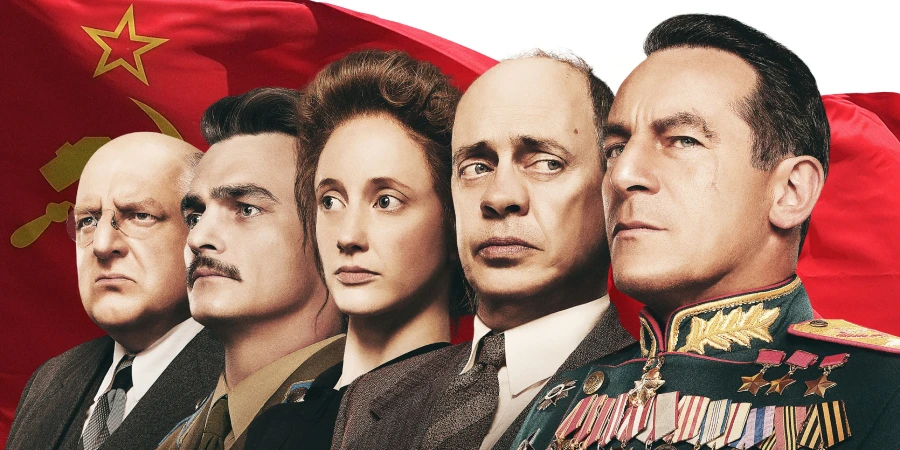

Stalin collapses in a puddle of his own urine, and nobody in the room can agree whether to call a doctor, because the best doctors are already in the Gulag. The Death of Stalin (2017) mines one of history’s darkest weeks for relentless comedy. Armando Iannucci makes the Politburo sound like a panicked middle-management meeting, and the laughs never quite cover the gunshots.
Detailed Summary
A Concert Replayed
Moscow, 1953. Stalin phones Radio Moscow demanding a recording of the live concert that just ended. There is no recording. Producer Andreyev drags the audience back, rounds up strangers off the street, and makes the orchestra play the whole thing again.
The Note in the Sleeve
Pianist Maria Yudina, whose family Stalin destroyed, slips a venomous note into the record sleeve. Stalin reads it in his dacha, chuckles, and suffers a massive stroke. His guards hear a thud and decide that investigating would be more dangerous than ignoring it.
Committee Chaos
Beria, head of the NKVD, arrives first and sweeps up Stalin’s secret files. Malenkov, the nominal deputy, dithers. Khrushchev turns up in pajamas under his suit. Nobody wants to be the one who calls for help without a unanimous vote.
Which Doctors Are Left
With the Doctors’ Plot having purged the medical profession, the committee assembles whatever physicians remain: the old, the frightened, and the recently released. Stalin lingers, briefly wakes, points at a painting, and dies.
Beria’s Opening Moves
Beria halts arrests, frees prisoners, and reshapes himself as a liberal reformer. He also plants his NKVD troops around Moscow and keeps the army locked out. Khrushchev receives the thankless job of organizing the funeral.
The Children
Svetlana grieves and looks for protection, while her brother Vasily, a drunk air force general, rants about a hockey team he got killed in a plane crash. Both become pawns for the men circling the throne.
Molotov Comes Back
Molotov, recently added to Stalin’s enemies list, is rehabilitated by Beria. His wife, whom he had already denounced, is returned to him alive, and he swings between gratitude and terror. Michael Palin plays him as the ultimate loyalist with nothing left to be loyal to.
Zhukov Arrives
Marshal Zhukov storms in wearing a chest full of medals and offers to hit Beria with the Red Army. Khrushchev begins stitching together a coup, but he needs Malenkov’s signature and every committee member’s nerve.
Movie Ending
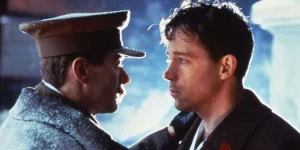
The funeral becomes a catastrophe. Beria opens Moscow to the mourning crowds, and NKVD troops fire on them, killing roughly 1,500 people. Khrushchev seizes the disaster as his weapon and persuades the committee that Beria must answer for it.
At a meeting, Khrushchev gives the signal. Zhukov’s soldiers burst in and drag Beria to the floor. Malenkov, cornered, finally signs the order. Beria is tried in a courtyard in minutes, read a list of crimes, and shot in the head.
His body is doused in petrol and burned while the committee watches. Khrushchev, who spent the film as the clown in pajamas, now stands at the center of power. Malenkov realizes too late that he has been outplayed.
The coda jumps ahead. Khrushchev sits at a concert beside Maria Yudina, a survivor he has chosen to spare. Behind him, a watchful Brezhnev leans forward. Title cards note that Khrushchev was later ousted by Brezhnev and that the cycle continued.
Why end there? Iannucci refuses a clean victory. The man who removed the monster becomes the next target, and the audience is left watching the watchers, which is exactly how the system worked.
Are There Post-Credits Scenes?
No. The title cards about Khrushchev’s fall are the final content, and the credits run without any extra scene.
Type of Movie
The Death of Stalin is a political satire and black comedy with the bones of a thriller. Its tone is fast, profane, and farcical, with sudden lurches into genuine horror. Actors use their own British and American accents, which makes the Soviet elite sound like a familiar office.
Cast
- Steve Buscemi – Nikita Khrushchev
- Simon Russell Beale – Lavrentiy Beria
- Jeffrey Tambor – Georgy Malenkov
- Michael Palin – Vyacheslav Molotov
- Jason Isaacs – Georgy Zhukov
- Andrea Riseborough – Svetlana Stalina
- Rupert Friend – Vasily Stalin
- Olga Kurylenko – Maria Yudina
- Paddy Considine – Andreyev
- Adrian McLoughlin – Joseph Stalin
- Paul Whitehouse – Anastas Mikoyan
- Dermot Crowley – Lazar Kaganovich
- Paul Chahidi – Nikolai Bulganin
Film Music and Composer
Christopher Willis, who also scored Iannucci’s television work on Veep, composed the music. He wrote in the style of Soviet-era symphonic music, echoing Shostakovich and Prokofiev with grand, ironic flourishes.
The opening concert sequence features Mozart’s Piano Concerto No. 23, played by Yudina, a nod to the real anecdote about Stalin and the pianist. Willis’s main theme turns the pomp of state music into a joke that keeps a straight face.
Filming Locations
Iannucci shot primarily in the United Kingdom, with London and Hertfordshire standing in for Moscow interiors and committee rooms. Period mansions doubled for Stalin’s dacha.
Kyiv, Ukraine, provided exteriors and Soviet-era architecture that British locations could not match. Shooting in a former Soviet capital, rather than Russia, added a layer of irony the production embraced.
Awards and Nominations
The film received BAFTA nominations, including Best Adapted Screenplay, and won the European Film Award for Best Comedy. Simon Russell Beale was honored for his performance as Beria at the British Independent Film Awards.
Behind the Scenes Insights
- The screenplay was written by Iannucci with David Schneider, Ian Martin, and Peter Fellows.
- Iannucci deliberately told actors not to attempt Russian accents, arguing that the characters would not perceive themselves as speaking with an accent.
- Russia’s Ministry of Culture withdrew the film’s distribution certificate days before release, effectively banning it.
- Jeffrey Tambor’s Malenkov was based partly on the real man’s vanity about his appearance.
- Much of the dialogue stayed scripted, with limited improvisation compared to Iannucci’s television work.
- The hockey team story Vasily tells is drawn from a real 1950 plane crash involving the VVS Moscow team.
Inspirations and References
The film adapts the French graphic novel La Mort de Staline by Fabien Nury and Thierry Robin. The comic’s two volumes cover the agony and the funeral, and Iannucci kept its structure while sharpening the comedy.
Historical sources include memoirs by Khrushchev and Svetlana Alliluyeva, as well as accounts of Beria’s arrest and execution. The Yudina note is a legend of uncertain truth, which the film treats as fact.
Alternate Endings and Deleted Scenes
No alternate ending has been released. Home video editions include some deleted scenes, mostly extended committee bickering that was cut for pace. The core structure never changed.
Book Adaptations and Differences
Yes, the film adapts the Nury and Robin graphic novel. The comic is darker and more somber, with fewer jokes and a more restrained portrait of Khrushchev. Iannucci compressed the timeline, moving Beria’s downfall, which took months in reality, into the funeral week, and expanded Zhukov into a swaggering comic force.
Memorable Scenes and Quotes
Key Scenes
- The frantic re-staging of the Radio Moscow concert.
- Stalin’s guards debating whether to check on the thud.
- The committee carrying Stalin’s body while arguing about protocol.
- Beria’s casual list of who gets shot and in what order.
- Zhukov’s entrance.
- The crowd massacre at the funeral.
- Beria’s trial and execution in the courtyard.
- Brezhnev in the concert hall, watching.
Iconic Quotes
- Khrushchev’s grumble that he has to try to remember who is alive and who is not (paraphrased).
- Zhukov’s offer to handle Beria with the army, delivered as a dare (paraphrased).
- Beria’s ominous promise that he has documents on everyone in the room (paraphrased).
Easter Eggs and Hidden Details
- Khrushchev’s pajamas under his suit reflect a real anecdote about his rushed arrival.
- Malenkov’s fixation on his hair and portrait mocks the real man’s post-Stalin image campaign.
- Molotov’s wife, Polina, was indeed released from prison only after Stalin’s death.
- Stalin’s children appear in costumes echoing real photographs from the funeral.
- Brezhnev’s silent presence in the finale sets up a sequel history never needed to film.
Trivia
- The film grossed well in Britain and became a cult hit despite modest American box office.
- Russian cinemas that screened it anyway faced fines.
- Steve Buscemi had worked with Iannucci only after a long admiration from afar.
- Michael Palin’s casting as Molotov was a nod to Monty Python, which was popular in the Soviet underground.
- The real Beria was shot in December 1953, nine months after Stalin’s death, not days.
- Iannucci has said he wanted the film to be funny while making audiences uncomfortable about laughing.
Why Watch?
The Death of Stalin turns the most frightening regime of the century into the funniest film about power ever made. Every joke lands, and every joke has a corpse behind it. Few comedies teach this much history. Watch it, then watch it again for the background terror.
Director’s Other Movies
- In the Loop (2009)
- The Personal History of David Copperfield (2019)
Recommended Films for Fans
- Dr. Strangelove (1964)
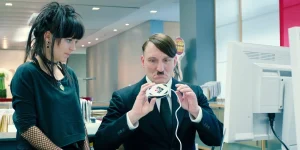
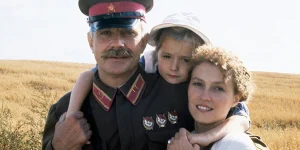
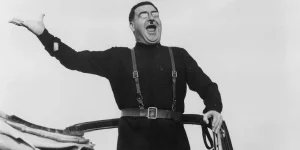
- Red Monarch (1983)
- Repentance (1984)
- In the Loop (2009)
- Khrustalyov, My Car! (1998)
- Jojo Rabbit (2019)
- Dear Comrades! (2020)