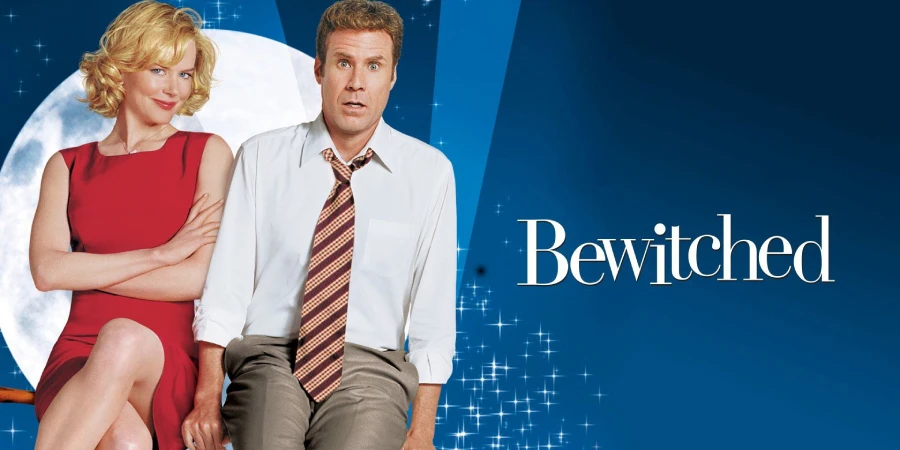

Hollywood’s long history of mining nostalgia for IP produced few misfires quite as fascinating as Bewitched (2005), a film that openly acknowledges it is a bad idea and then proceeds to be one anyway. Director Nora Ephron built a meta-romantic comedy on top of the beloved 1960s television series, casting Will Ferrell and Nicole Kidman in a story about making a TV show called Bewitched.
It is a concept so layered it collapses under its own cleverness. Yet buried inside the wreckage is genuine charm, real chemistry, and one of Nicole Kidman’s most underrated comedic performances.
Detailed Summary
Isabel Bigelow Moves to the Valley
Isabel Bigelow, played by Nicole Kidman, is a real witch who desperately wants a normal human life. She is tired of using magic to solve every problem. So she leaves her enchanted world behind and moves to a sunny house in the San Fernando Valley, determined to live as an ordinary woman.
Her father, Nigel Bigelow, played by Michael Caine, is baffled and mildly horrified. He cannot understand why any witch would voluntarily surrender power. He keeps popping into her life, using his own charm and magic on unsuspecting women, providing some of the film’s funniest supporting moments.
Jack Wyatt Needs a Nobody
Jack Wyatt, played by Will Ferrell, is a fading Hollywood star with a bruised ego and a desperate need for a comeback. His agent, played by Jason Schwartzman, pitches him a remake of the classic TV series Bewitched. Jack agrees, but only if his Samantha is a complete unknown, someone who will not overshadow him.
He spots Isabel in a bookstore, enchanted by the way she wiggles her nose. He has no idea she is an actual witch. Jack offers her the role of Samantha, and she accepts, seeing it as her ticket into ordinary human life.
Isabel Falls for the Wrong Guy
Isabel genuinely falls for Jack almost immediately, partly because he is handsome and partly because she is romantically inexperienced with mortals. However, Jack is self-absorbed, manipulative, and fundamentally uninterested in sharing the spotlight. He rewrites scripts to diminish her role and takes credit for every success on set.
Isabel catches on to his selfishness faster than the audience might expect. She uses a small spell to make him repeat the same insufferable line over and over in public, humiliating him. It is a petty revenge, but the film plays it for maximum comedic effect.
The Truth Comes Out On Set
Meanwhile, the TV production moves forward in chaotic fashion. Shirley MacLaine plays Iris Smythson, the veteran actress cast as Endora, Samantha’s mother. Iris turns out to be a real witch herself, adding another layer to the film’s already overcrowded meta-concept.
Isabel struggles to keep her magical identity secret while also managing Jack’s enormous ego. Consequently, she uses magic more and more on set, bending situations to her will. This directly contradicts her stated goal of living a normal life, and the film uses that tension as its emotional engine.
Jack’s Ego Implodes
Jack’s behavior reaches a peak of awfulness when he openly humiliates Isabel during a table read, talking over her and dismissing her contributions. Isabel confronts him. She finally tells him she is a real witch, and he does not believe her at first.
She demonstrates her powers without hesitation. Jack’s reaction shifts from disbelief to fascination to guilt, though not necessarily in a convincing or earned dramatic arc. This section of the film is where critics felt the script struggled most.
Isabel Reconsiders Everything
Isabel decides to cast a love spell on Jack, forcing him to love her. She almost goes through with it. In a moment of genuine moral clarity, she stops herself, recognizing that manufactured love is not the normal human experience she actually wants.
This is arguably the film’s most interesting beat. It forces Isabel to confront what “normal” actually means. Notably, the choice to abandon the spell is presented as her most authentically human moment in the entire story.


Movie Ending
Jack, having been on the receiving end of Isabel’s magical nose-twitch more than once, finally grasps the full reality of who she is. He tracks her down after she withdraws from the production and from his life. His apology is not grand or theatrical; it is awkward and fumbling in the way Will Ferrell does best.
Isabel forgives him, and the two reconcile genuinely, without magic playing any role. This matters because the film has spent its entire runtime examining whether Isabel can get what she wants, namely love and normalcy, without resorting to shortcuts. Her choice to accept Jack on honest terms validates her whole journey.
The production of the TV show within the film wraps up, and the couple films a scene together as Darrin and Samantha. In a sweet, circular touch, their chemistry on screen finally looks real, because it is real. The show-within-a-show structure closes itself neatly.
Nigel, Isabel’s father, watches from a distance with something approaching approval. He never fully understood her quest for ordinariness, but he respects the outcome. The film ends on a warm, low-key note rather than a sweeping romantic climax, which suits its peculiar tone surprisingly well.
Are There Post-Credits Scenes?
Bewitched (2005) contains no post-credits scene. Once the credits roll, there is nothing additional waiting for patient viewers. You can safely leave when the movie ends.
Type of Movie
Bewitched is a romantic comedy with strong meta-fictional and fantasy elements. Its tone is light and self-aware, leaning heavily into the absurdity of its own premise. Think of it as a comedy about Hollywood vanity that also happens to involve actual witchcraft.
In contrast to straightforward rom-coms, this film constantly winks at the audience. It is more interested in satirizing the entertainment industry than in delivering a conventional love story. That gamble produces both its funniest moments and its weakest dramatic beats.
Cast
- Nicole Kidman – Isabel Bigelow / Samantha
- Will Ferrell – Jack Wyatt / Darrin Stephens
- Michael Caine – Nigel Bigelow
- Shirley MacLaine – Iris Smythson / Endora
- Jason Schwartzman – Richie
- Kristin Chenoweth – Maria Kelly
- Heather Burns – Nina
- Jim Turner – Larry Wechsler
- Stephen Colbert – Jiminy Dowd
- Steve Carell – Uncle Arthur (cameo)
Film Music and Composer
George Fenton composed the score for Bewitched. Fenton is a seasoned British composer with decades of film work behind him, including scores for Gandhi and The Full Monty. His work here leans into whimsical, playful orchestration that matches the film’s fantasy-lite atmosphere.
The production also incorporated the iconic theme music from the original Bewitched television series, giving longtime fans an immediate audio connection to the source material. That familiar melody carries genuine nostalgic weight, possibly more than anything else in the film. Fenton’s original compositions blend around it without overpowering it.
Filming Locations
Principal photography took place in and around Los Angeles, California. The San Fernando Valley setting is not incidental; it grounds Isabel’s desire for suburban normalcy in a very specific, recognizable American landscape. Sunny sidewalks and tidy houses visually reinforce her fantasy of ordinary life.
Production also used studio facilities in the Los Angeles area to shoot the fictional TV show sequences. Those interior sets deliberately evoke the look of 1960s television production design. As a result, they create a layered visual effect, a modern film depicting a retro TV show, all within the same physical space.
Awards and Nominations
Bewitched received no significant awards recognition. It earned a Razzie nomination for Worst Remake or Rip-off, which reflects the critical reception more than the Oscars shortlist ever would. That is all there is to say on the subject.
Behind the Scenes Insights
- Nora Ephron co-wrote the screenplay with her sister Delia Ephron, a frequent creative partnership that produced films like You’ve Got Mail.
- Nicole Kidman reportedly worked closely with Ephron to shape Isabel’s emotional arc, particularly the scenes where Isabel nearly casts the love spell.
- Will Ferrell largely improvised several of Jack’s most self-aggrandizing moments, and the production embraced those takes.
- Steve Carell filmed his Uncle Arthur cameo around the same period his career was surging due to The 40-Year-Old Virgin, making his appearance a notable snapshot of that Hollywood moment.
- Shirley MacLaine brought her own eccentric energy to Iris, and cast members noted she required very little direction.
- Michael Caine has described the film as a fun, low-pressure project he enjoyed precisely because it did not take itself seriously.
Inspirations and References
The film draws directly from Bewitched, the ABC television series that aired from 1964 to 1972. That show starred Elizabeth Montgomery as Samantha and became a cultural landmark for its blending of domestic comedy with light fantasy. Nora Ephron’s film does not remake the show so much as use it as raw material for a meta-commentary.
In addition, the film reflects broader Hollywood anxieties about remakes and nostalgia in the early 2000s. It is self-aware enough to acknowledge that reviving beloved IP for commercial gain is a dubious enterprise. Furthermore, that self-awareness is both its cleverest trick and its most frustrating limitation.
Alternate Endings and Deleted Scenes
No officially documented alternate endings or significant deleted scenes for Bewitched (2005) have been widely reported or released. The DVD release did not include a substantial deleted scenes reel. If such material exists, Sony Pictures has not made it publicly available in any notable way.
Book Adaptations and Differences
Bewitched (2005) is not based on a book. It draws from the original television series and from an original screenplay by Nora and Delia Ephron. No literary source material exists to compare it against.
Memorable Scenes and Quotes
Key Scenes
- Isabel wiggles her nose in the bookstore, unaware that Jack is watching and instantly fixated on her distinctive quirk.
- Jack repeats the same embarrassing phrase on loop in public after Isabel casts a minor revenge spell on him, a scene Ferrell plays with perfect oblivious commitment.
- Isabel raises her finger to cast the love spell on Jack, pauses, and then deliberately lowers it, choosing honesty over magic in one of the film’s quietest and most effective moments.
- Nigel, played by Caine, uses his witch-like charm to seduce a series of mortal women, delivering a subplot that functions almost as a parallel romantic farce.
- The final scene where Jack and Isabel film the Darrin-and-Samantha scene together, their real affection finally visible on screen.
Iconic Quotes
- “I want someone to love me for exactly who I am, not who I could be with a little more effort.” – Isabel
- “You’re a witch. An actual witch. And you made me say that thing forty times.” – Jack
- “Normal is wildly overrated, my darling.” – Nigel
Easter Eggs and Hidden Details
- The bookstore where Jack first spots Isabel stocks titles related to witchcraft and folklore, visible on shelves behind them if you look closely.
- Steve Carell‘s Uncle Arthur character mirrors the original Uncle Arthur from the TV series, played by Paul Lynde, including similar comedic delivery and timing.
- Several set dressings on the fictional TV show in production deliberately replicate the color palette and furniture style of the original 1960s Bewitched sets.
- Nigel’s suits throughout the film are consistently impeccable and slightly anachronistic, a subtle visual signal that he exists slightly outside normal mortal time.
- Isabel’s house in the Valley has a garden that appears more lush and perfectly maintained than any of her neighbors’, a quiet nod to her unconscious magical influence on her surroundings.
Trivia
- Elizabeth Montgomery, the original Samantha, passed away in 1995, and the production was sensitive about how it honored the original series without exploiting her legacy.
- Nora Ephron was primarily known for dialogue-driven romantic comedies, making the fantasy elements of this project a genuine departure for her.
- The film was a box office disappointment, earning roughly $131 million worldwide against a reported production budget of around $85 million, before marketing costs.
- Nicole Kidman trained on the nose-twitch, a signature move from the original series, to replicate it authentically without looking like a parody.
- Several cast members from the original TV series were considered for cameo roles, though no such appearances made it into the final cut.
- Jason Schwartzman‘s agent character reads as a send-up of real Hollywood representation culture, and Schwartzman reportedly researched actual talent agencies for the role.
Why Watch?
Bewitched rewards patient viewers who appreciate Nicole Kidman playing against type with genuine comedic instinct and surprising warmth. Moreover, its satirical jabs at Hollywood ego and the remake machine land more sharply now than they did in 2005. It is a flawed, fascinating curiosity that earns its place as a comfort watch for fans of smart, self-aware romantic comedy.
Director’s Other Movies
- When Harry Met Sally… (1989)
- Sleepless in Seattle (1993)
- Michael (1996)
- You’ve Got Mail (1998)
- Lucky Numbers (2000)
Recommended Films for Fans
- My Super Ex-Girlfriend (2006)
- Practical Magic (1998)
- Enchanted (2007)
- The Holiday (2006)
- Sleepless in Seattle (1993)
- Hocus Pocus (1993)