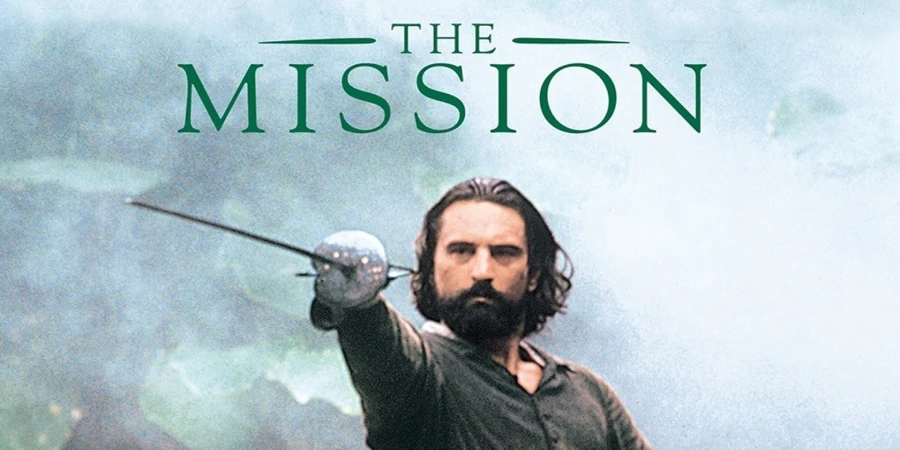

Roland Joffé’s 1986 film drops you into the South American jungle and refuses to let you breathe comfortably for over two hours. A Jesuit priest carries a load of armor up a waterfall as penance, a former slave trader converts to faith, and colonial powers carve up indigenous land like it belongs to them by divine right.
What follows is one of cinema’s most brutal arguments about whether God, politics, or violence can save a people already condemned by paperwork. Ennio Morricone’s score enters before the story does, and that choice tells you everything about where the film’s priorities lie.
Detailed Summary
The Martyrdom at the Waterfall
A Jesuit priest, Father Gabriel, played by Jeremy Irons, ventures into the jungle above the Iguazu Falls to make contact with the Guaraní people. His predecessor was killed and tied to a cross, then sent over the falls. Gabriel climbs anyway, playing his oboe, and the music disarms the tribe where words and weapons could not.
This opening sequence is the film’s single greatest directorial decision. Joffé frames Gabriel as tiny against the roaring water, a man whose only armor is melody. It works because it earns its symbolism without underlining it.
Rodrigo Mendoza and the Weight of His Past
Robert De Niro plays Rodrigo Mendoza, a mercenary and slave trader who captures Guaraní people and sells them to colonial plantations. He is brutal, efficient, and completely at ease with cruelty. His world collapses when he discovers his brother, Felipe, has been sleeping with his fiancée, Carlotta.
Rodrigo kills Felipe in a duel. He does not feel satisfaction afterward; he feels nothing useful. Father Gabriel finds him in prison, hollowed out by guilt, and challenges him to seek penance rather than death.
The Penance Climb
Rodrigo’s chosen penance is hauling a net packed with his old armor and weapons up the face of the Iguazu Falls. This sequence is physically punishing to watch. De Niro, wet and shaking, drags the bundle through mud and over rock while other Jesuits struggle ahead of him.
When the Guaraní finally cut the burden free and throw it into the water, Rodrigo collapses into laughter and tears simultaneously. It is the film’s emotional center, and De Niro earns every second of it with minimal dialogue and maximum physical commitment.
Life at the Mission of San Carlos
Rodrigo eventually takes vows and becomes a Jesuit brother. Life at the mission of San Carlos is portrayed as genuinely functional: the Guaraní farm, sing, create art, and govern themselves under Jesuit guidance. Joffé resists making the mission a utopia, but he does want you to understand what is about to be destroyed.
Father Gabriel trains the choir with patient intensity. The children singing Morricone’s compositions on screen feels less like a scene and more like a rebuke to everything that follows.
The Treaty of Madrid and the Political Machinery
Cardinal Altamirano, played by Ray McAnally, arrives in South America as the papal legate. His mission is to investigate whether the Jesuit reductions should be handed over to Portugal under the Treaty of Madrid, which would transfer the territory and almost certainly mean slavery or destruction for the Guaraní.
Altamirano tours the missions with representatives from Spain and Portugal watching him closely. His dilemma is not whether the missions are good; they clearly are. His dilemma is whether the Church can survive politically if it defies the colonial powers.
McAnally plays Altamirano as a man who knows exactly what he is doing and hates himself for it. That self-awareness makes him more tragic than a simple villain, and the film is smarter for casting someone capable of projecting that complexity.
Altamirano’s Decision
After witnessing the missions firsthand, Altamirano rules that the Jesuits must abandon San Carlos and the other reductions. He believes appeasing Portugal and Spain will protect the broader Church. Father Gabriel refuses to abandon his congregation. Rodrigo, whose conversion was always partly rooted in action rather than pure contemplation, makes a different choice.
Rodrigo renounces his vows and picks up his weapons again. He will fight for the Guaraní not as a priest, but as a soldier. This split between Gabriel and Rodrigo crystallizes the film’s central argument about faith and resistance.
Movie Ending
Portuguese and Spanish forces attack San Carlos. Rodrigo leads an armed Guaraní resistance in the jungle, fighting with guerrilla tactics, ambushes, and desperation. Father Gabriel refuses to take up arms; he leads his congregation in a procession, carrying the Blessed Sacrament toward the advancing soldiers.
Rodrigo’s fighters are overwhelmed. He takes multiple wounds, drags himself through the mud, and dies in the mission as fire consumes the buildings around him. It is not heroic in any clean Hollywood sense. It is exhausted, bloody, and futile.
Father Gabriel’s procession is massacred. Soldiers gun down priests, women, and children. Gabriel is shot and falls, still holding the monstrance. The camera does not look away.
A small group of Guaraní children escape by canoe into the river. They carry a few objects salvaged from the mission: a violin, a book. This image is spare and quiet after the carnage, and Joffé lets it sit without commentary.
Altamirano writes a letter to his superiors in Rome. He states plainly that the actions were an abomination, that the world is as it is, and that men like himself must live in it. His voiceover does not seek absolution. It acknowledges complicity with something close to despair.
The final image returns briefly to the survivors on the water. What haunts the ending is not the violence itself but the bureaucratic calm that caused it. A treaty caused this. Signatures on paper caused this. That is the film’s most disturbing point, and it lands because Joffé never lets Altamirano become a monster; he remains a reasonable man who chose badly.
Are There Post-Credits Scenes?
No. The Mission contains no post-credits scene of any kind. After Altamirano’s closing narration and the final shots, the film ends and Morricone’s music carries you out of the theater. Stay for the score if you like, but you will not miss any additional footage.
Type of Movie
The Mission is a historical drama with elements of a moral thriller. Its tone is solemn, elegiac, and at times genuinely devastating. It is not an action film despite its violent third act. Think of it as a political tragedy set inside a crisis of faith.
Joffé keeps the pacing deliberate. Some viewers find the first hour slow; those viewers are probably right that it is unhurried, but that pace is doing necessary work, building the world that gets demolished later.
Cast
- Jeremy Irons – Father Gabriel
- Robert De Niro – Rodrigo Mendoza
- Ray McAnally – Cardinal Altamirano
- Aidan Quinn – Felipe Mendoza
- Cherie Lunghi – Carlotta
- Ronald Pickup – Hontar
- Chuck Low – Cabeza
- Liam Neeson – Father Fielding
Film Music and Composer
Ennio Morricone composed the score, and it may be his most complete achievement in a film setting. Rather than underscoring emotion from beneath, the music here often carries scenes entirely. “Gabriel’s Oboe“ is the piece most people remember: a single melodic line, unadorned, played over Gabriel’s first contact with the Guaraní.
“On Earth as It Is in Heaven” opens the film with choral voices and a swelling orchestral arrangement that immediately signals you are watching something with spiritual ambitions. Morricone weaves Guaraní-inflected rhythms into several cues, grounding the score in the culture being depicted rather than imposing a purely European sound.
Morricone won the BAFTA Award for Best Film Music for this score. His work here rewards listening outside the film; it functions as a standalone composition that holds its emotional weight even without the images.
Filming Locations
Principal photography took place in Colombia and Argentina. The waterfall sequences used the actual Iguazu Falls, one of the largest waterfall systems in the world, straddling the border of Argentina and Brazil. Shooting there was logistically grueling, and the scale of the falls on screen is not a visual trick.
The jungle sequences were filmed in the Colombian rainforest. Joffé wanted real humidity, real mud, and real distance. Actors and crew spent weeks in genuinely remote locations, and that physical reality shows in every frame where someone looks exhausted.
Choosing real locations rather than studio sets locks the film’s moral argument into a specific geography. The land is not abstract. You can see it being fought over, and that visibility matters enormously to the film’s impact.
Awards and Nominations
The Mission won the Palme d’Or at the 1986 Cannes Film Festival, with the jury presided over by Sydney Pollack. It received seven Academy Award nominations, including Best Picture and Best Director for Roland Joffé, winning only Best Cinematography for Chris Menges.
Morricone’s BAFTA win for the score was one of the evening’s few uncontroversial outcomes. Most critics felt the film deserved more recognition at the Oscars than it received, and that feeling has only grown with time.
Behind the Scenes Insights
- Robert De Niro trained extensively for the penance climb sequence, performing much of the physical work himself in genuinely difficult terrain near the Iguazu Falls.
- Jeremy Irons learned to play the oboe well enough to perform convincingly on camera, a detail that gives the Gabriel scenes their unusual authenticity.
- Roland Joffé cast indigenous and local South American people in the Guaraní roles rather than using European extras in makeup, a casting decision that shapes how the community reads on screen.
- Screenwriter Robert Bolt wrote the script while recovering from a stroke, dictating the dialogue because he could not type. His physical struggle during composition gives the film’s themes of bodily suffering an uncomfortable biographical dimension.
- Ennio Morricone composed the score before filming began, an unusual arrangement that allowed Joffé to play music on set during certain scenes to guide the performances.
- Filming near the Iguazu Falls created constant equipment problems due to the spray and humidity, with camera gear requiring special protection throughout production.
Inspirations and References
Robert Bolt drew on the documented history of the Jesuit reductions in South America, particularly the missions established among the Guaraní people in what is now Paraguay, Argentina, and Brazil during the 17th and 18th centuries. These were real communities, and their destruction following the 1750 Treaty of Madrid is a matter of historical record.
The film engages with the broader history of the suppression of the Jesuit order in 1773, though it focuses on events leading up to and around that period. Bolt was interested less in strict historical accuracy and more in the moral architecture of the situation: what does an institution do when its values conflict with its survival?
Philosophical undercurrents from liberation theology, a movement active in Latin America during the 1970s and 1980s, inform how the film frames the tension between spiritual witness and armed resistance.
Alternate Endings and Deleted Scenes
No officially released alternate ending exists for The Mission. Joffé has discussed in interviews that the ending was always intended to be devastating, and no serious alternative was developed in post-production.
Some scenes involving the Guaraní community’s daily life were shortened or cut during editing to tighten the second act. These trims have not been restored in any home video release. No comprehensive deleted scenes package has been made publicly available.
Book Adaptations and Differences
The Mission is not based on a novel. Robert Bolt wrote an original screenplay. A novelization of the film was published to coincide with the release, but it derives from the script rather than the script deriving from a book. There is no source novel to compare against.


Memorable Scenes and Quotes
Key Scenes
- The oboe ascent: Gabriel climbs toward the Guaraní settlement playing his oboe while a warrior holds a blade to his throat, eventually lowering it as the music continues. No words are spoken.
- The penance climb: Rodrigo hauls his bundle of armor up the waterfall face, collapsing repeatedly, until a Guaraní man cuts it free. Rodrigo’s breakdown into laughter and weeping is De Niro working without a net.
- Altamirano’s tour of the missions: The cardinal watches the Guaraní choir perform and his face shows a man actively suppressing what he feels, because feeling it fully would complicate his decision.
- Gabriel’s final procession: Priests and Guaraní walk forward carrying the Blessed Sacrament as soldiers advance. The camera holds on Gabriel’s face, which shows no fear, only exhaustion and certainty.
- Children escaping by canoe: A small group of survivors paddle away from the burning mission carrying a violin and a few books, filmed in quiet long shot against the river.
Iconic Quotes
- “If might is right, then love has no place in the world.” – Father Gabriel
- “You have no need of me, Rodrigo. You have God.” – Father Gabriel
- “Thus have we made the world. Thus have I made it.” – Cardinal Altamirano, in his closing letter
Easter Eggs and Hidden Details
- The armor Rodrigo drags up the waterfall includes items that recall specific tools of the slave trade, not merely generic military gear. Watch for the chains mixed into the bundle.
- Morricone embeds a fragment of “Gabriel’s Oboe” into the choral arrangement heard during the mission scenes, connecting Gabriel’s personal musical signature to the community he built.
- During Altamirano’s tour, a Guaraní craftsman is visible in the background working on a woodcarving that echoes European baroque religious iconography fused with indigenous forms, a visual argument for the genuine cultural synthesis the missions achieved.
- The cross that appears at the opening, carrying the martyred priest over the waterfall, reappears in the background of several mission shots, a quiet reminder of what the community was built on and what it may become.
Trivia
- The Mission was one of the most expensive British films produced at the time of its release.
- Liam Neeson appears in a supporting role as Father Fielding, years before his career shifted toward leading-man status.
- The Iguazu Falls sequences required cast and crew to travel by helicopter to locations inaccessible by road.
- Chris Menges, who won the Oscar for cinematography, had previously won for The Killing Fields in 1985, making him one of the rare cinematographers to win in consecutive years for two different directors working in similar geopolitical territory.
- Robert Bolt’s screenplay was his first major project after the stroke that left him partially paralyzed. His output before this had included Lawrence of Arabia and A Man for All Seasons.
- Roland Joffé and producer David Puttnam had previously collaborated on The Killing Fields, and Puttnam brought the same commitment to politically serious subject matter to this production.
Why Watch?
Watch it for the specific moment when De Niro’s Rodrigo cuts his armor loose and dissolves into something between grief and relief, because that two-minute sequence contains more honest acting than most films manage across their entire runtime. Chris Menges shoots the waterfall sequences with such physical scale that you feel the weight Rodrigo is hauling. Morricone’s score then reframes everything you just watched as a kind of prayer.
Director’s Other Movies
- The Killing Fields (1984)
- Fat Man and Little Boy (1989)
- City of Joy (1992)
- The Scarlet Letter (1995)
Recommended Films for Fans
- The Killing Fields (1984)
- Aguirre, the Wrath of God (1972)
- Black Robe (1991)
- The Last of the Mohicans (1992)
- At Play in the Fields of the Lord (1991)
- The Bounty (1984)
- A Man for All Seasons (1966)