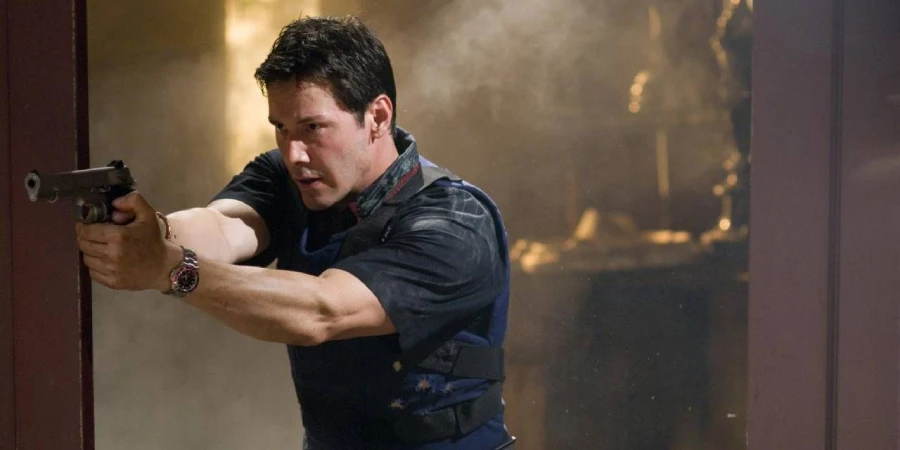

Keanu Reeves drinks himself into a stupor before his shift, kills four men in a convenience store, and gets a commendation by noon. Street Kings opens on that note and never pretends to be a movie about a good cop. It is about a dirty cop who wants to feel clean, and director David Ayer understands exactly how ugly that desire looks when you strip away the procedural gloss. This is Los Angeles noir with the serial numbers filed off and a .45 pressed to its own temple.
Detailed Summary
Tom Ludlow: A Weapon in a Suit
Detective Tom Ludlow (Keanu Reeves) works a Vice unit under Captain Jack Wander (Forest Whitaker) in the LAPD. He operates as Wander’s personal off-the-books enforcer, handling targets the department cannot legally touch. Ludlow is a functioning alcoholic who keeps vodka in water bottles and lives in a house that looks like a crime scene with a couch.
His opening mission involves tracking down two Korean gangsters who purchased children for trafficking. Ludlow stages the encounter to ensure both men die. He switches guns after the fact and feeds a cover story to Internal Affairs. It works, and Wander congratulates him like a proud father.
The Problem Named Terrence Washington
Ludlow’s former partner, Terrence Washington (Terry Crews), has been cooperating with Internal Affairs investigator Biggs (Hugh Laurie). Washington ratted on Ludlow, and Ludlow despises him for it. Their relationship is dead and hostile before the film’s inciting event arrives.
Ludlow follows Washington to a convenience store in a rough neighborhood, not to reconcile but to confront him. Two masked gunmen enter the store and execute Washington in front of him. Ludlow kills both shooters, but he was not supposed to be there, and the optics look catastrophic.
Internal Affairs Circles
Biggs immediately suspects Ludlow arranged Washington’s murder to silence him. Ludlow insists he witnessed the killing, nothing more. Nobody fully believes him, including the audience for a good stretch of the second act, which is exactly where the screenplay wants you.
Facing suspension and investigation, Ludlow refuses to stop digging. He pulls footage, traces the masked shooters, and identifies them as fellow LAPD officers. That discovery cracks the film open.
The Trail Points Inward
Ludlow partners with a younger detective, Paul Diskant (Chris Evans), who is idealistic and increasingly uncomfortable with how Ludlow operates. Their pairing generates real friction. Evans plays Diskant as someone genuinely trying to stay clean in a department that punishes that instinct.
Their investigation leads through gang territory, corrupt precincts, and evidence that Washington was not simply a rat but someone who had uncovered something much larger. A crew of dirty cops under Captain Biggs had been running their own criminal enterprise, using gang contacts to eliminate threats to the operation.
Wander’s True Face
Ludlow clings to Wander as the one honest authority in his life. Wander has been his mentor, his protector, the man who gave his violence a purpose. That faith is the film’s central dramatic trap.
As Ludlow digs deeper, evidence accumulates that Wander himself ordered Washington’s execution. Washington had not just exposed Ludlow’s misconduct. He had evidence linking Wander directly to the dirty crew. Wander arranged the hit to protect himself and used Ludlow’s presence at the scene as insurance, knowing Ludlow would investigate and destroy anyone in his path.
Diskant Pays the Price
Diskant uncovers enough to confirm Wander’s involvement. Before he can act on it, Wander’s men shoot him. His death is abrupt and genuinely affecting, partly because Evans plays the character with enough warmth that losing him costs the movie something. It is the clearest moment where Street Kings acknowledges that decency inside this institution gets you killed.
Movie Ending
Ludlow finally confronts the dirty crew responsible, working through them with the same brutality the film established in its opening sequence. There is no procedural elegance here. He shoots his way to the truth the way a man uses a sledgehammer on a wall he should have opened with a door.
Wander tries to frame the situation as protecting Ludlow, insisting everything he did was to keep his unit intact and his people safe. Whitaker plays this scene at a low simmer, which is the right choice. He does not beg or rage. He simply presents his logic as if it still makes sense.
Ludlow shoots Wander. He does not arrest him, does not call it in, does not waver. He executes his mentor with the same cold efficiency he has used throughout the film, and the camera does not look away. It is the film’s most honest beat, because Ludlow cannot become a legitimate cop. He can only redirect his violence toward a different target.
Biggs, who has been watching Ludlow operate with mounting disgust, pieces together what happened at the scene. He lets Ludlow walk. The explanation offered is that Wander was shot by a gang member at the scene, which everyone present knows is a lie. Biggs does not expose the truth. He buries it, which means Internal Affairs is not a solution. It is just another layer of compromise.
Ludlow drives away. He has not been redeemed. He has survived, and the film is careful not to dress those up as the same thing. Biggs recording the unofficial version of events suggests the cycle will continue, with different names and the same institutional rot underneath.
Are There Post-Credits Scenes?
Street Kings has no post-credits scene. When it ends, it ends. Given the film’s tone, a post-credits button would feel deeply wrong anyway.
Type of Movie
Street Kings is a neo-noir crime thriller with heavy procedural elements. Its tone is cynical throughout, never offering a clean moral position for the audience to stand on. Think corrupt-cop drama in the tradition of Training Day, but with less stylistic flair and more institutional bleakness.
Ayer shoots it with a desaturated, overexposed palette that makes Los Angeles look like a city running a fever. Action sequences are short, violent, and unglamorous. This is not a popcorn thriller dressed up as prestige. It commits to its ugliness.
Cast
- Keanu Reeves – Tom Ludlow
- Forest Whitaker – Captain Jack Wander
- Chris Evans – Detective Paul Diskant
- Hugh Laurie – Captain James Biggs
- Terry Crews – Detective Terrence Washington
- Jay Mohr – Detective Clady
- Amaury Nolasco – Detective Cosmo Santos
- John Corbett – Detective Dante Demille
- Common – Scrad
- Cedric the Entertainer – Speedy
- Martha Higareda – Grace Garcia
Film Music and Composer
Graeme Revell composed the score for Street Kings. Revell built his career on crime and thriller films, with a sound that favors tense, low-frequency dread over melodic themes. His work here stays mostly in the background, which suits the film’s refusal to tell you how to feel.
The score leans on percussive elements and ambient texture rather than traditional orchestration. It underscores interrogation scenes and surveillance sequences without telegraphing their significance. The restraint is a deliberate choice that keeps the film’s atmosphere cold and uncomfortable.


Filming Locations
Street Kings shot primarily in and around Los Angeles, California. Ayer has set multiple films in LA, and his eye for the city’s grimier geography is genuine. He chooses neighborhoods that look functional and worn rather than cinematic, which matters enormously to the film’s credibility.
Locations include police stations, strip mall parking lots, gang-controlled blocks, and featureless bureaucratic interiors. Nothing is dressed up. The production design lets LA look exactly like the kind of city where this story could happen and probably has.
Awards and Nominations
Street Kings did not receive major awards attention upon its release. It performed modestly at the box office and was largely treated as a mid-tier genre entry by critics, which undersells some of its better performances.
Behind the Scenes Insights
- David Ayer drew on his own childhood in South Los Angeles and his extensive research with the LAPD for the film’s texture and procedural details.
- James Ellroy, who wrote the original script, based elements on his long-standing interest in LAPD corruption scandals.
- Keanu Reeves reportedly trained extensively with real police officers to develop Ludlow’s physical presence and tactical movement.
- Forest Whitaker and Reeves worked together to develop the mentor-protege dynamic, building a genuine warmth between the characters that makes the betrayal land harder.
- Chris Evans took the role of Diskant between larger franchise commitments, and his performance here is one of the more underappreciated parts of his pre-Captain America catalog.
- Ayer and the producers clashed over the film’s tone during post-production, with some pressure to soften the ending’s implications.
Inspirations and References
James Ellroy wrote the original screenplay, drawing from his obsession with mid-twentieth century LAPD corruption that also fueled L.A. Confidential. Ellroy’s worldview, that police institutions corrupt individuals rather than individuals corrupting institutions, sits at the center of Street Kings.
The film also reflects the real Rampart Division scandal of the late 1990s, in which LAPD officers in an anti-gang unit were implicated in shootings, drug dealing, and evidence fabrication. Ayer had already used that scandal as inspiration for Training Day, and Street Kings revisits similar territory from a different angle.
Hard-boiled LAPD noir from writers like Joseph Wambaugh also hovers over the material. Wambaugh’s argument that police work psychologically destroys even well-intentioned officers echoes throughout Ludlow’s characterization.
Alternate Endings and Deleted Scenes
No widely documented alternate endings or significant deleted scenes have been officially released or discussed in major production materials. Some accounts suggest the studio explored a slightly more ambiguous final confrontation between Ludlow and Wander, but the theatrical version appears to reflect Ayer’s preferred outcome.
Given the reported post-production tensions over tone, it is plausible that earlier cuts handled Biggs’s final decision differently, but no confirmed version of those materials exists in the public record.
Book Adaptations and Differences
Street Kings is not based on a novel. James Ellroy wrote it as an original screenplay. A novelization was released alongside the film, adapting the screenplay back into prose, but the screenplay came first. Any comparison would run in reverse, with the book following the film rather than the other way around.

Memorable Scenes and Quotes
Key Scenes
- The opening convenience store sequence: Ludlow sits in his car drinking, follows Washington inside, and watches two shooters execute him. Reeves keeps his body completely still through most of it, hands at his sides, before snapping into violence. That stillness before action defines his performance.
- Wander’s praise after the Korean gangster takedown: Whitaker puts his arm around Reeves with genuine paternal warmth. It is the most unsettling scene in the film precisely because the affection reads as real.
- Diskant’s death: Evans goes down without a speech or a dramatic gesture. He is simply shot. The abruptness is the point.
- The final confrontation between Ludlow and Wander: Wander lays out his justifications quietly, and Ludlow listens to all of them before pulling the trigger. He does not interrupt. He does not argue. He just kills him, and that patience is chilling.
- Biggs listening to his own recording device after the scene: Hugh Laurie delivers an entire scene’s worth of moral weight with almost no dialogue. His face does the work.
Iconic Quotes
- “You’re the tip of the spear, Tom.” – Wander, early in the film, defining Ludlow’s role in a way that sounds honorable and functions as a leash.
- “I’m the police. I can do whatever I want.” – Ludlow, stated flatly, which is either self-delusion or an accurate description of his reality up to that point in the story.
Easter Eggs and Hidden Details
- Ludlow’s water bottles filled with vodka appear in nearly every scene before his shift, functioning as a visual shorthand for his deteriorating grip on any boundary between work and self-destruction.
- Wander’s office is decorated with commendations and photographs that emphasize community service, a deliberate visual irony given what he actually orchestrates.
- Diskant’s desk is notably clean and organized compared to every other detective’s workspace, a background detail that signals his difference from the culture around him without a line of dialogue.
- Several scenes feature Ludlow wearing the same clothes across different days, suggesting either continuity of a bad week or a man who has stopped tracking time entirely.
- The Korean gangsters at the film’s opening carry weapons that Ludlow later switches, and a careful viewer can spot the substitution happening in real time before the film explicitly explains it.
Trivia
- David Ayer both directed and co-wrote the film, working from James Ellroy’s original screenplay draft.
- James Ellroy’s script went through multiple rewrites before production began, with Ayer significantly shaping the final version.
- Keanu Reeves and Forest Whitaker had not worked together before this film, and their chemistry in the mentor-protege scenes required deliberate off-camera preparation.
- Chris Evans has cited this period of his career, between Fantastic Four and Captain America, as one where he actively sought darker material to stretch as an actor.
- Hugh Laurie was in the middle of his run on House when he shot this film, bringing his American accent work directly from that role.
- Street Kings received an R rating for strong violence, pervasive language, and drug content.
- The film’s title references both the street-level authority corrupt cops exercise and the chess piece, which operates diagonally and outside straight lines.
Why Watch?
Forest Whitaker is the reason. His Wander is the most dangerous kind of movie villain: one who genuinely loves the person he is destroying. Watch the scene where he congratulates Ludlow after the opening takedown and try to find a false note in it. Reeves’s weathered minimalism works better here than in almost any of his other crime roles, and the film earns its cynicism without ever mistaking bleakness for depth.
Director’s Other Movies
- Training Day (2001)
- Harsh Times (2005)
- End of Watch (2012)
- Sabotage (2014)
- Fury (2014)
- Suicide Squad (2016)
- Bright (2017)
- The Tax Collector (2020)
- The Beekeeper (2024)
Recommended Films for Fans
- Training Day (2001)
- L.A. Confidential (1997)
- Dark Blue (2002)
- Narc (2002)
- Harsh Times (2005)
- End of Watch (2012)
- Rampart (2011)
- Pride and Glory (2008)