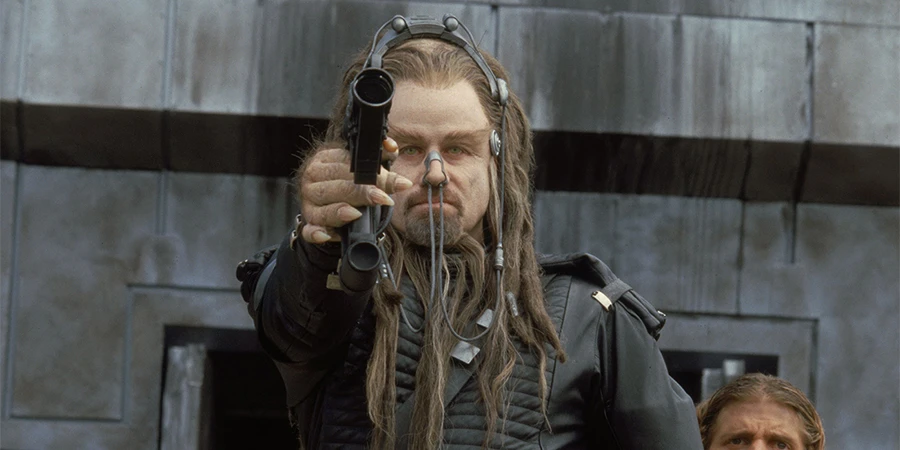

Watching Battlefield Earth is like witnessing a car crash in extreme slow motion, shot entirely at a nauseating Dutch angle. John Travolta spent years pushing this passion project into existence, betting his post-Pulp Fiction goodwill on a sprawling L. Ron Hubbard adaptation about alien conquerors and surprisingly resourceful cavemen. He lost that bet spectacularly.
What landed in theaters in May 2000 became one of the most gleefully terrible films ever committed to celluloid, a cinematic disaster so complete and consistent that it practically demands your attention.
Detailed Summary
The World in 2000 AD (Actually 3000 AD)
Set a thousand years after an alien race called the Psychlos conquered Earth in nine minutes flat, the film opens on a primitive human society scraping by in the mountains. Humans live in small tribes, hiding from the Psychlos and treating the alien-occupied cities as cursed, forbidden places.
Our hero is Jonnie Goodboy Tyler, played by Barry Pepper, a curious young man who refuses to accept the tribe’s superstitious fear. He leaves his village to explore the wider world, immediately gets captured by Psychlo security forces, and gets shipped off to the Denver slave compound. That is the entire first act.
Enter Terl, the Worst Security Chief in History
John Travolta’s Terl is the chief of security for the Psychlos on Earth, a position he hates and desperately wants to escape. He has been stuck on Earth as punishment and schemes constantly to get back to his home planet. His plan, hatched with his sycophantic subordinate Ker (Barry Pepper co-star Kim Coates), involves using human slaves to illegally mine gold for him personally.
Terl picks Jonnie as his lead slave because Jonnie shows curiosity and adaptability. This is, objectively, the dumbest decision any villain has made in science fiction cinema. Terl essentially hands the means of human liberation to the one man clever enough to use it.
The Learning Machine and the Turning Point
To make Jonnie useful, Terl hooks him up to a Psychlo learning machine, a device that downloads centuries of knowledge directly into his brain. Jonnie absorbs language, history, mathematics, and Psychlo technology overnight. What was a frightened caveman becomes, functionally, a genius revolutionary.
Jonnie also learns, through this machine, that the Psychlos have been strip-mining Earth for a thousand years and that humans were always capable of far more. This knowledge ignites his determination to fight back. He starts quietly organizing his fellow slaves and exploring the ruins of human civilization around Denver.
Fort Knox, Fighter Jets, and a Plan
Jonnie discovers an intact Fort Knox filled with gold bars, which becomes central to his scheme. He also locates a functional military base with Harrier jets, which his people learn to fly using a flight simulator. Yes, you read that correctly: cavemen learn to pilot advanced military aircraft using a video game-style simulator in a matter of days.
This is where the film’s internal logic completely collapses, and honestly it is almost endearing. Jonnie feeds Terl fake gold-coated rocks to satisfy his greed while stockpiling the real gold for leverage. He trains his ragtag band of former slaves into a fighting force, all while Terl remains oblivious.
Psychlo Leverage and Political Maneuvering
Terl needs Jonnie’s gold operation to succeed so he can bribe his way back to Psychlo. He photographs his own boss Leverage in compromising situations and uses blackmail to keep his operation secret from the Psychlo hierarchy. Travolta chews every inch of scenery during these scenes, cackling and monologuing with the enthusiasm of a man who genuinely believes he is starring in a classic.
Jonnie, playing along, pretends to be a loyal slave while secretly preparing the rebellion. He recruits not just the Denver slaves but also scattered human groups across what was once North America. A coordinated global uprising begins to take shape.
The Rebellion Ignites
Jonnie and his crew use the Harrier jets and other salvaged weapons to launch a coordinated attack on the Psychlo operations. They destroy mining equipment, attack security outposts, and generally wreak havoc on an alien civilization that somehow never anticipated any of this. Pepper plays Jonnie with grim intensity, trying his hardest to sell material that is working against him at every turn.
A critical part of Jonnie’s plan involves a nuclear device. He arranges to have one sent through a teleportation device to the Psychlo home planet. The teleporter is the Psychlos’ primary method of interstellar travel and resource transport.



Movie Ending
Jonnie’s nuclear gambit works, and it works catastrophically for the Psychlos. The bomb arrives on the Psychlo home planet and detonates, setting off a chain reaction that destroys the entire planet. Every Psychlo on Earth simultaneously explodes because their breathable gas, which they carry in their helmets, is somehow volatile when exposed to radiation, even radiation originating light-years away. This is the film’s crowning scientific absurdity, delivered with complete sincerity.
Terl survives the initial carnage and attempts one final confrontation with Jonnie in the ruins of Denver. He gets buried under rubble during their fight. Rather than kill him, Jonnie leaves Terl trapped, promising that humans will continue as a free species while Terl rots. It is meant to be a triumphant moment, and Barry Pepper plays it straight while Travolta howls theatrically from under a pile of debris.
A separate group of humans, working with Jonnie’s contact Carlo, transmits proof of the Psychlo defeat across the globe. Human groups everywhere receive the signal and understand that the occupation is over. Jonnie returns to his home village to reunite with his love interest Chrissy, completing the personal arc the film spent surprisingly little time developing.
What makes the ending worth discussing is its absolute conviction. The film does not wink at the audience or acknowledge how ridiculous the planet-exploding finale is. Everyone plays it as a genuinely moving liberation story, which makes it simultaneously hilarious and oddly compelling. Travolta’s Terl screaming curses from under rubble is the film’s perfect final image of villainy: loud, overblown, and completely defanged.
Are There Post-Credits Scenes?
Battlefield Earth has no post-credits scene. Given the film’s catastrophic box office reception, there was no franchise to tease and no sequel appetite to cultivate. The credits roll and that is genuinely, mercifully, the end.
Type of Movie
Battlefield Earth is a science fiction action film with aspirations toward epic adventure and political allegory. Its tone swings wildly between self-serious blockbuster and accidental comedy, often within the same scene.
Modern audiences tend to classify it firmly in the so-bad-it’s-good category, a film to watch with friends and cold beverages rather than in reverent silence. It is not satire; it just plays that way by accident.
Cast
- John Travolta – Terl
- Barry Pepper – Jonnie Goodboy Tyler
- Forest Whitaker – Ker
- Kim Coates – Carlo
- Kelly Preston – Chirk
- Sabine Karsenti – Chrissy
- Richard Tyson – Robert the Fox
- Travolta’s performance note: he wears platform boots, dreadlocks, and eight-fingered gloves for the role, physically committing in a way the script does not deserve
Film Music and Composer
Elia Cmiral composed the score for Battlefield Earth. Cmiral, a Czech-born composer, had previously scored the action thriller film Ronin… actually, that was Elia Cmiral on other projects. His work here aims for grand, sweeping science fiction grandeur in the tradition of late-1990s blockbuster scoring.
The music constantly oversells what is happening on screen, pumping out heroic brass and dramatic strings during scenes that cannot support the emotional weight. This gap between score ambition and film quality is itself a minor source of entertainment. Cmiral does his job professionally; the film simply cannot keep up.


Filming Locations
Principal photography took place primarily in Montreal, Quebec, Canada. The production used Montreal’s industrial zones, warehouses, and exterior landscapes to stand in for a post-apocalyptic Earth.
Some exterior sequences were filmed in other parts of Canada, using rugged terrain to suggest an overgrown, reclaimed wilderness after a thousand years without human maintenance. The Canadian locations were chosen largely for financial reasons, as Canadian production incentives made shooting there significantly cheaper than comparable American locations.
Denver, a key location in the story, appears mostly as dressed sets and partial location work rather than actual footage of Colorado. Considering that Denver plays such a central role in the plot, the production’s reliance on substitutes gives the film a slightly airless quality, like a stage play with ambitious backdrops.
Awards and Nominations
Battlefield Earth had a spectacular awards season, just not in the way the filmmakers hoped. It swept the Razzie Awards in 2001, winning Worst Picture, Worst Director, Worst Actor for Travolta, Worst Supporting Actor for Whitaker, Worst Supporting Actress for Preston, Worst Screen Couple, Worst Screenplay, and Worst Screen Couple. It was later named the Worst Picture of the Decade by the Razzies in 2010.
No major positive awards recognized the film in any category.
Behind the Scenes Insights
- John Travolta had been trying to get this film made for nearly two decades before production finally began, having long been attached to the L. Ron Hubbard source material through his connection to Scientology.
- Director Roger Christian had previously won an Academy Award for Best Set Decoration for Star Wars (1977), making his work here one of cinema’s more dramatic career trajectories.
- Travolta originally wanted to play Jonnie Goodboy Tyler, the hero, but eventually chose Terl because he found the villain more interesting to perform.
- The film’s budget was reportedly in the range of $73 million, an extraordinary sum for a production that looked, in places, like it cost considerably less.
- Virtually every shot in the film uses a canted Dutch angle, a stylistic choice by Christian intended to suggest an alien perspective; audiences and critics found it migraine-inducing.
- Barry Pepper has spoken publicly about how physically grueling the shoot was, with long days in heavy prosthetics and makeup for the Psychlo actors creating difficult on-set conditions.
- Forest Whitaker, who won an Academy Award six years later for The Last King of Scotland, has since been notably silent about this particular credit on his resume.
- Franchise Pictures, one of the production companies involved, was later sued by investors who alleged the company had fraudulently inflated the film’s reported budget.
Inspirations and References
Battlefield Earth adapts the first half of L. Ron Hubbard’s 1982 novel of the same name. Hubbard wrote the book as a straightforward pulp science fiction adventure, drawing on classic genre tropes: alien conquerors, enslaved humanity, a chosen hero who rises through intellect rather than brute force.
The film’s visual design draws loosely from 1970s and 1980s science fiction aesthetics, particularly in the Psychlo costumes and the grimy, industrial look of their technology. References to classic alien invasion narratives are present throughout, though none of them are executed with enough precision to feel like genuine homage.
Hubbard’s novel also carries ideological underpinnings tied to his broader philosophical writings, though the film largely strips out the more explicitly didactic elements, keeping the story at the level of pulp adventure.
Alternate Endings and Deleted Scenes
No officially released alternate endings or significant deleted scenes packages exist for public consumption from Battlefield Earth. Given the film’s poor reception and rapid commercial collapse, no major home video release appears to have assembled a substantial extended or alternate cut.
There is no evidence of a director’s cut circulating with materially different content. What was released theatrically appears to be what Roger Christian and the producers considered the finished film.
Book Adaptations and Differences
L. Ron Hubbard’s Battlefield Earth: A Saga of the Year 3000, published in 1982, runs to over 1,000 pages and covers considerably more story than the film. The novel has a full second half dealing with Jonnie’s efforts to negotiate with other alien civilizations and dismantle the Psychlo threat at a galactic political level; none of that material appears in the film.
The book develops Jonnie’s relationship with Chrissy far more thoroughly and gives considerably more depth to the Psychlo society and its internal politics. The film collapses this into a much simpler hero-versus-villain structure, which robs the story of whatever complexity Hubbard had built into it.
Terl’s characterization in the novel is similarly megalomaniacal but slightly more grounded. Travolta’s film version cranks every trait to an extreme that the book does not necessarily support, making Terl feel like a pantomime villain rather than a scheming political animal.



Memorable Scenes and Quotes
Key Scenes
- The learning machine sequence: Jonnie strapped to a chair with electrodes attached to his head, eyes flickering, as decades of knowledge pour into him; the scene is earnest where it should be thrilling, but Pepper’s physical commitment makes it oddly watchable.
- The Harrier jet training montage: Former cavemen sit in front of primitive flight simulators, and within what appears to be days, they are ready to dogfight; the sequence plays completely straight and is all the funnier for it.
- Terl’s blackmail photography: Travolta prancing around with a camera, photographing his superior in a compromising situation, cackling at his own genius; he is having the time of his life and it radiates off the screen.
- The Psychlo home planet explosion: A nuclear chain reaction destroys an entire civilization, every Psychlo on Earth simultaneously detonates, and the film presents this genocide as a triumphant crowd-pleaser moment.
- Jonnie discovering Fort Knox: Intact gold bars, a thousand years after civilization fell, lit dramatically as if this is the discovery of a lifetime; the shot genuinely works better than it has any right to.
Iconic Quotes
- “While you were still learning how to spell your name, I was being trained to conquer galaxies!” (Terl to Jonnie, Travolta’s delivery at full volume)
- “Stupid, stupid, stupid!” (Terl, a recurring line that Travolta deploys with increasing theatrical anguish)
- “Your race won’t live to see another day!” (Terl, during the climax, proving that subtlety was never the goal)
Easter Eggs and Hidden Details
- The film is set in the year 3000 AD, exactly one thousand years after the Psychlo conquest, though the opening text says “Man is an endangered species” rather than specifying the date immediately; it feels like a detail borrowed from a dozen other post-apocalyptic narratives.
- Fort Knox appearing intact after a millennium is either a sly joke about the durability of American financial institutions or a complete oversight; the film offers no explanation and apparently expects no questions.
- Several Psychlo sound effects were reportedly recycled or reprocessed from other science fiction productions, though the specific sources are not definitively documented.
- The constant Dutch-angle cinematography is so pervasive that the very few shots filmed level feel almost jarring by contrast, as if the camera accidentally forgot its assignment.
- Terl’s elaborate dreadlock-and-platform-boot costume was designed to make Travolta appear towering over human characters; in some shots, the height differential becomes so extreme it edges into surrealism.
Trivia
- Battlefield Earth was produced in part by Franchise Pictures and Scientology-affiliated production entities, with Travolta’s passion for the Hubbard material being the primary engine behind the project reaching production.
- Travolta gave interviews for years calling this film his dream project and comparing his enthusiasm for it to what he felt making Pulp Fiction.
- Roger Christian directed the film between his work on other projects and reportedly clashed with producers over aspects of the production design and schedule.
- Barry Pepper, who delivered a celebrated performance as the sniper in Saving Private Ryan just two years before, has since described Battlefield Earth as a career detour he needed to move past.
- The film grossed approximately $29 million worldwide against its reported $73 million production budget, making it a significant financial failure before accounting for marketing costs.
- At the 2010 Razzie ceremony, Battlefield Earth was named the single worst film of the entire decade of the 2000s, beating out considerable competition.
- The Dutch angle cinematography was so extreme that some theater owners reportedly received complaints from audience members about headaches and disorientation during screenings.
- Forest Whitaker wore full Psychlo prosthetics and makeup for his role as Ker, spending several hours in the makeup chair each shooting day for a performance that, through no fault of his own, reads as almost entirely wasted.
Why Watch?
Travolta’s performance as Terl is a masterclass in committed wrongness: every cackle, every towering platform-boot stride, every line reading pitched three notches above what any scene requires. Watching him fully believe in this material is genuinely more entertaining than many intentional comedies. Battlefield Earth is required viewing for anyone who wants to understand how a single person’s unchecked passion can capsize a $73 million production with perfect, catastrophic consistency.
Director’s Other Movies
- Nostradamus (1994)
Recommended Films for Fans
- Plan 9 from Outer Space (1957)
- Flash Gordon (1980)
- Howard the Duck (1986)
- Masters of the Universe (1987)
- Starship Troopers (1997)
- Mortal Kombat: Annihilation (1997)
- Wing Commander (1999)