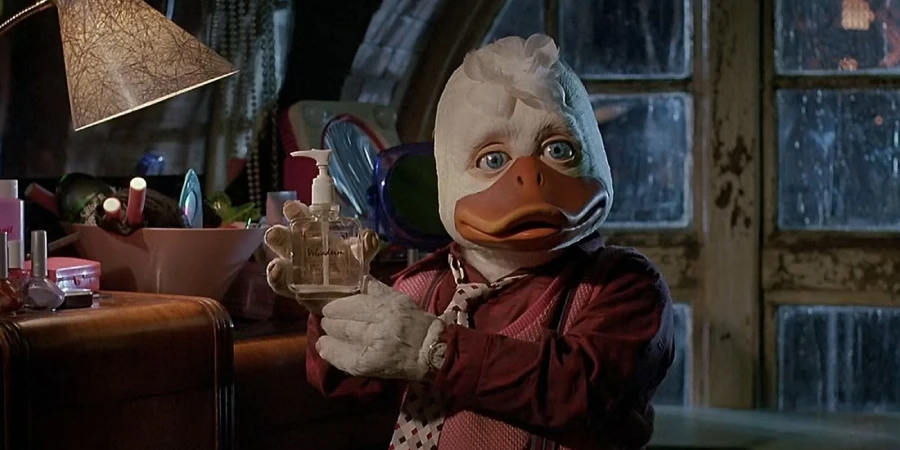

Marvel’s first major theatrical release was about a foul-mouthed, cigar-smoking duck from another dimension, and it bombed so spectacularly that it nearly killed George Lucas’s career. Howard the Duck (1986) is one of cinema’s great disasters and, depending on your tolerance for sheer weirdness, one of its secret pleasures.
Directed by Willard Huyck and produced by Lucasfilm, this adaptation of Steve Gerber’s cult Marvel comic throws a sardonic anthropomorphic duck into Cleveland, pairs him with a punk rocker named Beverly, and eventually pits him against a demon from the darkest reaches of space. It is deeply, consistently strange.
Detailed Summary
Howard Gets Pulled Off His Home Planet
We open on Duckworld, a planet where anthropomorphic ducks live ordinary human-style lives. Howard (performed by a rotating team of little-person actors inside a duck suit, with voice work by Chip Zien) is lounging in his apartment when a mysterious energy beam suddenly yanks him off his recliner and sucks him across the universe.
He crashes through a series of dimensions and lands in a back alley in Cleveland, Ohio. He is confused, he is small, and nobody is remotely pleased to see him.
Howard Meets Beverly
Howard wanders into trouble almost immediately, stumbling into a situation where two men are harassing a young woman in an alley. That woman is Beverly Switzler, played by Lea Thompson, a punk rock singer who performs in a band called Cherry Bomb.
Howard fends off the attackers with his signature “Quack-Fu,” and Beverly takes him in. She is sympathetic to his plight in a way nobody else in the film bothers to be, and their odd rapport is genuinely the emotional engine of the whole movie.
The Failed Return Attempt
Beverly introduces Howard to Phil Blumburtt, a bumbling lab assistant played by Tim Robbins, who connects them with Dr. Jenning, a scientist at a research laboratory. Jenning, played by Jeffrey Jones, operates a massive laser spectroscope that the characters believe might reverse Howard’s interdimensional transit and send him home.
Phil is mostly comic relief here, tripping over himself and providing warmth in an otherwise chaotic second act. Tim Robbins commits completely, which is either admirable or baffling given the material.
Dr. Jenning Gets Possessed
When the lab team attempts to use the laser to send Howard home, something goes catastrophically wrong. Instead of pulling Howard back through the dimensional conduit, the beam drags an entity from a far darker place into our world. That entity, a Dark Overlord of the Universe, possesses Dr. Jenning’s body.
Jeffrey Jones goes full scenery-chewer from this point forward. His performance shifts from frantic academic to genuinely menacing alien puppet, and he sells both registers with a manic physical energy that is honestly one of the film’s highlights.
Howard and Beverly on the Run
The possessed Jenning tries to use Howard as a bargaining chip and ultimately wants to complete the laser process to bring more Dark Overlords through the dimensional rift. Howard and Beverly flee, hit a diner, and share a weirdly sincere moment where Beverly essentially propositions Howard.
This scene caused enormous controversy on release because it implies a romantic and possibly sexual tension between a human woman and an anthropomorphic duck. Audiences in 1986 did not know what to do with it. Honestly, audiences in 2024 still do not.
The Diner Standoff
Government agents arrive and pursue Howard and Beverly. The possessed Jenning intercepts them, demonstrating increasingly alien powers: he shoots lightning from his fingertips, he levitates objects, and his eyes glow with a sickly light. Phil arrives in an ultralight aircraft to help the pair escape.
The chase through Cleveland is chaotic and mostly achieves its goal of sustained forward momentum, even if the action geography gets muddy. Howard at the controls of a vehicle is a recurring gag that never quite lands the way the filmmakers seem to think it does.
Return to the Laboratory
Jenning, now more Dark Overlord than human, forces the lab team to reactivate the laser. His plan is to open the dimensional gateway wide enough to allow his fellow Overlords to pour through and conquer Earth.
Howard and his friends race back to the laboratory to stop the process. Phil gets knocked around. Beverly screams. Everything catches fire. Standard third-act stuff, executed here with a surprisingly large practical effects budget.
Movie Ending
When the Dark Overlord’s plan fully kicks in, the laser spectroscope begins pulling something massive through the rift. Jenning’s body can no longer contain the entity, and the Overlord physically erupts out of him in a sequence involving some genuinely grotesque practical creature effects. What emerges is a massive, scorpion-like monster with a chitinous shell and claws that scrape the laboratory floor.
Howard grabs a neutron disintegrator, one of the lab’s experimental weapons, and blasts the creature point-blank. The Overlord dissolves in a burst of light. The dimensional gateway collapses before any additional Overlords can cross through. Earth is saved by a four-foot duck with a bad attitude.
Jenning, freed from possession but now thoroughly fried, reveals that activating the neutron disintegrator inside the lab has permanently destroyed the laser spectroscope. Howard cannot go home. That equipment was the only known method of interdimensional transit, and it is slag now.
Rather than collapsing into despair, Howard accepts his fate with a shrug that feels earned after ninety minutes of chaos. Beverly’s band, Cherry Bomb, needs a manager and a guitarist. Howard steps in. The film closes on a concert sequence where Howard jams on stage with the band, grinning under stage lights while the crowd goes wild.
It is a bittersweet ending dressed in neon. Howard will never see Duckworld again, but he has carved out a life, a community, and a reason to stay. The film asks you to find that sweet, and with some goodwill, you actually can.
Are There Post-Credits Scenes?
Howard the Duck does not feature a post-credits scene. You can leave when the credits roll. Nothing waits for you at the end, which feels philosophically appropriate for a film about a stranded creature with nowhere to be.
Type of Movie
Howard the Duck occupies a strange genre overlap: part sci-fi comedy, part action-adventure, and part very uncomfortable romantic fantasy. Its tone swings wildly between goofy slapstick and actual body-horror in the third act.
It was aimed at family audiences but earned a PG rating while containing content that confused and disturbed many of those families. Call it an alien fish-out-of-water comedy with delusions of being a superhero blockbuster.
Cast
- Lea Thompson – Beverly Switzler
- Jeffrey Jones – Dr. Walter Jenning / Dark Overlord of the Universe
- Tim Robbins – Phil Blumburtt
- Ed Gale – Howard the Duck (suit performer, lead)
- Chip Zien – Howard the Duck (voice)
- Paul Guilfoyle – Lieutenant Welker
- Leland Crooke – Dark Overlord (creature performance)
Film Music and Composer
John Barry composed the score, which is one of the most underappreciated elements of this production. Barry brings a genuine orchestral weight to material that probably did not deserve it, giving certain scenes a sweep that the screenplay itself fails to earn.
The film also features original rock songs performed by the fictional band Cherry Bomb. Thomas Dolby wrote and produced those tracks, giving them a polished, mid-eighties synth-rock sheen. The title track, “Howard the Duck,” is aggressively catchy in the way only 1986 pop could be.
Filming Locations
Principal photography took place primarily in California, with industrial and urban locations standing in for Cleveland, Ohio. Sets for the laboratory interiors and Duckworld were built at Industrial Light and Magic facilities, which handled the extensive practical and visual effects work.
Cleveland itself only appears in establishing shots and limited location work. Using California infrastructure made logistical sense given the scale of the production, but it gives the film a slightly anonymous urban texture when it steps outside.
Awards and Nominations
Howard the Duck won two Razzie Awards in 1987, including Worst Picture. It received additional Razzie nominations across several categories. No other major awards bodies gave it serious attention.
Behind the Scenes Insights
- George Lucas originally intended to sell the Howard the Duck rights to fund Pixar, but the deal fell through and Lucasfilm produced the film directly.
- The duck suit required multiple performers: Ed Gale and other little-person actors handled movement, while animatronic facial rigs controlled Howard’s expressions.
- Director Willard Huyck and his writing partner Gloria Katz had previously collaborated with Lucas on American Graffiti, which is how they landed the project.
- Lea Thompson has said in interviews that she wore an animatronic Howard puppet on set for eyeline purposes, which made filming her scenes surreal in a way the final film does not fully convey.
- The creature effects for the Dark Overlord’s physical form required months of practical construction and represented some of ILM’s most complex creature work at that time.
- The film’s budget was significant for its era, and its box office failure caused a major reassessment of how Lucasfilm would approach non-Star Wars projects going forward.
Inspirations and References
Howard the Duck adapts the Marvel Comics character created by writer Steve Gerber and artist Val Mayerik, who first appeared in 1973. Gerber’s comic was deliberately satirical, using Howard as a cynical outsider to skewer American culture, consumerism, and political absurdity.
The film strips away most of that satirical bite. What Gerber used as a scalpel, the screenplay uses as a rubber chicken. Fans of the source material noticed, and most of them were not thrilled.
Alternate Endings and Deleted Scenes
No officially confirmed alternate ending has been released in any home video version of the film. Some production documents suggest that earlier screenplay drafts featured a more successful return to Duckworld, but the decision to leave Howard stranded in Cleveland appears to have been locked in relatively early.
Deleted scenes have not been released in any widely available home video release. Given the film’s troubled legacy, a comprehensive restoration or special edition has never materialized.
Book Adaptations and Differences
Howard the Duck is not based on a novel. It adapts the Marvel Comics series created by Steve Gerber, which ran from the mid-1970s into the 1980s.
A movie novelization was published to coincide with the film’s release, adapting the screenplay rather than the comics. The comics themselves feature a far darker, more politically pointed Howard whose sardonic worldview drove entire storylines about existential alienation. Very little of that survived the journey to screen.

Memorable Scenes and Quotes
Key Scenes
- The Duckworld opening: a fully realized alien society built entirely for anthropomorphic ducks, complete with duck-themed magazine parodies and furniture scaled for webbed feet. It is absurd and oddly committed.
- The alley Quack-Fu fight: Howard dispatches multiple attackers using a martial arts style built around his short stature and unexpected ferocity. It earns a genuine laugh.
- Beverly’s hotel room scene: Howard and Beverly share a bed, Beverly tries to seduce him, and the camera lingers just long enough on Howard’s flustered face to make everyone in the theater deeply uncomfortable. It is the most talked-about scene in the film.
- Jenning’s possession transformation: Jeffrey Jones’s body language shifts mid-sentence, his voice drops, and a slow camera push into his glowing eyes sells the moment better than the script deserves.
- The Dark Overlord creature reveal: a practical monster erupts from a human body in a sequence that tonally belongs in a different, much darker film. It is genuinely alarming for about forty-five seconds.
- The final concert: Howard shreds on guitar under stage lighting while Cleveland cheers. It is ridiculous and oddly moving.
Iconic Quotes
- “No one laughs at Howard the Duck.”
- “What kind of a world is this, where a duck can get no peace?”
- “It’s not easy being a duck.”
- “I may be down, but I’m not out.”
Easter Eggs and Hidden Details
- The Duckworld apartment in the opening scene contains magazines and posters that are duck-themed parodies of real publications, including what appears to be a Playduck centerfold visible for a few frames.
- A poster for Breeders of the Lost Stork appears on a wall, one of several duck-themed puns referencing George Lucas’s own Raiders of the Lost Ark.
- Howard’s wallet contains a Duckworld driver’s license with his address listed.
- Cherry Bomb’s name is a nod to the 1976 Runaways song of the same name, nodding to the real-world punk era Beverly is meant to represent.
- Several background extras in the Cleveland scenes wear clothing that nods to 1980s Marvel Comics aesthetics, though these are subtle enough to miss on a first watch.
Trivia
- Howard the Duck was the first Marvel Comics character to headline a theatrically released feature film.
- The film’s failure was so significant that George Lucas reportedly sold his Lucasfilm computer graphics division, which later became Pixar, partly to cover losses from this and other underperforming projects.
- Chip Zien, who voiced Howard, is primarily known as a Broadway performer and originated the role of The Baker in Into the Woods.
- Steve Gerber, who created Howard, was famously unhappy with the film adaptation and had a complicated legal history with Marvel over ownership of the character.
- Despite its failure in 1986, the film developed a devoted cult following on home video through the late 1980s and 1990s.
- Howard the Duck appears as a background character in Guardians of the Galaxy (2014), voiced by Seth Green, marking his return to the Marvel Cinematic Universe.
- The duck suit weighed enough that performers could only wear it for short stretches before needing breaks.
- Tim Robbins filmed Howard the Duck the same year he appeared in Top Gun, which suggests 1986 was a complicated year for his agent.
Why Watch?
Watch it for Jeffrey Jones, who commits so completely to playing a cosmic entity wearing a middle-aged scientist like a bad suit that he single-handedly rescues the third act. Lea Thompson brings genuine warmth to a role that could have been pure embarrassment. This film is a fascinating wreck, and fascinating wrecks teach you more about what Hollywood was willing to gamble in the 1980s than any polished success story can.
Director’s Other Movies
- American Graffiti (1973) (co-written by Huyck and Katz, directed by George Lucas)
- Best Defense (1984)
Recommended Films for Fans
- Guardians of the Galaxy (2014)
- Big Trouble in Little China (1986)
- Buckaroo Banzai Across the 8th Dimension (1984)
- Teenage Mutant Ninja Turtles (1990)
- Flash Gordon (1980)
- RoboCop (1987)