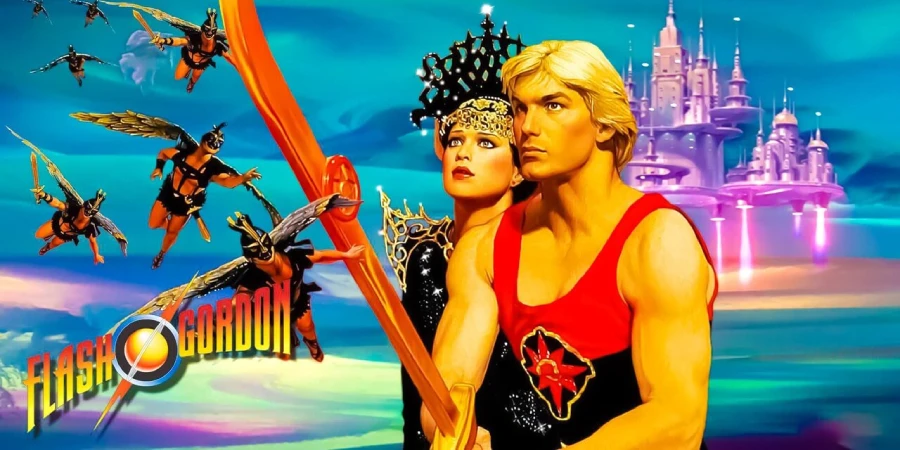

Flash Gordon is gloriously, unashamedly ridiculous, and that is precisely why it endures. Released in 1980, this Sam Raimi production brought the classic comic strip hero to life with neon costumes, operatic villains, and a soundtrack by Queen that turns every scene into a rock concert. It is campy, loud, and utterly committed to its own absurdity.
Detailed Summary
Earth Under Attack
Ming the Merciless, emperor of the planet Mongo, decides on a whim to destroy Earth. He triggers natural disasters across the globe: earthquakes, freak weather, and the moon drifting out of orbit. Nobody on Earth knows what is happening or why.
Flash and Dale Are Swept Into the Adventure
Flash Gordon, a professional football player for the New York Jets, boards a small plane during the chaos. He meets Dale Arden, a travel journalist, and the two are thrown together when the aircraft gets hijacked by the eccentric scientist Dr. Hans Zarkov.
Zarkov has built a rocket ship in his greenhouse and believes he can reach the source of the attacks. He forces Flash and Dale aboard, and the three of them blast off toward Mongo. Their arrival is bumpy, dangerous, and completely unplanned.
Arriving on Mongo
Ming’s court is a spectacle of excess. Alien delegates from Mongo’s various kingdoms fill the throne room, each more outlandish than the last. Ming immediately fixates on Dale, intending to make her his consort.
Flash, being Flash, punches a guard almost immediately. His defiance impresses Ming’s daughter Princess Aura, who develops an instant attraction to him. Meanwhile, Zarkov is taken away to have his mind erased by Ming’s scientists.
Flash Faces Execution
Ming sentences Flash to death. However, Aura intervenes behind the scenes and secretly arranges for Flash to survive the execution. Flash wakes up very much alive, confused, and in Aura’s hands.
Aura smuggles Flash to the arboreal kingdom of Arboria, ruled by Prince Barin. Barin resents Flash on arrival, partly out of jealousy over Aura’s obvious interest in the newcomer. The two men begin a tense and hostile relationship.
The Hawkmen and Prince Vultan
Flash eventually encounters the Hawkmen, a winged warrior race who live in a sky city called War World. Their boisterous leader, Prince Vultan, captures Flash and Barin and forces them to fight in gladiatorial combat. Vultan is loud, magnetic, and one of the film’s greatest pleasures.
Flash and Barin fight on a spinning platform over a deadly drop, armed with spiked clubs. Flash wins but refuses to kill Barin. That act of mercy begins to shift Barin’s attitude toward him.
Ming Tightens His Grip
Meanwhile, Ming moves forward with his plan to marry Dale. He also continues the systematic destruction of Earth, treating it as casual entertainment. Dale resists him, but her options are limited and her situation grows more desperate.
Zarkov, for his part, survives the mind-wiping procedure with his memories mostly intact. He uses his scientific knowledge to ingratiate himself with Ming’s court while quietly working against the emperor. His storyline provides some of the film’s sharpest, driest humor.
Flash Rallies the Kingdoms
Flash escapes Vultan’s city and begins building an alliance against Ming. He persuades Barin to join him, and together they start recruiting. Flash’s charisma and sheer stubbornness make him a credible rallying point for Mongo’s fragmented resistance.
Vultan initially refuses to commit his Hawkmen to the fight. However, Ming destroys War World in retaliation for harboring Flash, which pushes Vultan firmly into the rebellion. Losing his home transforms the jovial king into a furious, motivated warrior.


Movie Ending
With Earth hours from total destruction, Flash leads a desperate assault on Ming’s palace using a stolen rocket ship. Vultan and his Hawkmen provide air cover in a spectacular battle sequence set to Queen’s pounding score. Everything converges at once: the wedding, the war, and the countdown to Earth’s obliteration.
Flash pilots the rocket ship directly into Ming’s palace at full speed. Consequently, the impact is catastrophic for Ming’s defenses and creates the chaos the rebels need to press their advantage. Barin and the ground forces fight their way through the palace while Zarkov works to disable Ming’s weapon.
Flash confronts Ming directly. Ming attempts to use his ring, a device of immense power, to destroy Flash. Flash drives Ming’s own ring into him, and Ming dissolves in a burst of energy, seemingly destroyed. His death breaks his hold over the planet and saves Earth at the last possible second.
Dale is rescued before the forced marriage is completed. Barin, now recognized as a legitimate ruler, takes control of Mongo alongside Aura. Zarkov survives, delighted with himself, and the Earth is saved without anyone on the surface knowing how close they came to annihilation.
In the final moments, a close-up reveals Ming’s ring lying on the ground, still glowing faintly. A hand reaches down and picks it up. This final shot strongly implies that Ming may not be entirely gone, leaving the door open for a sequel that never materialized. It is a perfectly calibrated final sting, turning a triumphant ending into something slightly unsettling.
Are There Post-Credits Scenes?
Flash Gordon predates the modern post-credits scene tradition by decades. There is no scene after the credits roll. However, that final shot of Ming’s ring before the credits is essentially doing the same work: teasing a continuation and refusing to fully close the story.
Type of Movie
Flash Gordon sits firmly in the science fiction adventure genre, with heavy doses of fantasy and camp. Its tone is theatrical, self-aware, and deliberately over-the-top. In contrast to the grimy, serious science fiction that dominated the late 1970s, this film leans hard into color, spectacle, and pure fun.
It owes as much to old Hollywood serials and operatic melodrama as it does to contemporary blockbuster filmmaking. Think less hard science fiction, more comic book come to life.
Cast
- Sam J. Jones – Flash Gordon
- Melody Anderson – Dale Arden
- Max von Sydow – Ming the Merciless
- Topol – Dr. Hans Zarkov
- Ornella Muti – Princess Aura
- Timothy Dalton – Prince Barin
- Brian Blessed – Prince Vultan
- Peter Wyngarde – Klytus
- Mariangela Melato – General Kala
- John Osborne – The Arborian High Priest
Film Music and Composer
Queen composed and performed the soundtrack, and it is genuinely one of the most distinctive scores in science fiction cinema. Freddie Mercury, Brian May, Roger Taylor, and John Deacon brought their arena-rock sensibility to every cue. The result feels less like background music and more like a second film running parallel to the first.
The main theme, simply titled Flash, opens with a thunderous guitar riff and Mercury shouting the hero’s name. It is impossible to forget and nearly impossible not to sing along with. Moreover, the score adapts seamlessly across the film’s wildly varying moods, from bombastic battle sequences to quieter, more sinister palace scenes.
Howard Blake composed additional orchestral passages that complement Queen’s rock score. The combination of classical orchestration and hard rock was unusual at the time and remains distinctive today.
Filming Locations
Principal photography took place at Shepperton Studios in Surrey, England. Almost everything on Mongo was built on studio sets, which gave the film its deliberately artificial, theatrical look. In addition, the production design by Danilo Donati leaned into that artificiality, creating something that feels closer to a Renaissance painting than a realistic alien world.
Some exterior and location work also took place in England. The studio-bound approach was a deliberate aesthetic choice, echoing the look of the original Alex Raymond comic strips and the 1930s serials.
Awards and Nominations
Flash Gordon received a BAFTA nomination for Best Costume Design, recognizing Danilo Donati’s extraordinary work dressing Ming’s court. It did not win major awards, but its visual and musical contributions have earned significant retrospective appreciation over the decades.
Behind the Scenes Insights
- Sam J. Jones had a famously troubled production experience. He departed before all of his dialogue was recorded, and much of his voice work was dubbed by another actor in post-production.
- Brian Blessed ad-libbed a significant amount of his dialogue as Vultan, including the iconic “Gordon’s alive!” line. Director Mike Hodges kept most of it.
- Producer Dino De Laurentiis originally wanted a completely different, more serious tone for the film. Hodges pushed the material toward camp and spectacle.
- Max von Sydow reportedly enjoyed playing Ming enormously, describing the role as liberating precisely because of its absurdity.
- Queen initially had reservations about writing a rock score for a science fiction film. After watching rough footage, the band became enthusiastic and wrote the main theme almost immediately.
- Costume designer Danilo Donati had previously worked with Federico Fellini, and that influence is visible in the film’s ornate, maximalist visual design.
- Timothy Dalton took the role of Barin seriously despite the campy surroundings, bringing a genuine intensity that grounds his scenes.
Inspirations and References
Flash Gordon draws directly from the Alex Raymond comic strip of the same name, which debuted in 1934. Raymond created Flash as a direct competitor to Buck Rogers, and his strip became famous for its lush, detailed artwork and pulpy adventure plotting. The film captures that visual richness faithfully.
The 1930s Universal Pictures serials starring Buster Crabbe also informed the film’s structure and tone. Those serials were beloved but cheesy, and the 1980 film honors that legacy rather than trying to transcend it. Furthermore, the decision to embrace camp rather than apologize for it connects the film directly to its serial roots.
Alternate Endings and Deleted Scenes
No officially released alternate ending exists for Flash Gordon. The film’s troubled post-production, largely caused by the issues surrounding Sam J. Jones, reportedly led to significant editing decisions. However, no deleted scenes or alternate cuts have been widely released or documented in detail.
Some accounts suggest that additional scenes featuring Jones were cut or reworked due to the dubbing complications. Specific details about what those scenes contained remain unclear, so the full extent of the cuts is difficult to confirm.
Book Adaptations and Differences
Flash Gordon is not based on a novel. Its source material is the Alex Raymond comic strip, first published in 1934. The film draws characters, settings, and broad story beats from that strip rather than any prose adaptation.
A novelization of the 1980 film was published to coincide with its release, reversing the usual adaptation direction. The film itself takes considerable liberties with Raymond’s original stories, compressing multiple storylines and introducing its own specific plot mechanics.
Memorable Scenes and Quotes
Key Scenes
- Flash punching Ming’s guard in the throne room on arrival, setting the tone for the entire film in a single impulsive act.
- The spinning platform fight between Flash and Barin, a tense gladiatorial sequence elevated by Queen’s score and Brian Blessed’s enormous presence ringside.
- Vultan’s Hawkmen launching their aerial assault on Ming’s palace while Flash blasts on the soundtrack, one of the most purely exhilarating sequences in 1980s cinema.
- Flash piloting the rocket ship directly into Ming’s wedding ceremony, crashing through the palace and triggering the final confrontation.
- Ming’s apparent death, with Flash driving the ring into the emperor and watching him dissolve, followed immediately by that ominous final shot of the glowing ring.
Iconic Quotes
- “Flash! Ah-ahhhh, savior of the universe!” (Queen, from the main theme, repeated throughout the film)
- “Gordon’s alive!” (Prince Vultan, delivered by Brian Blessed with maximum volume)
- “Ming the Merciless, ruler of the universe.” (Ming’s self-introduction, delivered by Max von Sydow with complete sincerity)
- “I like to play with things a while before annihilation.” (Ming, explaining his leisurely approach to destroying Earth)
- “Football is wrong. And this is right.” (Flash, embracing his new role as interplanetary hero)
Easter Eggs and Hidden Details
- The visual design of Ming’s throne room directly references Alex Raymond’s original comic strip panels, particularly in the arrangement of alien delegates and the architecture of the set.
- Several costume pieces in Ming’s court contain deliberate echoes of Fellini’s films, a nod to Danilo Donati’s prior work with that director.
- Queen’s score includes musical motifs that subtly shift in instrumentation to signal which kingdom Flash is currently in, giving each faction its own sonic identity.
- The football Flash plays with in one early scene is a genuine New York Jets prop, grounding his character in a recognizable real-world detail before everything goes surreal.
- Klytus’s mask and costume were specifically designed to evoke a sinister, insect-like quality, reinforcing his role as Ming’s most loyal enforcer.
Trivia
- Queen’s soundtrack album for the film became a significant commercial success in its own right, independent of the film’s box office performance.
- Brian Blessed performed many of his own physical scenes as Vultan, bringing genuine athletic energy to the role despite the elaborate costume.
- The film was a moderate box office performer on initial release but gained a devoted cult following through television broadcasts and home video throughout the 1980s.
- Director Mike Hodges was better known for gritty crime films, most notably Get Carter (1971), making his assignment to a flamboyant space opera an unusual career move.
- Sam J. Jones had relatively little acting experience before landing the lead role. His casting was partly based on his physical presence and look.
- The film’s production design budget was considerable, and Danilo Donati’s sets and costumes remain visually impressive even by contemporary standards.
- Multiple attempts to produce a remake or sequel have been announced over the years, but none has reached production as of this writing.
Why Watch?
Few films commit so completely to their own joyful excess. Flash Gordon delivers Queen at peak power, Max von Sydow at his most magnificently villainous, and Brian Blessed at a volume that should probably be illegal. It is a film that knows exactly what it is and refuses to be anything less.
Director’s Other Movies
- Get Carter (1971)
- Pulp (1972)
- The Terminal Man (1974)
- Croupier (1998)
- I’ll Sleep When I’m Dead (2003)
Recommended Films for Fans
- Barbarella (1968)
- Buck Rogers in the 25th Century (1979)
- Masters of the Universe (2026)
- Labyrinth (1986)
- Big Trouble in Little China (1986)
- Guardians of the Galaxy (2014)
- The Fifth Element (1997)
- Masters of the Universe (1987)
- Battlefield Earth (2000)
- Krull (1983)