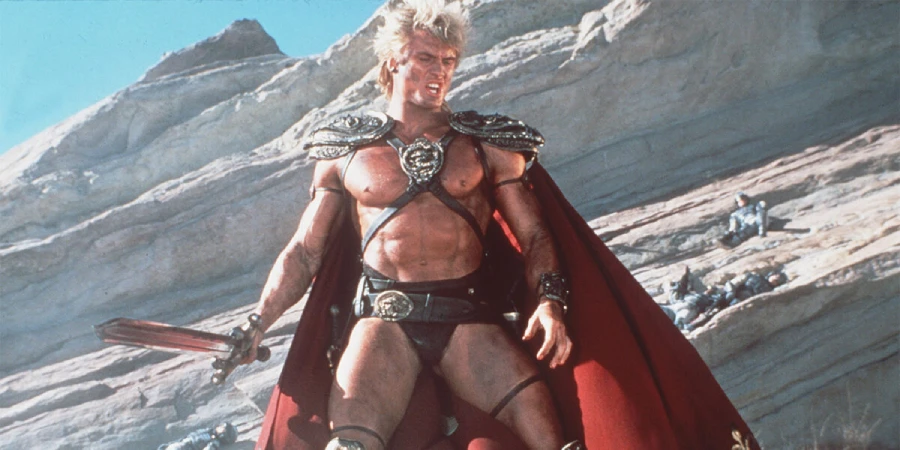

Gary Goddard’s Masters of the Universe opens with a planet already lost. Eternia has fallen, Skeletor sits on the throne of Castle Grayskull, and He-Man arrives not as a triumphant hero but as a desperate survivor fighting a rearguard action. That premise, bleak for a toy-commercial movie aimed at children, gives the film a surprisingly grim backbone that its neon-lit, low-budget execution only partially squanders.
Detailed Summary
Eternia Has Already Fallen
When the film begins, Skeletor has won. He controls Castle Grayskull and has imprisoned the Sorceress, draining her power to claim mastery over the universe. He-Man, played by Dolph Lundgren, leads a small resistance alongside Man-At-Arms and Teela.
A diminutive inventor named Gwildor has created a device called the Cosmic Key, which opens portals between dimensions. Skeletor’s forces already destroyed the original Key; Gwildor kept a prototype.
The Escape to Earth
Skeletor’s forces, led by the imposing Evil-Lyn, chase He-Man’s group. During a firefight, Gwildor activates the Cosmic Key and accidentally teleports the entire group to present-day Earth, specifically a small American town.
They land in a field and immediately lose the Key. A teenage girl named Julie Winston and her boyfriend Kevin find it, mistaking it for a synthesizer because it produces musical tones.
Julie’s Grief and the Cosmic Key
Julie is already emotionally raw. Her parents died in a plane crash, and she plans to leave town with Kevin. She carries enormous guilt about her last conversation with her mother.
Kevin, a musician, begins playing the Key’s tones, inadvertently broadcasting a homing signal across dimensions. Skeletor’s bounty hunters track that signal directly to Earth.
Skeletor’s Mercenaries Arrive
Skeletor dispatches a squad of mercenary hunters, including the blade-wielding Blade and the hulking Beastman, through a portal to Earth. They pursue He-Man, Julie, and Kevin through the town.
A police detective named Lubic gets caught in the middle, convinced he is dealing with a gang or a film crew. His skeptical, grumbling presence provides most of the film’s intentional comedy.
The High School Showdown
He-Man fights Skeletor’s hunters across a high school courtyard in a scene that cheerfully destroys school property and several police cars. Dolph Lundgren swings his sword with genuine physicality, and the choreography, while rough, has real energy.
Kevin manages to record some of the Key’s tones before Skeletor’s forces capture it. That recording becomes the group’s only way back to Eternia.
Skeletor Claims Cosmic Power
Back on Eternia, Skeletor fully absorbs the power of Grayskull. His costume shifts from purple robes to gleaming gold armor, and Frank Langella leans into the transformation with a performance that no one in this film deserved but everyone benefits from. He becomes a god-level threat, and the film commits to that escalation.
He-Man Captured
Skeletor’s forces capture He-Man and bring him back to Eternia in chains. He faces torture and humiliation before Skeletor’s court, and Lundgren plays the vulnerability with more restraint than you might expect.
Julie and Kevin, aided by Gwildor and a reluctant Lubic, reconstruct the Key’s tones from Kevin’s keyboard recording and open their own portal back to Eternia.
The Final Battle at Castle Grayskull
Julie’s group arrives at Grayskull just in time. Man-At-Arms and Teela fight their way through Skeletor’s guards while Kevin and Gwildor work to free He-Man and disrupt Skeletor’s power conduit.
He-Man breaks free, retrieves his sword, and challenges Skeletor directly. Their duel plays out on the bridge and ramparts of Grayskull with real visual scale, especially given the film’s limited budget.
Movie Ending
Skeletor, now radiating gold-tinged cosmic power, physically dominates He-Man in their confrontation. He drives He-Man to the edge of a pit and delivers one of Frank Langella’s best lines, relishing every syllable as He-Man dangles. Then He-Man, through sheer will, pulls himself back up and turns the fight around.
He drives Skeletor into the pit below Grayskull, and Skeletor plunges into darkness. The Sorceress is freed. Power returns to Grayskull. He-Man reclaims the title of the most powerful man in the universe, and Eternia is liberated.
Julie, however, lost her parents before this adventure began, and no magic key changes that. Except the film does change it. The Sorceress, grateful and newly restored, offers He-Man one wish. He uses it to send Julie back in time so she can warn her parents, saving them from the crash. Her parents survive. Julie wakes up in her old bedroom as if nothing happened.
That wish fulfillment ending is the most divisive choice in the film. On one hand, it retroactively deflates Julie’s entire emotional arc. On the other hand, it earns a genuine emotional reaction because the film spent real time establishing her grief. Whether you find it cheap or satisfying depends entirely on how much you invested in Julie’s story, which is more than most people expected to invest in a He-Man movie.
Kevin stays on Earth, though the nature of his memories is left vague. Lubic, having seen genuine alien technology and interdimensional warfare, chooses to stay on Eternia and open a restaurant. It is a deeply absurd decision presented with complete sincerity, and somehow it works.
Are There Post-Credits Scenes?
Yes, and it matters. After the credits, the film cuts back to a rocky shore on Eternia where a skeletal hand rises from the water. Skeletor, very much alive, snarls directly at the camera: “I’ll be back.”
A sequel was planned and never made. The line and the scene exist purely to set up that sequel, which means audiences got a teaser for a film that would not arrive for decades. A follow-up has been in development in various forms ever since, but the 1987 movie remains the only theatrical entry in the live-action series.
Type of Movie
Masters of the Universe is a science fantasy action film with strong elements of 1980s blockbuster adventure. Its tone sits somewhere between earnest and campy, never quite committing to either direction. Think a lower-budget cousin of Flash Gordon crossed with a Saturday morning cartoon that wandered onto a Hollywood backlot.
Cast
- Dolph Lundgren – He-Man / Prince Adam
- Frank Langella – Skeletor
- Meg Foster – Evil-Lyn
- Billy Barty – Gwildor
- Courteney Cox – Julie Winston
- Robert Duncan McNeill – Kevin Corrigan
- James Tolkan – Detective Lubic
- Chelsea Field – Teela
- Jon Cypher – Man-At-Arms
Film Music and Composer
Bill Conti composed the score. Conti was already famous for Rocky and had a gift for brassy, percussive themes that announce heroism at full volume. His work here fits that mold, with a main theme that blends orchestral bombast and synthesizer textures typical of the era.
The score rarely surprises, but it does its job efficiently. Conti keeps the action sequences kinetically supported without the music overpowering the already loud production design. The most memorable cue underscores He-Man’s final stand against Skeletor, building to a full orchestral swell as he reclaims his power.


Filming Locations
Principal photography took place in and around Whittier, California. The production dressed Whittier’s suburban streets and buildings to represent a generic American small town, which works precisely because the film needs Earth to feel mundane against Eternia’s grandiosity.
Castle Grayskull interiors and Eternia’s exterior sets were built on soundstages. Budget constraints meant Eternia itself appears only briefly; most of the film is set on Earth, which frustrated fans of the cartoon but gave the production a fighting chance of staying coherent without a massive effects budget.
Awards and Nominations
Masters of the Universe did not receive any significant awards recognition. It was not a critical success on release, and awards bodies at the time had little appetite for toy-adapted fantasy films of this scale and genre.
Behind the Scenes Insights
- The production company Cannon Films ran into serious financial difficulties during filming, which directly reduced the budget and forced the story to be set primarily on Earth rather than Eternia.
- Dolph Lundgren trained extensively to maintain his physique for the role, but the physical demands of the costume, particularly the armor, caused genuine discomfort during long shooting days.
- Frank Langella has said in interviews that he took the role of Skeletor specifically because his son loved the cartoon, and he approached the character with complete seriousness rather than irony.
- Director Gary Goddard was a theme park designer and entertainment producer by background, not a veteran film director, and this was his only theatrical feature.
- The Cosmic Key’s musical interface was partly inspired by the idea that music is a universal language, a concept Goddard wanted built into the plot’s mechanics.
- Courteney Cox was a relative newcomer at the time of filming, and the role of Julie was one of her first major film appearances before Friends made her a household name.
- Several scenes were cut to reduce runtime and budget, including more extensive sequences set on Eternia that would have shown more of the world’s mythology.
Inspirations and References
The Masters of the Universe toy line, launched by Mattel in 1982, and the accompanying animated series He-Man and the Masters of the Universe served as the primary source material. Gary Goddard and his team worked to translate those properties into something that could hold together as a feature film rather than an extended episode.
The fish-out-of-water structure, with a warrior from another world stranded in suburban America, draws loosely from science fiction traditions going back decades. Some observers have pointed to Starman and similar 1980s sci-fi as tonal reference points for how the film handles its Earth-bound section.
Frank Langella’s theatrical, almost Shakespearean approach to Skeletor owes something to stage villain traditions rather than any specific film. Langella brought a gravitas to the role that the character had never received in animated form.
Alternate Endings and Deleted Scenes
Several scenes featuring more extensive Eternia world-building were cut, including sequences that would have better established the political situation on Skeletor’s occupied Eternia. These cuts are part of why the opening of the film feels compressed.
An alternate or extended version of the Earth sequences was discussed but not finalized. Some footage exists of scenes that were trimmed for pacing, though no widely released director’s cut has ever been produced. The existing home video versions are functionally the same cut that played in theaters.
Book Adaptations and Differences
This film was not based on a book. It was adapted directly from the Mattel toy line and the Filmation animated series. A novelization of the film was published to accompany the theatrical release, but the film itself is the source material for that book, not the other way around.
Memorable Scenes and Quotes
Key Scenes
- The opening Eternia sequence: He-Man and his rebels move through a devastated, fog-heavy Grayskull while laser fire cuts through the ruins. It establishes a post-defeat mood that the cartoon never attempted.
- The high school courtyard battle: Skeletor’s mercenaries descend on the school while police squad cars explode and He-Man fights in his full armor under suburban streetlights. Absurd on paper, genuinely fun on screen.
- Skeletor’s golden transformation: Frank Langella in gold-lit armor, arms spread, as Grayskull’s power flows through him. Langella’s eyes do more work in this moment than any special effect in the film.
- He-Man’s torture and defiance: Chained before Skeletor’s court, Lundgren holds a quiet, dignified stillness that the role did not require but the scene benefits from enormously.
- Julie’s wish and the reset: Julie wakes in her childhood bedroom and hears her mother’s voice from downstairs. No dialogue explains it. The film just cuts to her face and lets the audience process what happened.
Iconic Quotes
- “I have the power!” – He-Man, reclaiming his sword and his identity in the final battle.
- “Kneel before your master!” – Skeletor, at the height of his power over a defeated He-Man.
- “I’ll be back.” – Skeletor, post-credits, setting up a sequel that never came.
- “Come, Gwildor. Destiny calls us all.” – He-Man, with the kind of sincere portentousness only an 80s hero delivers without blinking.
Easter Eggs and Hidden Details
- The Cosmic Key’s tonal sequences were designed to resemble synthesizer music popular in 1987, grounding the alien device in something a contemporary teenage character would plausibly mistake for a musical instrument.
- Gwildor’s design incorporated elements from the toy line’s “Gwildor” figure but was substantially redesigned for the film because Cannon wanted a more sympathetic, less monstrous look.
- Skeletor’s golden armor in the final act is a direct visual reference to the toy line’s “Battle Armor” variants, a nod that toy-familiar audiences in 1987 would have recognized immediately.
- Detective Lubic’s diner in Eternia at the end of the film is a joke about American cultural imperialism, delivered so deadpan that it almost reads as unintentional commentary rather than a gag.
- The musical tones Kevin plays on his keyboard to reconstruct the Key’s homing signal are a loose riff on the five-note motif from Close Encounters of the Third Kind, a wink that may or may not be deliberate.
Trivia
- Cannon Films was so financially strained during production that the crew reportedly ran out of money before completing several planned Eternia sequences, forcing the script to be rewritten around Earth-set scenes that were cheaper to film.
- Dolph Lundgren had just come off Rocky IV when he was cast, making him arguably the most physically convincing live-action He-Man possible at that specific cultural moment.
- Frank Langella later described Skeletor as one of his favorite roles because it let him play pure theatrical menace without the constraints of realism.
- Gary Goddard had previously designed theme park attractions, and some reviewers noted that the Eternia sets felt more like theme park installations than lived-in environments, which is both a criticism and, depending on your tolerance, a compliment.
- A sequel was in active development at Cannon Films, with a script commissioned, but the studio’s financial collapse ended the project before production began.
- Courteney Cox was 23 years old during filming and had previously appeared in a Bruce Springsteen music video, which was her most prominent credit before this film.
- The film’s Rotten Tomatoes score has climbed over the decades as nostalgia and critical reappraisal have warmed to its particular brand of earnest excess.
Why Watch?
Frank Langella’s Skeletor is the single best argument for sitting through this film. He plays a skull-faced cartoon villain with the gravity of a Shakespearean tyrant, and every scene he occupies becomes worth watching on that basis alone. No other element of the production matches his commitment, and that gap is fascinating to observe.
Director’s Other Movies
- Masters of the Universe (1987) is Gary Goddard’s only theatrical directorial credit.
Recommended Films for Fans
- Masters of the Universe (2026)
- Flash Gordon (1980)
- Conan the Barbarian (1982)
- Krull (1983)
- The Beastmaster (1982)
- Willow (1988)
- Highlander (1986)