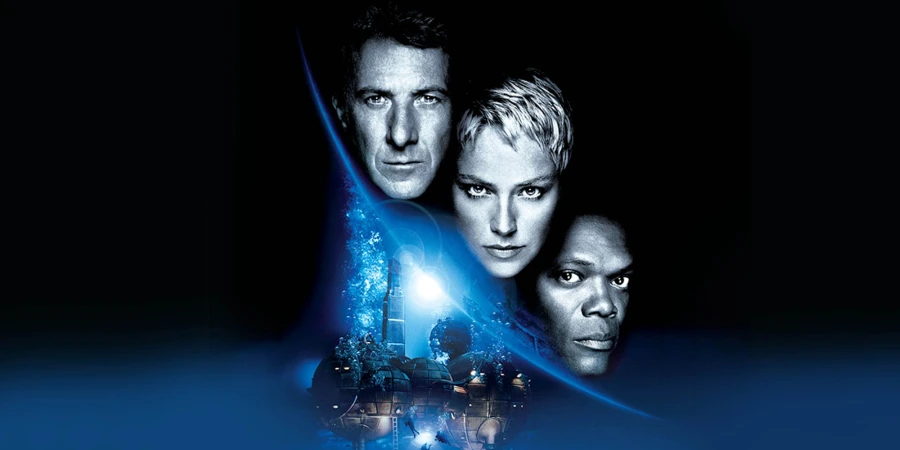

A golden sphere sitting on the bottom of the Pacific Ocean, untouched for three centuries, holds a secret that will shatter the minds of everyone who enters it. Sphere (1998) is a psychological science fiction film that takes a brilliant premise and wraps it in paranoia, self-destruction, and a genuinely unsettling twist. Directed by Barry Levinson and based on Michael Crichton’s novel, it remains one of the most underappreciated sci-fi thrillers of its era. Not many films dare to suggest that the greatest danger in the universe is the human subconscious.
Detailed Summary
The Discovery Beneath the Ocean
Psychologist Dr. Norman Goodman (Dustin Hoffman) receives a call from the U.S. Navy and travels to a remote location in the Pacific. He descends to an underwater habitat, where a team of scientists has gathered to investigate an enormous spacecraft resting on the ocean floor.
Norman quickly realizes the ship is not alien in origin. In fact, it appears to be American, and its construction suggests it came from the future, not from another world. This detail is quietly devastating: humanity apparently built this craft, launched it, and somehow it ended up three hundred years in the past.
Inside the Spacecraft
Norman and his colleagues, including mathematician Dr. Harry Adams (Samuel L. Jackson), astrophysicist Dr. Beth Halperin (Sharon Stone), and biochemist Dr. Ted Fielding (Liev Schreiber), explore the vessel. Inside, they find the cargo hold filled with cultural artifacts, essentially a time capsule of human achievement.
Most crucially, they find the sphere. It is perfectly golden, perfectly smooth, and roughly fifty feet in diameter. Norman’s team cannot determine its origin or purpose. It clearly did not originate on Earth, which means the ship picked it up somewhere during an interstellar journey.
Harry Enters the Sphere
Against all caution, Harry enters the sphere and emerges changed. He seems fine at first, but strange phenomena soon begin plaguing the habitat. A mysterious entity starts communicating through the habitat’s computer system, identifying itself as Jerry.
Jerry is erratic, childlike, and deeply threatening. Massive, deadly sea creatures begin attacking the habitat. A swarm of jellyfish, a giant squid, and other terrors arrive seemingly from nowhere. People start dying, and the survivors can find no rational explanation for the attacks.
The Paranoia Escalates
Suspicion spreads among the group. Ted dies during one of the creature attacks, leaving only Norman, Harry, and Beth. Meanwhile, Beth begins exhibiting her own erratic behavior. She seems to develop abilities of her own after also entering the sphere.
Norman becomes the de facto detective of the situation, trying to understand what the sphere actually does. He reviews his own earlier research and realizes something chilling: the sphere grants humans the power to manifest their imagination into reality. Whatever they fear, dream, or subconsciously desire becomes real.
The Truth About Jerry
Norman eventually pieces it all together. Jerry is not a separate alien intelligence. Jerry is Harry, specifically Harry’s subconscious mind running wild with the sphere’s power. Harry’s inner child, his fears, and his darkest impulses are generating the deadly phenomena.
Harry’s favorite childhood book, 20,000 Leagues Under the Sea, directly inspires the giant squid attack. His subconscious is literally pulling monsters from the stories and fears he internalized as a child. This is one of the film’s most elegant reveals: the alien threat is entirely human in origin.

Movie Ending
As the habitat deteriorates and more explosive devices arm themselves around the structure, Norman confronts the reality of their situation with full clarity. All three survivors, Norman, Harry, and Beth, have now entered the sphere and all three possess the power to manifest reality.
Beth, unstable and terrified, attempts to destroy the sphere using explosives. Norman and Harry stop her, and together the three make a pivotal choice. They collectively decide to forget. Using their shared power, they consciously choose to have no memory of the sphere, its powers, or anything they experienced below.
However, the implications of this ending run much deeper than a simple memory wipe. They surface, are rescued, and tell the Navy nothing useful. In contrast to the film’s opening optimism about contact with an unknown intelligence, the ending is a portrait of deliberate erasure. Norman, the psychologist who built a career on understanding the human mind, chooses to destroy the most profound psychological discovery in history.
Audiences frequently debate whether the forgetting actually works, and whether it should be read as cowardice or wisdom. On one hand, the trio could argue they are protecting humanity from a power no one is psychologically ready for. On the other hand, they are suppressing knowledge that could redefine civilization. Levinson refuses to give a clean answer, and that ambiguity is precisely the point.
Furthermore, a subtle final note lingers: we never fully know if the forgetting is complete or permanent. Norman stares at his hands in the closing moments, and the film cuts away before offering any reassurance.
Are There Post-Credits Scenes?
Sphere contains no post-credits scenes. Once the film ends, it ends completely. Given the story’s themes of erasure and forgetting, that silence feels almost intentional.
Type of Movie
Sphere occupies a specific and somewhat lonely corner of science fiction. It is a psychological sci-fi thriller with strong horror elements, far closer in spirit to Solaris than to Independence Day. Its tone is slow-burn, claustrophobic, and deeply pessimistic about human nature.
Notably, the film treats its science fiction premise as a psychological study first and a spectacle second. Viewers expecting action-heavy alien contact will find something far more unsettling and interior instead.
Cast
- Dustin Hoffman – Dr. Norman Goodman
- Sharon Stone – Dr. Beth Halperin
- Samuel L. Jackson – Dr. Harry Adams
- Liev Schreiber – Dr. Ted Fielding
- Peter Coyote – Harold C. Barnes
- Queen Latifah – Fletcher
- Marga Gomez – Jane Edmunds
Film Music and Composer
Elliot Goldenthal composed the score for Sphere. His approach favors dense, atonal orchestration that amplifies the film’s sense of dread and psychological unease. Goldenthal, known for his work on films like Interview with the Vampire and Batman Forever, brings a genuinely unsettling texture to the underwater sequences.
The score never tries to comfort the audience. In contrast to more conventional sci-fi music that suggests wonder, Goldenthal’s compositions push toward anxiety and wrongness, which suits the material perfectly.



Filming Locations
Production crews built massive underwater habitat sets on soundstages in Los Angeles. Practical tank work supplemented the soundstage interiors, giving actors a genuine sense of physical confinement that translates on screen.
The claustrophobic, enclosed look of the habitat was a deliberate creative choice. By keeping the characters trapped in cramped, dimly lit corridors, the production design reinforced the psychological pressure at the story’s core. There was no need to shoot on location deep at sea; the sealed, artificial environment served the narrative far better.
Awards and Nominations
Sphere did not receive significant awards recognition. Critics were largely unkind to the film upon release, and it underperformed at the box office, which kept it off major awards radar entirely.
Behind the Scenes Insights
- Barry Levinson and the cast reportedly found the shoot physically exhausting due to the confined, water-heavy sets and long production days.
- Dustin Hoffman, Samuel L. Jackson, and Sharon Stone all took pay cuts to make the film, given their combined asking prices would have exceeded the budget; their commitment reflects genuine belief in the material.
- The production faced significant technical challenges in filming the underwater and aquatic sequences, particularly for the giant squid attack scenes, which relied heavily on practical effects and early CGI.
- Levinson approached the film as a character study rather than a creature feature, a choice that created tension with Warner Bros., who expected a more commercially accessible product.
- Michael Crichton had been trying to get Sphere adapted for years before this production finally moved forward; the novel had previously attracted interest from other directors without resulting in a greenlit project.
Inspirations and References
Michael Crichton’s 1987 novel Sphere is the direct source material. Crichton drew on several intellectual traditions when writing the book, including Stanislaw Lem’s Solaris, which similarly explores the idea of an alien presence that manifests human psychology rather than presenting an independent intelligence.
Jules Verne’s 20,000 Leagues Under the Sea appears directly within the story, not merely as an inspiration but as a literal plot device. Harry’s childhood attachment to Verne’s novel shapes the specific monsters his subconscious generates. In addition, the film engages with longstanding philosophical questions about whether humanity is psychologically ready for contact with the unknown.
Alternate Endings and Deleted Scenes
No officially released alternate endings for Sphere exist in the public domain. Some scenes were trimmed during post-production to tighten the pacing, though specifics of deleted content have not been extensively documented in publicly available production materials.
Levinson’s tonal choices during editing reportedly leaned further into ambiguity than the studio preferred. Consequently, some character development scenes may have been shortened to accelerate the third act, though no confirmed deleted scene reel has been widely released.
Book Adaptations and Differences
Sphere is based directly on Michael Crichton’s 1987 novel of the same name. The film follows the novel’s core plot quite faithfully, preserving the central mystery, the key characters, and the crucial reveal about the sphere’s power.
However, the book develops Norman’s psychological and professional background in considerably more detail. Crichton spends more time on Norman’s history with Beth, adding romantic tension that the film handles more briefly. Furthermore, the novel’s ending includes a slightly more explicit examination of whether the forgetting was the right choice, giving readers a few extra pages of Norman’s internal debate that the film resolves more abruptly.


Memorable Scenes and Quotes
Key Scenes
- Harry stepping inside the sphere and emerging seemingly unharmed, with the team having no idea what just happened to him.
- The giant squid attack on the habitat, a terrifying sequence that reveals the sphere’s power to make imagination physical and lethal.
- Norman reviewing the computer logs and realizing that Jerry is a corruption of Harry, solving the film’s central mystery in a single quiet moment.
- Beth threatening to detonate explosives around the sphere while Norman and Harry struggle to reach her before she destroys everything.
- The three survivors joining hands and collectively willing themselves to forget, a scene that is simultaneously hopeful and deeply tragic.
Iconic Quotes
- “We are dwarfed by what we do not know.”
- “I think we should get out of here before something else happens.”
- Norman reflecting on the sphere’s power: “Whatever you think about, you have the power to make it happen. And that is very, very dangerous.”
Easter Eggs and Hidden Details
- Harry’s copy of 20,000 Leagues Under the Sea is visible early in the film, long before the giant squid appears; on a rewatch, it reads as a direct foreshadowing of the attack.
- The name Jerry as the entity’s identifier is never fully explained to the characters within the story, but its connection to Harry becomes obvious once the twist lands.
- Norman’s profession as a psychologist who wrote a government report on how to handle contact with alien intelligence is quietly ironic: he is the least psychologically prepared person in the group.
- Several of the habitat’s corridor designs echo the interior architecture of real deep-sea research stations, grounding the fantastical premise in visual authenticity.
- Beth’s increasingly erratic behavior in the second half mirrors classic psychological literature on dissociation under extreme stress, a subtle nod to the film’s psychological themes.
Trivia
- Sphere was produced with a budget of approximately 80 million dollars and earned roughly 37 million dollars at the worldwide box office, making it one of the more notable box office disappointments of 1998.
- Michael Crichton considered Sphere one of his weaker novels, reportedly expressing dissatisfaction with the book even after its commercial success.
- The film opened in February 1998, a notoriously difficult month for wide releases, which contributed to its underperformance.
- Samuel L. Jackson’s Harry Adams is one of the few characters in the film who seems genuinely excited rather than frightened by the sphere, a characterization choice Jackson brought to the role.
- Barry Levinson is primarily known as a director of dramas and comedies; Sphere remains one of his very few forays into science fiction and horror territory.
- Queen Latifah appears in a supporting role as Fletcher, one of the Navy personnel stationed at the habitat, in a relatively early film appearance for her acting career.
Why Watch?
Sphere rewards patient viewers with a genuinely intelligent premise and a cast operating at a high level. Its central idea, that humanity’s subconscious is the most dangerous force in the universe, still resonates decades later. For fans of slow-burn psychological science fiction, it sits alongside Solaris and Annihilation as essential viewing.
Director’s Other Movies
- Diner (1982)
- The Natural (1984)
- Good Morning, Vietnam (1987)
- Rain Man (1988)
- Bugsy (1991)
- Wag the Dog (1997)
- Bandits (2001)