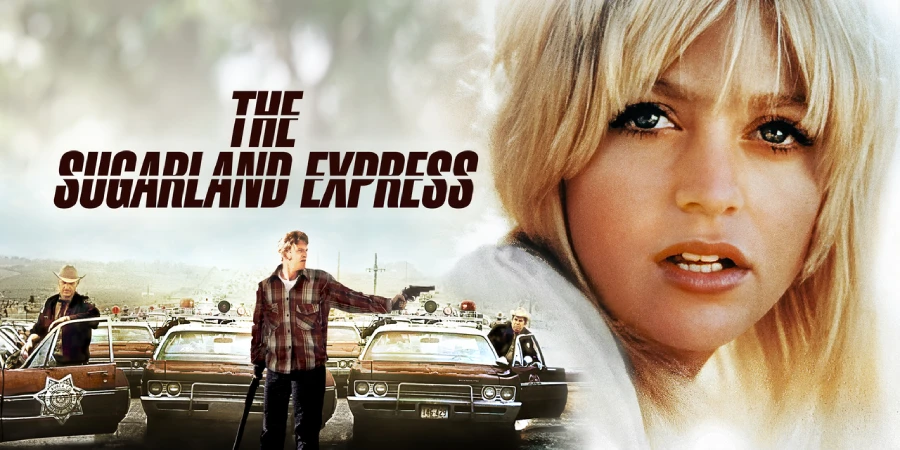

Steven Spielberg made his theatrical feature debut with a film about a desperate mother, a kidnapped highway patrolman, and a convoy of police cars stretching across the Texas flatlands, and somehow it plays like both a chase thriller and a gut-punch tragedy. The Sugarland Express arrived in 1974 before Jaws turned Spielberg into a household name, and it remains one of his most emotionally raw works. Based on a true story, it pulls off a rare trick: making you root for people whose plan is doomed from the first minute.
Detailed Summary
Lou Jean Breaks Clovis Out of Prison
Lou Jean Poplin has a problem. The state of Texas has placed her infant son, Baby Langston, with foster parents, and she refuses to accept it. Her husband, Clovis, sits in a minimum-security prison with only a few months left on his sentence, but Lou Jean cannot wait.
She visits Clovis, talks him into walking out with her, and the two immediately hit the road toward Sugarland, Texas, where their baby is living with the foster family. Clovis is not a hardened criminal; he is a weak, well-meaning man who loves his wife and follows her lead straight into disaster.
The Takeover of Patrolman Slide
Almost immediately after escaping, Lou Jean and Clovis encounter a young highway patrolman named Maxwell Slide. A brief confrontation escalates quickly, and Clovis takes Slide’s gun and forces him into the back of his own patrol car. Clovis then drives, with Slide as a hostage, continuing south toward Sugarland.
Slide is young and scared, but he is not hostile toward his captors. He observes them, talks with them, and gradually develops a strange, uneasy sympathy for their situation. This relationship becomes the emotional core of the film.
The Growing Convoy
Texas law enforcement mobilizes fast. Captain Harlin Tanner of the highway patrol takes charge of the pursuit and makes a crucial decision: he will not storm the vehicle and risk Slide’s life. Instead, a convoy of police cars simply follows the stolen patrol car across the state.
The convoy grows absurd in scale, stretching for miles. Spielberg shoots it with a kind of dark comedy, showing onlookers treating the procession like a parade. Crowds cheer, locals offer food and gifts to Clovis and Lou Jean at stops, and the couple briefly becomes a folk-hero spectacle.
Tanner’s Restrained Pursuit
Tanner is a fascinating figure in the film. He genuinely does not want anyone to die, and he controls his officers with quiet authority. However, he also communicates with a pair of bounty hunters who trail the convoy with less patience and far more dangerous intentions.
Tanner negotiates at a distance, speaks with Clovis and Lou Jean over the radio, and even facilitates small gestures of goodwill. He understands that the Poplins are not killers. Nonetheless, he knows the situation cannot end well, and that knowledge weighs on him throughout.
The Human Cost Along the Road
As the journey continues, small moments humanize the Poplins further. Clovis takes Lou Jean to a used-car lot so she can pick a car she likes. Slide bonds with them over meals and conversation, and Clovis even lets him call his girlfriend.
These quieter scenes are deliberately placed to deepen the tragedy ahead. Spielberg never lets the audience forget that Clovis and Lou Jean are parents acting out of love, even as their decisions grow more dangerous. The film refuses to flatten them into criminals or martyrs.
Slide’s Complicated Loyalty
Slide, for his part, begins to actively steer the Poplins toward surrender. He tells Clovis honestly that the plan will not work and that facing the law is better than the alternative. Clovis listens, but Lou Jean’s determination overrides every rational argument.
Lou Jean is the engine of this disaster. She is not villainous, but she is relentless in a way that borders on delusion. Her love for her child is real, yet her refusal to consider consequences drags everyone around her toward the edge.
Arrival at the Foster Home
After a long, winding journey across Texas, the convoy finally reaches Sugarland and the neighborhood where the foster family lives. By this point, the situation has attracted enormous media and public attention. Clovis and Lou Jean arrive at what should be the goal, but nothing unfolds the way they imagined.
The police have sealed off the area. Tanner positions his officers carefully. The bounty hunters, meanwhile, operate outside Tanner’s direct control, and their presence creates a volatile element that Tanner cannot fully manage.
Movie Ending
Clovis steps out of the car, and the bounty hunters shoot him dead. It happens quickly, without ceremony, and without catharsis. Lou Jean watches her husband die in the street outside the house where their baby is living, and the film refuses to soften the moment or cut away from its bleakness.
Tanner is furious. He did everything he could to prevent this outcome, and the rogue action by the bounty hunters destroyed everything he worked to control. His anger is quiet but devastating, and it lands harder than any outburst would.
Lou Jean surrenders. She does not reach her baby. Langston remains with the foster family, and Lou Jean faces criminal charges. Consequently, the couple’s entire desperate journey accomplished nothing except the death of Clovis and the destruction of whatever family they might have rebuilt.
A title card closes the film, informing audiences that Lou Jean was sentenced to prison and that Baby Langston remained with the foster family. Furthermore, it notes that Patrolman Slide recovered and later married. These cold facts hit hard precisely because the film spent its entire runtime making you care about these people.
What makes this ending so punishing is how inevitable it felt all along. Spielberg never offered false hope. He let the folk-hero energy build, let the crowds cheer, and then pulled the floor out. In contrast to the carnival atmosphere of the journey, the ending is quiet, almost clinical. That tonal whiplash is the point.
Are There Post-Credits Scenes?
The Sugarland Express contains no post-credits scene. The film ends with the title cards describing the real-life fates of those involved, and then it is over. There is nothing after the credits roll.
Type of Movie
The Sugarland Express occupies an interesting tonal space. It is part road movie, part crime thriller, part domestic tragedy, and part dark comedy. Spielberg blends these modes fluidly, and no single label quite captures it.
Tonally, the film leans into a Southern Gothic sensibility while maintaining a distinctly American populist energy. It shares DNA with Bonnie and Clyde (1967) in its fugitive-couple structure, but it carries more emotional restraint and less romanticism about its outlaws.
Cast
- Goldie Hawn – Lou Jean Poplin
- William Atherton – Clovis Poplin
- Ben Johnson – Captain Harlin Tanner
- Michael Sacks – Officer Maxwell Slide
- Gregory Walcott – Officer Mashburn
- Steve Kanaly – Slide’s partner, Officer Jessup
Film Music and Composer
John Williams composed the score for The Sugarland Express, marking one of his early collaborations with Spielberg. Williams draws heavily on Americana and country-folk traditions, using harmonica and acoustic guitar to root the music in the Texas landscape.
The score feels warm and even playful at times, which deepens the tragedy by placing a gentle, almost wistful sound beneath increasingly grim events. Williams and Spielberg would go on to define Hollywood film music together, but this early work already shows their instinctive creative alignment.


Filming Locations
Principal photography took place across Texas, with locations including the San Antonio area and stretches of the state’s highway system. Shooting on actual Texas roads and towns gave the film its authentic, sun-baked texture.
Moreover, using real locations reinforced the film’s documentary-adjacent quality, grounding its based-on-a-true-story premise in visible, tangible geography. The flat, open landscape also serves a narrative function: there is nowhere to hide, and the convoy is always visible on the horizon.
Awards and Nominations
At the Cannes Film Festival in 1974, Goldie Hawn and the writing team of Hal Barwood and Matthew Robbins received recognition. Specifically, the film won the Best Screenplay award at Cannes, a notable achievement for a debut theatrical feature.
Behind the Scenes Insights
- Spielberg had previously directed television movies and episodes before The Sugarland Express, making this his first theatrical feature film.
- Goldie Hawn was already an established comedic star from Cactus Flower and her television work, and her casting against type as a desperate working-class mother was a deliberate creative choice.
- Spielberg reportedly used multiple cameras simultaneously to capture the sprawling convoy sequences, a logistically complex approach for the era.
- Cinematographer Vilmos Zsigmond shot the film, and his use of telephoto lenses to compress the convoy into a dense mass of vehicles became one of the production’s most striking visual signatures.
- The script went through development at Universal Pictures, where Spielberg was under contract after the success of his television work.
- Spielberg has spoken about this film as a personal project that genuinely moved him, despite its modest commercial performance on release.
Inspirations and References
The Sugarland Express draws directly from the true story of Bobby and Ila Fae Dent, a Texas couple who in 1969 kidnapped a state trooper and led police on a chase across Texas to recover their child from foster care. The real events ended in tragedy, closely mirroring the film’s conclusion.
Screenwriters Hal Barwood and Matthew Robbins shaped the factual events into a screenplay, and Spielberg developed the project from there. The story’s roots in actual news coverage also informed the film’s tone, which at times feels like observational journalism as much as dramatic storytelling.
Alternate Endings and Deleted Scenes
No widely documented alternate endings or significant deleted scenes from The Sugarland Express are part of the public record. The film appears to have reached theaters largely as Spielberg intended.
Given the film’s basis in real events, the ending was arguably locked by history rather than by studio negotiation. Spielberg and his writers were working within the factual boundaries of what actually happened to the real couple.
Book Adaptations and Differences
The Sugarland Express is not based on a book. It originates from the true story of the Dent case and from an original screenplay by Hal Barwood and Matthew Robbins, developed in collaboration with Spielberg. No source novel exists for comparison.

Memorable Scenes and Quotes
Key Scenes
- Lou Jean talking Clovis out of the prison camp, their walk to freedom cross-cut with the cheerful mundanity of ordinary traffic on the highway outside.
- The initial takeover of Officer Slide’s patrol car, which escalates from an awkward standoff into a kidnapping with startling speed.
- Tanner watching the convoy from a distance through binoculars, his face registering the absurdity and the dread simultaneously.
- Clovis and Lou Jean at the used-car lot, browsing vehicles with Slide in tow, a scene of domestic normalcy set against utterly abnormal circumstances.
- Clovis stepping out of the car at the foster home, the moment before the shooting, in which the film holds its breath.
- The final title cards rolling over a still frame, delivering the fates of the real people involved in cold, factual prose.
Iconic Quotes
- “We’re gonna get our baby back.” Lou Jean, stated with total conviction at multiple points, functioning almost as a mantra and a warning.
- Tanner to his officers: “Nobody shoots. Nobody does a thing unless I say so.” A line that establishes his authority and ultimately underscores his tragic inability to control every variable.
Easter Eggs and Hidden Details
- Vilmos Zsigmond’s use of telephoto compression in the convoy shots visually echoes the feeling of entrapment; the cars appear to press in on the lead vehicle even from miles back.
- Spielberg places several shots from inside the stolen patrol car looking out through the windshield, a framing device that puts the audience in the Poplins’ subjective position rather than law enforcement’s.
- John Williams incorporates a subtle shift in the harmonica motif as the journey nears Sugarland; the melody slows and flattens, telegraphing the tonal collapse ahead.
- Background extras in crowd scenes along the route are dressed in distinctly regional Texas clothing, grounding the film in authentic mid-1970s rural Americana without calling attention to the detail.
Trivia
- The Sugarland Express was the first film Spielberg made for theatrical release, predating Jaws by one year.
- Goldie Hawn’s performance received strong critical praise, with many reviewers noting her ability to carry dramatic weight beyond her comedic reputation at the time.
- The real chase that inspired the film took place in 1969, five years before the movie’s release.
- Despite positive reviews and the Cannes screenplay award, the film underperformed commercially, and Jaws effectively overshadowed it the following year.
- William Atherton, who plays Clovis, later became well known for playing antagonists in films such as Ghostbusters and Die Hard; this early role shows a very different register from his later persona.
- Cinematographer Vilmos Zsigmond received considerable industry attention for his work on this film, contributing to his growing reputation as one of Hollywood’s most inventive visual talents of the era.
- Spielberg has cited this film as evidence of his early interest in morally complicated characters rather than straightforward heroes and villains.
Why Watch?
Few films capture the specific American tragedy of good intentions and bad decisions with this much precision and heart. Goldie Hawn delivers a career-best dramatic performance, John Williams’s score quietly breaks your spirit, and Steven Spielberg’s eye for landscape and tension is already fully formed. Watching this film means watching a great director find his voice in real time.
Director’s Other Movies
- Duel (1971)
- Jaws (1975)
- Close Encounters of the Third Kind (1977)
- Raiders of the Lost Ark (1981)
- E.T. the Extra-Terrestrial (1982)
- Schindler’s List (1993)
- Saving Private Ryan (1998)
- Catch Me If You Can (2002)
- Munich (2005)
- Lincoln (2012)
Recommended Films for Fans
- Bonnie and Clyde (1967)
- Badlands (1973)
- Thieves Like Us (1974)
- Duel (1971)
- Electra Glide in Blue (1973)
- Vanishing Point (1971)
- Thunderbolt and Lightfoot (1974)