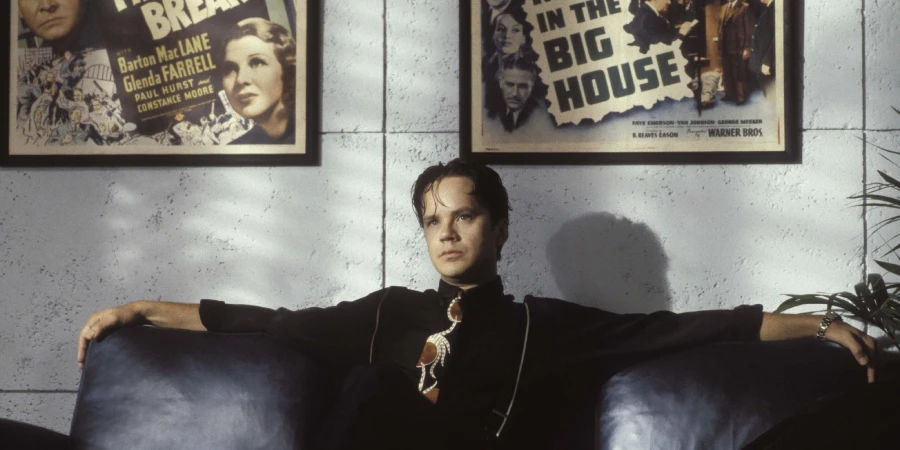

Robert Altman’s The Player opens with a single, unbroken eight-minute tracking shot that watches Hollywood eat itself for breakfast. Griffin Mill, a studio executive, fields pitches about movies while casually planning a murder, and the film never once asks you to feel bad about laughing.
Tim Robbins plays Mill with the slick, dead-eyed confidence of a man who genuinely cannot tell the difference between a story and a transaction. That confusion is the whole film.
Detailed Summary
The Opening Shot and the World of Griffin Mill
Altman opens with that legendary tracking shot, circling the studio lot as executives argue about film pitches, screenwriters beg for meetings, and everyone references Touch of Evil and its famous long take. Altman is announcing his intentions with a smirk. He is making a movie about movies, and he is going to be brilliant and irritating about it.
Griffin Mill works at a fictional Hollywood studio, greenlighting and killing projects with equal detachment. He is smart, charming, and completely hollow. His job is under threat from a younger executive, Larry Levy, played by Peter Gallagher with the kind of confidence that only very stupid ambitious people possess.
The Threatening Postcards
Mill starts receiving anonymous threatening postcards from a writer he apparently wronged. He cannot remember which writer, which tells you everything about his character. He receives so many pitches, he discarded this person’s script without a second thought and has no memory of doing it.
Mill narrows the suspect down to David Kahane, played by Vincent D’Onofrio. He tracks Kahane down at a screening of The Bicycle Thief in Pasadena. The two men drink together, and their conversation crackles with barely concealed hostility.
The Murder
Mill follows Kahane to the parking lot. An argument breaks out. Mill pushes Kahane’s head into a puddle and holds it there until Kahane drowns. It is filmed with startling casualness, no swelling score, no dramatic lighting, just two men struggling in the dark and then one of them stops moving.
This is the best scene in the film, and it works precisely because Altman refuses to make it feel like a movie death. Mill does not know he intended to kill Kahane until it is already done. He walks away, and the film keeps moving, almost as indifferent as Mill himself.
The Investigation and June Gudmundsdottir
Detective Avery, played by Whoopi Goldberg, begins investigating Kahane’s death. She suspects Mill almost immediately, but the case keeps slipping away from her. Mill, meanwhile, begins pursuing Kahane’s girlfriend, June Gudmundsdottir, played by Greta Scacchi.
June is an Icelandic artist with no interest in Hollywood. She is serene and strange and completely outside Mill’s usual world. His attraction to her is genuine, which makes him more dangerous, not less.
The Wrong Writer
Here comes the twist the film saves for the third act. Mill killed the wrong man. Kahane was not sending the postcards. The real writer, Tom Oakley, kept sending them throughout Mill’s investigation, courtship of June, and near-arrest.
This is a wickedly funny piece of plotting. Mill committed actual murder and got away with it because he was careless about which writer he chose to confront. The moral horror of that fact barely registers on his face.
The Trial and Its Outcome
Mill faces a hearing over the Kahane killing, but the case collapses. A witness who could identify him recants. The studio rallies behind him once it becomes clear he is not going to jail. Hollywood protects its own, and Mill walks out clean.
Detective Avery knows he did it. She has known for a while. She tells him so, quietly, and then lets him go because the evidence simply is not there. Goldberg delivers that moment with a controlled fury that is the most underrated performance in the entire film.

Movie Ending
A year later, Mill has everything. He married June, who is now pregnant with his child. He runs the studio. Larry Levy, his rival, got pushed out. Mill won, comprehensively and without consequence, because this is how Hollywood works in Altman’s vision.
Tom Oakley, the real writer who sent the postcards, arrives at the studio to pitch a film. Mill greets him with the smooth warmth of a man who has never killed anyone. Oakley pitches a story about a studio executive who receives threatening postcards, murders the wrong man, gets away with it, and ends up happily married to the dead man’s girlfriend. It is, beat for beat, the plot of The Player itself.
Mill listens, smiles, and says he loves it. He asks for a happy ending. Oakley says it already has one. Mill buys the pitch. The film cuts to Mill arriving home, where June runs out to embrace him as a car pulls up. Oakley’s pitch plays out as live action: Mill and June kiss, the car drives away, and we hear Mill’s voice saying “It’s got a happy ending.” Roll credits.
Altman wraps the entire film inside itself. Mill gets away with murder and profits from the story of getting away with murder. Oakley gets his deal. Nobody learns anything. The system absorbs the crime, packages it, and sells it back as entertainment. That final scene is not ironic in a winking way; it is genuinely bleak, dressed in sunshine and a warm score.
Are There Post-Credits Scenes?
The Player has no post-credits scene. Altman was not interested in that kind of crowd-pleasing punctuation. Once the film closes the loop on itself, it is done.
Type of Movie
The Player is a satirical neo-noir thriller with heavy doses of black comedy. It plays genre beats straight enough to work as a crime film while constantly undercutting every expectation those beats create. Tonally, it sits in a place where you laugh and then feel faintly ashamed for laughing.
It is also a Hollywood satire in the tradition of Sunset Boulevard, though far less sympathetic to its protagonist than Wilder was to Norma Desmond. Griffin Mill never gets the tragic dignity of a true noir antihero. He just gets richer.
Cast
- Tim Robbins – Griffin Mill
- Greta Scacchi – June Gudmundsdottir
- Fred Ward – Walter Stuckel
- Whoopi Goldberg – Detective Avery
- Peter Gallagher – Larry Levy
- Brion James – Joel Levison
- Cynthia Stevenson – Bonnie Sherow
- Vincent D’Onofrio – David Kahane
- Dean Stockwell – Andy Civella
- Richard E. Grant – Tom Oakley
- Sydney Pollack – Dick Mellen
Film Music and Composer
Thomas Newman composed the score for The Player. His work here is characteristically understated, full of spare, slightly off-kilter piano lines and light percussion that refuse to tell you how to feel. Newman never underlines the film’s dark jokes with music; he lets scenes breathe.
The score keeps a cool, almost lounge-like tone that suits the world of poolside meetings and casual amorality perfectly. Newman would go on to far more prominent scores, but his work here deserves attention for how well it stays out of Altman’s way.
Filming Locations
Principal photography took place in and around Los Angeles, California. Altman shot extensively on real studio lots, including the Paramount Pictures lot, which grounds the film’s satire in physical, recognizable space rather than a backlot approximation of Hollywood.
Shooting at actual industry locations was a deliberate choice. When characters walk past real studio infrastructure, the satire sharpens. You are not watching a movie about Hollywood; you are watching a movie made inside Hollywood, pointing at itself.
The Pasadena theater where Mill first confronts Kahane gives the film one of its few genuinely quiet locations. That contrast between the quiet arthouse cinema and the noisy studio world carries meaning without Altman having to spell it out.
Awards and Nominations
Robert Altman won the Best Director prize at the Cannes Film Festival in 1992 for The Player. Tim Robbins also won the Best Actor prize at Cannes that same year.
The film received three Academy Award nominations, including Best Director for Altman, Best Film Editing, and Best Adapted Screenplay for Michael Tolkin. It did not win in any category.
Behind the Scenes Insights
- Altman reportedly shot the opening long take around two dozen times to get it right. The final version runs approximately eight minutes without a cut.
- Tim Robbins prepared for the role by spending time with real Hollywood executives, observing how they pitched and deflected.
- More than 60 real Hollywood celebrities appear in cameos throughout the film, many playing themselves. Altman called friends and acquaintances and asked them to show up.
- Michael Tolkin wrote the screenplay based on his own novel, which gave the adaptation an unusual coherence; the same sensibility shaped both versions.
- Altman had been largely out of favor in Hollywood during the 1980s. The Player was his return to mainstream critical attention, which gave the film’s satire of the industry a personal edge.
- Greta Scacchi’s casting was partly chosen because June needed to feel genuinely foreign to the Hollywood world, and Scacchi brought that quality without having to perform it.
Inspirations and References
Michael Tolkin based the screenplay on his own 1988 novel of the same name. Tolkin worked in Hollywood and drew on direct observation of studio culture. His novel is sharper in places about Mill’s psychology, but the film benefits from Altman’s ability to populate the background with an entire ecosystem.
Altman and Tolkin both cited Billy Wilder’s Sunset Boulevard as a touchstone for Hollywood self-examination. The Player is less operatic and more deadpan, but both films share the conviction that the industry devours the people inside it.
The film’s long opening shot explicitly invokes Orson Welles’ Touch of Evil, which a character names on screen. Altman knew he was entering a conversation about virtuoso filmmaking with that choice, and he committed fully.
Alternate Endings and Deleted Scenes
No widely documented alternate endings exist for The Player. Tolkin’s novel ends differently, with Mill in a more psychologically fractured state, but Altman’s decision to push the ending toward pure satirical satisfaction appears to have been firm from an early stage.
Some scenes involving Detective Avery were reportedly longer in earlier cuts, giving Whoopi Goldberg more screen time. Those trims are one of the film’s few genuine missteps, as Avery’s investigation gives the film its only real moral anchor.
Book Adaptations and Differences
The Player is based on Michael Tolkin’s 1988 novel of the same name. Tolkin wrote the screenplay himself, which kept the adaptation unusually faithful in structure and tone.
The novel spends more time inside Mill’s head, exploring his genuine lack of remorse in a way that prose allows and film resists. Altman compensates by keeping Robbins’ face readable and unreadable at the same time, which is its own kind of interiority.
The celebrity cameos are an Altman invention. The novel has no equivalent device. Populating the edges of the film with real Hollywood faces deepens the satire in ways Tolkin’s prose could not achieve.


Memorable Scenes and Quotes
Key Scenes
- The eight-minute opening tracking shot, circling the studio lot while characters pitch movies and argue, establishing the entire film’s tone before a single plot point arrives.
- Mill drowning Kahane in the parking lot puddle, shot without score or dramatic framing, just two figures in dim light and then one gone still.
- Detective Avery confronting Mill quietly near the end, telling him she knows exactly what he did, her voice flat and controlled, and then walking away.
- Tom Oakley pitching the plot of the film back to Mill in the final scene, with Mill’s face showing only pleasure at a good story.
- Mill and June at her home early in their courtship, her indifference to his world making him visibly uneasy for the first time in the film.
Iconic Quotes
- “It’s got a happy ending.”
- “I was just thinking what an interesting concept it is to eliminate the writer from the creative process.”
- “Do you think they’ll ever make a movie without a writer?”
Easter Eggs and Hidden Details
- Characters in the opening shot reference Touch of Evil specifically while Altman is in the middle of executing his own long take, a self-aware joke about influence and one-upmanship.
- Many of the cameo appearances by Hollywood celebrities are deliberately unglamorous, catching stars in mundane moments that strip away their usual movie-star presentation.
- Pitch summaries characters describe throughout the film are parodies of real Hollywood pitch-speak, combining recognizable films into absurd hybrids to mock formulaic thinking.
- The film Kahane attends when Mill tracks him down is The Bicycle Thief, a film about a man pushed to a moral breaking point by economic desperation, which quietly comments on what Mill is about to do.
- Altman’s camera frequently catches people in conversation in the background who are mimicking the main characters’ situations, a layering technique he used throughout his career.
Trivia
- Over 60 Hollywood celebrities appear in cameo roles, many playing themselves at studio events and parties.
- Altman had been considered a difficult and uncommercial director through much of the 1980s, and The Player marked a full critical rehabilitation.
- The opening tracking shot is widely studied in film schools as a technical and narrative achievement, both for its length and for how much exposition it plants without feeling like exposition.
- Richard E. Grant, playing the real postcard writer Tom Oakley, has relatively little screen time but delivers the film’s most quietly devastating line readings.
- Tim Robbins has spoken about how he played Mill as a man who genuinely does not know he is the villain of his own story, which tracks with every choice Robbins makes on screen.
- Michael Tolkin appears in the film briefly, a cameo that adds another layer to the film’s blurring of fiction and industry reality.
Why Watch?
Tim Robbins builds Griffin Mill from the inside out, never signaling evil, never asking for sympathy, just a man whose face stays pleasantly blank while terrible things happen around and because of him. That performance, combined with Altman’s refusal to punish his protagonist, makes The Player far more unsettling than most films marketed as thrillers. Watch it for the murder scene, and stay for the ending that makes you complicit in laughing at it.
Director’s Other Movies
- M*A*S*H (1970)
- McCabe and Mrs. Miller (1971)
- Nashville (1975)
- Short Cuts (1993)
- Prêt-à-Porter (1994)
- Gosford Park (2001)
- A Prairie Home Companion (2006)
Recommended Films for Fans
- Sunset Boulevard (1950)
- Barton Fink (1991)
- Swimming with Sharks (1994)
- Short Cuts (1993)
- Adaptation (2002)
- Living in Oblivion (1995)
- Maps to the Stars (2014)