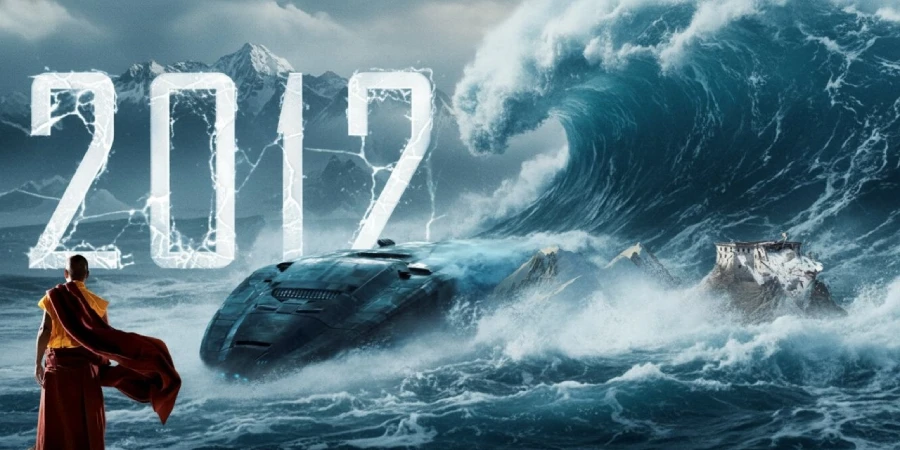

Roland Emmerich took one look at every disaster movie ever made and said, “Not enough.” 2012 opens with a scientist standing in a flooded copper mine in India, staring at a neutrino reading that should be impossible, and from that quiet moment of dread the film commits fully to its promise: it will destroy everything. Crust displacement, mega-tsunamis, Yellowstone exploding like a Roman candle, the Sistine Chapel cracking down the middle. Emmerich does not flinch once.
Detailed Summary
The Discovery in India
In 2009, American geologist Adrian Helmsley (Chiwetel Ejiofor) travels to a copper mine in Charapani, India, to meet his friend and fellow scientist Satnam. Satnam has discovered that solar neutrinos are mutating and heating Earth’s core at an alarming rate. Adrian rushes this data to Washington.
White House Chief of Staff Carl Anheuser (Oliver Platt) dismisses Adrian at first, but the data reaches President Thomas Wilson (Danny Glover), who authorizes a secret global initiative. World governments quietly begin constructing massive ships, which they call arks, in the Himalayas of China.
Jackson Curtis and His Fractured Family
Cut to 2012. Struggling science fiction writer Jackson Curtis (John Cusack) lives in Los Angeles, divorced, working as a limo driver for a Russian billionaire named Yuri Karpov (Zlatko Buric). Jackson picks up his kids, Noah and Lily, for a camping trip to Yellowstone.
His ex-wife Kate (Amanda Peet) has moved on with a plastic surgeon named Gordon (Thomas McCarthy). Jackson is the definition of a man life has quietly passed by, and Cusack plays that low-grade embarrassment better than anyone in this cast.
Yellowstone and the First Warning Signs
At Yellowstone, Jackson and his kids find their favorite lake has dried up completely. Military personnel fence off the area. Jackson stumbles onto a conspiracy theorist named Charlie Frost (Woody Harrelson), who broadcasts from a camper van and claims the government knows the apocalypse is coming.
Charlie hands Jackson a map showing the ark locations. Jackson initially dismisses him, but the cracked earth and the military presence plant a seed of doubt. Woody Harrelson plays Charlie with infectious, unhinged glee, and his brief arc is honestly one of the film’s best stretches.
Los Angeles Crumbles
Back in Los Angeles, the ground begins to crack during a grocery run. Jackson gets a call from Satnam in India, who tells him the timeline has accelerated dramatically. Jackson rounds up Kate, Gordon, Noah, and Lily and steals a limousine.
What follows is the film’s most shamelessly fun set piece. Jackson drives the limo through crumbling freeways as entire city blocks drop into sinkholes. Buildings collapse in slow motion behind them. Emmerich frames it so the destruction always trails just one beat behind the car, which keeps the tension absurd but functional.
They reach a small airport and commandeer a plane, with Gordon at the controls. Los Angeles disappears into the Pacific behind them as they ascend.
Yellowstone Erupts
They land briefly near Yellowstone to retrieve Charlie’s map. Charlie himself refuses to leave. He stands on a ridge broadcasting as the supervolcano erupts beneath him, grinning like a man who always knew this was coming and made peace with it years ago.
Yellowstone’s eruption sends a pyroclastic cloud chasing the plane down the runway. Gordon barely gets the aircraft airborne in time. A wall of ash and fire fills the entire frame as they escape, and it genuinely looks spectacular even now.
The Russian Billionaire’s Arc
Yuri Karpov has purchased tickets aboard one of the arks for himself and his twin sons. He leaves his girlfriend Tamara (Beatrice Rosen) behind without a second thought. The arks cost one billion euros per ticket, meaning only the ultra-wealthy and politically connected survive by design.
This thread runs alongside Jackson’s story as a pointed class critique, though Emmerich never hammers it too hard. Yuri is cartoonish but his selfishness serves the film’s moral argument efficiently.
The Flight to China
Jackson’s group commandeers a larger Russian cargo plane, courtesy of Yuri, and heads for China. Yuri’s pilot Sasha (Johann Myers) flies the overloaded plane while one engine fails after another. They land on a Himalayan glacier, and Sasha sacrifices himself to keep the plane level long enough for everyone to jump.
Gordon dies shortly after, crushed by gears in the ark’s loading mechanism. His death is abrupt and unglamorous, which actually lands harder than a more theatrical exit would have.
The Arks Revealed
Four massive arks sit hidden inside the Himalayan mountains, each capable of carrying 100,000 people plus genetic material and cultural artifacts. Jackson and his family are smuggled aboard by a monk’s family. They hide as stowaways in the ark’s underbelly.
Adrian, now aboard and increasingly at odds with Anheuser, pushes for the arks to let in refugees still outside as the floods rise. Anheuser refuses, prioritizing the paying passengers and selected officials. Oliver Platt plays Anheuser as a man who is not evil so much as purely pragmatic, which makes him the film’s most unsettling villain by a significant margin.
The Flooding Begins
Mega-tsunamis generated by the crustal displacement sweep across every continent. A wave carries the aircraft carrier USS John F. Kennedy over Washington D.C. and crushes the White House. President Wilson chooses to stay behind with his people, standing on the White House lawn as the wave approaches.
Satnam and his family attempt to reach high ground in India. The wave swallows them. It is a gut-punch of a scene precisely because Satnam is the character who first sounded the alarm, and he never gets a seat on any ark.
The Ark Door Crisis
A piece of drilling equipment lodges in the gears of Ark Four’s hydraulic door, preventing it from closing. With the floodwaters rising inside the mountain chamber, the ark cannot engage its engines. Everyone inside will drown.
Jackson volunteers to swim through the flooded engine room to free the obstruction. Gordon is already dead, so Jackson goes alone into freezing water, guided by radio directions from Noah. He locates the drill piece and physically yanks it free, cutting his hand badly in the process.
He nearly drowns. Kate dives in to pull him back. The door seals. The engines fire.

Movie Ending
Ark Four powers up and surfaces through the floodwaters just before impact with Mount Everest. The crew navigates to open ocean as the new geography of Earth settles. Twenty-seven days pass.
A radio signal comes from survivors in Africa. The continent’s landmass rose during the crustal displacement, leaving large stretches of it above water while every other continent drowned. Adrian had suspected this possibility early and quietly steered the arks toward Africa before the crisis hit its peak.
Anheuser’s authority collapses once the immediate danger passes. The surviving heads of state strip him of his role and appoint Adrian as a voice of reason for the new world. It is a tidy comeuppance, perhaps a little too tidy, but the film earns it by spending two hours building Anheuser as the embodiment of institutional callousness.
Jackson and Kate reconcile. Noah and Lily are safe. Yuri died heroically during the flooding, pushing Tamara onto a rescue boat before the water took him, which redeems him just enough to make the audience feel something it probably did not expect to feel.
The film closes on the arks sailing toward Africa across a vast, calm, sunlit ocean. Giraffes stick their heads out of portholes. It is ridiculous. It is also oddly moving, because Emmerich commits to the image completely without a trace of irony. The Earth is gone. Something new begins.
Are There Post-Credits Scenes?
No. 2012 has no post-credits scene of any kind. Once the final shot of the arks sailing toward Africa fades out, the credits roll and that is the end. You can leave your seat.
Type of Movie
2012 is a disaster film with elements of science fiction and survival thriller. Its tone swings deliberately between white-knuckle action spectacle and sentimental family drama, sometimes within the same scene.
Emmerich treats the spectacle seriously and the personal stakes sincerely, which separates 2012 from pure parody even when the set pieces push into absurdity. Call it earnest apocalyptic blockbuster cinema.
Cast
- John Cusack – Jackson Curtis
- Chiwetel Ejiofor – Dr. Adrian Helmsley
- Amanda Peet – Kate Curtis
- Oliver Platt – Carl Anheuser
- Thandiwe Newton – Laura Wilson
- Danny Glover – President Thomas Wilson
- Woody Harrelson – Charlie Frost
- Liam James – Noah Curtis
- Morgan Lily – Lily Curtis
- Zlatko Buric – Yuri Karpov
- Beatrice Rosen – Tamara
- Thomas McCarthy – Gordon Silberman
- Johann Myers – Sasha
- Jimi Mistry – Satnam Tsurutani
- John Billingsley – Professor Frederic West
Film Music and Composer
Harald Kloser and Thomas Wanker composed the score. Kloser had a long working relationship with Emmerich, having previously scored The Day After Tomorrow and 10,000 BC. Their work on 2012 leans heavily into sweeping orchestral drama.
The score prioritizes emotional momentum over sonic adventurism. It never upstages the visuals, which is probably the right call when the visuals involve California sliding into the ocean. The main theme carries a mournful grandeur that suits the film’s scale.
Adam Lambert contributed the song “Time for Miracles” to the film’s soundtrack, which plays over the end credits. It is the kind of earnest power ballad that disaster movies have always needed and never quite apologized for.

Filming Locations
Principal photography took place in Vancouver, British Columbia, which doubled for nearly every location in the film. Stages at Yellowknife and Vancouver studios housed the massive ark interiors.
Emmerich also shot footage in Washington D.C. and used location work in South Africa for some exterior sequences representing the surviving African continent at the film’s close.
Most of the disaster sequences were created entirely through CGI, meaning Los Angeles, Yellowstone, and the Himalayan glacier sets were digital constructions built over location plates. At this scale of destruction, there was simply no other option.
Awards and Nominations
2012 received a nomination at the Visual Effects Society Awards for its computer-generated imagery work. It did not win major awards at the major ceremonies, which surprised nobody but also undersells how technically accomplished its destruction sequences genuinely are.
Behind the Scenes Insights
- Roland Emmerich and Harald Kloser co-wrote the screenplay, continuing their collaboration from earlier films.
- The production built some of the largest set pieces in the studio’s history for the ark interiors, including a fully functional hydraulic door mechanism that was later adapted for the film’s climax.
- John Cusack performed a significant portion of his own physical sequences, including several running shots through collapsing set pieces on stages in Vancouver.
- Emmerich reportedly studied actual geological theories about crustal displacement, specifically the work of Charles Hapgood, to give the film’s science a surface plausibility.
- The film’s visual effects team used reference footage from real volcanic eruptions and tsunami events to ground the CGI destruction in recognizable behavior.
- Woody Harrelson improvised a number of Charlie Frost’s lines, and Emmerich kept several of them in the final cut.
- The sequence depicting the aircraft carrier washing over Washington D.C. required months of pre-visualization before a single effects shot was rendered.
Inspirations and References
Emmerich and Kloser drew from Charles Hapgood’s theory of crustal displacement, which proposes that Earth’s outer crust can shift dramatically in a geologically short period. Hapgood published this theory in the 1950s and Albert Einstein reportedly found it worth considering, which the film references directly in its opening titles.
The Mayan Long Count Calendar ending on December 21, 2012, provided the cultural hook for the film’s title and premise. Popular interest in the 2012 date was already building when the film went into production, and Emmerich leaned into it fully.
Thematically, the film shares obvious DNA with Deep Impact and The Day After Tomorrow, as well as older disaster epics like When Worlds Collide from 1951. The ark narrative has roots in the biblical flood story, which the film acknowledges when a Tibetan monk character explicitly draws the parallel.
Alternate Endings and Deleted Scenes
An alternate ending was filmed in which the arks originally set course for the Cape of Good Hope but were redirected, and this extended cut included a slightly longer sequence of Adrian and Laura Wilson’s relationship developing aboard the ark. Emmerich trimmed it for pacing.
Several scenes establishing the political machinations behind the ark program in greater detail were cut from the theatrical release. These scenes reportedly gave Anheuser more context and made his pragmatism feel less like villainy and more like tragic necessity, which may be why Emmerich removed them; a fully sympathetic Anheuser would have complicated the film’s moral resolution.
Book Adaptations and Differences
2012 is not based on a book. The screenplay was written directly by Roland Emmerich and Harald Kloser as an original work. A novelization was released alongside the film, but that novelization adapted the screenplay rather than the other way around.

Memorable Scenes and Quotes
Key Scenes
- The limo chase through Los Angeles: Jackson drives through crumbling streets with the road literally collapsing behind each tire, including a sprint through a collapsing parking structure where he drives between falling concrete pillars.
- Charlie Frost on the ridge: Woody Harrelson stands grinning as Yellowstone erupts behind him, broadcasting his final show to nobody and everybody at once.
- The aircraft carrier over Washington: The USS John F. Kennedy crests a mega-tsunami and slides across the White House lawn, shot from ground level so the scale feels genuinely impossible.
- Satnam’s final call: Satnam phones Adrian from a beach in India as the wave appears on the horizon, telling him the data was right, saying goodbye without saying goodbye.
- Jackson freeing the drill piece: He swims through a dark, freezing, flooded engine chamber while his son guides him by radio from above, his breath running out in real time.
- The giraffes at the end: Ark portholes open to reveal giraffes extending their necks into sunlight over a calm ocean, the film’s final image and its strangest, most sincere gesture.
Iconic Quotes
- “The neutrinos are mutating.” (Satnam, delivering the film’s inciting scientific impossibility with complete earnestness)
- “The moment we stop fighting for each other, that’s the moment we lose our humanity.” (Adrian, delivering the film’s thesis statement directly to Anheuser)
- “I told you so!” (Charlie Frost, as Yellowstone erupts around him, a line that earns its laugh and its lump in the throat simultaneously)
Easter Eggs and Hidden Details
- The number on Jackson Curtis’s limo is a reference to a previous Emmerich production, a small callback for fans paying close attention to background details.
- Jackson’s novel, which nobody buys in the film, is titled Farewell Atlantis, a direct nod to the sunken civilization myth and a sly piece of foreshadowing about continents disappearing beneath the water.
- When the Sistine Chapel cracks, the fracture runs precisely between God’s finger and Adam’s finger in Michelangelo’s painting, severing the image of divine connection at the moment of global catastrophe.
- President Wilson’s decision to stay on the White House lawn mirrors a specific archetype of presidential sacrifice that Emmerich had played with differently in Independence Day, and sharp viewers will note the deliberate inversion.
- Satnam’s farewell phone call to Adrian is shot so that the wave is visible in the background for several seconds before Satnam turns to see it, giving the audience a beat of dread his character does not get.
- Charlie Frost’s website URL appears briefly on screen and was a functional site during the film’s marketing campaign, part of an alternate reality marketing effort.
Trivia
- 2012 grossed over 760 million dollars worldwide against a reported production budget of approximately 200 million dollars, making it one of the most commercially successful disaster films ever made.
- Roland Emmerich stated in interviews that he wanted 2012 to be the ultimate disaster movie, intentionally incorporating destruction on a scale that no previous film had attempted.
- Chiwetel Ejiofor, who plays the film’s moral center, had not previously led a major Hollywood blockbuster at this scale, and his grounded performance became one of the film’s most praised elements.
- The film depicts the destruction of landmarks from multiple world religions, including the Sistine Chapel, the Rio Christ statue, and St. Peter’s Basilica, a choice Emmerich defended as thematically consistent with a truly global catastrophe.
- John Cusack replaced another actor who had been attached to the Jackson Curtis role during early development.
- The ark interiors required some of the longest continuous set builds in recent blockbuster history at the time of production.
- Emmerich shot the film largely without 3D conversion in mind, a notable choice given the industry’s push toward 3D in 2009.
- The Mayan calendar angle was hotly debated by archaeologists and Mayan scholars, many of whom pointed out publicly that the ancient Maya never predicted an apocalypse for 2012.
Why Watch?
Watch it for Chiwetel Ejiofor, who plays a man trying to preserve human decency inside a machine designed to discard it, and who does so without a single false note across nearly three hours of CGI carnage. The scene where he stands in front of Anheuser and simply refuses to close the door is the best two minutes of acting in any Emmerich film. That scene alone justifies the ticket price.
Director’s Other Movies
- Independence Day (1996)
- Godzilla (1998)
- The Patriot (2000)
- The Day After Tomorrow (2004)
- 10,000 BC (2008)
- Anonymous (2011)
- White House Down (2013)
- Midway (2019)
- Moonfall (2022)
Recommended Films for Fans
- The Day After Tomorrow (2004)
- Deep Impact (1998)
- Armageddon (1998)
- Independence Day (1996)
- San Andreas (2015)
- Geostorm (2017)
- Snowpiercer (2013)
- Knowing (2009)